Security patrols
Security assignment instructions: what they should say, and how to keep them working
Security assignment instructions (AIs) are the site-specific document that tells a security officer what to do on a particular site – the duties, the patrol routes, the procedures and who to call – and BS 7499, the British Standard code of practice for static guarding, makes recommendations on them.
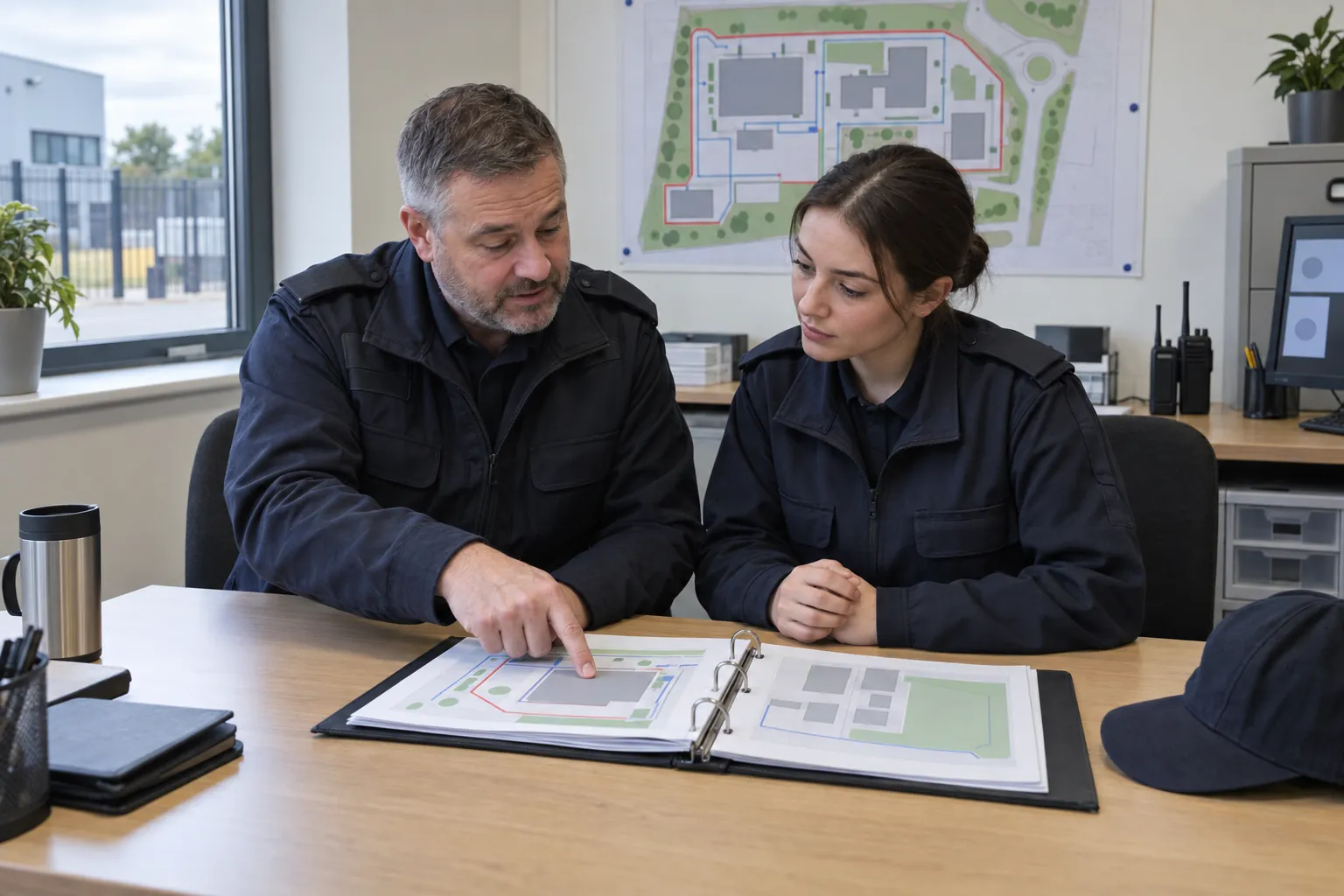
Done well, they mean any trained officer can arrive at a site and do the job properly. This guide covers what they should contain, how they are agreed and reviewed, and how to tell whether they are being followed.
01
What assignment instructions are
Assignment instructions, usually shortened to AIs, are the site-specific instructions that set out what a security officer must do on a particular assignment. They translate the security contract and the site's risk assessment into the working detail: which posts are covered and when, the patrol routes, the access control procedure, what to do in an emergency and how to report. Some providers call the post-by-post part post orders; the idea is the same.
The requirement comes from the standards the security industry works to rather than from an Act. BS 7499, the British Standard code of practice for static guarding, expects the provider to prepare assignment instructions for each site, agree them with the client and make them available to the officers working there. The Security Industry Authority's voluntary Approved Contractor Scheme assesses providers on how they manage the service they deliver, and assessors expect to see current, agreed AIs on site. The current edition, BS 7499:2026, was published by BSI on 31 August 2026; BSI says it was revised alongside BS 10800 and lists updated assignment instruction recommendations among its key changes.
Assignment instructions are also part of the licence-linked training for security officers, door supervisors and CCTV operators. Pearson's sample assessment for the SIA licence-linked Level 2 awards asks, in Unit 1, Principles of Working in the Private Security Industry, what the purpose of assignment instructions is; the answer it marks correct is that they describe duties for a specific site. They are central to the job because they tell the officer exactly what is required, so nothing is left to guesswork.
In practice, assignment instructions support the officer because they:
- outline each duty on the assignment, so the officer knows where their responsibility starts and ends;
- give clarity in an emergency, with the security protocols and actions to take already decided, rather than improvised;
- ensure consistency, so every officer on the site, including relief personnel, works to the same procedures;
- help the officer be proactive, by naming the risks and the places to watch;
- protect the officer, who can show they followed the agreed procedure;
- enhance professionalism and the client's confidence in the security operations on its site.
How do assignment instructions support the security operative role?
Assignment instructions support the security operative role by describing the officer's roles and duties for that specific site and the actions to take in an emergency, including who to call, so the officer does not have to guess. Pearson's current specification for the BTEC Level 2 Award for Security Officers in the Private Security Industry (Issue 2, September 2023) teaches exactly this under Unit 1: they describe "the security operative's roles and duties for specific location", outline "actions to take in an emergency including obtaining contact numbers", and form part of a contract between the client and the security company.
02
What security assignment instructions should include
The contents vary with the site, but effective assignment instructions usually cover:
- The site: address, a description, site plans marked with entrances, fire exits, alarm panels, assembly points, isolation points and first aid kits.
- Contacts: the client's representatives, the security company's control room and supervisor, keyholders, maintenance and the out-of-hours escalation list.
- Posts and hours: each post, when it is staffed, and the specific duties at each one.
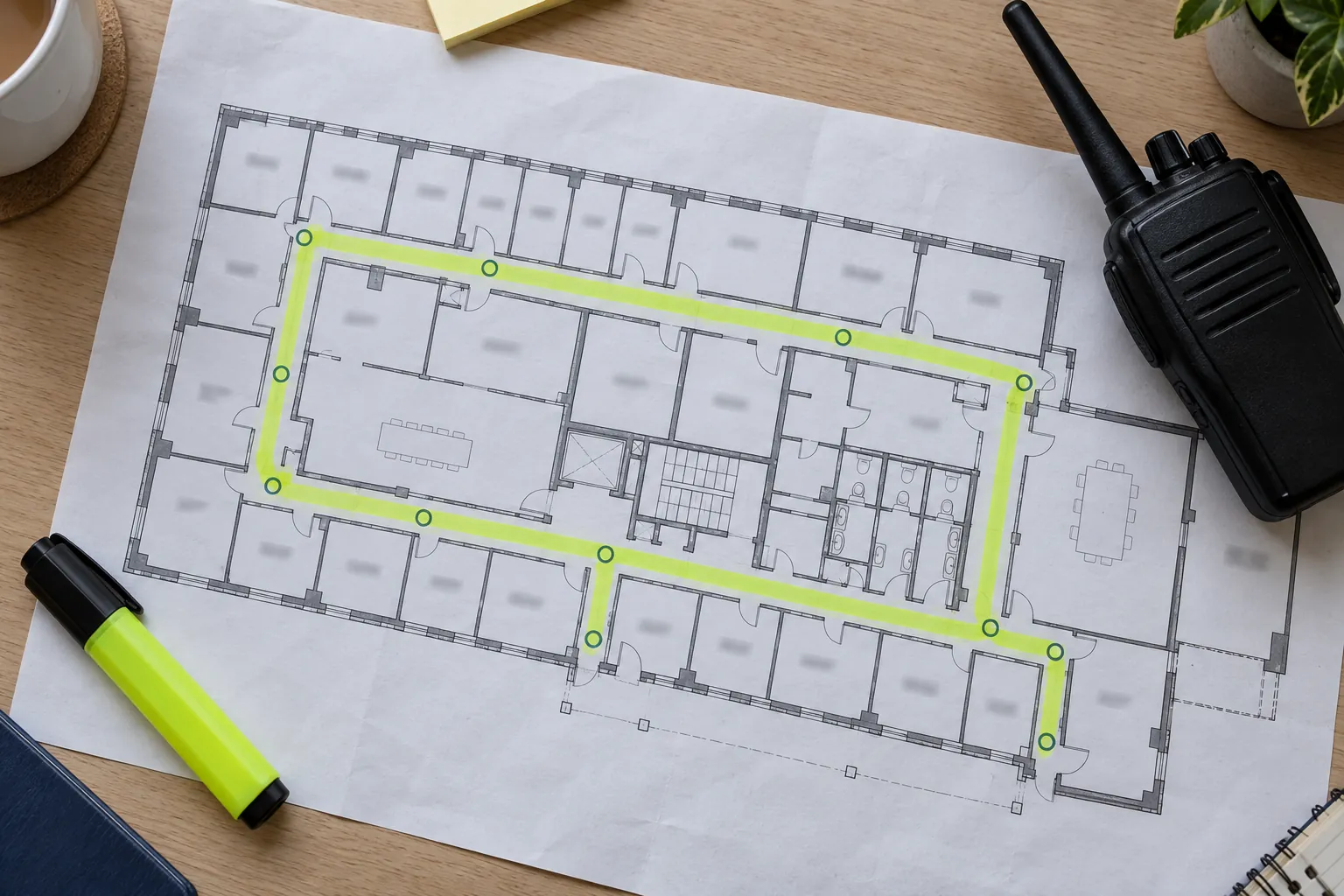
- Patrol routes: the route, the checkpoints, the frequency and the times, and what to check at each point.
- Access control procedures: passes, visitor and contractor sign-in, deliveries, vehicles, who may be let in out of hours and how to check.
- Key control and handling: which keys are held, the key register and who may sign keys out.
- Systems: CCTV, intruder alarm, access control and fire alarm panels, with what to do on each kind of alert.
- Emergency protocols: fire and evacuation, medical emergencies, bomb threats and suspicious items, floods and utility failures, lockdown or invacuation where the site has a plan.
- Incident reporting: what must be reported, to whom and how quickly, and the forms or logs to use.
- Health and safety: the risk assessment for the assignment, lone working arrangements, hazards on site and personal protective equipment.
- Conduct and appearance: uniform, displaying the SIA licence, the code of conduct, mobile phone use and breaks.
- Records: the daily occurrence book, patrol records, handover, and how the client receives reports.
- Data protection: how CCTV, visitor records and incident reports are handled.
- Version and sign-off: the date, version number, client approval and a signature sheet for officers.
A template is a useful starting point, but AIs copied from another site are one of the commonest faults auditors find. The site's own layout, risks and people must be in them.
03
Writing assignment instructions that officers use
The test of effective assignment instructions is whether a trained officer who has never been to the site could do the job properly after reading them. That rules out a lot of what ends up in a binder in the gatehouse.
- Be specific. "Patrol the site regularly" gives no guidance; "patrol route B, checkpoints 1 to 8, at 22:00, 01:00 and 04:00, checking all ground floor fire exits are closed" does.
- Say what to do, not just what to watch for. For each alarm, incident type or emergency, set out the actions to take in order, and who to call.
- Use plain language and short sections. An officer dealing with a fire alarm at 03:00 needs the procedure on one page, not buried in chapter nine.
- Use the site plan. Mark patrol routes, checkpoints and fire exits on it.
- Keep the contacts current. An out-of-date escalation list is worse than none, because it wastes the minutes that matter.
- Separate the permanent from the temporary. Put short-term changes, such as a contractor on site for a week or a door out of action, in a dated temporary instruction rather than editing the whole document.
04
Agreeing, signing and reviewing them
Assignment instructions are the security provider's document, written by its security managers, but they describe the client's site and the client's requirements, so the client should approve them. The usual cycle is:
- Draft at mobilisation, after a site survey and the security risk assessment.
- Agree with the client, and record who approved which version and when.
- Brief every officer during their site induction, and have them sign to confirm they have read and understood the instructions. Relief and mobile officers need the same briefing before their first shift.
- Keep a copy on site where officers can reach it at any time, on paper or on a device, with the current version clearly marked.
- Review and re-sign when something changes.
No law sets an expiry date for assignment instructions. They should be reviewed whenever the site, its risks or the client's requirements change – after an incident, a change of layout or occupancy, new systems, or a change in the threat picture – and at a fixed interval as well, which many providers set at least once a year. Each time they change, officers should sign again for the new version.
05
How to check the instructions are followed
Assignment instructions are only a tool if someone checks the work against them. The security supervisor and the client's representative can use them as the basis for monitoring and evaluating security officer performance:
- Supervisory visits: ask the officer what they would do if a particular alarm went off, where the nearest fire exit is, or who the out-of-hours contact is. The answer should match the AIs.
- Record checks: compare the daily occurrence book and patrol records against the patrol frequency and times the AIs set.
- Signature sheet: check that every officer who has worked on site since the last version signed it.
- Incident reviews: after any incident, check whether the procedure was followed and whether the procedure was right.
- Audits: the provider's own compliance audits and, for ACS providers, the scheme's assessment.
Where the record and the instructions disagree, one of them needs to change. Patrols that never happen at the time the AIs set may mean the officers are not following them, or that the times are unworkable. Either way, that is a conversation about accountability and operational efficiency worth having before the client raises it.
06
Where assignment instructions fail in practice, and where SiteClara fits
The AIs say the patrol visits eight checkpoints three times a night. The record says "patrol completed, all in order". Nobody can tell from that line which checkpoints were visited, when, or whether the fire exit on the far side of the building was checked at all. The instructions are clear; the evidence that they were followed is not.
SiteClara turns the patrol in the assignment instructions into a record. A printed QR poster, with an optional NFC tag behind it, goes at each checkpoint the AIs name. The officer scans the code or taps the tag on their own phone, with no app to install, sees the checks due at that point and marks them done, or explains what stopped them. The time and the named officer are recorded as it happens, with a photo when one is useful. Anything found wrong is reported there and goes onto the team's list of jobs until someone closes it.
The supervisor sees what was due, done and missed, with the reason where one was recorded, and approves a daily report that goes to nominated management or client contacts at 8am the next morning, showing how the scheduled checks went – for example 24 of 24 completed – and what is still open.
07
Further reading, and a list to take away
BSI publishes BS 7499, the code of practice for static guarding, and BS 7984-3 for mobile patrol services. The Security Industry Authority publishes the Approved Contractor Scheme standard and the specifications for the licence-linked qualifications on GOV.UK. The National Protective Security Authority and ProtectUK publish guidance on emergency procedures, including suspicious items and bomb threats, that is worth reflecting in the AIs.
Before an officer's next shift on the site, check that the assignment instructions:
- are written for this site, not copied from another;
- set out each post, patrol route, checkpoint and time;
- give the actions to take and who to call for each alarm, incident and emergency;
- have a current contact and escalation list;
- are approved by the client, with the version and date recorded;
- have been read and signed by every officer who works there;
- are kept on site where officers can reach them;
- have a date for their next review.
Sources
Every document this guide quotes or links to, in the order it first cites them.
- BS 7499 knowledge.bsigroup.com
- Approved Contractor Scheme gov.uk
- Sample assessment for the SIA licence-linked Level 2 awards qualifications.pearson.com
- Specification for the BTEC Level 2 Award for Security Officers in the Private Security Industry qualifications.pearson.com
- BS 7984-3 knowledge.bsigroup.com
Related guides
 Security patrolsSecurity officer duties and responsibilities: what the role involves, and how it is checkedSecurity officer duties in the UK: licensing, patrols, access control, incidents and reporting, what officers cannot do, and how duties are set and checked.
 Security patrolsSite security checklist: what to check, how often, and how to show it was doneSite security checklist for UK construction sites and business premises: perimeter, access, lighting, CCTV, alarms, keys, and how to record the checks.
 Security patrolsDaily occurrence book: what to record, and how to keep one that stands upDaily occurrence book (DOB): what to record, how to write entries that stand up, how it differs from an incident report, and paper or digital.
 Security patrolsSecurity officer report: what to write, and how to make it stand upThe reports a UK security officer writes on shift – incident, patrol, handover – what each should record, and how to write one that stands up later.