Security patrols
Security officer duties and responsibilities: what the role involves, and how it is checked
A security officer's duties and responsibilities are to guard premises against unauthorised access, disorder and damage, property against damage and theft, and people against assault, which in practice means patrolling, controlling access, monitoring CCTV and alarms, responding to incidents and emergencies, and keeping records.

The job is easy to describe and hard to see: keep a site safe and secure, and deal with whatever happens. This guide sets out the duties and responsibilities of a security officer in the UK, how they differ between sites, the limits of the role, and how a client or supervisor can tell the duties are being carried out.
01
What a security officer is, and the licence behind the role
A security officer, or security guard – the two titles mean the same job in the UK – protects premises, property and people against unauthorised access, theft, damage and disorder, and is trained to respond to emergencies until the emergency services arrive. The role is to ensure the safety and security of everyone on site, not only to guard the building. Most work for security companies that supply security services to clients under contract; others are employed in-house by the organisation whose site they protect.
Private security in the UK is regulated by the Security Industry Authority (SIA) under the Private Security Industry Act 2001. Security guarding, which the Act calls manned guarding and describes in Schedule 2, paragraph 2 as guarding premises, property or people, is a licensable activity, and anyone doing it under a contract must hold a front-line SIA licence. To get one, an applicant has to pass identity and criminal record checks and complete the licence-linked qualification, and since 2021 applicants for a security guard or door supervisor licence have also needed an emergency first aid qualification. A licence normally lasts three years. Licence holders must follow the licence conditions, which include wearing the licence where it can be seen while working.
The rules differ for in-house staff and between the nations, so check the SIA's guidance for the arrangement you have. A door supervisor licence also covers security guarding; a CCTV licence is needed separately for monitoring public space surveillance systems under contract.
Two British Standards shape how many providers employ and deploy officers: BS 7858, the code of practice for screening people who work in a secure environment, and BS 7499, the code of practice for static guarding. The SIA's voluntary Approved Contractor Scheme assesses security providers against its own standard, which draws on the same ground.
02
The core duties of a security officer
The security officer job description varies by site, but the primary duties of a security officer are much the same everywhere:
- Being proactive: spotting potential security threats and security concerns – a door that does not latch, someone testing handles, a gap in the fence – and dealing with them before they become a security breach.
- Maintaining a visible security presence, which is the simplest deterrent there is.
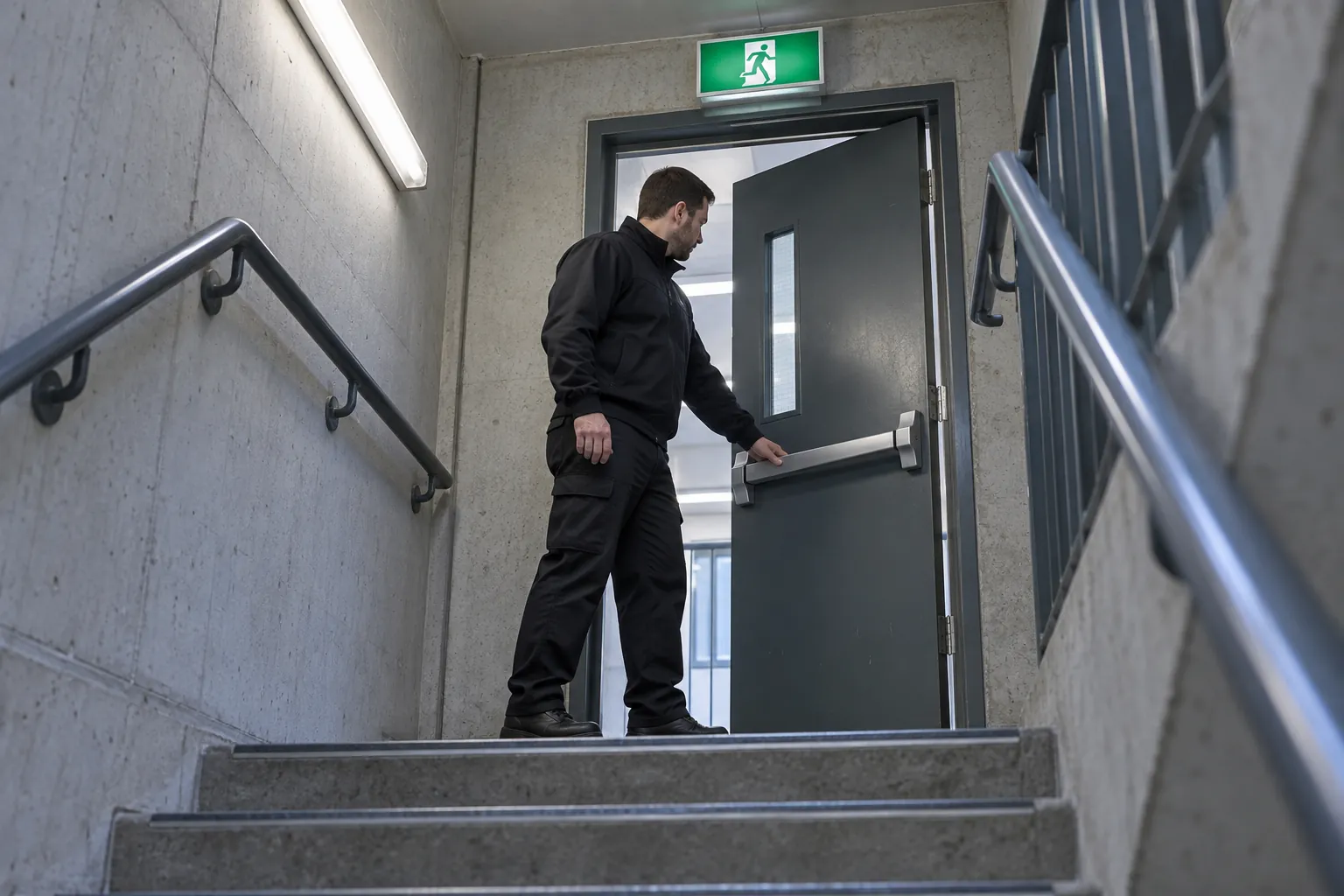
- Patrolling buildings and grounds on set routes and at set times, and at irregular times too, checking doors, windows, gates, fire exits and alarms.
- Access control: checking passes, signing in visitors and contractors, issuing and recovering keys and badges, and refusing entry to people who should not be there.
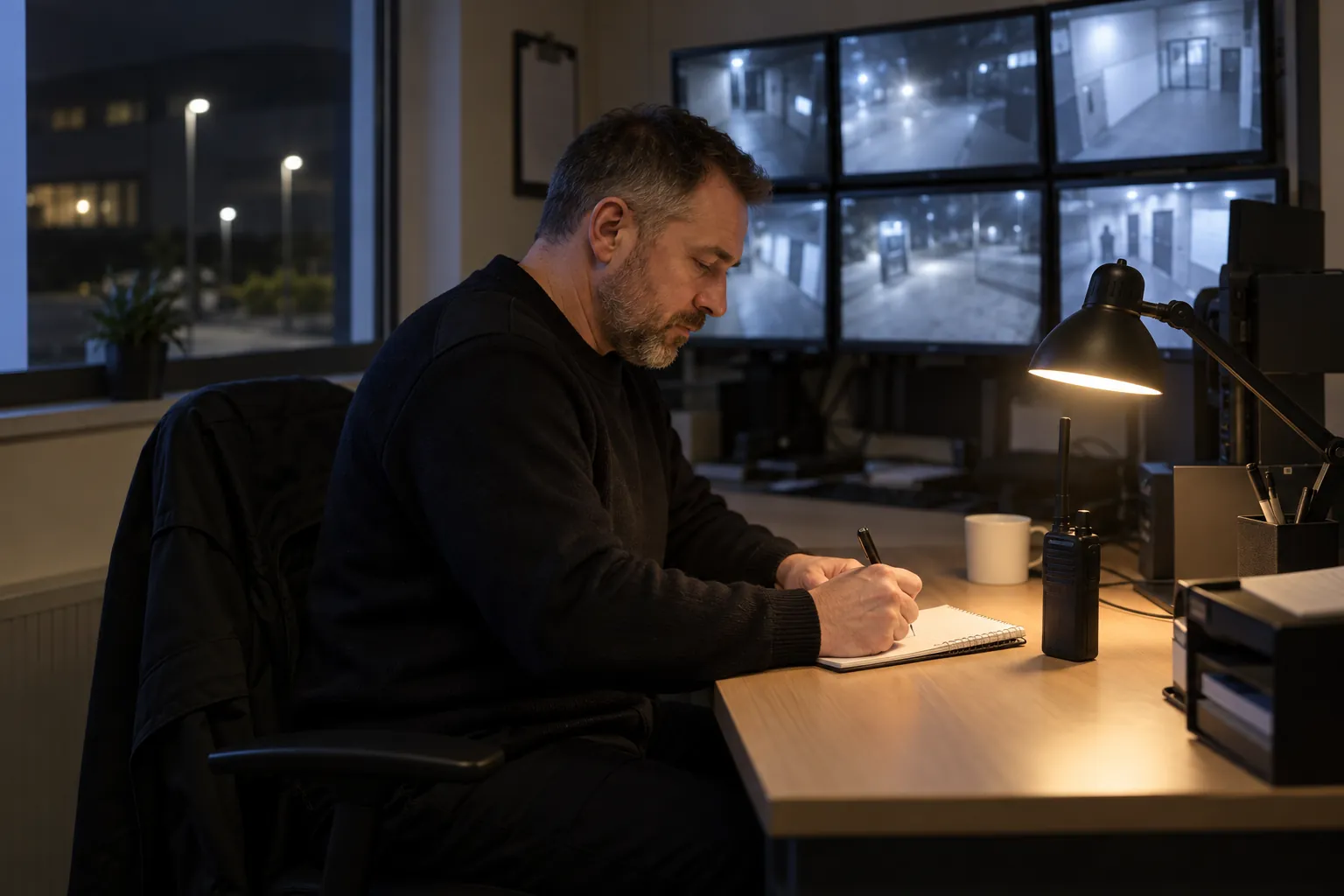
- Monitoring security systems: CCTV, intruder alarms, access control panels and fire alarm panels where the site has them.
- Responding to incidents and alarms: investigating activations, dealing with intruders, disputes and suspicious behaviour, and calling the police when needed.
- Responding to emergencies: fire evacuations, medical emergencies and first aid, floods, power failures, and meeting the emergency services on arrival.
- Keeping records: the daily occurrence book, patrol records, incident reports, key logs and visitor logs.
- Reporting faults and hazards: broken locks, failed lighting, leaks, blocked fire exits and anything unsafe, to whoever fixes them.
- Customer service: as the first point of contact for many visitors, giving directions, answering questions and helping people calmly.
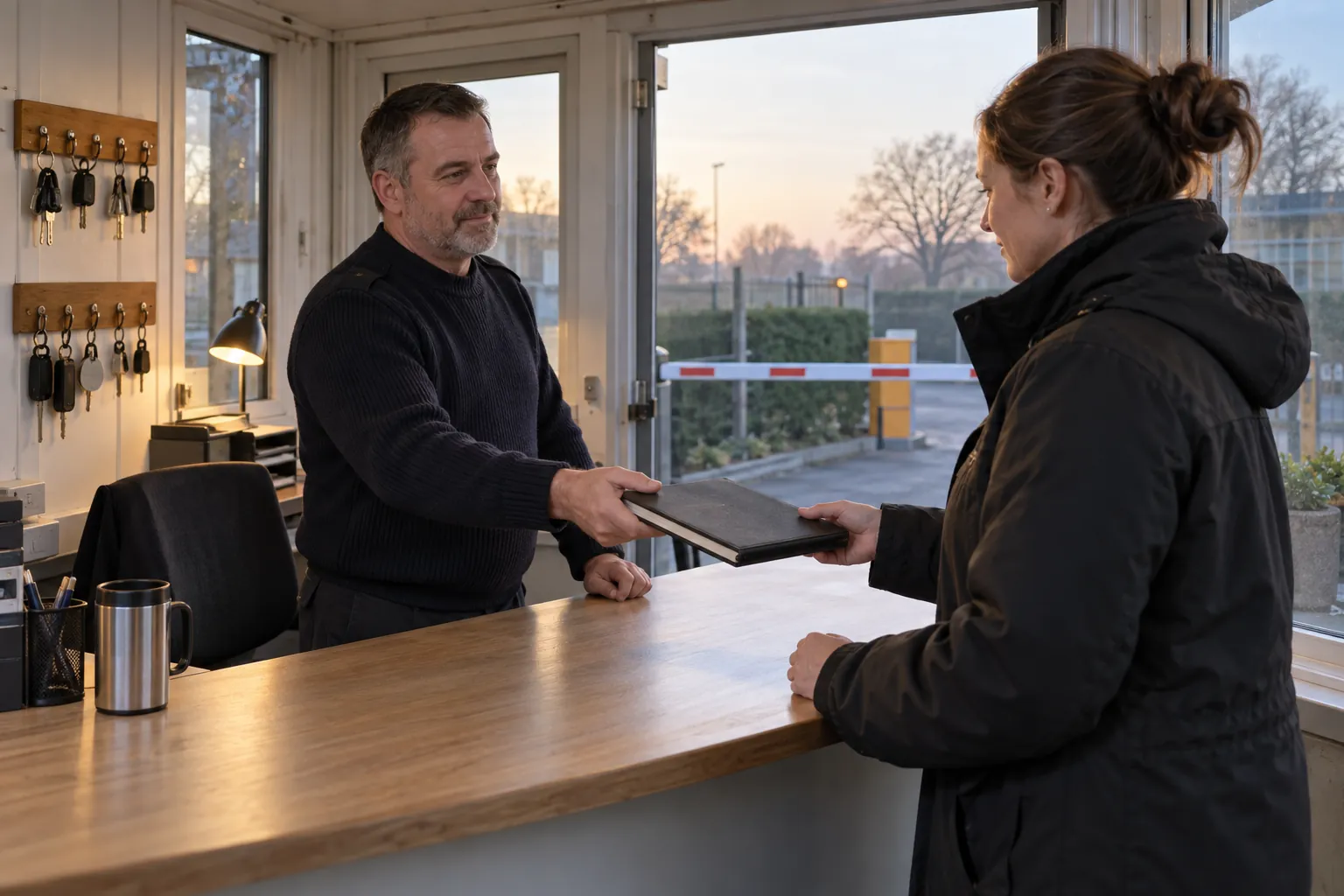
- Handing over to the next shift, with open issues, keys out and anything that needs watching.
Behind every item on that list is a single aim: a safe and secure environment for the people who use the site, and a record that shows what was done to keep it that way.
03
How the responsibilities vary between sites
Security officers have different responsibilities in different industries, and the site's assignment instructions are where those differences are written down. Some common settings:
- Offices and multi-tenanted buildings: corporate security is often a reception duty as much as a guarding one – visitor management, passes, deliveries, lifts and car parks – with locking-up patrols in the evening and tenant satisfaction as part of the measure.
- Retail security: a visible presence on the shop floor, dealing with shoplifting in line with the store's policy, supporting staff with difficult customers and securing the store at close.
- Construction sites and vacant properties: perimeter patrols, gate control, checking plant and materials, and deterring trespass and theft, often through the night.
- Industrial sites and warehouses: gatehouse duties, vehicle and load checks, and patrols of large yards and buildings.
- Hospitals, universities and public buildings: open sites with many entrances, where the job leans towards de-escalation, welfare and helping people rather than keeping them out.
- Events: crowd management, bag searches as a condition of entry and working alongside door supervisors and stewards.
Additional responsibilities may include fire watch during hot works or when a fire alarm is out of action, lone worker checks, key holding and alarm response, or reception duties. Whatever they are, they should be in writing.
04
What a security officer cannot do
Part of understanding the role of a security officer is knowing its limits. A licence is permission to work in the security industry; it does not give the holder any extra legal powers.
- No police powers. A security officer has the same legal powers as any other member of the public, including the limited power to arrest someone in the circumstances the law allows, and must use no more force than is reasonable.
- Searches need consent. A bag search is usually a condition of entry that a person can refuse, and refusing entry is the remedy; an officer cannot search someone against their will.
- No locking of fire exits while people are inside, whatever the security reason.
- No work outside the licence. An officer licensed for security guarding cannot work as a door supervisor or CCTV operator under contract without the right licence.
- No personal data beyond the need. Visitor logs, CCTV and incident reports must be handled under the UK GDPR and the Data Protection Act 2018.
Officers who understand these limits are safer and more effective, and the security training for the licence covers them. Security personnel who are unsure should ask their supervisor before acting, not after. When an incident goes beyond them, the officer's duty is to observe, record and call the police.
05
How duties are set and checked
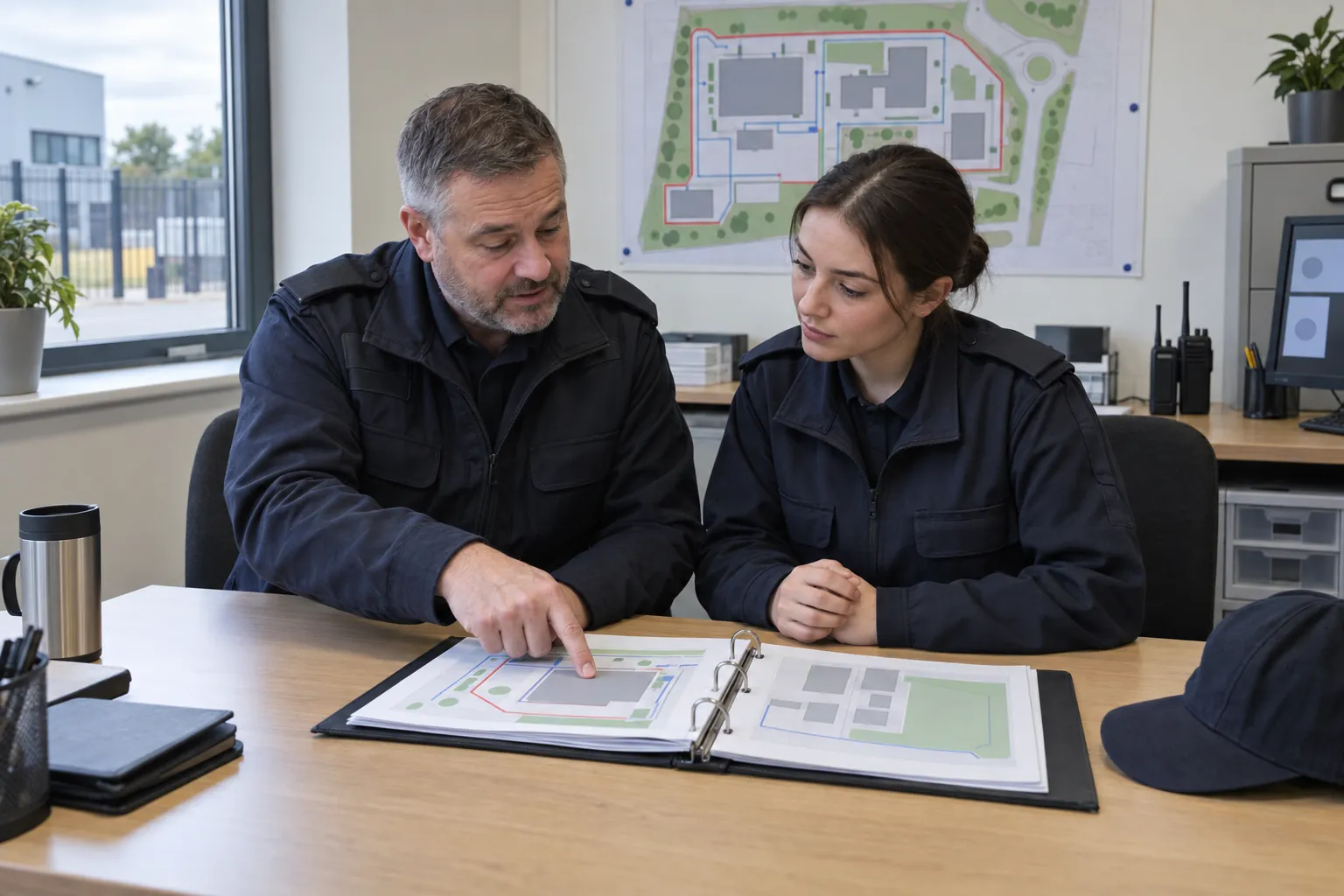
The security officer's duties on any site should come from three documents: the contract, which sets the service; the site risk assessment, which says what the security measures are for; and the assignment instructions, which set out the security procedures and protocols for the site and tell the officer exactly what to do, when and how. Together they define the roles and responsibilities of each member of the security team. An officer who is unsure what is expected should be able to find the answer in the assignment instructions without having to ask.
The security supervisor, or the provider's area manager responsible for security operations on the contract, then checks the work. The usual methods are:
- Supervisory visits, announced and unannounced, including at night, to check the officer is alert, in uniform, displaying the licence and following the assignment instructions.
- Record reviews: reading the daily occurrence book, incident reports and patrol records for completeness, and for patterns in security incidents that point to a change in the site's security needs.
- Patrol evidence: a guard tour record showing each checkpoint was visited, when and by whom.
- Client feedback and KPIs: complaints, response times, incidents dealt with, and patrols completed against those scheduled.
- Training records: licence expiry dates, site induction, first aid and any site-specific training.
Good officers need more than a licence. Communication skills, customer service skills, sound judgement and the ability to stay calm are what make security work effective, and the best way to show them is a clear, honest record of what happened on each shift.
06
Where the evidence of duties fails, and where SiteClara fits
Most of what a good security officer does leaves no trace. A patrol that finds nothing is recorded as "all in order", and a client who never sees a problem may start to wonder what the security provision is for. The patrol log written at 06:00 for the whole night, the fault noted in the book but never passed on and the check nobody can prove happened are where confidence in a security contract erodes.
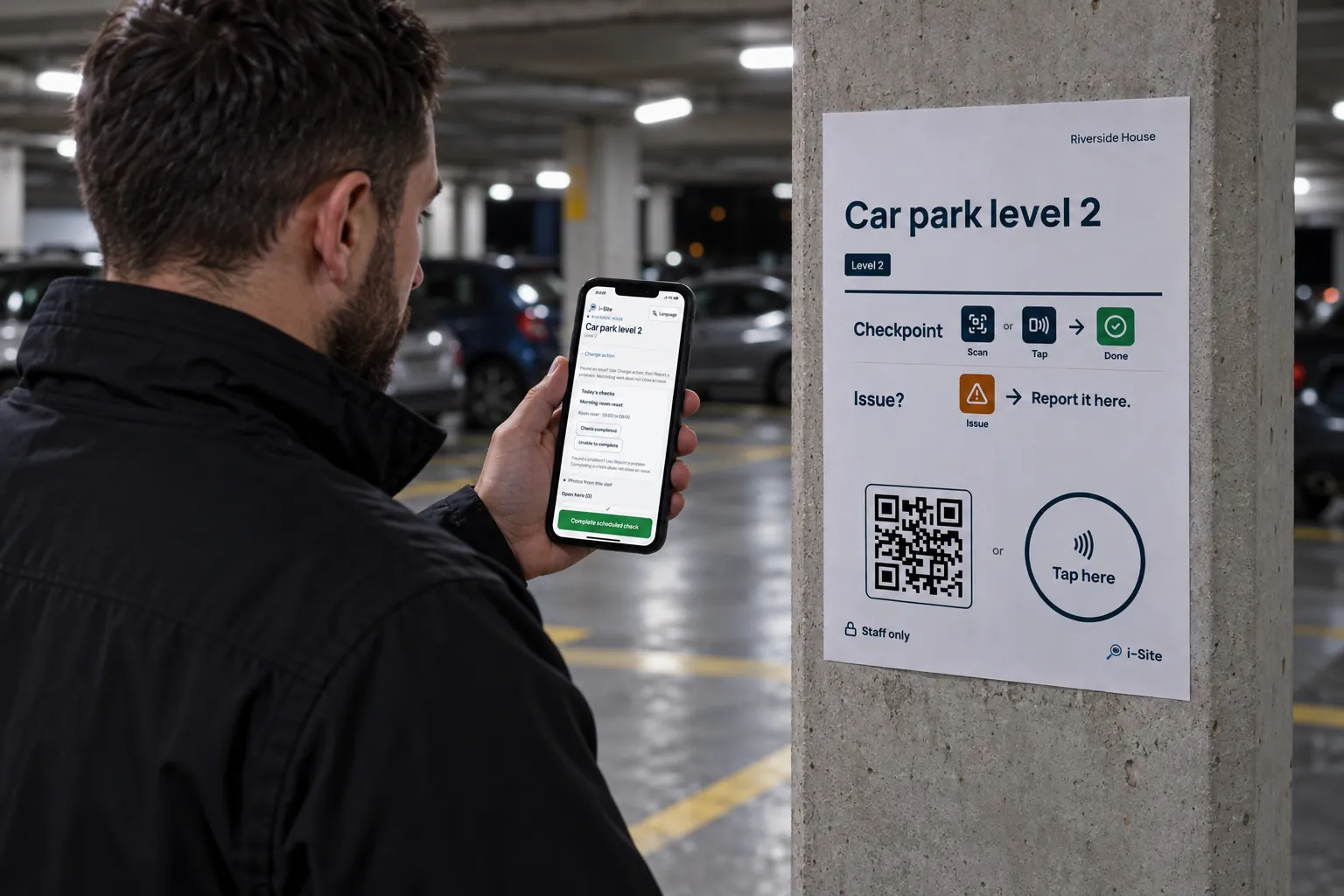
SiteClara gives the routine duties a record. A printed QR poster, with an optional NFC tag behind it, sits at each checkpoint on the patrol: a gate, a fire exit, a plant room, a car park level. The officer scans the code or taps the tag on their own phone, with no app to install, and marks the scheduled check done, or explains what stopped them. The time and the named officer are recorded as it happens, with a photo when one helps. A fault or incident found on the round is reported there and goes onto the team's list of jobs until someone closes it.
The security supervisor sees what is due, done and missed, and can record why a check was missed. At the end of the day the supervisor reviews the totals and photos, adds a note and approves the daily report, which goes to nominated management or client contacts at 8am the next morning, showing what was reported, what is still open and how scheduled checks went.
07
Questions people ask
What is the primary responsibility of a security officer?
The primary responsibility of a security officer is guarding, which Schedule 2, paragraph 2 of the Private Security Industry Act 2001, on manned guarding, describes as guarding premises against unauthorised access or occupation, disorder or damage, guarding property against damage or theft, and guarding people against assault or injury caused by the unlawful conduct of others. The same paragraph counts a physical presence, a patrol or surveillance as guarding when it is there to deter something from happening or to provide information if it does.
What are 5 qualities of a good security guard?
Five qualities of a good security guard are customer service skills for challenging people politely but firmly, patience and the ability to stay calm in stressful situations, concentration to stay alert and aware of the surroundings, thoroughness and attention to detail, and the ability to work well with others. All five are among the skills the National Careers Service's security officer job profile lists, and the same profile says a security officer must be over 18 and pass enhanced background checks.
08
Further reading, and a list to take away
The Security Industry Authority publishes licensing requirements, the licence conditions and the Approved Contractor Scheme standard on GOV.UK. The National Careers Service has a job profile for security officers covering training and entry routes. BSI publishes BS 7499 for static guarding, BS 7984-3 for mobile patrols and BS 7858 for security screening. The Health and Safety Executive publishes guidance on lone working, which many security roles involve.
Before an officer starts on a new site, check that:
- they hold the right SIA licence for the work, and it is in date;
- they have read and signed the site's assignment instructions;
- they know the patrol routes, the checkpoints and the times;
- they know who to call for each kind of incident, and the emergency procedures;
- they know how to record patrols, incidents and faults, and who reads the records;
- they understand what they may and may not do, including searches and fire exits;
- their supervisor has a plan for visits and record reviews.
Sources
Every document this guide quotes or links to, in the order it first cites them.
- Private Security Industry Act 2001 legislation.gov.uk
- Schedule 2, paragraph 2 legislation.gov.uk
- The licence conditions gov.uk
- BS 7858 knowledge.bsigroup.com
- BS 7499 knowledge.bsigroup.com
- Data Protection Act 2018 legislation.gov.uk
- Security officer job profile nationalcareers.service.gov.uk
Related guides
 Security patrolsSecurity assignment instructions: what they should say, and how to keep them workingSecurity assignment instructions (AIs): what they should include, who agrees and signs them, how often to review them, and how to check they are followed.
 Security patrolsSecurity officer report: what to write, and how to make it stand upThe reports a UK security officer writes on shift – incident, patrol, handover – what each should record, and how to write one that stands up later.
 Security patrolsDaily occurrence book: what to record, and how to keep one that stands upDaily occurrence book (DOB): what to record, how to write entries that stand up, how it differs from an incident report, and paper or digital.
 Security patrolsGuard tour systems: how they work, what they prove, and how to choose oneHow guard tour systems record security patrols – wands, RFID, NFC, QR codes, GPS apps – what the data shows and does not, and what to ask before choosing one.