Premises and facilities management
Facilities management KPIs: how to choose them, and how to keep them honest
Facilities management KPIs are measures with targets that show whether an organisation's buildings and FM services are performing, such as statutory inspections completed in date, planned maintenance completed on schedule, reactive jobs fixed within target, customer satisfaction and cost per square metre.

They are also how an FM provider shows it is earning its fee. Chosen well, a short list tells you what matters. Chosen badly, it rewards closing jobs rather than fixing faults. This guide covers the KPIs worth considering across FM services, how to balance them, where the data comes from, and how to stop them being gamed.
01
What facilities management KPIs are
Key performance indicators are measures chosen because they show whether something important is being achieved; a KPI is a metric with a purpose and a target attached. In facility management, KPIs track the performance of services such as maintenance, cleaning, security and the helpdesk, and of the estate itself: whether it is compliant, available, affordable and fit for the people who use it.
KPIs are different from service levels. A service level agreement sets the standard for each piece of work, such as a fault fixed within four hours; a KPI measures how often those standards are met, or tracks something broader, such as customer satisfaction or cost per square metre. In an outsourced contract, KPIs often carry service credits or deductions; in an in-house team, they are how facilities management performance is reported to the business.
There is no statutory list of facility management KPIs. ISO 41001, the international standard for facility management systems, requires an organisation to decide what needs to be monitored and measured, how, when, and how the results are evaluated, but leaves the choice of measures to the organisation. The Institute of Workplace and Facilities Management (IWFM) publishes guidance for the profession. Across the facilities management sector the same measures recur, but the choice, and its consequences, are yours. For cleaning alone, see cleaning KPIs.
02
Facilities management KPIs worth considering
These are examples of facilities management KPIs, grouped by what they tell you. No organisation needs all of them, and a small in-house team will track far fewer than a large outsourced contract. The right facility management KPIs also depend on the facility type: a school, a laboratory and an office block need different measures.
- Statutory compliance: statutory inspections and tests completed in date, and remedial actions closed within their agreed time. Many organisations treat anything less than full compliance as an exception to explain, not a percentage to average.
- Planned maintenance completion: planned preventive maintenance tasks completed within their scheduled window, as a share of those due.
- Planned to reactive maintenance ratio: the balance of planned and reactive maintenance work. A rising share of reactive work orders often means planned maintenance is being skipped or assets are ageing.
- Reactive response time and fix: work orders attended and completed within target, by priority. Work order completion on its own says little; completion within the agreed time says more.
- First-time fix and repeat faults: jobs fixed on the first visit, and faults that come back within a set period.
- Backlog: open maintenance or repair tasks, and how old they are.
- Availability and downtime: how long critical assets, such as lifts, heating, cooling or the building management system, are out of service, and how often.
- Helpdesk: calls answered, requests acknowledged and requesters kept informed.
- Cleaning and security delivery: scheduled checks, cleans and patrols completed as specified, alongside audit scores for quality.
- Health and safety: accidents and near misses on the premises, incidents reportable under RIDDOR, and open actions from risk assessments.
- Customer satisfaction: feedback on completed requests and periodic occupant surveys.
- Cost: spend against budget, maintenance cost per asset or per building, and facility costs per square metre of floor area.
- Energy and sustainability: energy consumption per square metre, water use, and waste recycled.
- Space: space utilisation or occupancy, where space is a significant cost.
Some sources also suggest a facility condition index: the cost of the maintenance and repairs outstanding on a building divided by what it would cost to replace. It is a useful long-term measure of whether an estate is being run down, provided the backlog is costed honestly. Most US sources quote cost per square foot. UK estates normally use square metres; either way, say which floor area measure is used, such as gross internal or net internal area as defined by RICS, or year-on-year comparisons will be meaningless.
What are the 5 key performance indicators for maintenance?
No standard fixes a list of five. BS EN 15341:2019, Maintenance Key Performance Indicators, lists the KPIs of the maintenance function, including economic, technical and organisational ones, and gives guidelines for choosing a suitable set for existing physical assets, facilities and civil buildings among them. For facilities, five worth reporting are planned maintenance completed on schedule, the planned to reactive ratio, reactive response and fix times by priority, first-time fix, and the size and age of the backlog.
03
Balancing input, output and outcome measures
A useful way to choose the right KPIs is to ask what kind of thing each one measures.
- Input measures count the resources used: hours on site, engineers deployed, money spent. They are easy to collect and say little about results.
- Output measures count work done: planned maintenance tasks completed, work orders closed, patrols walked, checks carried out. They show delivery, and can be met by doing the task badly.
- Outcome measures show whether the building works for the people in it: systems available when needed, occupants satisfied, the estate compliant, repeat faults falling. They matter most and are the hardest to measure.
Effective facility management KPIs help because they are balanced. A balanced set uses outputs to show the work was done and outcomes to show it made a difference, with inputs kept for cost management. Pair measures that pull against each other: speed of fix with first-time fix, planned maintenance completion with the reactive maintenance ratio, cleaning checks completed with audit scores.
Keep the number small. Five to ten core KPIs across the service, reported every month, are easier to act on than forty; strategic KPIs for the board and management teams, and operational KPIs for facility managers and their teams, can be different lists. Review the set each year and drop any KPI that has not changed a decision.
04
Data sources and definitions
Every KPI needs a data source both sides trust, and KPI tracking is only as reliable as the records underneath it. The usual sources for facilities management performance metrics are:
- CAFM or CMMS systems: work orders and operational data, planned maintenance tasks, asset management records and timestamps. Most facilities management software can report these directly.
- The helpdesk: call and request logs, priorities, and requester feedback.
- Compliance records: certificates, inspection reports and the compliance calendar.
- Meters and the building management system: energy management data, temperatures and plant run times.
- Audits and inspections: cleaning quality, health and safety, and service quality scores.
- Records of routine checks and patrols: the day-to-day delivery of soft services.
- Finance: budgets, invoices and cost allocations.
Then write each KPI down so that two people calculating it from the same data would get the same answer:
- the name and the question it answers;
- exactly how it is calculated, including what is counted and what is excluded;
- the data source, and who can inspect it;
- how often it is measured and reported;
- the target, and the threshold that triggers action;
- who owns it, and what happens when it is missed.
KPI reporting belongs in the facilities management monthly report, with the records behind each figure available on request.
05
Avoiding perverse incentives
Once a measure becomes a target, people change their behaviour to meet it, and not always in the way intended. This is often called Goodhart's law, and facilities management has plenty of examples:
- a fix-time KPI rewards closing jobs quickly, so jobs are closed before the fault is really fixed and reopened as new ones;
- priorities are downgraded after the event so that a missed emergency counts as a routine job met;
- the clock is paused for "awaiting access" more often than access was really refused;
- planned maintenance is marked complete when the visit happened, whether or not every task was done;
- satisfaction surveys go only to people whose requests went well;
- a cost KPI rewards deferring maintenance, which is cheaper this year and more expensive later.
Treat this as risk management for the KPI set itself. The defences are simple. Pair each speed measure with a quality measure. Count reopened and repeat jobs. Let requesters confirm a job is done before it closes. Audit a sample of completed work each month. Report exceptions, not only percentages, and treat statutory compliance failures individually. And make sure the person reporting a KPI is not the only person who can see the data behind it.
06
Where the delivery data fails, and what SiteClara does about it
Maintenance KPIs usually rest on system data, because every job passes through a helpdesk and a CAFM system. Soft service KPIs often do not. "Scheduled cleaning checks completed" or "patrols completed as instructed" are frequently worked out from paper sheets, or reported as 100% because nobody recorded a miss. A KPI with no record behind it cannot be audited, and a provider that reports 100% every month is rarely believed.
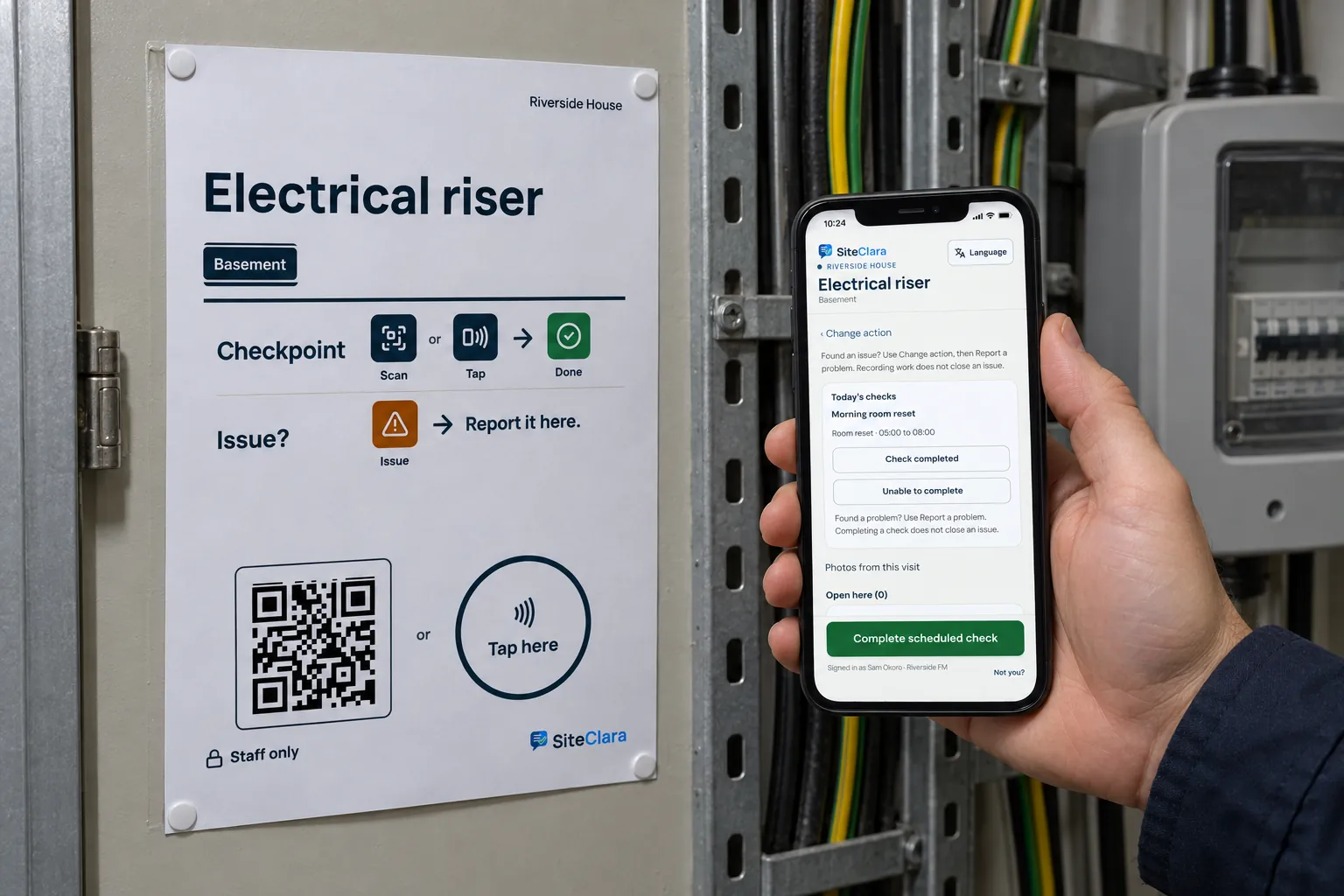
SiteClara records that routine work where it happens. A printed QR poster at each location, with an optional NFC tag behind it, lets cleaning, security or site staff scan the code or tap the tag on their own phone, with no app to install. They see the scheduled checks due there and mark each one done, or explain what stopped them, with a photo when it helps. An issue reported there goes onto the team's list of jobs until someone closes it.
The supervisor sees what is due, done and missed, and can record the reason a check was missed. Each day the supervisor approves a report that goes to nominated client and management contacts at 8am the next morning, showing what was reported, completed and still open, and how scheduled checks went, for example 12 of 12 completed. Those daily records are data a KPI for soft service delivery can be built on, and checked against.
07
Further reading, and a list to take away
ISO 41001, available from BSI, sets out how a facility management system monitors and evaluates performance. The Institute of Workplace and Facilities Management (IWFM) publishes professional guidance for facilities managers. RICS publishes the standards for measuring floor areas that cost and energy KPIs depend on. The Health and Safety Executive publishes guidance on RIDDOR reporting and on the statutory duties behind compliance KPIs, and BESA publishes SFG20 for planned maintenance tasks.
Before you agree a set of FM KPIs, check that:
- each KPI answers a question someone will act on;
- the set mixes output and outcome measures, with speed paired against quality;
- statutory compliance is reported item by item, not only as a percentage;
- every KPI has a written definition, a data source and an owner;
- the data can be inspected by someone other than the person reporting it;
- soft services have delivery measures backed by records, not only audit scores;
- the list is short enough to discuss every month;
- there is a date to review the set and drop what is not used.
Sources
Every document this guide quotes or links to, in the order it first cites them.
- ISO 41001 knowledge.bsigroup.com
- Institute of Workplace and Facilities Management (IWFM) iwfm.org.uk
- RIDDOR legislation.gov.uk
- BS EN 15341:2019 knowledge.bsigroup.com
- SFG20 sfg20.co.uk
Related guides
 Premises and facilities managementFacilities management SLA: setting service levels across FM servicesHow to write a facilities management SLA: helpdesk response and fix times, planned maintenance, cleaning and security standards, KPIs and reporting.
 CleaningCleaning KPIs: what to measure, and how to know the figures are trueThe cleaning KPIs worth measuring, how to define and target them, how to report them, and how a KPI can look green while the building is not clean.
 Premises and facilities managementFacilities management monthly report: what to include, and what makes it believableWhat an FM monthly report should contain: compliance, planned and reactive maintenance, KPIs, health and safety, costs, and the evidence behind them.
 Premises and facilities managementPlanned preventative maintenance: how to plan it and prove it was donePlanned preventative maintenance (PPM): what it is, how to build an asset register and schedule, statutory versus discretionary tasks, and evidencing the work.