Premises and facilities management
Facilities management monthly report: what to include, and what makes it believable
A facilities management monthly report is the account an FM team or provider gives the client or its own organisation each month of the buildings and services it runs: statutory compliance, planned and reactive maintenance, KPIs against target, health and safety, costs, and the risks and decisions that need attention.

It is where a facilities management contract is judged. The client reads it to decide whether the building is safe, compliant and looked after; the provider writes it to show that it is. Too often it is forty pages of charts that answer neither question. This guide covers what a facilities management monthly report should include, how to present it, and what makes the numbers in it believable.
01
What a facilities management monthly report is for
A facilities management monthly report is the regular account an FM team, or a company providing facilities management services, gives of the buildings and services it runs, from a single commercial building to a national estate: what was done, what was not, what is at risk, and what it cost. It goes to the client, the estates director, the property owner or the managing agent, and it is usually reviewed at a monthly contract meeting.
There is no statutory format. The content is set by the contract: the specification, the service level agreement and the key performance indicators the two sides agreed. Where an organisation runs a facility management system to BS EN ISO 41001, the standard expects performance to be monitored, measured, analysed and reviewed by management, and the monthly report is often the main way that happens.
Behind the report sit legal duties that belong to the client or the person in control of the building, whoever carries out the work: fire safety under the Regulatory Reform (Fire Safety) Order 2005 in England and Wales, legionella control under HSE's ACOP L8, maintenance of the workplace under the Workplace (Health, Safety and Welfare) Regulations 1992, lifting equipment under LOLER 1998, pressure systems, gas safety, electrical safety and asbestos management. The report is where the client learns whether those duties are being met on their behalf, which is why its compliance section matters more than any other.
02
What to include
A useful facilities management monthly report covers the same headings every month, so that changes stand out:
- Summary: one page of the operational picture, in plain words, of what went well, what did not, and what the client needs to decide or know.
- Health and safety: accidents, near misses and incidents, any reportable under RIDDOR, and actions taken.
- Statutory compliance: the status of each statutory inspection and test, such as fire alarm, emergency lighting, fire extinguishers, water hygiene, gas safety, fixed electrical testing, lift thorough examinations, pressure systems and air conditioning, with anything overdue, failed or awaiting remedial work shown clearly.
- Planned preventive maintenance: tasks scheduled, tasks completed, tasks missed and why, across mechanical and electrical plant, HVAC systems, building systems and the building fabric.
- Reactive maintenance: jobs logged by the helpdesk, by priority and building, completed within the response time and completion time, and still open, with the oldest explained.
- Soft services: cleaning, security, waste management, pest control, grounds and reception, with audit scores or the contract's own measures.
- Key performance indicators: the KPIs in the contract, against target, with the trend over several months.
- Finance: operational costs against budget, reactive repair costs outside the fixed price, and quotations awaiting approval.
- Energy and sustainability: energy consumption and water use against the same month last year, and progress on any energy efficiency improvements.
- Risks, issues and recommendations: failing plant, repeat faults, items near the end of their life on the asset register, and the repairs or replacements the provider recommends, with the likely disruption to occupants.
- Actions: what was agreed at the last meeting, and whether it has been done.
Keep what the contract asks for and cut the rest. Every page that nobody reads makes it harder to find the page that matters.
03
Reporting compliance and maintenance properly
The compliance section is the one a client relies on, and the one most often written loosely. "Fire safety: compliant" tells the reader nothing. A good compliance report is a table, one row per duty and per building, showing:
- what the check or inspection is, and how often it is due;
- when it was last done, by whom, and the result;
- when it is next due;
- any remedial actions from the last inspection, and whether they are complete;
- where the certificate or record is held.
An item that is overdue, or passed with remedial actions still open, should be obvious at a glance, not hidden in a percentage. A figure such as "96% of statutory tasks complete" can hide one overdue lift thorough examination, which matters more than the other ninety-six.
For planned and routine maintenance, report maintenance tasks completed against the schedule, and separate the statutory tasks from the rest. For reactive maintenance, report the response time and the completion time separately, and show the open jobs by age. Downtime of critical plant, and the disruption it caused, such as heating, lifts or cooling in a server room, deserves its own line, because the occupant experiences the building through what does not work.
Where the maintenance programme follows an industry standard such as SFG20, say so, and report adherence to it: any tasks deliberately changed or removed from the schedule, with the reason. Upkeep that is deferred this month becomes building maintenance cost later, and the report is where that trade-off should be visible.
04
KPIs, and the evidence behind them
Key performance indicators work best when there are few of them, each measures something the client cares about, and each can be checked. Common FM KPIs include:
- statutory compliance tasks completed on time;
- planned preventive maintenance completed on schedule;
- reactive jobs attended and completed within the agreed times, by priority;
- helpdesk calls answered and jobs logged, and repeat faults;
- cleaning and security audit results against the specification;
- occupant satisfaction, from a short survey or feedback when jobs close;
- health and safety incidents and near misses reported.
A KPI is only as good as the record behind it. If "99% of cleaning tasks completed" comes from sheets signed at the end of each shift, or "all security patrols completed" from a book nobody checks, the client is reading the provider's assurance, not evidence. Before a number goes into the monthly report, the facility managers writing it should know where it came from and be able to show the underlying records if asked.
Trends matter more than single months. A report that shows the last six or twelve months for each KPI lets the reader see a slow slide, such as reactive jobs creeping up as plant ages, that a single month's figure hides.

05
Presenting the report and the monthly review
Good monthly reports share a few habits:
- Lead with exceptions. Put what is overdue, failed, at risk or needs a decision on the first page. Green charts can come later.
- Use the same structure every month, so the reader knows where to look and can compare months.
- Report by building where there are several, because an average across a portfolio hides the one site that is struggling.
- Explain every miss. A missed task with a reason and a new date is credible; a missed task with no comment invites the question.
- Be timely. A report issued three weeks into the next month describes a building that no longer exists. Agree a date, and keep to it.
- Keep the actions list live. Each action has an owner and a date, and stays on the list until it is done.
The monthly review meeting should work through the exceptions and the actions, not read the report aloud, and cover any notification received during the month from a regulator, an insurer or a visiting technician. Good FM teams also walk part of the building with the client from time to time. What the report says and what the building shows should match; when they do not, the report is the thing to fix.
06
Where the record fails, and what SiteClara does about it
The monthly report is usually assembled at the end of the month from whatever records exist: the CAFM system for maintenance, contractors' certificates for compliance, and, for cleaning and security, paper sheets, patrol books and the supervisor's memory. Those last records are the weakest, and they cover the services occupants notice most. A month of problems that nobody wrote down arrives in the report as a single line: "no issues".
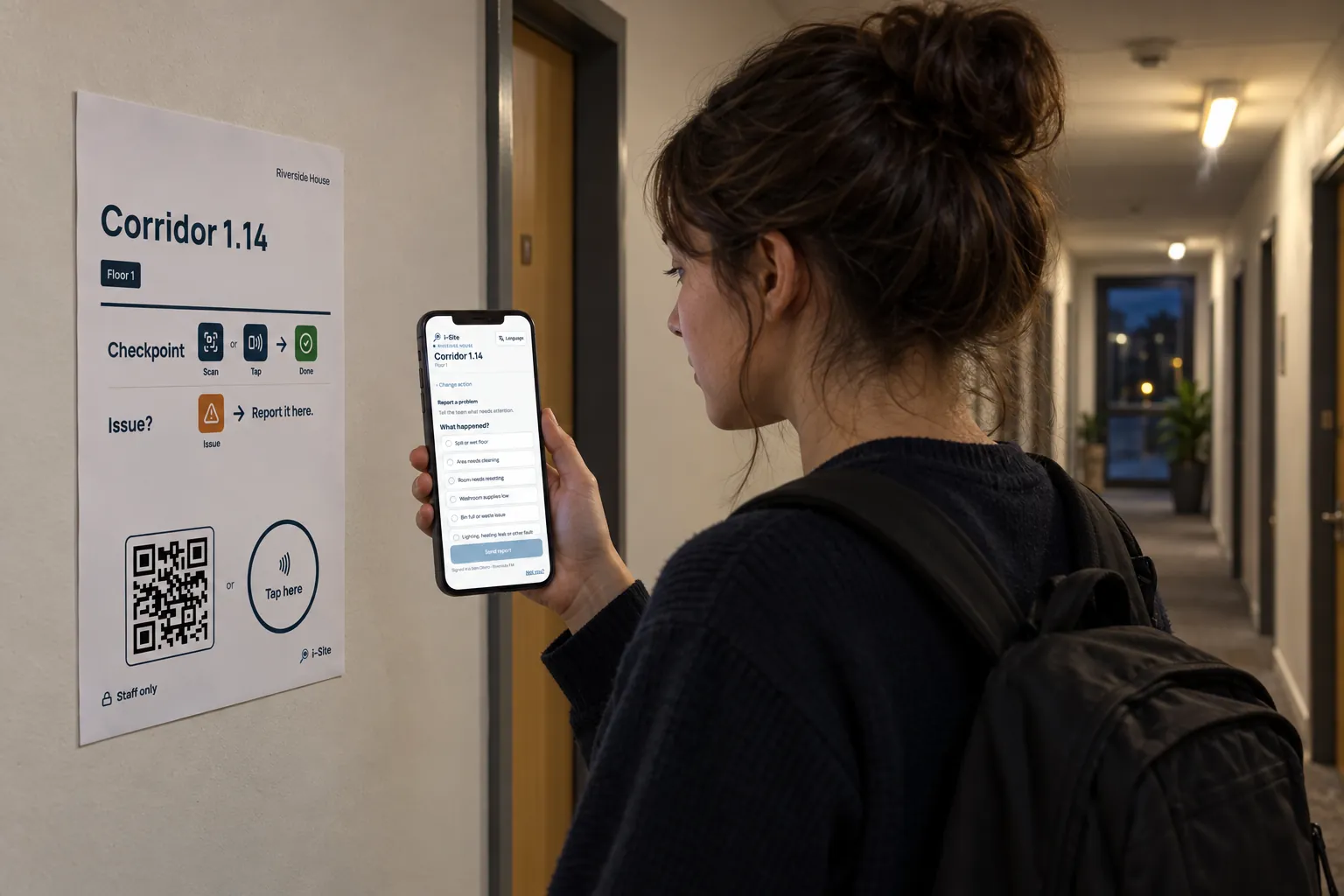
SiteClara does not write the monthly report. It produces a record each day. A printed QR poster, with an NFC tag behind it if staff prefer to tap, sits at each location; cleaning, security and premises staff scan or tap with their own phone, with no app to install, complete the scheduled checks due there or explain what stopped them, and report issues with a photo, which go onto the team's list of jobs until someone closes them.
Each day the supervisor reviews the totals and photos, adds a note, records who was notified and approves the daily report, which goes to nominated management or client contacts at 8am the next morning. It shows what was reported, what was completed, what is still open and how the scheduled checks went, for example 12 of 12 completed. Whoever writes the monthly report has a month of approved daily reports to draw on, rather than a month of memory.
07
Further reading, and a list to take away
BS EN ISO 41001 sets out requirements for a facility management system, including monitoring and reviewing performance. The Institute of Workplace and Facilities Management (IWFM) publishes guidance on FM practice and contract management, and SFG20 is the industry standard maintenance specification. The Health and Safety Executive publishes guidance on each of the statutory duties named above, including L8 on legionella and the guidance on LOLER, and on reporting incidents under RIDDOR.
Before the next monthly report goes out, check that:
- the first page shows what is overdue, failed, at risk or needs a decision;
- statutory compliance is a table by duty and building, not a percentage;
- reactive jobs show response and completion times separately, and open jobs by age;
- every KPI has a named source record that could be shown if asked;
- cleaning and security figures come from records made at the time, not end-of-shift sheets;
- trends cover at least six months;
- every missed task has a reason and a new date;
- the actions list has owners and dates, and is reviewed at the monthly meeting.
Sources
Every document this guide quotes or links to, in the order it first cites them.
- BS EN ISO 41001 knowledge.bsigroup.com
- Regulatory Reform (Fire Safety) Order 2005 legislation.gov.uk
- ACOP L8 hse.gov.uk
- Workplace (Health, Safety and Welfare) Regulations 1992 legislation.gov.uk
- RIDDOR legislation.gov.uk
- SFG20 sfg20.co.uk
Related guides
 Premises and facilities managementFacilities helpdesk: what it does, and how to run one wellWhat a facilities helpdesk does, how it logs, prioritises and closes jobs, the people and systems behind it, and how to tell whether it is working.
 CleaningCleaning KPIs: what to measure, and how to know the figures are trueThe cleaning KPIs worth measuring, how to define and target them, how to report them, and how a KPI can look green while the building is not clean.
 Premises and facilities managementFault reporting system: how faults are reported, prioritised and closedHow a fault reporting system for a building should work: how occupants report faults, how facilities teams log and prioritise them, and how a fault is closed.
 CleaningCleaning service level agreement: what to include, and how to show it is metWhat a cleaning SLA should contain, how to set service levels and response times, service credits and escalation, and how to show the service was delivered.