Cleaning
Hygiene audit: what is checked, who does it, and what happens next
A hygiene audit is a structured, planned check of whether a place, its people and its routines meet their hygiene standards and keep infection and contamination under control.
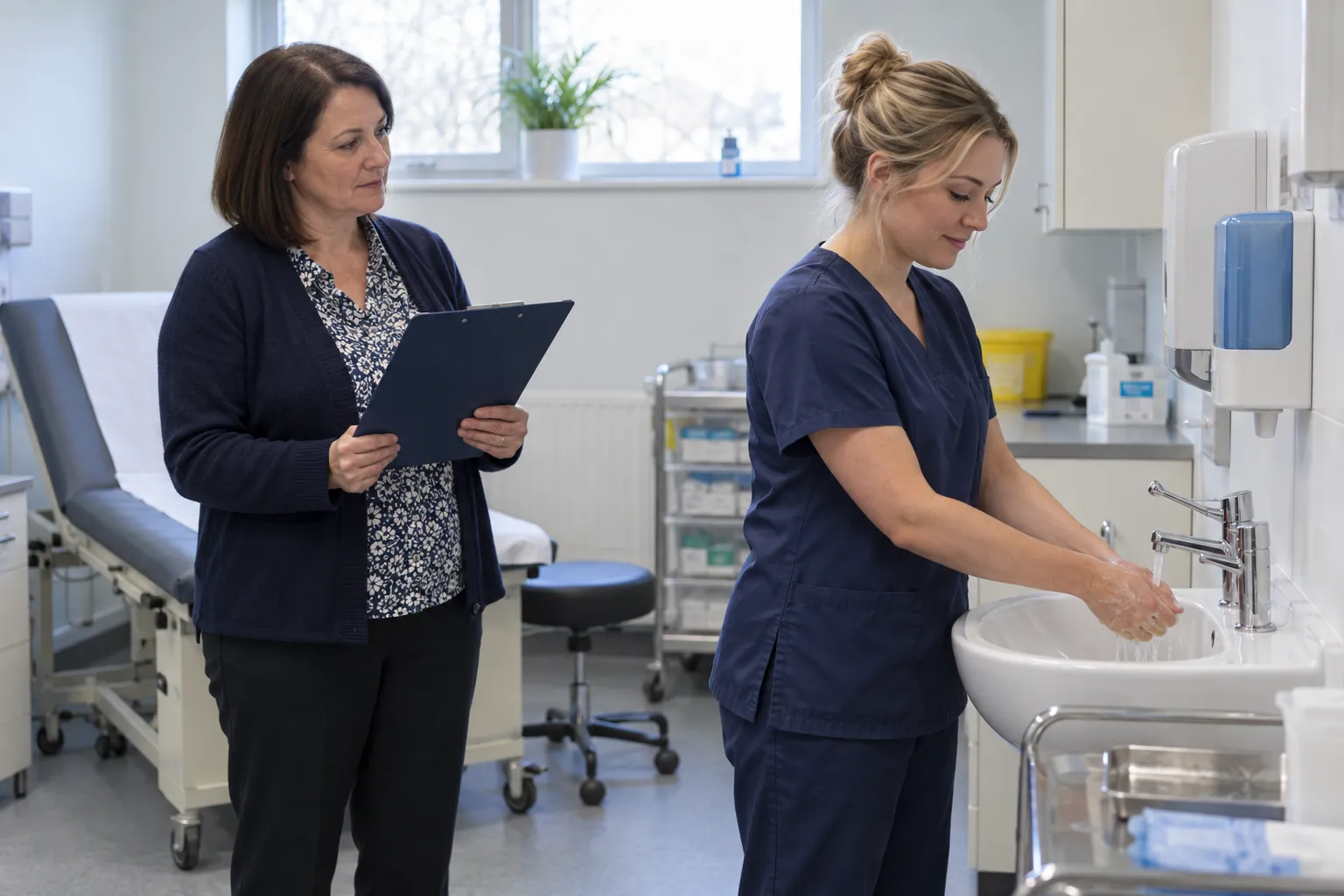
Care homes, GP practices, hospitals, schools and food businesses all run them, for different reasons and against different rules. This guide covers what is audited, who does it, how audits are scored, and how an action plan turns findings into change.
01
What a hygiene audit is, and what the law requires
A hygiene audit compares what actually happens with the organisation's hygiene standards and hygiene policies: the cleanliness of the environment and equipment, hand hygiene, the handling of food, waste and laundry, and the training and records behind them. It is done by someone following a set audit tool to assess compliance, it produces a score and a list of findings, and it ends with an action plan of corrective actions.
Few laws say "carry out a hygiene audit" in those words. The duty is usually to control a risk, and audit is how an organisation shows it is doing so:
- Health and social care in England. Providers registered with the Care Quality Commission must assess, prevent and control the spread of infection under Regulation 12 of the Health and Social Care Act 2008 (Regulated Activities) Regulations 2014, and keep premises and equipment clean under Regulation 15. The Department of Health and Social Care's Code of Practice on the prevention and control of infections expects providers to have infection prevention and control (IPC) policies and to audit compliance with them. The other UK nations have their own regulators and equivalent expectations.
- NHS cleaning. In England, the National standards of healthcare cleanliness 2025 set cleanliness audits whose frequency depends on the functional risk of each area.
- Food businesses. Under the Food Safety Act 1990 and the assimilated hygiene regulation, Regulation (EC) No 852/2004, food business operators must keep premises clean and put in place food safety procedures based on HACCP principles, including checking that those procedures work. A third-party food hygiene audit is not generally required by law, but the business must be able to show its food safety management system is followed, and a local authority officer will inspect it.
- Schools and other workplaces. There is no statutory hygiene audit, but the workplace regulations require premises and washrooms to be kept clean, school kitchens fall under food law, and the UK Health Security Agency's health protection guidance for education and childcare settings sets out infection control practice.
An inspection by an environmental health officer or a CQC inspector, or a hygiene inspection of a food processing facility by its customer, is not an internal audit in this sense. It is the regulator checking you. The internal audit is how you find the problems first.
02
What a hygiene audit checks
Audit tools differ by setting, but most hygiene checklists draw from the same list:
- Environmental cleanliness: floors, high-touch surfaces, fixtures, washrooms, kitchens and sluices, against the cleaning schedule and standard.
- Hand hygiene: whether facilities are there and working, with soap, drying and hand sanitiser, and whether staff practise proper hand washing at the right moments. The World Health Organization's five moments for hand hygiene are the usual basis for a hand hygiene audit in healthcare and care.
- Personal protective equipment: gloves, aprons and protective clothing available, used for the right tasks and removed and disposed of properly, including glove use in food handling.
- Equipment decontamination: shared care equipment, commodes, mops and cloths, with colour coding to prevent cross-contamination.
- Waste management: segregation of clinical and general waste, safe waste handling, sharps handling where relevant, and storage that keeps waste secure, supports good sanitation and keeps pests out.
- Linen and laundry: separating used and clean linen, and handling soiled items safely.
- Food safety: temperature control, food storage, separating raw and ready-to-eat items, cleaning of food contact surfaces, personal hygiene, and pest control.
- Premises and ventilation: work areas with surfaces that can be cleaned, equipment maintenance and repairs that affect hygiene, and adequate ventilation.
- Chemical storage: cleaning products stored and used as their COSHH assessments require.
- Staff training and records: hygiene training up to date, cleaning schedules completed, and a regular review of hygiene policies against current best practices.
A good audit tool for a care home will weight hand hygiene and equipment; one for a school kitchen will weight temperature control and cross-contamination. Use a tool built for the setting rather than a generic template.
03
Who carries out hygiene audits
Most audits are internal, done often, by people close to the work, and their adherence to one method matters more than their seniority:
- The IPC lead in a care home or practice, or the infection prevention team in a hospital, who owns the audit programme and its results.
- Managers and supervisors: the home manager, the domestic services or cleaning supervisor, the catering manager, who run routine audits in their own areas.
- Peer auditors: staff from one unit auditing another, which removes the temptation to mark your own work kindly.
- The cleaning provider, auditing its own service against the contract, often jointly with the client.
Some audits are external. Commissioners and local IPC teams may audit care providers; food businesses, especially those supplying others, and food production sites use independent food safety auditors against a certification standard, and know the audit expectations in advance; and consultants are brought in before an inspection or after a failure. External auditors bring fresh eyes and experience, but they visit rarely, and an audit programme that relies on them alone will miss most of the year.
How often depends on risk. High-risk clinical areas in healthcare facilities and busy kitchens are audited more often than offices; a new service, a poor result or an outbreak is a reason to audit more often for a while.
04
How hygiene audits are scored
Most tools use a simple method: each item is marked compliant, non-compliant or not applicable, and the score is the percentage of applicable items that are compliant. A few refinements make the number more honest:
- Critical items. Some failures matter more than others. A missing hand-wash basin or raw meat stored above ready-to-eat food should fail the section, whatever the rest scores.
- Thresholds. Many organisations band scores, for example red, amber and green, with an agreed action for each band, and set higher thresholds for higher-risk areas.
- Comparability. Use the same tool, the same method and trained auditors, so a score this month means the same as last month.
- Evidence. Record what was seen, where, with a photo where it helps, so that a finding can be followed up and cannot be argued away.
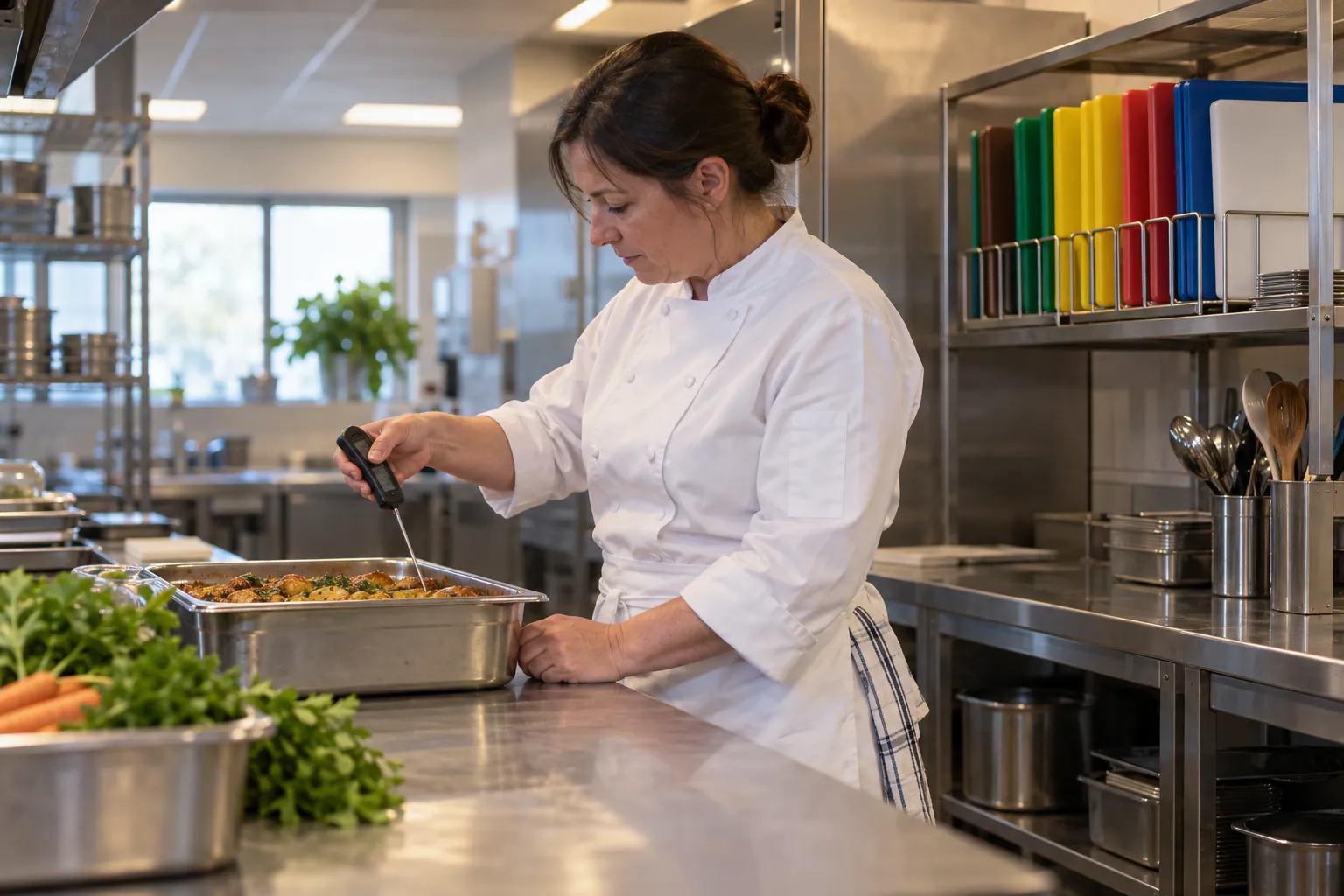
Public scores exist too. NHS organisations in England turn cleanliness audit results into star ratings under the national standards. Food businesses in England, Wales and Northern Ireland receive a food hygiene rating from 0 to 5 after an inspection, which takes account of hygienic food handling, the condition of the premises and confidence in management; in Scotland the result is Pass or Improvement Required. These inspection reports are the regulator's view. A business whose own audits ensure compliance and test everyday hygiene practices rarely has a surprise on inspection day.
05
From findings to an action plan
A hygiene audit report is only as useful as the action plan that follows it. For each finding, write:
- What was found, where, and why it matters, in plain words, separating failures from areas for improvement.
- The corrective action: what will be done, which may be a repair, a clean, a change to a cleaning schedule, retraining or a change of product.
- An owner: one named person, not a department.
- A date, set by risk: a hand-wash basin with no soap is fixed today; a worn worktop that cannot be cleaned properly goes into the repair programme with a date.
- How it will be checked: a re-audit of that item, or evidence that the change has held.
Then look across audits. The same failure in three areas usually has one cause, such as a product that is not being restocked, a cleaning task no one owns, or a shift pattern that leaves a gap. Report trends in hygiene compliance to whoever oversees infection prevention or hygiene and food safety, such as an IPC committee, a governing board or a directors' meeting, so that recurring findings lead to changes in resources or policy, not only to reminders. That is the continuous improvement the audit exists for. Our guide to cleaning quality control covers the wider cycle of inspection and corrective action for a cleaning service.
06
Where the audit trail fails, and where SiteClara fits
Audits sample. Between them, hygiene rests on routine checks: washrooms checked through the day, high-touch surfaces cleaned on a schedule, soap and paper towels restocked, a leaking tap reported. Auditors often find that the records of these routines are the weakest part of the picture: a cleaning schedule initialled at the end of the week, or a problem noticed by several people and reported by none. Action plans suffer the same way, with an action marked complete that nobody can show was done.
SiteClara records the routine checks between audits. A printed QR poster at each location, with an optional NFC tag behind it, lets staff confirm a scheduled check with a scan or a tap on their own phone, with no app to install. Staff see the checks due there and mark them done, or explain what stopped them, and can report an issue with a photo, which goes onto the team's list of jobs until someone closes it. The supervisor sees what was due, done and missed, and can escalate a job to the building manager. An approved daily report goes to nominated management or client contacts at 8am the next morning.
07
Questions people ask
What are the NHS guidelines for hygiene?
In England, the NHS's guidance on hygiene is NHS England's National infection prevention and control manual (NIPCM), which should be adopted as mandatory guidance in NHS settings and settings where NHS services are delivered, with its principles applied in all care settings.
Its standard infection control precautions are to be used by all staff, in all care settings, at all times, and have 10 elements: patient placement and assessment of infection risk, hand hygiene, respiratory and cough hygiene, personal protective equipment, safe management of the care environment, of care equipment, of healthcare linen and of blood and body fluids, safe disposal of waste including sharps, and occupational safety.
What is the purpose of a hand hygiene audit in the NHS?
A hand hygiene audit checks that staff clean their hands when they should, because NHS England's infection prevention and control manual says monitoring of the standard infection control precautions, of which hand hygiene is one, must be ongoing to ensure compliance with safe practices. The manual adds that this demonstrates ongoing commitment to patient, staff and visitor safety, as required by the Health and Safety Executive and the Care Quality Commission.
What are the 5 points of hand hygiene?
The five moments for hand hygiene, from the World Health Organization's Your 5 Moments for Hand Hygiene, are before touching a patient, before a clean or aseptic procedure, after a body fluid exposure risk, after touching a patient, and after touching a patient's surroundings. NHS England's infection prevention and control manual lists the same five for direct patient care, and adds that hand hygiene is always performed before putting on and after removing gloves.
08
Further reading, and a list to take away
Useful official sources are the Code of Practice on the prevention and control of infections and the Care Quality Commission's guidance on Regulations 12 and 15; the National infection prevention and control manual, published for England by NHS England and for Scotland by Antimicrobial Resistance and Healthcare Associated Infection (ARHAI) Scotland; NHS England's National standards of healthcare cleanliness 2025; the Food Standards Agency's Safer food, better business packs and Food Standards Scotland's CookSafe; the UK Health Security Agency's health protection guidance for education and childcare settings; and the World Health Organization's hand hygiene guidance.
Before your next hygiene audit, check that:
- the audit tool fits the setting and weights the items that matter most there;
- auditors are trained and use the same method each time;
- the frequency follows risk, and increases after a poor result or an outbreak;
- findings carry evidence: what, where, and a photo where it helps;
- every action has one owner, a date and a way to check it held;
- routine checks between audits are recorded as they happen;
- trends are reported to whoever can change resources or policy.
Sources
Every document this guide quotes or links to, in the order it first cites them.
- Regulation 12 of the Health and Social Care Act 2008 (Regulated Activities) Regulations 2014 legislation.gov.uk
- Code of Practice on the prevention and control of infections gov.uk
- National standards of healthcare cleanliness 2025 england.nhs.uk
- Food Safety Act 1990 legislation.gov.uk
- National infection prevention and control manual (NIPCM) england.nhs.uk
- Standard infection control precautions england.nhs.uk
- Your 5 Moments for Hand Hygiene cdn.who.int
Related guides
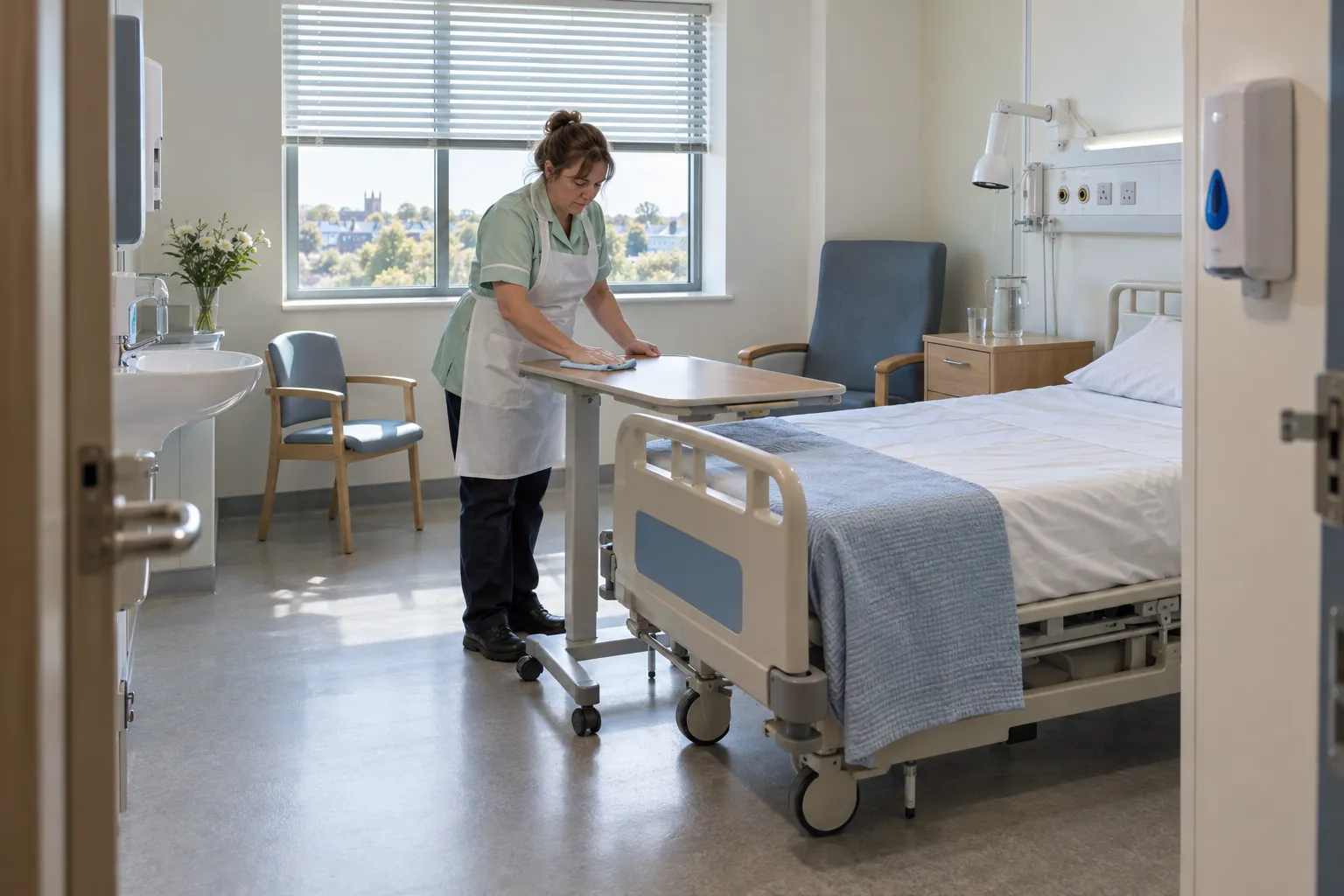 CleaningCleaning standards in the UK: a map, and how to chooseA map of UK cleaning standards: NHS cleanliness standards, the NHSScotland specification, BS EN 13549, BICSc, CQC and food hygiene law, and how to choose.
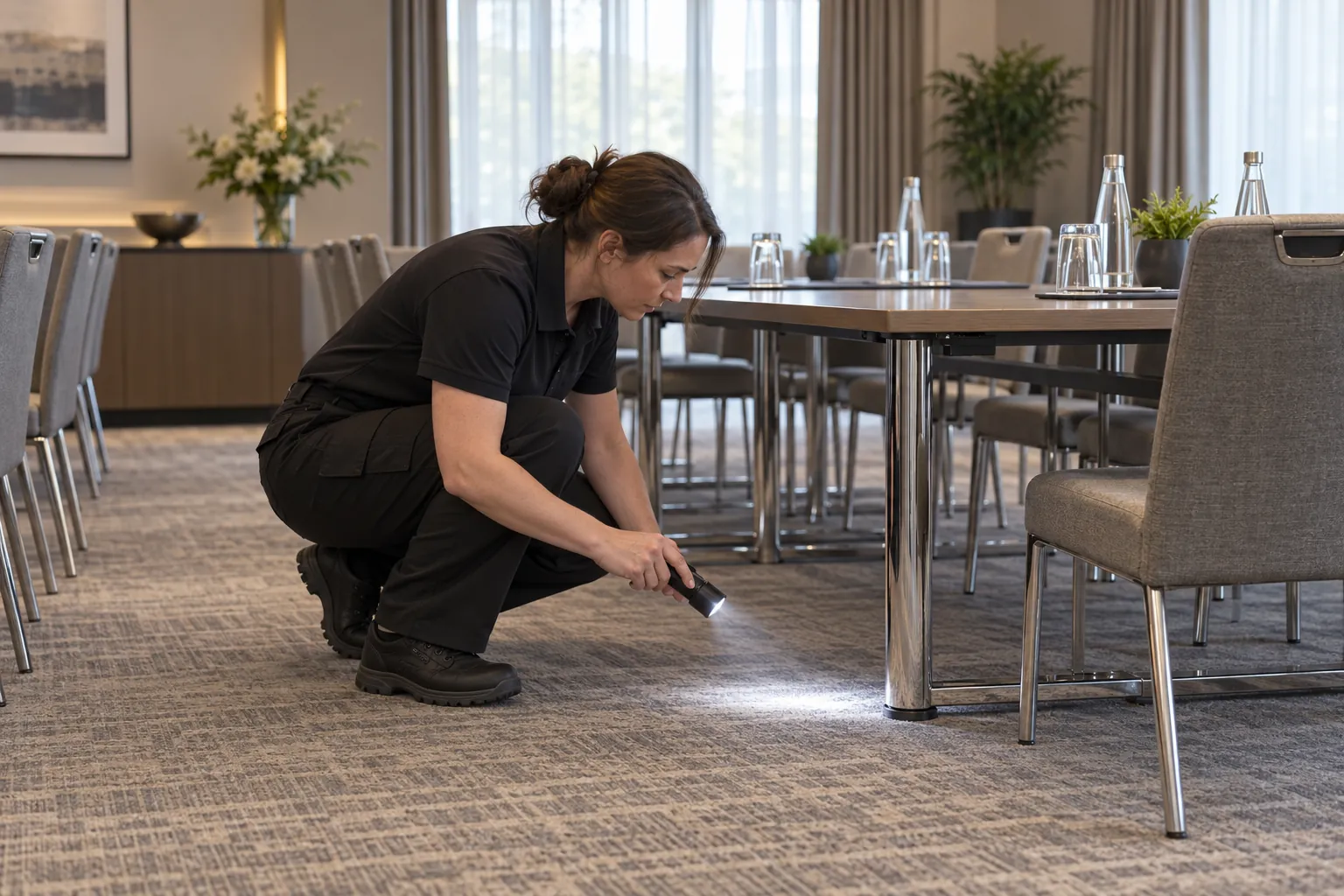 CleaningCleaning quality control: how to inspect, correct and prove the standardHow quality control works in commercial cleaning: QA versus QC, setting standards, running inspections, corrective action and a record that holds up.
 CleaningToilet check sheet: what to record and how to make it credibleWhat a washroom check sheet should record, how often to check, the legal duty behind it, and how to keep a record a client or inspector will believe.
 CleaningSchool cleaning checklist: what to clean, how often, and how to show it was doneA school cleaning checklist for classrooms, toilets, corridors, dining hall and changing rooms, with daily, weekly and holiday tasks and how to record them.