Premises and facilities management
Owners' management companies: what an OMC must do, and how to show the common areas are looked after
An OMC, or owners' management company, is the company that owns the common areas of an apartment block or managed estate in Ireland with five or more homes and is responsible for managing, maintaining and repairing them.
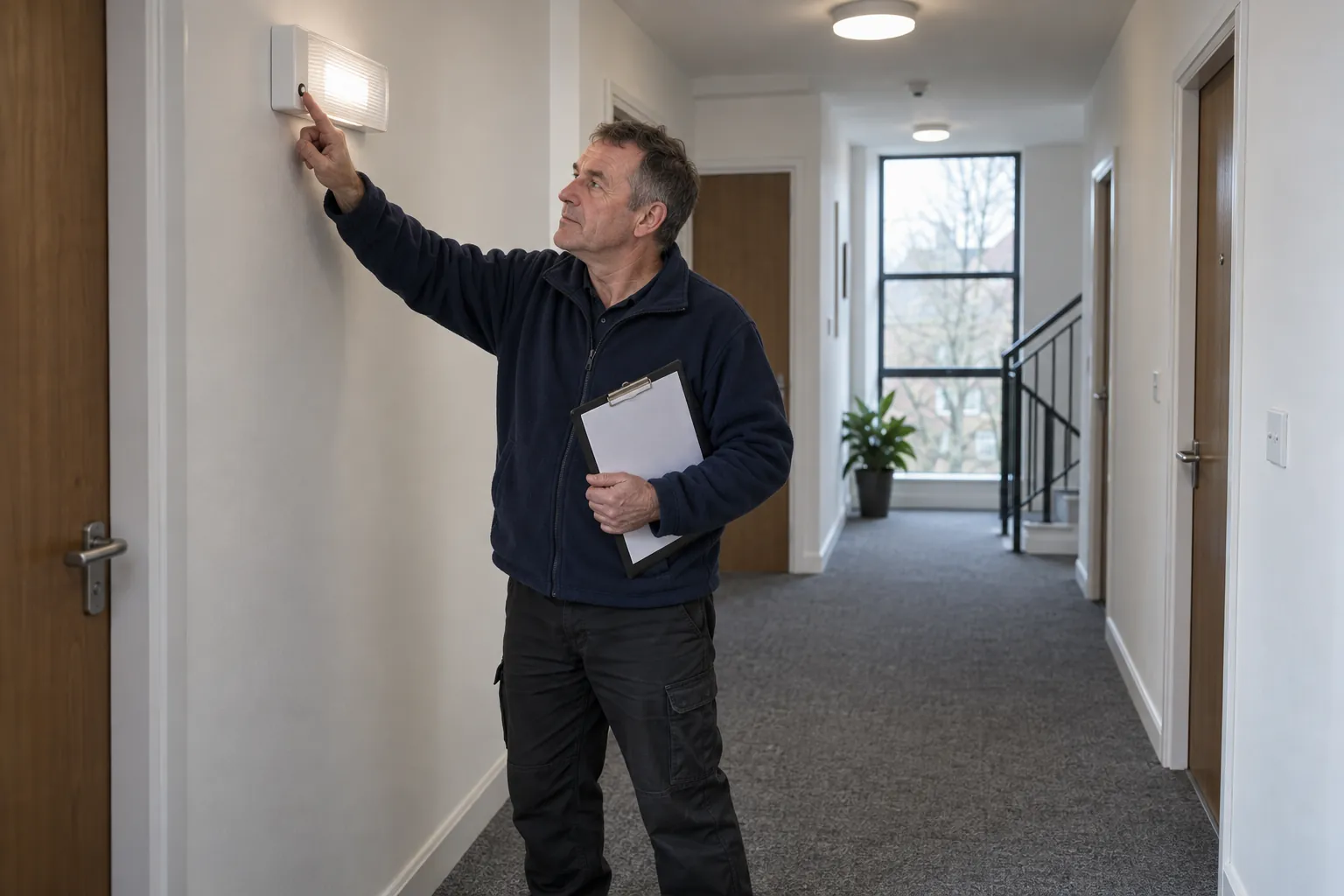
The directors are usually volunteers who live there; the day-to-day work is done by a managing agent, a caretaker and a list of contractors. This guide covers what the law asks of an OMC, who does what, the fire safety duty that comes with the common areas, and what a record of the upkeep should show.
01
What an owners' management company is, in law
The Multi-Unit Developments Act 2011 defines an owners' management company as "a company established for the purposes of becoming the owner of the common areas of a multi-unit development and the management, maintenance and repair of such areas", registered in Ireland under the Companies Acts. A multi-unit development, in the Act's words, is land with a building or buildings on it whose units are intended to share "amenities, facilities and services" and which contains not less than five residential units. That takes in the apartment block, the duplex scheme and many managed housing estates.
The Act lists what counts as common areas: the external walls, foundations, roofs and load-bearing walls; entrance halls, landings, lifts, staircases and passages; access roads, footpaths, landscaped areas and boundary walls; areas provided for common use; and the ducts, tanks, drains, pipes, wires and central heating boilers that do not serve only one unit. In short, almost everything outside the front doors.
Before a unit can be sold, the developer must set up the OMC and transfer the common areas to it. Every buyer becomes a member, and the members elect the directors. The Act sets voting at one vote per residential unit, each of equal value, with a narrow exception the Circuit Court can authorise in some older developments, and an OMC formed for a development first sold after the Act must carry the words "owners' management company", or "OMC", in its name. A director cannot be appointed for life or for a term of more than three years, though a director can be re-elected at the annual general meeting unless the company's constitution prevents it.
The OMC is also a company, so company law applies: its constitution, directors' duties, a register of members, annual returns to the Companies Registration Office and financial statements, all set out in Citizens Information's page on management companies for apartment blocks. And because it controls the common parts of a building where people sleep, the Fire Services Acts give it a fire safety duty (section 04 below).
02
What an OMC looks after in practice
Section 18 of the 2011 Act requires the OMC to run an annual service charge scheme to pay for "the insurance, maintenance (including cleaning and waste management services) and repair of the common areas" and for common or shared services to owners and occupiers. The budget put to members must be broken down into set headings: insurance; general maintenance; repairs; waste management; cleaning; gardening and landscaping; concierge and security services; legal services and accounts preparation; and other costs of maintaining, repairing and managing the common areas.
Those headings are close to a list of what the development needs week to week:
- Cleaning of entrance halls, stairwells, corridors, lifts and the basement car park, to a written frequency.
- Waste management: the bin store kept clean, locked and clear of anything that could burn, bins presented for collection, dumped items removed.
- Gardening and landscaping: grass, planting, paths and play areas, and leaves and ice on footpaths in season.
- Fire safety equipment: the common-area fire alarm, emergency lighting, fire doors, dry risers, smoke vents and extinguishers (see section 04).
- Plant and services: lifts, pumps, water tanks, gates and door entry, each under a maintenance contract.
- Security: door entry, CCTV, fobs and keys, and a concierge or patrols in larger developments.
- Repairs: faults in the common areas reported and put right.
Larger, non-recurring work, such as a roof, a lift replacement or redecoration, comes from the sinking fund. Section 19 requires every OMC to keep one in a separate account, with €200 a year per unit unless a meeting of members agrees another amount. Spending counts as non-recurring only where it is not generally incurred every year, the directors certify it and a members' meeting approves it.
The OMC can also make house rules under section 23, approved at a meeting of unit owners, which bind unit owners, their tenants, and the servants, agents and licensees of both, visitors included. Rules about bikes in corridors, barbecues on balconies and what goes in the bin store are often where fire safety and house rules meet.
03
Who does what: the board, the managing agent and the contractors
Most OMCs have a small board of volunteer directors and no staff. The OMC's job is to decide what is needed, pay for it from the service charge, and check that it happened.
- The board of directors proposes the budget and service charge, approves contracts, sets priorities and answers to the members at the annual general meeting.
- The managing agent, or property management agent, runs the development day to day: service charges, accounts, contracts, residents' reports and repairs. Property management agents are licensed and regulated by the Property Services Regulatory Authority, which publishes a Property Services Agreement for property management services for use where a licensee is engaged by an owners' management company to provide management services in a multi-unit development.
- The caretaker, where there is one, walks the common areas, checks the fire alarm panel and escape routes, deals with the bin store, lets contractors in and notices what is broken.
- Contractors do the cleaning, gardening, security and specialist maintenance, each to a contract with its own scope and frequency.
Section 32 of the 2011 Act stops an OMC entering into a contract for services or goods expressed to run for more than three years, or one that penalises it for ending the contract after three years. That covers the management agreement and the service contracts alike.
The people who do the work have duties of their own. Under the Safety, Health and Welfare at Work Act 2005, each employer, whether the agent, the cleaning company or the lift contractor, must prepare a safety statement based on its risk assessment (section 20), and employers who share a place of work must co-operate, co-ordinate and inform each other of the risks (section 21). How far the duties of a person in control of a non-domestic place of work (section 15) reach an OMC is a question for the board's advisers; a good management agreement settles in writing who arranges what.
04
Fire safety: the OMC as the person having control
Section 18 of the Fire Services Act 1981 applies to premises used for sleeping accommodation, other than a dwelling house occupied as a single dwelling. In the wording as amended in 2003, which the Department of Housing, Local Government and Heritage quotes, section 18(2) requires every person having control over such premises to take all reasonable measures to guard against the outbreak of fire, to provide reasonable fire safety measures and procedures, to ensure they are applied at all times, and to ensure, as far as is reasonably practicable, the safety of people on the premises in the event of a fire.
The Department's Fire Safety Guide for Building Owners and Operators (August 2023) says that in buildings containing flats or apartments, the section 18(2) responsibilities "are likely to fall on the building owner or the Owners' Management Company (OMC) or other organisation". It adds that an OMC needs "a reliable funding stream from service charges" so that money is there to maintain fire protection facilities, and that the person having control should review the arrangements for making sure those facilities are "checked and maintained routinely".
Where section 18(2) responsibilities are shared, for example between landlord and tenant, with a property manager or managing agent, or between the occupiers of different parts of a building, such as a commercial unit on the ground floor, the guide says the allocation of fire safety management should be clear to all parties and the lease or contract between them should say where responsibility lies. It adds that the person having control may delegate specific duties but keeps overall responsibility for making sure they are carried out.
The guide's maintenance schedule separates what a trained designated person can do from what needs a competent person. The routine is the part that falls to the caretaker or agent:
- Daily: escape routes clear and not used for storage, with no appliances or battery charging in common corridors, lobbies or stairways; final exit doors readily openable; fire doors on escape routes kept closed unless fitted with hold-open devices that release when the fire alarm operates; the fire alarm panel showing normal, or any fault logged and acted on.
- Weekly: the fire detection and alarm system checked, including that the control equipment can receive a fire signal and start the evacuation procedure, as set out in I.S. 3218, the Irish standard for fire detection and alarm systems; and at least a quarter of the emergency lighting checked under I.S. 3217, so that all of it is checked at least every four weeks.
- Monthly: the emergency lighting checks set out for the month in I.S. 3217, on top of the weekly ones.
- Periodic: the quarterly, six-monthly and annual inspection and servicing of alarms, emergency lighting, dry risers, sprinklers and smoke control by a competent contractor, who issues a certificate.
For apartments, the guide adds that flat entrance doors are part of the protection of the escape route, should be fire doors, and should not be replaced with doors that are not fire resisting; that occupants should be given instructions on what to do in a fire; and that residents should allow reasonable access to maintain the common fire alarm. The fire safety register, which the guide says should be kept for every premises covered by section 18, has its own guide.

05
What a good record of the common areas shows
The 2011 Act says a good deal about records, most of it financial. Section 18(15) requires the OMC to keep "sufficient and proper records of expenditure" to allow verification and audit. Section 17 requires an annual report to every member, sent at least 10 days before the annual meeting, which must be called on at least 21 days' notice. The report must include the income and expenditure, assets and liabilities, the sinking fund balance and contribution, the service charge and its basis, planned non-recurring work, the insured value and principal risks, any contracts with directors or people connected to them, and "a statement setting out, in general terms, the fire safety equipment installed in the development and the arrangements in place for the maintenance of such equipment".
That last item is where operational records and governance meet: a board that reports each year on how the fire safety equipment is maintained needs to know it from records, not recollection.
When the development stage ends, section 31 and Schedule 3 require the developer to hand over documents including any safety file, as-built drawings, operation and maintenance manuals, the existing service contracts, and a schedule of plant, equipment and fire protection systems with their expected useful life. That schedule is a sound starting point for the OMC's own list of what to check.
Beyond what the Act requires, a working record of the common areas should let the board and the agent answer plain questions:
- Was the cleaning done, in each block and on each floor, to the contract's frequency, and by whom?
- Were the routine fire checks done: the daily walk of escape routes and the panel, the weekly alarm test, the emergency lighting checks? When one was missed, why?
- What was found, and what happened next: a propped fire door or a failed emergency light, at a named place and time, who it was passed to and when it was fixed.
- What the contractors did: visit dates, certificates and defects, kept with the register rather than in an inbox.
Good records are specific. "Stairwells checked, all OK" tells a director nothing. "Block B, stair 2, fire door on level 3 wedged open, closed, 08:40" tells them what the building is actually like, and several of those on the same door tell them a door closer or a house rule needs attention.
06
Where the record fails, and what SiteClara does about it
In most developments the failure is not a lack of contracts. It is that nobody on the board can see the work. The cleaning sheet on the bin store door is filled in a week at a time. The caretaker walks the escape routes every morning and writes nothing down. A resident reports a broken car park light to whoever is passing, and it is never heard of again. The annual report can truthfully say the fire safety equipment is maintained under contract; whether the routine checks between visits happen is harder to say.
SiteClara puts a printed QR poster, with an NFC tag behind it where staff should tap, at the places that matter in the common areas: each stairwell, the bin store, the car park, the fire alarm panel, the plant room door. The caretaker, cleaner or security officer scans or taps with their own phone and sees the checks due at that location, marks each one done, or says what stopped them, with a photo when one is asked for. The time and the person are recorded as it happens, so a round shows where people were, not where they meant to be.
A problem found on a round, such as a wedged fire door or a failed emergency light, is reported at that location and stays on the team's list of jobs until someone closes it. A supervisor can escalate it to the building manager, who answers with what happens next. The supervisor sees which checks are due, done and missed, records why one was missed, and approves a daily report that goes to nominated contacts, such as the managing agent or a director, the next morning.
07
Further reading, and a list to take away
The Multi-Unit Developments Act 2011 is short and readable, especially sections 17 to 19, 23, 31 and 32; Citizens Information on management companies for apartment blocks explains it alongside company law, and the Housing Agency publishes a concise guide for OMC directors. For fire safety, read sections 7 and 8 of the Department's Fire Safety Guide for Building Owners and Operators. For the managing agent, see the PSRA's property management services agreement.
For the upkeep of the common areas, make sure that:
- the board has a written agreement with a PSRA-licensed managing agent that says who arranges each contract and each routine check;
- every service contract states its scope and frequency, and none runs longer than three years;
- the developer's handover documents, including the schedule of plant and fire protection systems, are held and used to build the maintenance list;
- someone named walks the escape routes and checks the fire alarm panel, and the weekly alarm test and monthly emergency lighting check are recorded;
- cleaning, bin store and car park checks are recorded when they are done, not filled in afterwards;
- a fault found on a round has a clear route to whoever fixes it, and the board can see when it was closed;
- the fire safety register is kept on the premises and up to date, with contractors' certificates in it;
- the annual report's statement on fire safety equipment is written from those records.
Sources
Every document this guide quotes or links to, in the order it first cites them.
- Multi-Unit Developments Act 2011 irishstatutebook.ie
- Citizens Information's page on management companies for apartment blocks citizensinformation.ie
- Property Services Agreement for property management services psr.ie
- Safety, Health and Welfare at Work Act 2005 irishstatutebook.ie
- Section 18 of the Fire Services Act 1981 irishstatutebook.ie
- Fire Safety Guide for Building Owners and Operators assets.gov.ie
Related guides
 Fire and water checksFire safety register: what to record, who keeps it and how to make it credibleWhat a fire safety register should hold under section 18(2) of the Fire Services Acts, the routine checks behind it, who keeps it, and what makes it credible.
 Premises and facilities managementCaretaker duties in Ireland: what the job involves, and how to show it was doneCaretaker duties in Irish schools, parish halls, offices and apartment developments: the law behind the job, the daily and weekly checks, lone working and records.
 Premises and facilities managementBuilding maintenance checklist: what to check in an Irish building, how often, and who byA building maintenance checklist for non-domestic buildings in Ireland: daily to annual checks under the 2005 Act, the 2007 Regulations and the Fire Services Acts.
 Premises and facilities managementSafety statement: what the 2005 Act requires, and how to show it is followedWhat a safety statement must contain under section 20 of the Safety, Health and Welfare at Work Act 2005, who needs one, when to review it and how to show it works.