Premises and facilities management
Caretaker duties in Ireland: what the job involves, and how to show it was done
Caretaker duties are the everyday work of keeping a building open, secure, clean, safe and in good repair: opening and locking up, routine safety checks, cleaning, minor repairs, looking after the grounds, and reporting anything bigger to whoever can fix it.
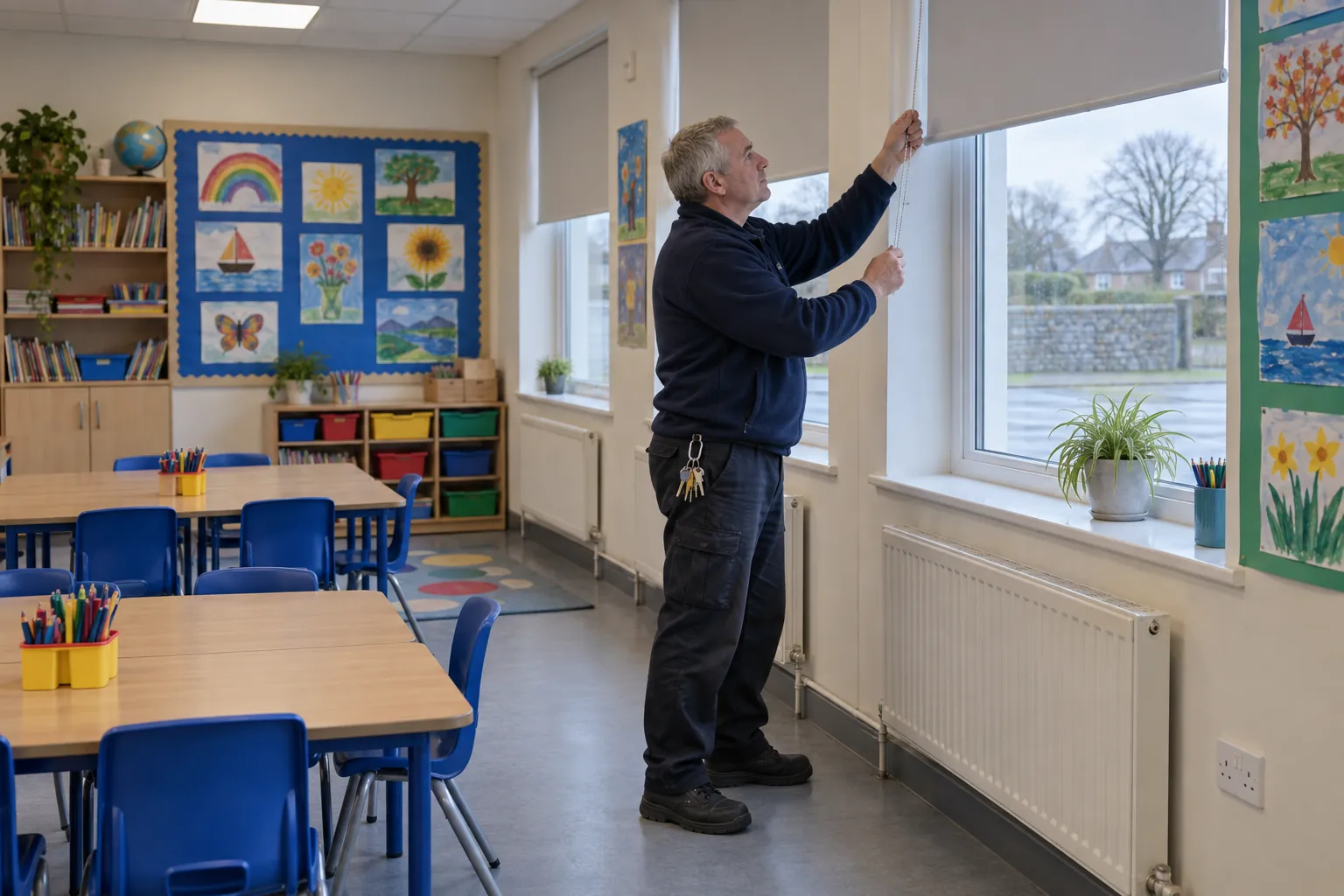
The caretaker is often the first to know when something is wrong. This guide covers caretaker duties in Ireland across schools, community and parish halls, offices and apartment developments: the Irish law the work carries out, the daily and weekly checks, working alone, Garda vetting, and how the work can be recorded so that it counts.
01
What a caretaker is, and the Irish law behind the job
A caretaker looks after a building and its grounds for whoever owns or runs it. In Ireland the title is used in schools, community centres and parish halls, churches, offices and apartment developments; elsewhere the same work is done by a porter, a facilities assistant or a maintenance person. Most of the legal duties behind the job belong to the employer or to whoever controls the premises. The caretaker is how they are carried out day to day.
The main duties behind the job in Ireland are these:
- Safety, Health and Welfare at Work Act 2005, section 8 requires every employer to ensure, so far as is reasonably practicable, the safety, health and welfare at work of employees, including maintaining the place of work "in a condition that is safe and without risk to health", safe means of access and egress, and "the information, instruction, training and supervision necessary".
- Section 12 of the 2005 Act extends the employer's duty to people who are not its employees, such as pupils, hall users, residents and visitors, and section 15 places a duty on anyone who has control of a non-domestic place of work used by people other than their own employees, or who must maintain or repair it under a contract, tenancy or licence, to ensure, so far as is reasonably practicable, that it and its means of access and egress are safe and without risk to health.
- Section 18 of the Fire Services Act 1981, as amended by section 29 of the Licensing of Indoor Events Act 2003, requires every person having control over premises it covers, which include schools, halls, premises open to the public and any workplace, to guard against the outbreak of fire, to provide reasonable fire safety measures and procedures, and to ensure they "are applied at all times".
- The Safety, Health and Welfare at Work (General Application) Regulations 2007 (S.I. No. 299 of 2007, as amended), covering the workplace itself, manual handling and work at height, and the Safety, Health and Welfare at Work (Chemical Agents) Regulations 2001 (S.I. No. 619 of 2001, as amended), for cleaning chemicals and de-icers.
Under section 13 of the 2005 Act the caretaker, as an employee, must take reasonable care of their own safety and that of others affected by what they do, co-operate with the employer, and attend the training the employer reasonably requires.
Caretakers in Ireland work for a school's board of management or an Education and Training Board, a parish, a community centre committee, a local authority, a facilities company, or, in an apartment development, the owners' management company or its managing agent. Whoever the employer is, the caretaker should have a written job description, training for its tasks, and a clear line for reporting problems. The employer's safety statement should say what the caretaker is responsible for: section 20 of the 2005 Act requires it to name each person responsible for tasks assigned under it.
02
Caretaker duties and responsibilities in practice
A caretaker's job description in Ireland usually includes most of the following:
- Opening and locking up: unlocking before the working day, a booking or a Mass, unsetting and setting the intruder alarm, checking windows, doors and gates at close, and keeping keys and fobs secure.
- Routine safety checks: escape routes clear, final exits openable, fire doors closing, the fire alarm panel showing normal, and anything unsafe taken out of use and reported.
- Cleaning: in a small building the caretaker may be the cleaner; in a larger one they cover between the cleaners' visits, dealing with spills, emptying bins, checking and restocking the toilets, and keeping entrances, steps and paths clear.
- Minor repairs: changing a lamp, tightening a hinge, clearing a blocked sink, adjusting a door closer, replacing a ceiling tile, and reporting anything bigger to the right contractor.
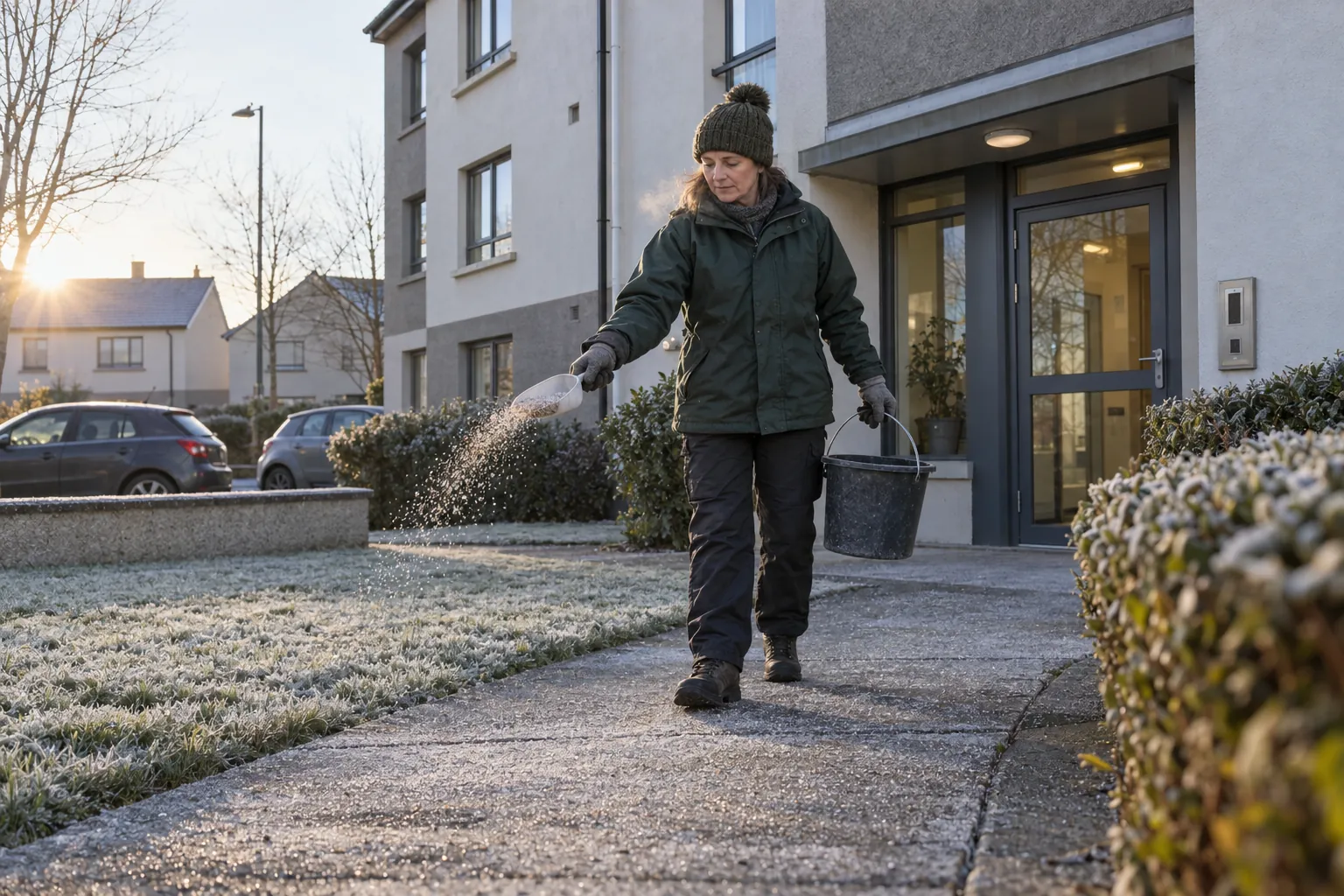
- Grounds: litter picking, sweeping, clearing leaves from gullies, and gritting paths and car parks in frost and snow.
- Security: watching for damage, graffiti or signs of a break-in, and acting as keyholder when the alarm goes off out of hours, where the job includes it.
- Setting up rooms: tables and chairs for classes, meetings, exams and hall bookings, and putting them away again.
- Contractors and deliveries: letting contractors in, showing them where they are working and the building's hazard information, including any asbestos survey.
- Waste: putting the bins out for collection, and keeping the bin store tidy and the recycling sorted.
What a caretaker should not do matters as much. Electrical work beyond changing a lamp or a plug fuse, gas work, work on the fire alarm or sprinklers beyond the routine user checks, and work at height without the right equipment and training belong to a competent person. The Health and Safety Authority's page on working at height counts working on a ladder as work at height, and Part 4 of the 2007 Regulations requires such work to be "properly planned, appropriately supervised" and risk assessed.
03
How the job differs from building to building
The core of caretaking is the same everywhere, but each kind of Irish building adds its own work.
- Schools: the caretaker opens early and closes late, works around the school day, after-school activities and lettings, and is part of the school's safeguarding arrangements. Much of the heavier work happens in the summer holidays, when classrooms are cleared and contractors are in.
- Community centres and parish halls: the day follows the bookings. The caretaker opens for each group, checks the hall, kitchen and toilets before and after, and locks up after an evening event. Many posts are part-time, and the committee or parish that controls the hall keeps the section 18 duty whoever does the work.
- Churches: the church, sacristy, parish centre and grounds, with heating, lighting and access arranged around Masses, funerals and weddings.
- Offices: the caretaker, often called a facilities assistant or porter, opens the building, sets up meeting rooms, handles deliveries and is the first person staff tell when something breaks.
- Apartment developments: the common areas belong to the owners' management company, and Citizens Information's page on management companies for apartment blocks explains that a property management agent, regulated by the Property Services Regulatory Authority, usually runs the day to day for the OMC's board. The caretaker cleans stairs, landings and lobbies, checks lights and entry doors, keeps escape routes clear of bikes and buggies, and reports repairs. The agent follows the board's instructions, and the caretaker follows the agent's or the contractor's.
Split shifts, with an early start and an evening return, are common in schools and halls, and many jobs include out-of-hours call-outs as keyholder.
04
The routine checks, and working alone safely
Much of a caretaker's value is in checks nobody notices while they are done. The Department of Housing, Local Government and Heritage's Fire Safety Guide for Building Owners and Operators (August 2023), written for persons having control under section 18(2), says that the person having control may delegate specific fire safety duties to staff but keeps overall responsibility for making sure they are done. It describes "general daily routines, such as checking the fire alarm panels and ensuring that escape routes are available for egress, and doors on escape routes are in working order", which can be done by people with a suitable level of training, and says plainly: "All escape routes should be checked on a daily basis." Those daily routines are very often the caretaker's.
A typical pattern, set by the building's risk assessment and fire safety arrangements, looks like this:
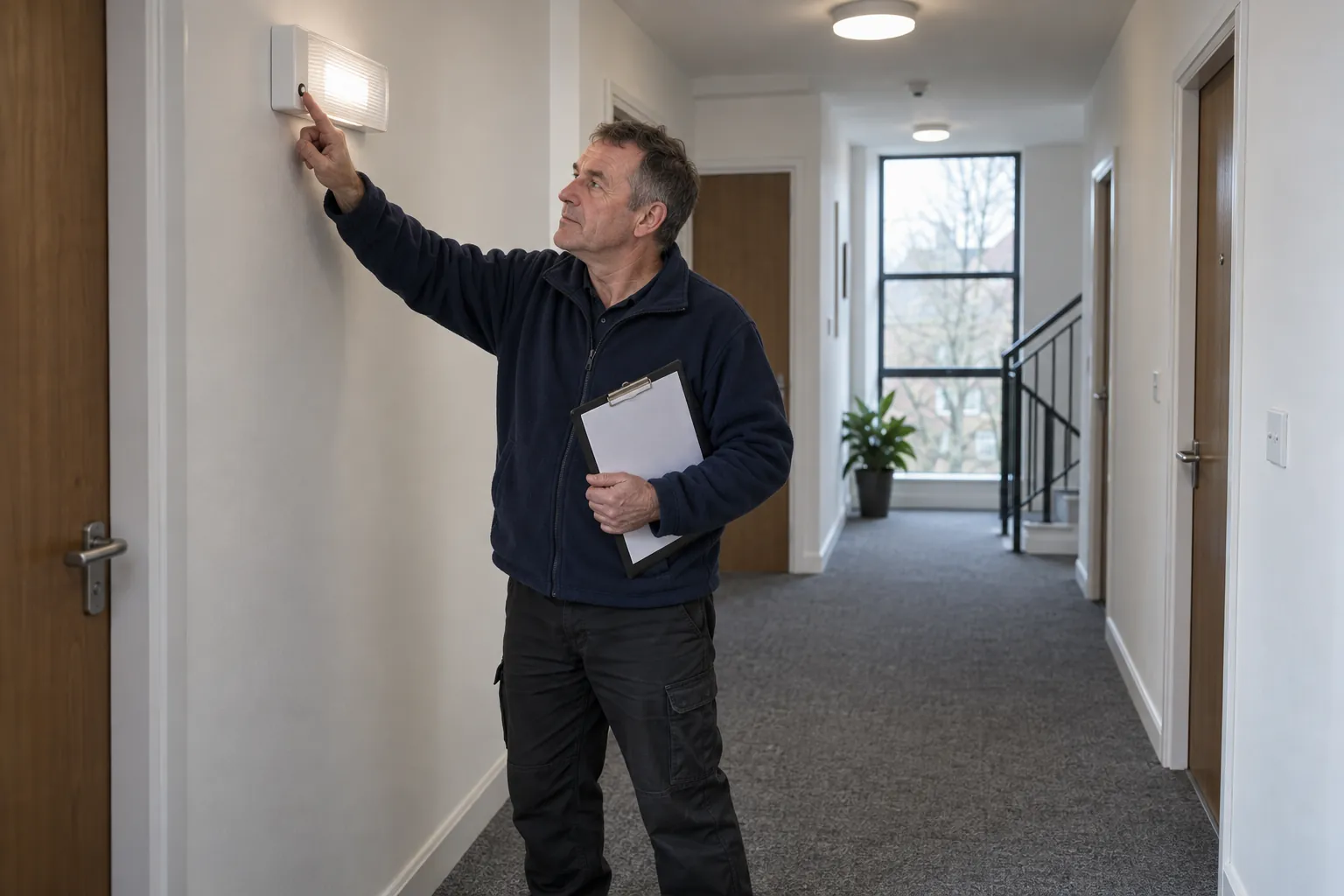
- Every opening: escape routes and final exits clear and openable, fire doors closed or on their hold-open devices, the fire alarm panel showing normal with any fault logged and acted on, the indicator on each emergency light fitting working, the building secure overnight, the toilets clean and stocked, and no obvious hazards such as a wet floor, a trailing lead or a broken paving slab.
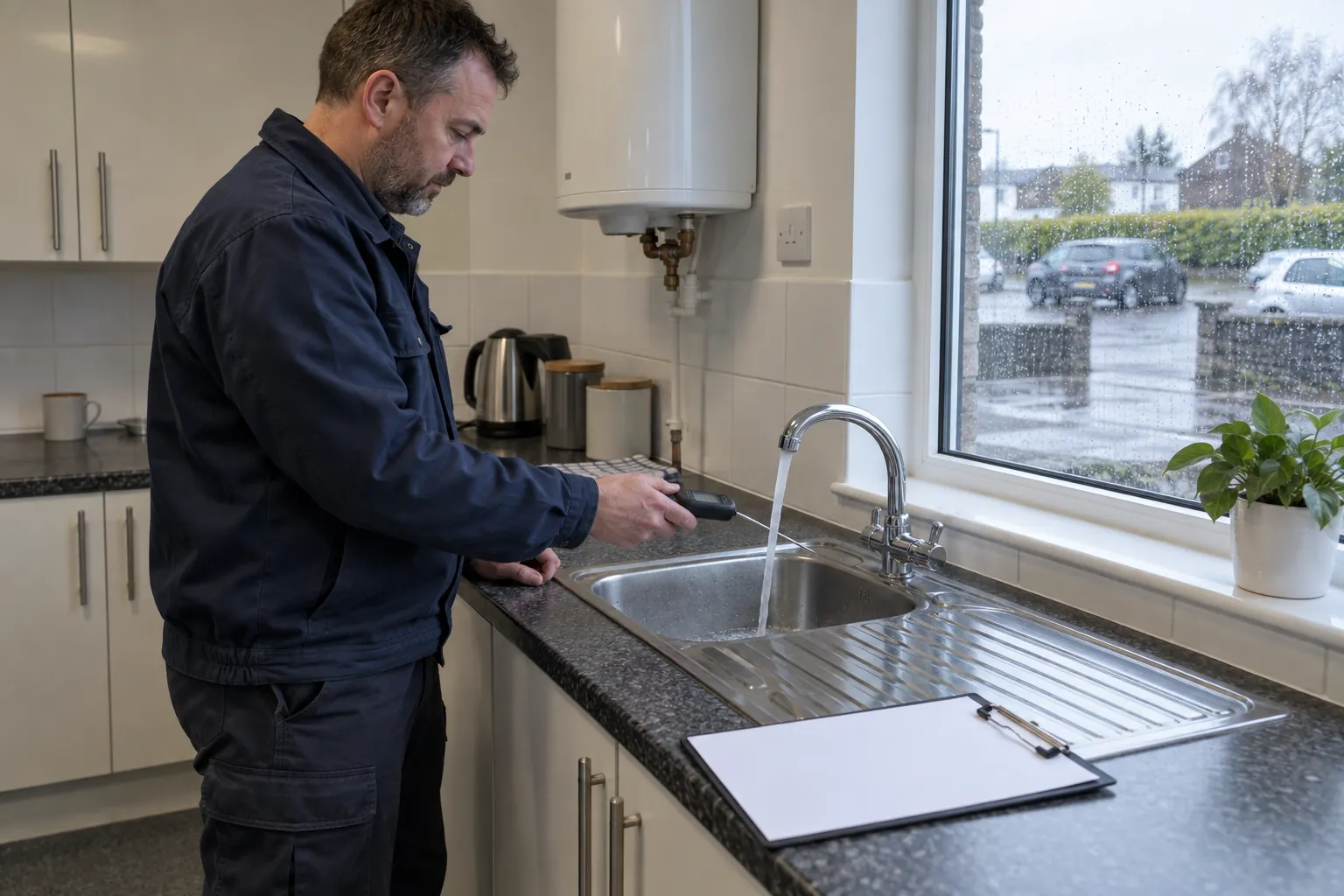
- Weekly: the fire alarm test, recording which call point or device was used, where the arrangements give it to the caretaker; flushing of little-used taps and showers, where the water risk assessment asks for it; a visual check of at least a quarter of the emergency light fittings, lamps lit and status indicators healthy, so that every fitting is seen at least every four weeks; and a walk round the outside for damage and rubbish.
- Monthly: the monthly emergency lighting inspection set out in I.S. 3217 and a check of every point where a fire extinguisher or hose reel is kept, where the caretaker has been given them, and water temperature checks where they are part of the water management plan.
- After every event or letting: the hall, kitchen and toilets left clean and safe, equipment put away, windows shut and the building locked.
The weekly flushing comes from the Health Protection Surveillance Centre's National Guidelines for the Control of Legionellosis in Ireland, 2009, which give intermittently used outlets a weekly flush for several minutes, avoiding the production of aerosols. Planned maintenance of the fire alarm, emergency lighting and sprinklers, to I.S. 3218, I.S. 3217 and I.S. EN 12845, is for a competent person; the caretaker's part is the routine user checks.
Caretakers often work alone, early, late or in the holidays. The Health and Safety Authority's page on lone workers says nothing in general legislation prohibits working alone, and names people "who work outside normal hours, e.g. cleaners, security, special production, maintenance or repair staff" among lone workers. The employer must assess the risk; the HSA's examples of controls include a mobile phone or radio, controlled periodic checks, automatic warning devices, training and first-aid provision, and it adds: "It should not be left to individuals to decide whether they require assistance." A caretaker should know which jobs, such as going up a ladder or lifting heavy items, wait until someone else is there.
05
Garda vetting, skills and a good record
Caretakers in schools, and in buildings used by children or vulnerable adults, should expect to be Garda vetted. The Department of Education's Circular 0031/2016, Commencement of Statutory Requirements for Garda Vetting, explains that since 29 April 2016 it has been a criminal offence, other than in certain limited circumstances, for a school authority to commence the employment of an employee without first obtaining a vetting disclosure from the National Vetting Bureau. For non-teaching staff the diocesan office, school management body or ETB handles the application, and a statutory declaration and form of undertaking is required before a teaching or non-teaching appointment of any duration. Outside schools, the National Vetting Bureau (Children and Vulnerable Persons) Act 2012, Schedule 1 sets out the relevant work that requires vetting.
Most caretaker posts are filled on practical experience rather than a particular qualification. Useful skills and training include manual handling, since much of the work is physical, safe use of ladders, chemical safety, fire safety awareness and first aid, and the personal qualities matter as much: reliability, organising your own day, clear communication with staff, users and contractors, and dealing calmly with whoever arrives with a problem.
A good caretaking record shows three things: that the routine checks were done, when and by whom; what was found and reported; and what happened to each report. Some of that record has a statutory home. The fire safety register is where the gov.ie guide expects fire safety checks, faults and maintenance to be written, as "a living document – with daily, weekly, monthly, quarterly and annual records", kept on the premises and available to an authorised officer of the fire authority. The guide adds that "faults should be entered in the fire safety register and corrected promptly". Reporting prescribed accidents and dangerous occurrences to the HSA is the employer's duty under section 8 of the 2005 Act, through its own process. The rest, the toilets checked, the leak reported, the paths gritted, is the caretaker's working record, and it protects the caretaker as much as the employer when something goes wrong.
06
Where the record fails, and what SiteClara does about it
Caretakers are often the most reliable people in a building and the worst recorded. The checks happen, but they are ticked on a sheet in the cleaners' store, written into the fire safety register at the end of the week from memory, or not written down at all. A leak reported to whoever was in the office may never reach the person who can fix it. When the principal or the OMC's board asks whether the building was checked, the caretaker's word is all there is.
SiteClara gives each check a place. A printed QR poster at each location, such as the main entrance, the hall kitchen, the toilets, a fire exit, the plant room door or the bin store, with an optional NFC tag behind it, lets the caretaker scan the code or tap the tag on their own phone, with no app to install. They see the checks due there and mark each one done, or say what stopped them, with a photo when it helps. A problem reported there goes onto the team's list of open jobs until someone closes it.
The supervisor, or whoever manages the caretaker, sees what is due, done and missed, and can escalate a job to the building manager, who can answer it. Each day the supervisor approves a short report, which goes to nominated contacts, such as the board of management, the managing agent or the client, the next morning, showing what was reported, what was completed, what is still open and how the scheduled checks went.
07
Questions people ask
What are some basic duties of a caretaker?
Taking care of the building and its contents, opening and locking up, keeping it clean and secure, and looking after the grounds. A typical Irish example is Mayo, Sligo and Leitrim ETB's Job Description – Caretaker, whose first duty is "to take care of the premises and contents and to prevent as far as possible, any damage to the structure, furniture, fittings and equipment". Its list goes on to opening and closing the buildings, keeping the premises, furniture and fittings clean, including the bathrooms "on a continual basis throughout the day", keeping the keys in safe custody so that no unauthorised person gets in, seeing to the heating and protecting the pipes in cold weather, setting out rooms and furniture, and keeping the grounds, paths and parking areas in good order. It also includes completing "relevant documentation as required under Health and Safety legislation", working in compliance with the safety statement, and "such similar duties as may be required".
What does a school caretaker do?
The same core duties, arranged around the school day. In Mayo, Sligo and Leitrim ETB's Candidate Information Booklet for a caretaker at Davitt College, Castlebar, the post is 39 hours a week, and the caretaker makes sure the school buildings are "safe and secure at the conclusion of classes, examinations or functions", supervises the canteen at meal times, controls the entry and exit of students, and has rooms ready at least half an hour before classes, examinations and school functions begin. The person specification asks for a Leaving Certificate standard of education or equivalent relevant experience, experience as a caretaker and good numeracy and literacy skills, and lists experience of general building maintenance, such as plumbing, carpentry, painting, decorating and gardening, and a qualification in health and safety as desirable.
What is the difference between a caretaker and a caregiver?
A caretaker looks after a building; a caregiver looks after a person. In Ireland a caregiver is usually called a carer: Citizens Information's page on Carer's Allowance describes the payment as going to people who care for someone because of their age, disability or illness, including mental illness. Caretaker duties are about premises, such as opening up, cleaning, security, minor repairs and routine checks, not personal care.
08
Further reading, and a list to take away
The Health and Safety Authority publishes guidance on lone working, working at height, manual handling and chemicals, and the Irish Statute Book holds the Acts and regulations named above. The Department of Housing's Fire Safety Guide for Building Owners and Operators sets out the routine fire checks and the fire safety register, with a section on buildings containing apartments. The HPSC's guidelines cover Legionella, and the Department of Education's circulars cover Garda vetting in schools.
If you are writing a caretaker job description in Ireland, or starting as a caretaker, check that you know:
- who your employer is, who has control of the building, and who you report problems to;
- which buildings and grounds you look after, and your hours, including evenings, holidays and call-outs;
- which routine checks are yours, how often, and where each is recorded, including what goes in the fire safety register;
- which repairs you may do yourself, and which go to a contractor or a competent person;
- where the safety statement, the asbestos information, the fire safety register and the emergency contacts are kept;
- the lone working arrangements, and which tasks wait until someone else is present;
- whether your post needs Garda vetting, and that it has been done before you start;
- how you show, at the end of the day, what you did and what is still outstanding.
Sources
Every document this guide quotes or links to, in the order it first cites them.
- Safety, Health and Welfare at Work Act 2005, section 8 irishstatutebook.ie
- Section 12 of the 2005 Act irishstatutebook.ie
- Section 15 irishstatutebook.ie
- Section 18 of the Fire Services Act 1981 irishstatutebook.ie
- Section 29 of the Licensing of Indoor Events Act 2003 irishstatutebook.ie
- Safety, Health and Welfare at Work (General Application) Regulations 2007 irishstatutebook.ie
- Safety, Health and Welfare at Work (Chemical Agents) Regulations 2001 irishstatutebook.ie
- Section 13 of the 2005 Act irishstatutebook.ie
- Section 20 of the 2005 Act irishstatutebook.ie
- Health and Safety Authority's page on working at height hsa.ie
- Citizens Information's page on management companies for apartment blocks citizensinformation.ie
- Fire Safety Guide for Building Owners and Operators assets.gov.ie
- National Guidelines for the Control of Legionellosis in Ireland, 2009 hpsc.ie
- Health and Safety Authority's page on lone workers hsa.ie
- Circular 0031/2016, Commencement of Statutory Requirements for Garda Vetting assets.gov.ie
- National Vetting Bureau (Children and Vulnerable Persons) Act 2012, Schedule 1 irishstatutebook.ie
- Job Description – Caretaker msletb.ie
- Candidate Information Booklet for a caretaker at Davitt College, Castlebar msletb.ie
- Carer's Allowance citizensinformation.ie
Related guides
 Premises and facilities managementBuilding maintenance checklist: what to check in an Irish building, how often, and who byA building maintenance checklist for non-domestic buildings in Ireland: daily to annual checks under the 2005 Act, the 2007 Regulations and the Fire Services Acts.
 Fire and water checksFire safety register: what to record, who keeps it and how to make it credibleWhat a fire safety register should hold under section 18(2) of the Fire Services Acts, the routine checks behind it, who keeps it, and what makes it credible.
 Premises and facilities managementOwners' management companies: what an OMC must do, and how to show the common areas are looked afterWhat an owners' management company (OMC) is under the Multi-Unit Developments Act 2011, what it must do, who does the work, and the records that show it was done.
 Fire and water checksLegionella checks in Ireland: the routine that keeps the water safe, and the record that shows itRoutine legionella checks in Irish buildings under the HPSC guidelines and HSA guidance: weekly flushing, monthly temperatures, who does them and what to record.