Premises and facilities management
Building maintenance checklist: what to check in an Irish building, how often, and who by
A building maintenance checklist is a schedule of the routine tasks that keep a building's fabric, systems and grounds safe and working, inside and out, with each check given a frequency and a person responsible, from the daily walk-round to the annual inspections by a competent person.
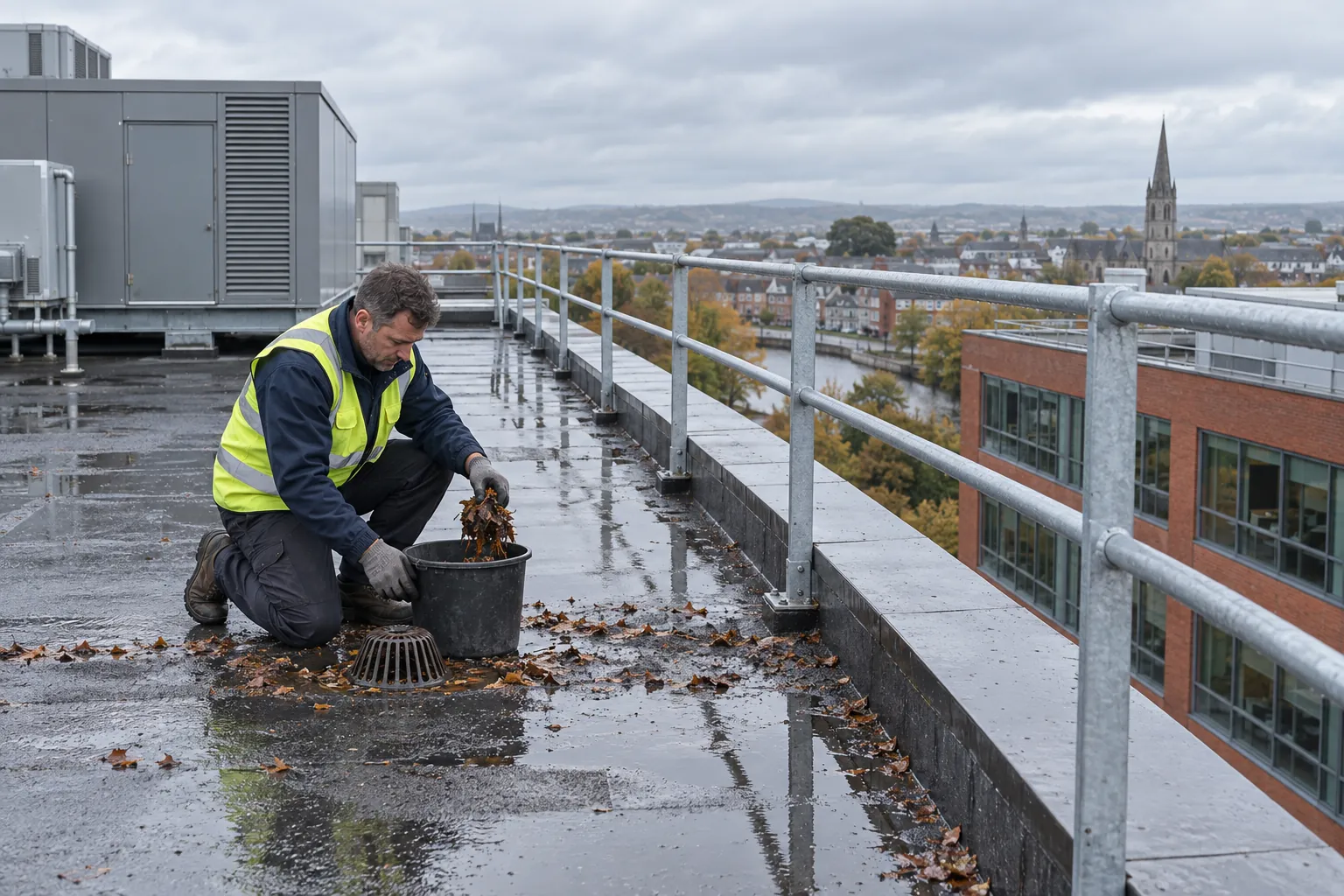
In Ireland it turns the general duty to keep a place of work safe into specific checks on specific days. This one is written for offices, schools, shops, health centres, community buildings and the common areas of apartment blocks. It follows the Safety, Health and Welfare at Work Act 2005, the General Application Regulations 2007 and the Fire Services Acts, and marks the items that need a competent person rather than the caretaker or site team.
01
The duty behind a building maintenance checklist in Ireland
The general duty is in section 8 of the Safety, Health and Welfare at Work Act 2005. As regards the place of work, the employer must ensure, so far as is reasonably practicable, "the design, provision and maintenance of it in a condition that is safe and without risk to health", and the same for safe access and egress and for plant and machinery.
The duty is not only the employer's. Under section 15 of the 2005 Act, a person who has control to any extent of a non-domestic place of work made available to others, and anyone who by contract, tenancy or licence has an obligation to maintain or repair it, must ensure so far as is reasonably practicable that it and its means of access and egress are safe and without risk to health. That is how a landlord or an owners' management company (OMC) with common areas that others work in comes to have maintenance duties of its own.
The detail is in the Safety, Health and Welfare at Work (General Application) Regulations 2007 (S.I. No. 299 of 2007). Part 2, Chapter 1 covers the workplace, including forced ventilation "maintained in working order" (regulation 6), a minimum of 17.5°C for sedentary office work after the first hour, so far as is reasonably practicable (regulation 7), emergency routes and exits kept clear and exit doors never locked against easy and immediate opening (regulation 12), and fire detection and fire-fighting equipment "inspected and maintained as frequently as necessary" and "serviced by a competent person as frequently as necessary" (regulation 13). Regulation 18 requires every place of work to be kept in a clean state, and regulation 20 requires sanitary and washing facilities to be provided, maintained and kept clean.
Fire safety adds a second duty. Section 18 of the Fire Services Act 1981, as amended by section 29 of the Licensing of Indoor Events Act 2003 (together the Fire Services Acts 1981 and 2003), requires every person having control over premises to which it applies, which since 2003 include any workplace, to provide reasonable fire safety measures and procedures and to "ensure that the fire safety measures and procedures ... are applied at all times". A building maintenance checklist is the everyday form of both duties, and the record that the checks were done.
02
What a building maintenance checklist covers
Most of a building maintenance checklist is preventive maintenance: routine checks that find problems early, before they become breakdowns or hazards. A complete checklist for a non-domestic building in Ireland covers four areas, the exterior as well as the interior:
- Building fabric: roofs, gutters and downpipes, external walls and render, windows and doors, floors, ceilings, stairs and handrails.
- Building services: heating and hot water, ventilation and air conditioning (HVAC), plumbing, cold water storage and distribution, drainage, the electrical installation, lighting, and lifts.
- Fire safety and life safety systems: the fire detection and alarm system, emergency lighting, fire doors and hold-open devices, fire extinguishers and hose reels, and, where fitted, sprinklers, dry or wet risers, smoke control and a standby generator.
- Grounds: paths, car parks, external lighting, gates and fences, gullies and drains, bin stores, and the areas around final exits and fire hydrants.
The checks split into two kinds, and the Department of Housing, Local Government and Heritage's Fire Safety Guide for Building Owners and Operators (August 2023) draws the same line for fire equipment. Many daily, weekly and monthly activities "can be carried out without expert knowledge of the equipment or system"; the quarterly, six-monthly and yearly activities "should be carried out by persons who have competency in their specific areas and can provide certification". In the lists below, items marked (CP) need a competent person. The rest are for a trained caretaker, facilities operative or member of staff named as the designated person.
Who owns the checklist depends on the building. Where one organisation occupies a building, it is usually the facilities or premises manager. In a multi-let office, the landlord or its managing agent usually looks after the common parts and central plant, and each tenant looks after its own space, as the lease sets out. In an apartment block the OMC is responsible for the common areas and usually appoints a managing agent to run them; the agent acts for the OMC, it does not take its place. Whoever it is, the checklist should name them.
03
Daily and weekly checks
Daily, usually as a walk-round at opening:
- escape routes clear, not used for storage, and final exit doors capable of being readily opened;
- fire alarm control panel showing normal operation, or any fault logged and acted on, and yesterday's fault attended to, as the fire guide sets out for I.S. 3218;
- fire doors on escape routes closed, not wedged; doors on automatic hold-open devices released daily, as the guide recommends;
- emergency light fittings showing their healthy indicator;
- floors, entrances and stairs free of slip and trip hazards, including wet entrances in bad weather;
- toilets and washrooms working, clean and stocked, with no leaks or blockages;
- heating and ventilation keeping occupied rooms comfortable, and the 17.5°C office minimum met after the first hour;
- lifts in service, with any fault reported to the lift contractor;
- external doors, gates and windows secure at close, and bins kept away from the building.
Weekly:
- fire alarm test, confirming the panel receives a fire signal and starts the evacuation procedure, and recording which call point or device was used (see the fire alarm testing guide);
- standby batteries of the fire alarm in good condition, and fuel, oil and coolant levels of any standby generator correct;
- emergency lighting: the guide's reading of I.S. 3217 is a visual check of at least 25% of the system each week, so the whole system is checked at least every four weeks (see the emergency lighting testing guide);
- smoke control, where fitted: actuation simulated once a week and the fans, dampers and vents seen to operate;
- little-used taps and showers run through, where the legionella risk assessment calls for it;
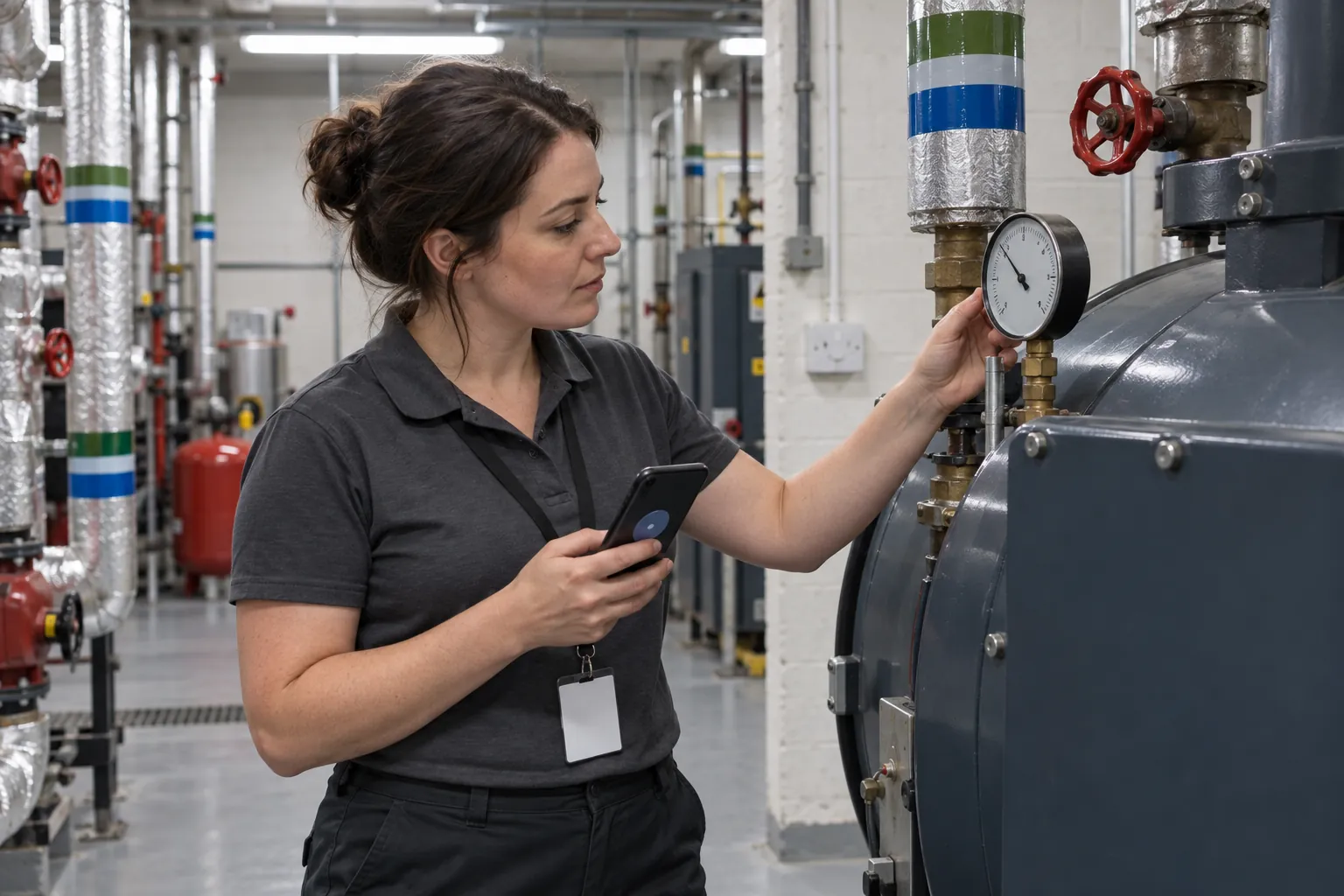
- plant rooms walked for leaks, noises, smells and alarms, and kept free of storage;
- external areas: paths, car park, external lighting, gates, and access to final exits and hydrants.
These are the checks most often done without a record. A walk-round that finds nothing wrong is still worth recording, because it shows the check happened.
04
Monthly and quarterly checks
Monthly:
- fire extinguisher and hose reel points checked, and anything missing replaced at once; hose reels visually inspected for leaks and a drum that turns freely (see the fire extinguisher checks guide);
- automatic hold-open devices tested by simulating mains failure or a fire alarm signal, with the result recorded;
- standby generator started by simulating failure of the normal supply and run for at least an hour, then the starting battery charging checked;
- hot and cold water temperatures at sentinel taps: the National Guidelines for the Control of Legionellosis in Ireland, 2009 give cold below 20°C after running for up to two minutes, and hot at least 50°C within one minute;
- panic and emergency exit devices on escape doors inspected and operated, which the guide sets at intervals of not more than a month under I.S. EN 1125;
- doors, closers, locks and ironmongery on main routes;
- roofs, gutters and gullies looked at for damage and blockages from the ground or a safe viewpoint, more often in autumn and after a storm;
- fire exit and safety signs in place and legible.
Quarterly:
- showerheads and hoses dismantled, cleaned and descaled, which the HPSC guidelines give as quarterly or more often on a risk assessment, and monthly in high-risk areas;
- emergency showers and eye wash sprays flushed through, quarterly or as the manufacturer recommends;
- emergency lighting quarterly inspection and test (CP), with a report placed in the emergency lighting logbook;
- smoke control: every zone actuated and tested every three months (CP where the system needs it);
- external fabric walked: walls, render, windows, sealants and any cladding; internally, ceiling tiles for stains that suggest a leak;
- a review of repeat faults that need a planned fix rather than another call-out.
Build the seasonal jobs into the quarter they belong to: gutters and gullies after leaf fall, heating checked before the first cold spell, and grit ready for paths and car parks in winter.
05
Six-monthly, annual and longer, and the competent person items
Most of these are for a competent person; the site team makes sure each is booked, attended and certified, and that defects are put right.
- Lifts (CP): the HSA's safety alert on passenger and goods lifts says lifts "must have a periodic thorough examination by a competent person every 6 months", with the reports kept for an inspector and a register of lifting equipment maintained, as Part B of Schedule 1 to the 2007 Regulations sets for a hoist or lift.
- Fire doors: inspected six-monthly under the fire guide's schedule, or biennially for apartment entrance doors: the leaf free from distortion and damage, a consistent 3mm gap to the frame, the closer closing the door onto its latch, intumescent seals in place, and at least three hinges with every screw fitted. See the fire door inspection guide.
- Fire detection and alarm system (CP): periodic inspection and servicing to I.S. 3218, with a test and servicing certificate issued each time.
- Sprinklers (CP): the weekly, monthly, quarterly and half-yearly inspections and tests in I.S. EN 12845 for commercial systems, which the fire guide assigns to a competent person.
- Emergency lighting (CP): the annual inspection and a test of every system to its full rated duration, under I.S. 3217.
- Fire extinguishers and hose reels (CP): extinguishers maintained to I.S. 291 at intervals not exceeding 12 months, plus or minus one; hose reels maintained annually to I.S. EN 671-3, and pressurised to maximum working pressure every five years.
- Water systems (CP for the risk assessment): calorifiers and cold water storage tanks inspected annually, incoming cold water temperature taken in winter and summer, and the legionella risk assessment kept under review. Cooling towers have their own regime; see the HSA's information sheet on legionella control in water cooling towers.
- Asbestos (CP): the HSA's asbestos FAQs say any workplace built before 2004 needs an asbestos risk assessment, a management survey and an asbestos management plan, and that the condition of asbestos in place "should be checked by a competent person on an annual basis".
- Electrical installation (CP): regulation 89(b), as substituted by the General Application (Amendment) Regulations 2007 (S.I. No. 732 of 2007), requires an existing installation to be tested by a competent person "from time to time where required having regard to the nature, location and use of the installation", or when an inspector requires, with a report. The fire guide points to I.S. 10101 for electrical installations and I.S. 820 for non-domestic gas installations.
- Work equipment and portable equipment (CP): under regulation 30, equipment exposed to conditions causing deterioration has periodic inspections, recorded and kept for five years; under regulation 81, portable equipment above 125 volts in such conditions is checked by the user before use and periodically inspected by a competent person.
Over the longer term, a condition survey every few years feeds a plan for the big items, the roof, windows, lifts and boilers, so that major repairs are planned and their costs budgeted rather than met as emergencies. In an apartment block these are what the sinking fund is for: section 19 of the Multi-Unit Developments Act 2011 requires an OMC to keep one for refurbishment, improvement and "maintenance of a non-recurring nature", while section 18 makes the annual service charge cover ongoing maintenance and repair of the common areas.
Alterations are a separate matter. Material alterations, extensions and changes of use fall under the Building Control Act 1990 and the building regulations made under it, and may need a fire safety certificate, which approves a design and is not a maintenance record. For the statutory side in more detail, see the building compliance checklist.
06
Where the checklist fails, and what SiteClara does about it
The competent person items usually have good records, because the contractor leaves a certificate. It is the routine checks that fail: a checklist printed in January and ticked in batches on a Friday, a caretaker who mentions a dripping valve in the plant room to whoever is passing, a fire door found wedged on Tuesday that nobody writes down. When the fire officer asks, nobody can say when the check was last done, or by whom.
SiteClara records those routine checks where they happen. A printed QR poster at each location, such as a plant room, a fire exit, a stair core or a washroom, with an optional NFC tag behind it, lets the caretaker or facilities operative scan the code or tap the tag with their own phone, with no app to install. They see the checks due there and mark each one done, or say what stopped them, with a photo when one is asked for. A fault found on the round, such as a leak or a failed emergency light, goes onto the team's list of jobs until someone closes it, and the supervisor can escalate it to the building manager, who can answer it.
The supervisor sees what was due, done and missed, and records the reason for anything missed. Each day they approve a report that goes the next morning to nominated managers or client contacts, such as the facilities manager, the managing agent or the OMC's directors: what was reported, completed and still open, and how the scheduled checks went, for example 12 of 12 completed.
07
Questions people ask
What is included in a building maintenance checklist?
For a place of work in Ireland, the checklist follows the duty in section 8 of the Safety, Health and Welfare at Work Act 2005: the maintenance of the place of work "in a condition that is safe and without risk to health", of "safe means of access to and egress from it", and of plant and machinery. In practice that means the building fabric, the building services, the fire and life safety systems and the grounds, each check with a frequency and a named person.
What does building maintenance consist of?
Two kinds of work. The Department of Housing, Local Government and Heritage's Fire Safety Guide for Building Owners and Operators divides its maintenance schedule into "Regular Checks to be carried out by designated person" and "Planned inspection and maintenance to be carried out by a competent person". Many of the daily, weekly and monthly activities can be done "without expert knowledge of the equipment or system"; the quarterly, bi-annual and yearly ones should be carried out by someone who can "provide certification to the relevant standard for the work carried out".
Is there a free building maintenance checklist template for Ireland?
For fire and life safety systems, yes. Table 2 of the Fire Safety Guide for Building Owners and Operators, a free PDF from the Department, is a "Maintenance Programme Schedule for Buildings" set out as daily, weekly, monthly, quarterly, bi-annual and annual activities, and its Appendix J has an emergency lighting log sheet and check list and a portable fire extinguisher check sheet. It does not cover the fabric, heating, water or grounds, so add those from your own risk assessments and the manufacturers' instructions.
08
Further reading, and a list to take away
The Health and Safety Authority publishes guidance on the 2005 Act and the 2007 Regulations. The Department of Housing, Local Government and Heritage publishes the Fire Safety Guide for Building Owners and Operators, whose Table 2 is a maintenance schedule for fire and life safety systems from daily to yearly. The HPSC publishes the National Guidelines for the Control of Legionellosis in Ireland. The Irish Standards named here, including I.S. 3218, I.S. 3217, I.S. 291 and I.S. 10101, are published by NSAI.
Before you adopt a building maintenance checklist, check that:
- each check has a frequency, taken from a risk assessment, an Irish Standard, the fire guide or the manufacturer;
- competent person items are marked, booked, certified and tracked to completion;
- each check names who is responsible, including where an OMC and its managing agent share the work;
- faults found on a check have a route to someone who will fix them;
- the daily and weekly checks are recorded, not only the annual ones, and fire checks reach the fire safety register;
- it is reviewed when the building, its use or its equipment changes.
Sources
Every document this guide quotes or links to, in the order it first cites them.
- Section 8 of the Safety, Health and Welfare at Work Act 2005 irishstatutebook.ie
- Section 15 of the 2005 Act irishstatutebook.ie
- Safety, Health and Welfare at Work (General Application) Regulations 2007 (S.I. No. 299 of 2007) irishstatutebook.ie
- Section 18 of the Fire Services Act 1981 irishstatutebook.ie
- Section 29 of the Licensing of Indoor Events Act 2003 irishstatutebook.ie
- Fire Safety Guide for Building Owners and Operators (August 2023) gov.ie
- National Guidelines for the Control of Legionellosis in Ireland, 2009 hpsc.ie
- Safety alert on passenger and goods lifts hsa.ie
- Information sheet on legionella control in water cooling towers hsa.ie
- Asbestos FAQs hsa.ie
- General Application (Amendment) Regulations 2007 (S.I. No. 732 of 2007) irishstatutebook.ie
- Multi-Unit Developments Act 2011 irishstatutebook.ie
- Building Control Act 1990 irishstatutebook.ie
- Fire Safety Guide for Building Owners and Operators assets.gov.ie
Related guides
 Premises and facilities managementBuilding compliance checklist: the statutory picture for a building in IrelandBuilding compliance checklist for non-domestic buildings in Ireland: fire, electrical, gas, water, asbestos, lifts, energy and access, who holds each duty and when.
 Premises and facilities managementCaretaker duties in Ireland: what the job involves, and how to show it was doneCaretaker duties in Irish schools, parish halls, offices and apartment developments: the law behind the job, the daily and weekly checks, lone working and records.
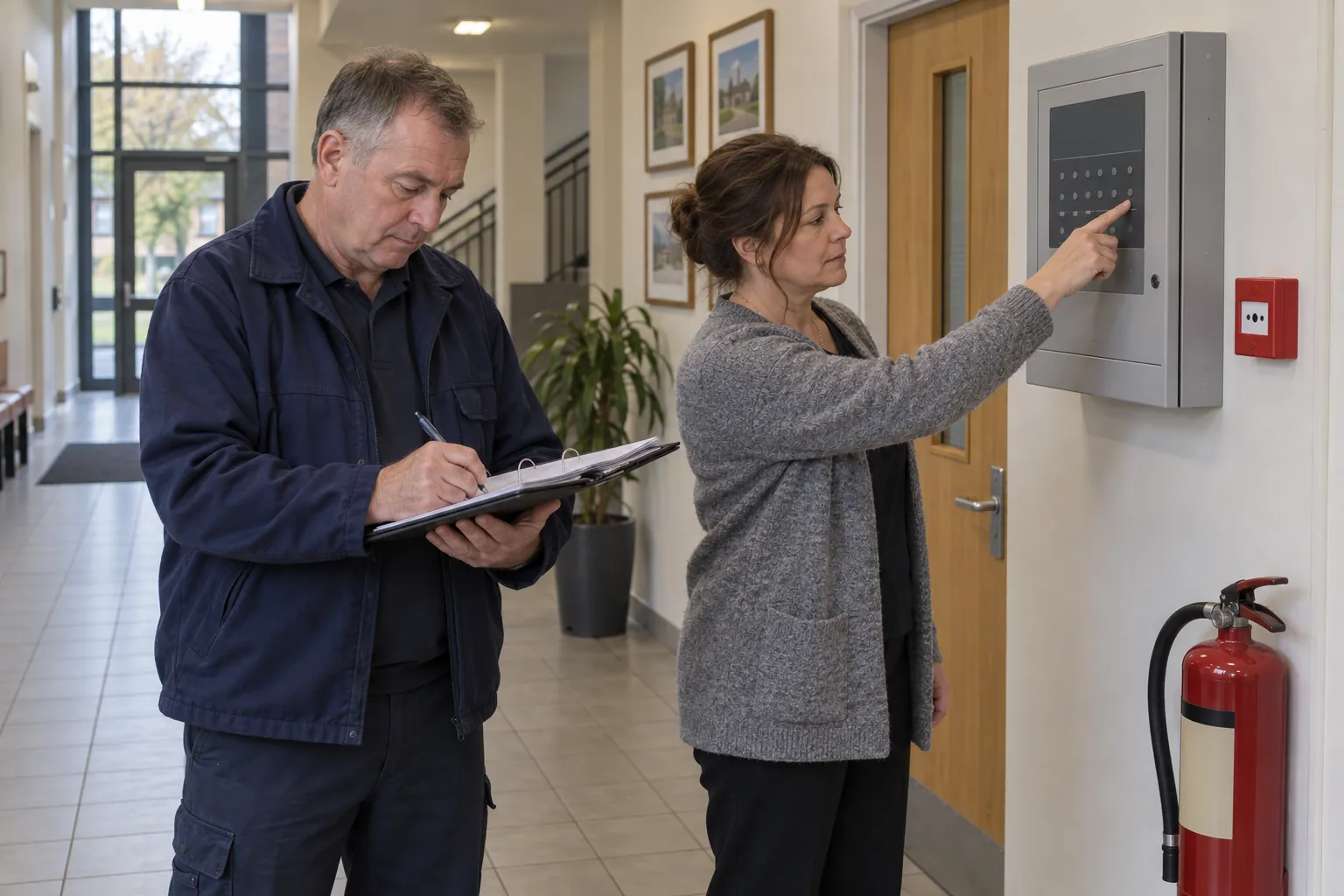 Fire and water checksFire safety register: what to record, who keeps it and how to make it credibleWhat a fire safety register should hold under section 18(2) of the Fire Services Acts, the routine checks behind it, who keeps it, and what makes it credible.
 Premises and facilities managementFacilities management report: what to include, and what makes it believableWhat a facilities management report in Ireland should contain: the duties behind it, the fire safety register, statutory checks, OMC reporting and believable KPIs.