Fire and water checks
Fire door inspection: the compliance schedule checks, the IQP and the owner's part
A fire door inspection in New Zealand is a check that each fire door and smoke control door on a building's escape routes still closes, latches and seals as it should, carried out at the intervals the building's compliance schedule sets so the building can keep its warrant of fitness.
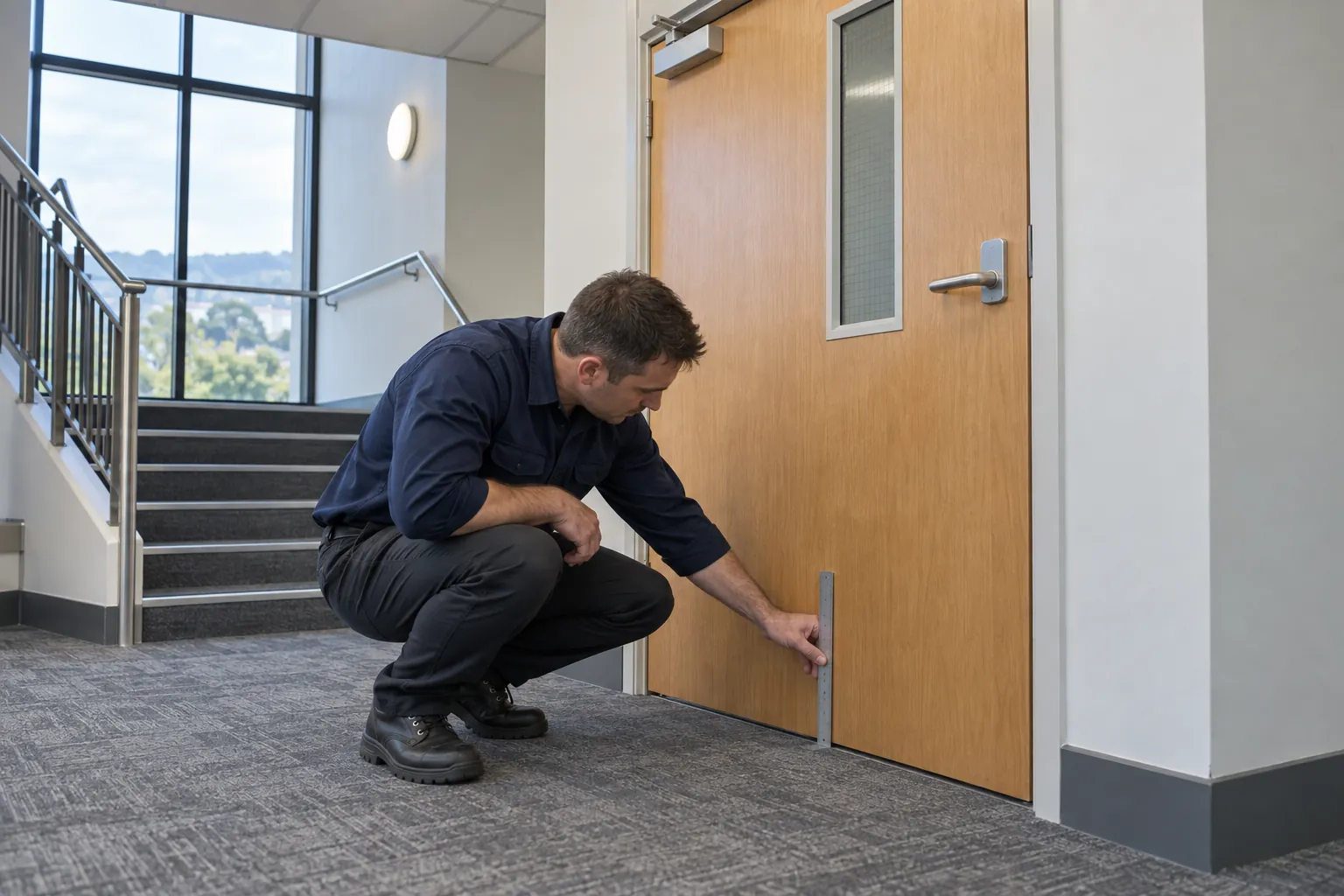
In a building with a compliance schedule, a fire door is usually part of a specified system: a fire or smoke separation on the means of escape. Some of those inspections are quick visual checks the owner's own people can make; the detailed ones fall to an independent qualified person. This guide explains what the schedule asks for, how often, who does what, and what to do with the findings.
01
What a fire door is in New Zealand, and the duties behind its inspection
MBIE's Acceptable Solution C/AS2 (second edition, effective 28 July 2025), which covers protection from fire for buildings other than risk group SH, defines a fire door as "a doorset, single or multi-leaf, having a specific fire resistance rating, and in certain situations a smoke control capability, and forming part of a fire separation." It adds: "The door, in the event of fire, if not already closed, will close automatically and be self-latching." A smoke control door is "a doorset, single or multi-leaf, having smoke control capability and forming part of a smoke separation." C/AS2 requires every fire door and smoke control door leaf to be self-closing, except in the few places it allows otherwise.
A door built that way only keeps working if somebody checks it. In New Zealand that duty runs through the Building Act 2004 and the building's compliance schedule. MBIE's page on specified systems and compliance schedules lists the systems that put a building on a schedule, including "electromagnetic or automatic doors or windows (for example, ones that close on fire alarm activation)" and, among the means of escape, fire separations and smoke separations. It is plain about who answers for them: "It is the responsibility of the building owner to ensure the specified systems continue to perform as was intended."
MBIE's Compliance Schedule Handbook (amendment 3, February 2014) shows where fire doors sit:
- SS 15/3 Fire separations, listed where the separation "forms part of the means of escape from fire which contains one or more of the specified systems 1–6, 9 and 13". Its first example is a "fire door forming part of a fire separation".
- SS 15/5 Smoke separations, on the same condition, with "a smoke stop door" among the examples.
- SS 3/3 Interfaced fire or smoke doors or windows, for a door "designed to open or close on the activation of the building emergency warning system or detection device", such as one on an electromagnetic door holder, which may also fall under SS 15/3 or SS 15/5.
So in a building with an alarm or sprinklers, the fire doors on the escape routes are usually on the schedule. The owner must see that every procedure on it is carried out, and each year supplies the council with a building warrant of fitness. As MBIE's page on managing your BWoF puts it, the owner must display a copy "in an area of the building where it can be seen by all building users".
The Health and Safety at Work Act 2015 sits alongside the Building Act. WorkSafe's property management FAQs say that "a commercial property owner/landlord is a Person Conducting a Business or Undertaking (PCBU)", and that a property manager with management and control of the property has "the duty to ensure the property (if it's a workplace) is without risks to health and safety." A fire door wedged open on a stair is both.
02
What a fire door inspection covers
Each building's compliance schedule sets the procedures. The handbook gives the minimum it expects where the schedule's standard says nothing more, in two levels.
The daily and monthly inspection is visual. Fire separations that bound exitways are looked at for:
- signs of damage or deterioration that could weaken their fire resistance, "particularly with respect to closures, exposed fire-stopping and surface finish";
- new penetrations without suitable fire-stopping;
- doors forming part of an escape route that are locked, barred or blocked, and so cannot be opened.
The six-monthly and annual inspection goes door by door. The handbook's minimum checks for fire separations, "when appropriate to the installation", are that:
- doors are not damaged or obstructed;
- door leaves or fire shutters close and latch automatically from any position;
- double-acting and double-leaf doors stop with the leaves in line with the frame, with the seals in contact where they are fitted;
- door leaves on self-closers shut with an acceptable maximum closing force (the handbook points to Building Code clause D1.3.4(f));
- hardware is securely fixed, and no unauthorised hardware is attached;
- fire doors in exitways can be opened without keys, so people can get out at all times;
- fire door to frame clearances comply with NZS 4232, or as reasonably practicable where the door was legally installed to an earlier standard;
- the manufacturer's label is on the leaf or shutter and the frame, where the door was installed to that standard;
- doors are not kept open by anything other than hold-open devices that comply with the Building Code and are in good working order;
- doors have not been moved without suitable fire separation in the ceiling space;
- the separations themselves are not damaged, and have no new penetrations without fire-stopping.
SS 15/5 repeats most of this for smoke separations, and adds that smoke control door seals, where fitted, "are intact and provide continuous contact". For an SS 3/3 door on a magnetic hold-open, the annual checks add the fail-safe operation in a power cut, the manual release and the connection to the building's emergency warning system.
03
How often fire doors are inspected
The frequency is whatever the building's compliance schedule says, and the schedule follows the standard the doors were installed to. Where that standard is silent, the handbook sets a minimum for SS 15/3 and SS 15/5:
- daily, when the building is in use, for crowd occupancies (which the handbook, written before the current acceptable solutions, lists as CS, CL, CO and CM), and for any building where building work is happening that may affect a fire or smoke separation;
- six-monthly, for crowd occupancies;
- monthly and annually, for all other occupancies.
For SS 3/3 doors, the handbook's daily and monthly check is that the doors are not locked, barred or blocked, with the fail-safe, manual release and alarm connection checked annually.
Read the schedule, not a rule of thumb: it is the document the IQP certifies against.
Some events call for a look outside the cycle:
- a tenant's fit-out or any building work near a fire separation, which moves the handbook's minimum to daily for the duration;
- a door, closer or lock replaced, or hardware added;
- the same door found wedged open, or failing to latch, week after week;
- a change to the means of escape. Fire and Emergency New Zealand's page on maintaining an evacuation scheme lists an alteration to the means of escape from fire as something an owner with an approved scheme must tell them about.
04
Who inspects fire doors: the owner's people and the IQP
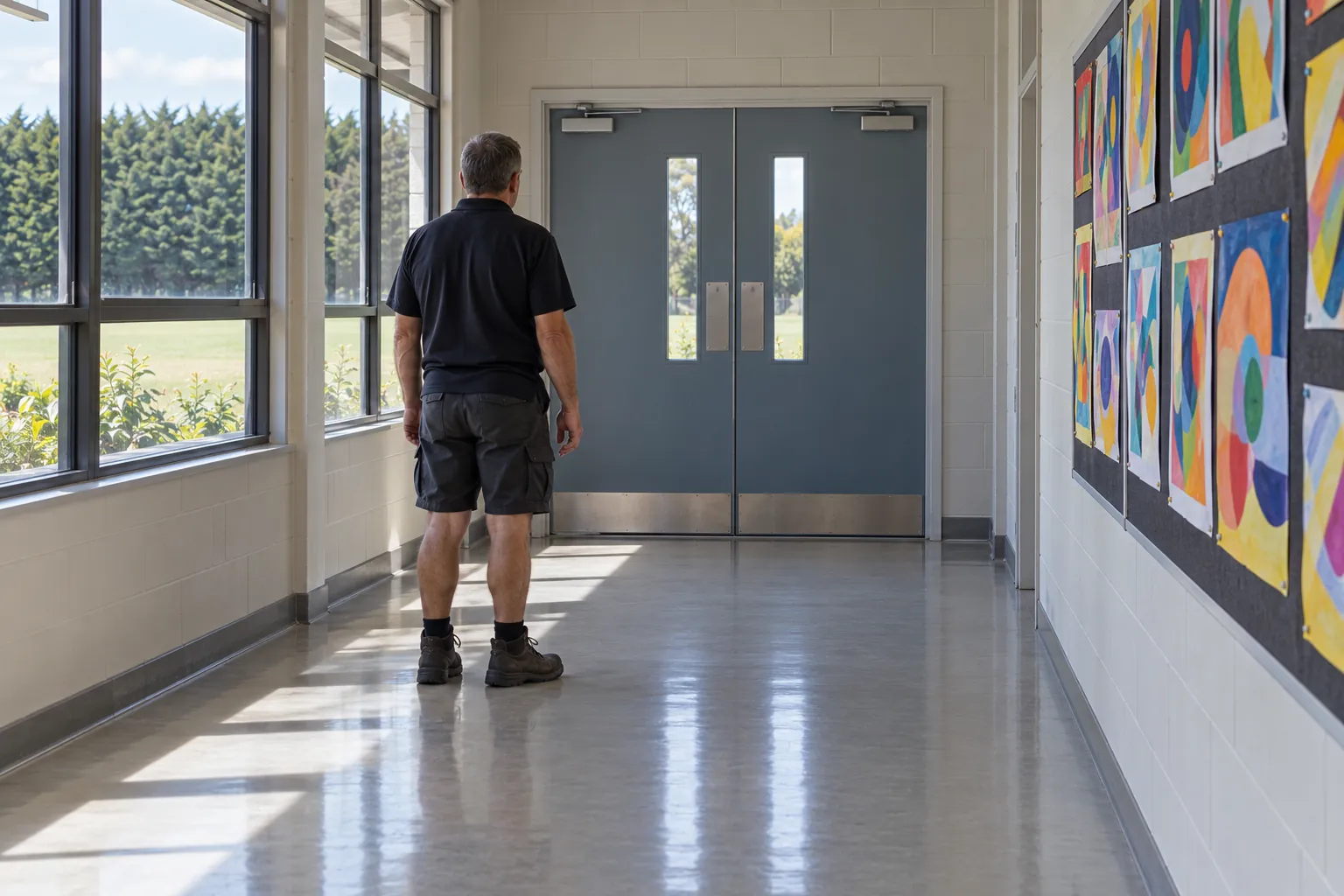
MBIE's page on inspection and maintenance of specified systems describes the usual division. The compliance schedule typically gives "the more complex inspection and maintenance procedures to be carried out by an IQP", while the owner may handle "some less complex and more frequent inspection tasks." For fire doors, that often means the daily or monthly visual walk is the owner's, carried out by a caretaker, a facilities team, a cleaning or security contractor or a body corporate's building manager, and the six-monthly or annual door-by-door inspection is the IQP's. The schedule for each building says which is which.
An independent qualified person (IQP) is, in MBIE's words, "a person (or firm) approved by the territorial authority as qualified to inspect certain specified systems and ensure that necessary maintenance occurs". Independent means no financial interest in the building. At the end of the year the IQP issues a Form 12A, which MBIE describes as certifying that "the inspection, maintenance and reporting procedures of the compliance schedule have been carried out for the previous 12 months." Without it there is no BWoF.
The standards behind the doors matter to the IQP. MBIE's Building Product Specifications (first edition, amendment 1, effective 2 April 2026) require fire doors to comply with AS 1905.1:2015 Sections 1 to 5 or NZS 4520:2010, and their markings and labels to comply with NZS 4520:2010 Section 6, so that "doorsets shall be clearly marked to show their FRR and, if used as a smoke control door, to show their smoke stopping capability." A fire resistance rating is written as -/xx/yy, the integrity and insulation ratings in minutes, so a -/60/- door has a 60-minute integrity rating. It notes that NZS 4520:2010 Section 7 is an example of inspection, maintenance and reporting provisions for fire doors as a specified system.
When you engage or review an IQP for fire separations, ask:
- whether the council has approved them for the specified systems that cover your doors, SS 15/3 and SS 15/5, and SS 3/3 if you have magnetic hold-opens;
- which inspections on the schedule they will carry out, and which they expect your own people or contractors to do;
- what records of the routine checks they will need to see before they sign the Form 12A;
- whether their report lists each door by reference and location, with the defects found.
05
The records, and putting defects right
The Building Act puts record keeping on the owner, although the handbook accepts that the IQP may keep records on the owner's behalf. MBIE says owners must "obtain and keep reports detailing inspections, maintenance and repairs" for at least two years after they are issued. The handbook's example reporting statement asks for records of all inspection, maintenance and repairs in the previous 24 months, including:
- the details of each inspection, test or preventative maintenance, with the date, the work done, the faults found, the remedy applied and the person who did it;
- the details of any other fault found or repair made to keep the system working, with the same particulars.
That applies to the monthly walk as much as to the IQP's visit.
The handbook's maintenance clause for fire separations is "responsive maintenance": remedy any defect the inspections find. List each defect with a door reference and a priority: a door on an escape route that will not close and latch needs putting right straight away.
Repairs and replacements should keep the door within what it was tested and certified to be:
- a replacement fire door should comply with AS 1905.1:2015 or NZS 4520:2010 and carry the marking and labels that standard requires;
- under C/AS2, self-closers must be adjustable after installation, and the force to open a fire door or smoke control door on an escape route must not exceed 67 N to release the latch, 133 N to set the door in motion and 67 N to open it to the minimum required width;
- doorsets between firecells and vertical safe paths or protected shafts need smoke seals on all edges, with limited exceptions such as the sill;
- new hardware should be of a kind the door's certification allows.
06
Where the record fails, and what SiteClara does about it
The annual inspection is rarely the problem. The gap is the monthly walk in between, which the schedule leaves to the owner and the owner hands on to a caretaker, a cleaner or a security patrol. The sheet in the riser cupboard is signed for the whole quarter in one sitting. The stair door wedged open every morning for deliveries is found by the IQP, not by the person meant to check it. At the anniversary, nobody can show the IQP that every monthly check happened, and the Form 12A waits.
SiteClara records those routine checks at the door. A printed QR poster, with an optional NFC tag behind it, goes by each fire door or group of doors on the walk. Staff scan the code or tap the tag with their own phone, with no app to install, see the checks due there and mark each one done, or say what stopped them. The time and the named person are recorded as it happens, with a photo when the check asks for one. A fault, such as a closer that no longer latches, a missing seal or a door chocked open, is reported there with a photo and goes onto the team's list of open jobs until someone closes it.
The supervisor sees what is due, done and missed across the building, records the reason a check was missed, and approves a daily report that goes to nominated contacts the next morning. Where a cleaning or security company does the owner's monthly walk in a building a property manager runs, both can read the same record.
07
Questions people ask
Do fire doors need to be inspected?
Yes, where they are part of a building's specified systems. MBIE's page on specified systems and compliance schedules says any building other than a single residential building needs a compliance schedule if it contains specified systems, and lists fire separations, smoke separations and electromagnetic or automatic doors among them; the owner must ensure the systems are "regularly tested, maintained, and reported as per the compliance schedule", including some inspections by independent qualified persons. MBIE's Compliance Schedule Handbook gives a "fire door forming part of a fire separation" as the first example of specified system SS 15/3, where the separation forms part of the means of escape from fire.
How is a fire door inspection carried out?
Door by door, against the procedures in the building's compliance schedule. Where the schedule's standard says nothing more, MBIE's Compliance Schedule Handbook lists the minimum six-monthly and annual checks for SS 15/3 fire separations: the door is not damaged or obstructed; the leaf closes and latches automatically from any position; double-acting and double-leaf doors stop in line with the frame, with any seals fitted in contact; closers shut with an acceptable maximum force; hardware is securely fixed and nothing unauthorised is attached; the door opens without a key; the door to frame clearances comply with NZS 4232; the manufacturer's label is on the leaf and the frame; and the door is not held open by anything but a compliant hold-open device in good working order. The daily or monthly check in between is visual: damage, new penetrations without fire-stopping, and escape doors that are locked, barred or blocked.
What are the regulations for fire doors in New Zealand?
Three documents do most of the work. Under the Building Act 2004, a fire door in a fire or smoke separation on the means of escape usually goes on the building's compliance schedule, and MBIE's page on specified systems and compliance schedules says "it is the responsibility of the building owner to ensure the specified systems continue to perform as was intended when they were installed." Acceptable Solution C/AS2, for buildings other than risk group SH, sets the design rules, including that "all fire door and smoke control door leaves shall be self-closing" except where its Subsection 4.5.1 allows otherwise. MBIE's Building Product Specifications require fire doors to comply with AS 1905.1:2015 Sections 1 to 5 or NZS 4520:2010, with marking and labelling to NZS 4520:2010 Section 6.
What are the requirements of a fire door?
Acceptable Solution C/AS2 defines a fire door as "a doorset, single or multi-leaf, having a specific fire resistance rating, and in certain situations a smoke control capability, and forming part of a fire separation", which in a fire "will close automatically and be self-latching." Subsection 8.3.1 of MBIE's Building Product Specifications requires a fire door to be evaluated in circumstances representative of its use in service and to comply with AS 1905.1:2015 Sections 1 to 5 or NZS 4520:2010, with fire resisting glazing that has the same integrity value as the door, and says doorsets "shall be clearly marked to show their FRR and, if used as a smoke control door, to show their smoke stopping capability." A door marked -/60/- has a 60-minute integrity rating.
08
Further reading, and a list to take away
Start with MBIE's pages on specified systems and compliance schedules and inspection and maintenance of specified systems. The Compliance Schedule Handbook sets out SS 3/3, SS 15/3 and SS 15/5 in full. The design requirements for fire doors are in Acceptable Solution C/AS2, with the other acceptable solutions and verification methods listed on MBIE's page for Building Code clauses C1 to C6 (protection from fire), and the product requirements in the Building Product Specifications. NZS 4520:2010, AS 1905.1:2015 and NZS 4232 are available from Standards New Zealand. Your council administers compliance schedules and BWoFs and approves IQPs for your district.
For the fire doors in a building with a compliance schedule, check that:
- every fire door and smoke control door on an escape route is identified, with a reference and a location, and covered by the schedule under SS 15/3, SS 15/5 or SS 3/3;
- you know which checks fall to the IQP and which to the owner's named person or contractor, and how often;
- each check leaves a dated record of who did it, what they found and what was put right, kept for at least two years;
- defects go onto a list with priorities and are closed when repaired, with replacement doors and hardware kept within the door's certification;
- building work near fire separations is watched daily while it lasts, and any change to the means of escape is reported where your evacuation scheme requires it;
- the IQP has the records well before the BWoF anniversary.
Sources
Every document this guide quotes or links to, in the order it first cites them.
- Acceptable Solution C/AS2 building.govt.nz
- Specified systems and compliance schedules building.govt.nz
- Compliance Schedule Handbook building.govt.nz
- Managing your BWoF building.govt.nz
- Property management FAQs worksafe.govt.nz
- Maintaining an evacuation scheme fireandemergency.nz
- Inspection and maintenance of specified systems building.govt.nz
- Building Product Specifications building.govt.nz
- Building Code clauses C1 to C6 (protection from fire) building.govt.nz
Related guides
 Fire and water checksThe compliance schedule: what it lists, and how to keep a building to itWhat a New Zealand compliance schedule lists, which buildings need one, how it is issued and amended, who does the checks and the records behind every BWoF.
 Fire and water checksIQPs and specified systems: who inspects what, and what the owner must keepWhat an IQP is, the specified systems SS 1 to SS 16, how to engage IQPs, what they inspect and what is left to the owner, and how the Form 12A works in New Zealand.
 Fire and water checksThe building warrant of fitness: what a New Zealand owner signs each year, and how to make it trueWhat a New Zealand building warrant of fitness declares, who signs it, the Form 12 and Form 12A cycle, the records behind it, and the checks that keep it true.
 Fire and water checksFire evacuation scheme: which buildings need one, and how to keep it workingWhich New Zealand buildings need an approved fire evacuation scheme, what it contains, how it is kept up with trial evacuations or training, and what to tell FENZ.