Fire and water checks
Fire evacuation scheme: which buildings need one, and how to keep it working
A fire evacuation scheme is a plan, approved by Fire and Emergency New Zealand (FENZ), for getting everyone out of a building in a reasonable time if there is a fire or a fire alarm, and in New Zealand the owner of a building where 100 or more people gather, 10 or more work or 6 or more sleep usually needs one.

The scheme is more than a document lodged once: it has to be kept up with trial evacuations or a training programme, reported within 10 working days, and FENZ has to be told when the building changes. This guide explains which buildings need a scheme, how to develop one and what goes in it, how it is maintained, and the everyday checks that decide whether it works on the day.
01
What a fire evacuation scheme is, and where the duty comes from
FENZ's page on evacuation schemes and procedures defines an evacuation scheme as "a plan that is designed to enable evacuation from the scene of a fire in a reasonable time, in the event of a fire, or an alarm of fire". In practice it is the building's agreed answer to four questions: how people will be warned, how they will get out, where they will go, and who will help the people who cannot get out on their own.
The duty sits in two places. Section 75 of the Fire and Emergency New Zealand Act 2017 sets out which buildings are "relevant buildings" that must have an approved scheme. The detail is in the Fire and Emergency New Zealand (Fire Safety, Evacuation Procedures, and Evacuation Schemes) Regulations 2018 (LI 2018/96), in force since 1 July 2018. Part 1 of the Regulations applies to buildings generally; Part 2 covers evacuation schemes.
Two Part 1 duties matter, scheme or not. Regulation 5 requires the owner and every tenant to maintain the means of escape from fire: escape routes kept clear of obstacles at all times, exit doors unlocked and free of barriers so occupants can leave in a fire emergency, smoke-control and fire-stop doors kept closed unless held open in a way that complies with the building code, and stairwells and passageways free of stored items and accumulated waste. Regulation 7 requires the owner of most buildings used by the public to have an evacuation procedure for the safe, prompt and efficient evacuation of the building's occupants in a fire emergency.
The scheme is the owner's responsibility. FENZ puts it plainly: "The owner of a relevant building must submit the proposed evacuation scheme to Fire and Emergency for approval." The owner may nominate a contact person to apply and to handle the reports, and in a multi-tenanted office block or a body corporate that is often the property manager or body corporate manager. The duty stays with the owner.
02
Which buildings need an approved evacuation scheme
FENZ's guide to preparing a draft evacuation scheme summarises the relevant buildings under section 75. A building needs a scheme if it is used for any of these purposes:
- the gathering together of 100 or more people, such as a hall, a church, a cinema, a shopping centre or a large café;
- providing employment facilities for 10 or more people, which takes in most offices, warehouses, retail stores and schools;
- providing accommodation for 6 or more people, other than in 3 or fewer household units, such as student halls, backpackers, hotels and boarding houses;
- storing or using hazardous substances above certain quantities;
- early childhood education, medical, nursing, geriatric or disability care services, unless the building is a normal home (a household unit);
- prisons and holding cells.
The criteria describe how the building is used, and the scheme is the building owner's, so in a shared building one scheme covers every tenant, however small each tenant is.
There is one common exception. FENZ says an owner of a relevant building "is not required to provide or maintain an evacuation scheme" if the building is used for employment facilities for 10 or more people, accommodation for 6 or more people (other than in 3 or fewer households), or both, has an automatic sprinkler system that complies with NZS 4515:2003, NZS 4541:2007, NZS 4515:2009, NZS 4541:2013 or NZS 4515:2020, and the owner notifies Fire and Emergency that a scheme is not required. The notification is part of the exception: a sprinklered building whose owner never told FENZ has not used it. FENZ's evacuation scheme application guide adds that the exception applies only where the building is used for nothing but those two purposes, so a sprinklered building that is also used for, say, gatherings of 100 or more still needs a scheme.
A building that uses the sprinkler exception still needs an evacuation procedure under Part 1 of the Regulations, as do most other buildings used by the public that fall outside section 75; both still have to keep its means of escape clear under regulation 5, and each PCBU working in it still needs an emergency plan. WorkSafe's page on workplace emergency plans says a plan must include evacuation procedures, procedures for notifying emergency services at the earliest opportunity, plans for testing the procedures and how often, and the training workers will get, and that emergency plans "should be tested at least yearly".
03
What goes in the scheme, and how it is approved
FENZ's draft scheme guide lists what an application must describe. It follows Schedule 4 of the Regulations:
- the building's evacuation procedure, which will be supplied to occupants: what to do on discovering a fire, and what to do on hearing the alarm;
- copies of the fire action signs and notices displayed in the building;
- the places of safety, where they are and how they are reached, whether an assembly point outside or a protected place of safety inside;
- the firefighting equipment, if the building has any, such as extinguishers and hose reels;
- the automatic sprinkler system, if there is one;
- the fire alarm, or other means of warning occupants of a fire;
- the provision for people requiring particular assistance, such as people with disabilities or limited mobility, and any equipment for helping them;
- how the scheme will be maintained, by trial evacuations or by an evacuation training programme, and how often.
Write the procedure for the building as it is used, not as it was drawn. The parts that fail are rarely the alarm:
- Wardens. The Act and Regulations do not require wardens, but where the scheme uses them, name a warden and a deputy for each floor or area; the warden is on leave on the day that matters.
- People needing assistance. The scheme says what support they get and who gives it; the building needs a way of knowing who is in today.
- After-hours occupants. Cleaners, security officers and contractors at night are occupants too, and the procedure has to work with no wardens present.
- Tenants. Each tenant's staff follow the owner's scheme and share the regulation 5 duty to keep escape routes clear. Tell each new tenant.
Guidance for your own building's warden roles is in our guide to fire warden duties.
04
Keeping the scheme approved: trial evacuations and training programmes
An approved scheme has to be maintained, and the maintenance is what most owners are measured on. FENZ's guide Maintaining Approved Evacuation Schemes says schemes "need regular maintenance", either by completing trial evacuations or by the training and assessments of an evacuation training programme, at the frequency chosen in section 4 of the application: "either 6-monthly or more often".
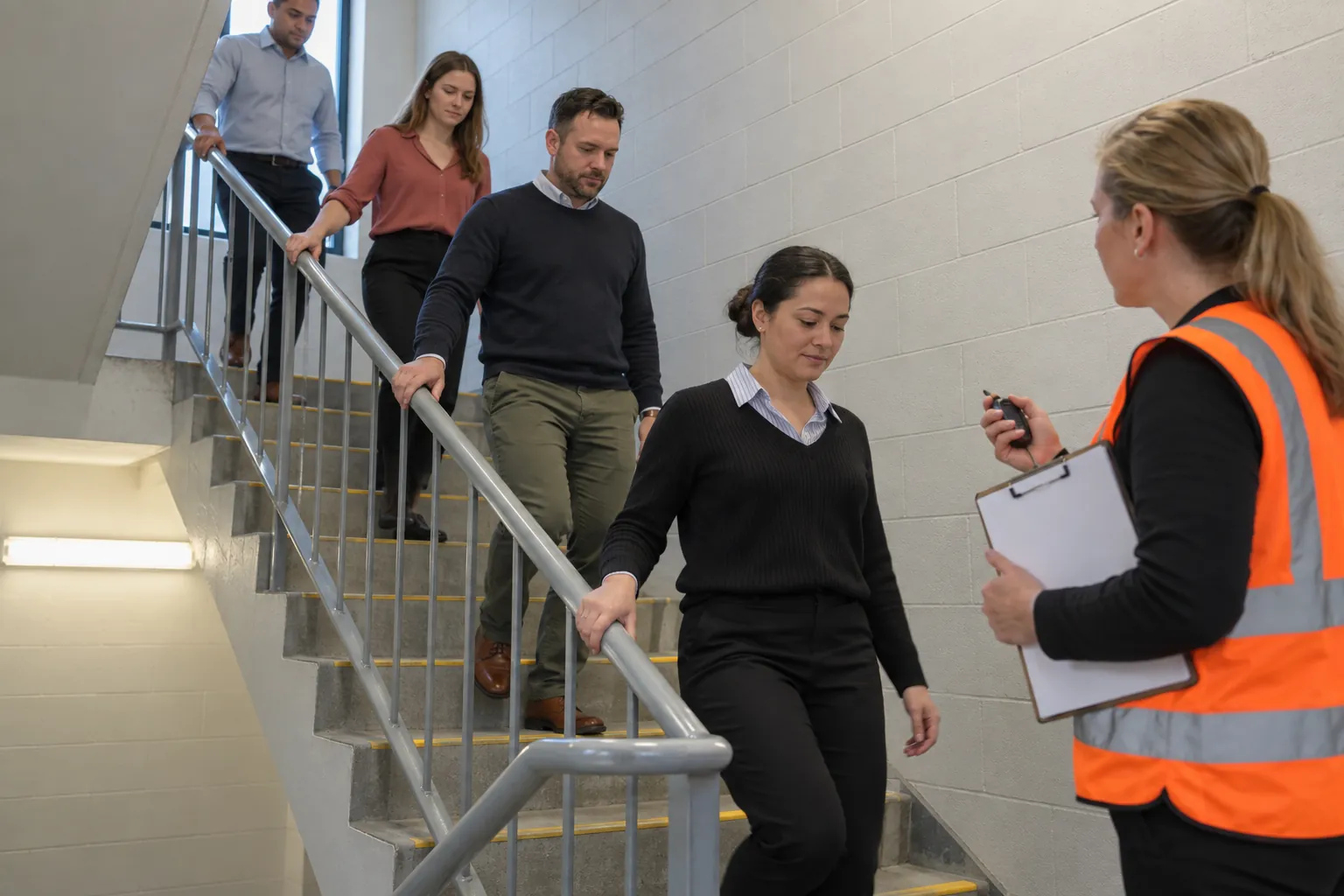
- Trial evacuations. The same guide says trials are held as set in section 4 of the approved application, at least every six months, and that the trial "should be a surprise to staff and occupants and resemble a real emergency as closely as possible". Call the Fire Communications Centre 10 to 15 minutes before and again straight after, time the evacuation, and check that everyone reached the place of safety and people needing assistance were supported.
- Evacuation training programmes. Available for buildings other than early childhood centres and educational institutions. Permanent occupants are trained and assessed at intervals of not more than six months, and the report is accompanied by the training content and the assessment results, which FENZ says could be signed acknowledgements from participants or a list of those who passed.
- Schools and early childhood centres. These hold trial evacuations at intervals of not more than six months. The Ministry of Education's page on school fire evacuation and fire alarm or sprinkler system shutdowns tells schools to "hold trial evacuations every 6 months".
Either way, the report goes to FENZ's Regulatory Compliance Group within 10 working days of the trial or the training, online or on the printed form. FENZ recommends holding a trial two to three weeks before it is due, to leave room to move it.
A real evacuation counts too. FENZ says false alarms and actual fire emergencies "can be treated as trial evacuations", but only if a report of the evacuation is provided to FENZ. Reported within 10 working days, one moves the next trial's due date. Unreported, it does not count, and the building still owes its trial. The practical detail of running one, from the scenario to the debrief, is in our guide to the trial evacuation.
05
Changes to tell FENZ about, and the everyday checks between trials
A scheme is approved for the building as it was described. When the building changes, FENZ needs to know. Its maintenance guide lists, among others, these events to notify in writing, using the Notification of building changes form:
- any time the building's fire detection and suppression systems are non-operational;
- building work that significantly affects the means of escape, or alterations to the means of escape;
- the building's life being extended;
- changes in occupancy that leave the means of escape no longer adequate;
- changes to the places of safety in the scheme;
- a change of purpose or of the activities in the building;
- the building no longer needing a scheme.
FENZ must also be told if the nominated contact person will be overseas for 21 consecutive days or more, with the dates and an alternative contact, and when the contact person changes.
Fire alarm and sprinkler shutdowns are the change that happens most often. For schools, the Ministry of Education says the contractor completes a shutdown notice saying what it is for, how long it lasts and which buildings are affected, that the notice goes to the property advisor, the alarm monitoring company, FENZ's Regulatory Compliance Group and the insurers, and that the school must "have a plan for how you will alert the areas of the school affected by the shutdown if there is an emergency". Any building owner facing a shutdown needs the same thinking.
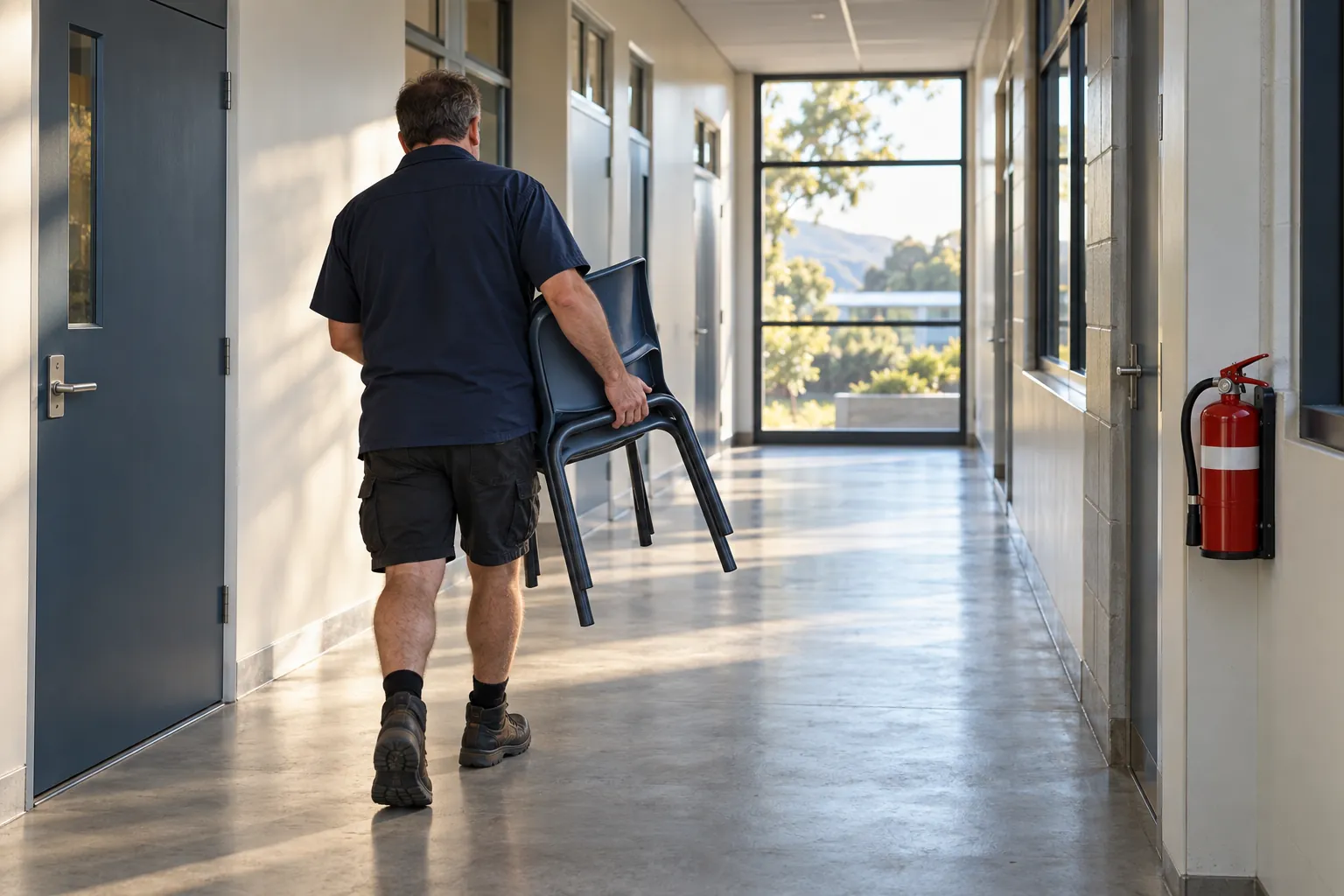
Between trials, the scheme depends on things nobody reports to FENZ: escape routes clear this morning, exit doors openable from inside, fire doors shut, the place of safety not turned into a builder's compound. These are the regulation 5 duties, checked by the people in the building every day: the caretaker on the morning unlock, the cleaners on their round, the security officer on the evening lock-up. Make them named checks at named places, with a time.
The fire systems themselves are a separate regime: alarms, sprinklers and emergency lighting are specified systems on the building's compliance schedule, inspected by independent qualified persons and certified each year in the building warrant of fitness. A trial evacuation is not a test of their maintenance.
06
Where the record fails, and what SiteClara does about it
The trial evacuation report is usually in order, because FENZ chases it. The record that fails is the everyday one. The escape route check on the plant room door is initialled for the week on Monday. The pallet in the rear exit corridor was mentioned to whoever was passing, and was still there on the day of the trial. Asked how the owner knows the means of escape are kept clear, there is nothing to show but good intentions.
SiteClara records the checks at the location. A printed QR poster, with an optional NFC tag behind it, sits at each place a check is scheduled, such as a stairwell door, a rear exit corridor or an assembly point. Staff scan or tap on their own phone, with no app to install, see the checks due there, and mark each one done or explain what stopped them. The time and the named person are recorded as it happens, with a photo when one is asked for, so a clear exit on a Tuesday morning is a record, not an assumption. A blocked exit reported at the location goes onto the team's list of open jobs until someone closes it.
The supervisor sees what is due, done and missed, records the reason a check was missed, and approves a daily report that goes to nominated management or client contacts the next morning, showing what was reported, what was completed and what is still open. Where a cleaning or security company does the morning and evening rounds in a building the property manager looks after, both read the same record, which is useful evidence when the scheme's contact person is preparing a trial or answering a question from FENZ.
07
Questions people ask
What is a fire evacuation scheme?
FENZ's page on evacuation schemes and procedures defines it as "a plan that is designed to enable evacuation from the scene of a fire in a reasonable time, in the event of a fire, or an alarm of fire". A relevant building needs one approved by FENZ. Most other buildings used by the public need an evacuation procedure instead, which the same page says "describes how occupants will escape to a place of safety in a safe, prompt and efficient manner if there is a fire, or an alarm of fire".
How do I apply for an evacuation scheme approval?
FENZ's page on how to apply for an evacuation scheme approval says the building owner can apply or nominate a contact person to complete the application on their behalf. The easiest way is online, logging in with RealMe, which is also where the scheme is managed afterwards; a paper form can be emailed or posted instead, and the Regulatory Compliance Group supplies it on 0800 734 2667. There is no charge to apply. FENZ has 20 working days to decide, which it can extend once by up to 10 working days if it needs more information or a trial evacuation, and an owner whose proposed scheme is not approved must amend it and reapply within 20 working days of receiving the notice.
How do I develop a fire evacuation plan for the scheme?
FENZ's guide to preparing a draft evacuation scheme says to create your own draft before starting the application, including the building's evacuation procedure, which will be supplied to occupants. The draft covers the requirements listed earlier in this guide, from fire action signs and places of safety to the provision for people requiring particular assistance and how the scheme will be maintained.
Is there an evacuation scheme template for New Zealand buildings?
FENZ's evacuation schemes and procedures pages offer example application forms and supporting documents for common kinds of building, including apartments, childcare facilities, churches, marae, medical centres, motels, offices, rest homes, schools and sports clubs. Use one as a starting point and write the procedure for your own building as it is used.
How do I report a trial evacuation?
FENZ's guidance on maintaining your scheme says to complete an online trial evacuation report within 10 working days of the trial, or otherwise advise Fire and Emergency in writing of the result. An evacuation for a real fire or an alarm of fire can be treated as a trial if FENZ receives the completed report within the same 10 working days.
08
Further reading, and a list to take away
Start with FENZ's evacuation schemes and procedures pages, its page on the regulations for evacuation schemes, and its guide Maintaining Approved Evacuation Schemes. The law is section 75 of the Fire and Emergency New Zealand Act 2017 and the Fire and Emergency New Zealand (Fire Safety, Evacuation Procedures, and Evacuation Schemes) Regulations 2018 on legislation.govt.nz. Schools should also read the Ministry of Education's page on school fire evacuation and fire alarm or sprinkler system shutdowns, and every PCBU WorkSafe's page on workplace emergency plans.
For a building with an evacuation scheme, check that:
- you know whether the building is a relevant building, and if you rely on the sprinkler exception, that FENZ was notified;
- the approved scheme describes the building as it is used today, including its places of safety and its tenants;
- the nominated contact person is current, and their reminders reach someone who acts on them;
- there is a plan for each person who needs particular assistance;
- trial evacuations or training happen at least every six months and are reported within 10 working days, false alarms included;
- shutdowns, building work and changes of use are notified to FENZ;
- escape routes, exit doors, fire doors and the place of safety are checked at set times, by named people, with a record of when.
Sources
Every document this guide quotes or links to, in the order it first cites them.
- Evacuation schemes and procedures fireandemergency.nz
- Section 75 of the Fire and Emergency New Zealand Act 2017 legislation.govt.nz
- Fire and Emergency New Zealand (Fire Safety, Evacuation Procedures, and Evacuation Schemes) Regulations 2018 legislation.govt.nz
- Preparing a draft evacuation scheme fireandemergency.nz
- Evacuation scheme application guide fireandemergency.nz
- Workplace emergency plans worksafe.govt.nz
- Maintaining Approved Evacuation Schemes fireandemergency.nz
- School fire evacuation and fire alarm or sprinkler system shutdowns education.govt.nz
- Apply for an evacuation scheme approval fireandemergency.nz
- Maintaining your scheme fireandemergency.nz
- Regulations for evacuation schemes fireandemergency.nz
Related guides
 Fire and water checksFire drill: how to plan, run and report a trial evacuationHow New Zealand buildings plan, run and report a fire drill, called a trial evacuation, under the 2018 FENZ Regulations: timing, what to check, the 10-day report.
 Fire and water checksFire warden duties: the everyday checks, and the job when the alarm soundsWhat a fire warden does in a New Zealand building: where the role sits in the evacuation scheme, the everyday checks, the job when the alarm sounds, and the record.
 Fire and water checksThe building warrant of fitness: what a New Zealand owner signs each year, and how to make it trueWhat a New Zealand building warrant of fitness declares, who signs it, the Form 12 and Form 12A cycle, the records behind it, and the checks that keep it true.
 Fire and water checksFire alarm testing in New Zealand: what the compliance schedule asks, and what the building team can doFire alarm testing in New Zealand: SS 2 on the compliance schedule, NZS 4512:2021, the IQP's monthly and annual visits, and what the building team records.