Premises and facilities management
First aid kit checklist: what goes in a workplace first aid box, and how to keep it stocked
A first aid kit checklist is the list of what a workplace first aid box should hold and how it is checked, and for a low-hazard workplace the Health and Safety Executive suggests a minimum stock of a first aid leaflet, 20 individually wrapped sterile plasters, two sterile eye pads, two triangular bandages, six safety pins, two large and six medium sterile unmedicated wound dressings, and at least three pairs of disposable gloves.
Also written for Ireland · United States · Canada · Australia · New Zealand · South Africa
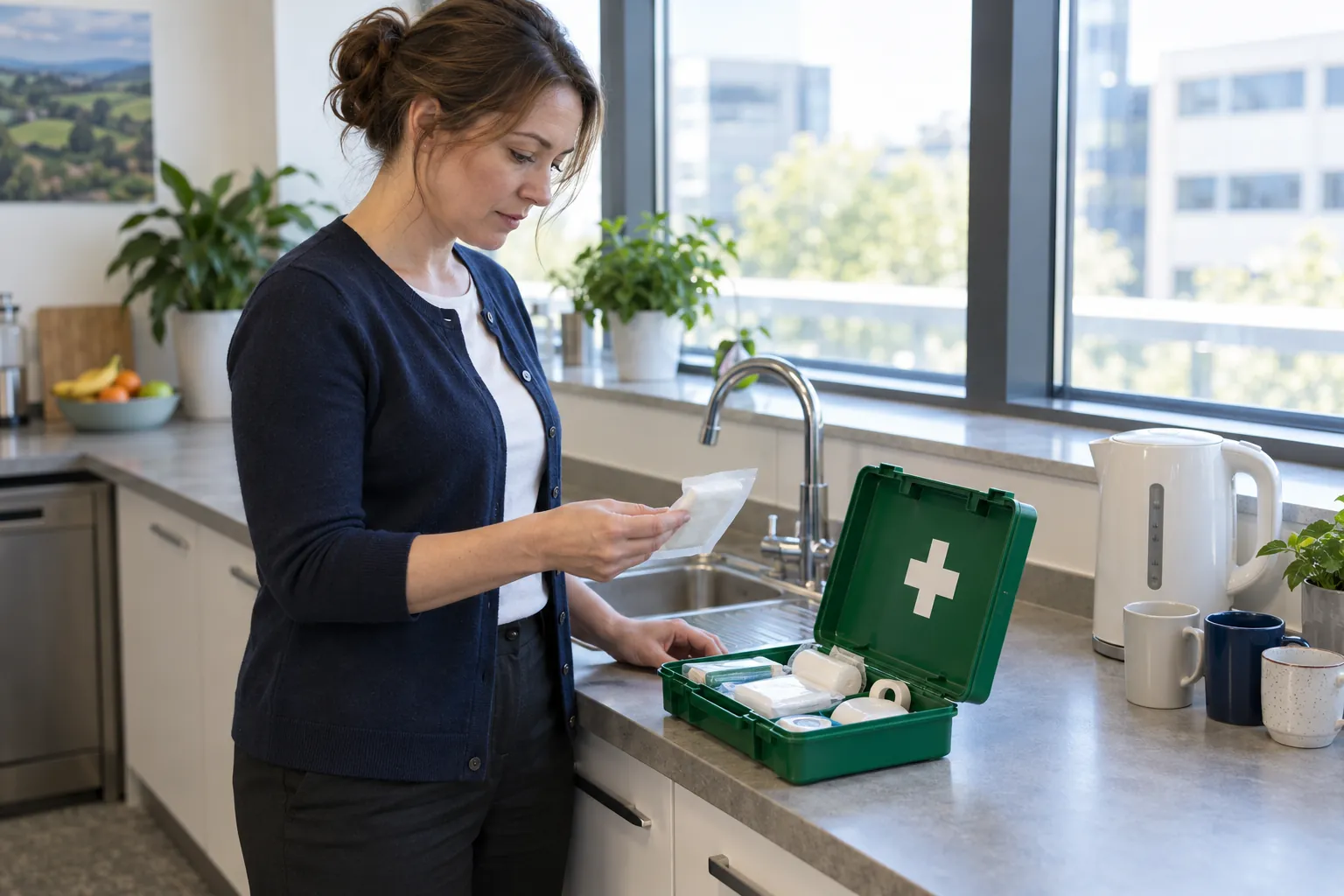
There is no legal list: the Health and Safety (First-Aid) Regulations 1981 require equipment that is adequate and appropriate, and what that means depends on your first aid needs assessment. This guide covers the law, the suggested contents, BS 8599-1, how many kits and where, how often to check and restock them, and how to record it.
01
The law: first aid equipment at work
In Great Britain the duty comes from regulation 3(1) of the Health and Safety (First-Aid) Regulations 1981: "An employer shall provide, or ensure that there are provided, such equipment and facilities as are adequate and appropriate in the circumstances for enabling first-aid to be rendered to his employees if they are injured or become ill at work." Regulation 4 adds that employees must be told of the arrangements, "including the location of equipment, facilities and personnel". A well-stocked box nobody can find does not meet it.
The Regulations never list what a box must contain. The detail is in HSE's guidance, First aid at work: The Health and Safety (First-Aid) Regulations 1981, Guidance on Regulations (L74, third edition, 2013, reissued with minor amendments in 2018 and 2024). Paragraph 36 sets the floor: "The minimum level of first-aid equipment is a suitably stocked and properly identified first-aid container. Every employer should provide for each work site at least one first-aid container supplied with a sufficient quantity of first-aid materials suitable for the particular circumstances."
For an office or shop with low-level hazards, L74 says the minimum is an appointed person to take charge of first aid arrangements and "a clearly identified and suitably stocked first-aid box". HSE's page on appointing someone to take charge of first aid says that role includes "looking after the equipment, facilities and calling the emergency services". Where there are first aiders instead, looking after the kits still needs to be someone's named job.
02
What should be in a first aid box at work
Appendix 2 of L74 says "There is no mandatory list of items to be included in a first-aid container"; the needs assessment decides the first aid kit contents. As a guide, where work activities involve low hazards, it suggests this minimum stock:
- a leaflet giving general guidance on first aid, for example HSE's free leaflet Basic advice on first aid at work (INDG347);
- 20 individually wrapped sterile plasters of assorted sizes, appropriate to the work (hypoallergenic if necessary);
- two sterile eye pads;
- two individually wrapped triangular bandages, preferably sterile;
- six safety pins;
- two large sterile individually wrapped unmedicated wound dressings;
- six medium-sized sterile individually wrapped unmedicated wound dressings;
- at least three pairs of disposable gloves.
HSE's page What to put in your first aid kit gives the same items without the numbers. Treat the list as the starting point for a low-risk building, not the answer for every one.
Additional items. L74 paragraph 39 says the assessment may call for "foil blankets, haemostatic dressings, tourniquets, wound packing materials (sterile gauze), disposable aprons and individually wrapped moist wipes", with microporous tape, shears that cut through clothing and sterile tweezers. The 2024 amendments to L74 renamed "catastrophic bleeding" as "life-threatening bleeding" and added guidance where it is a risk, so a workshop or a kitchen may need bleed-control items an office does not. Where mains tap water is not readily available for washing wounds and eyes, paragraph 40 asks for at least one litre of sterile water or sterile normal saline (0.9% w/v) in sealed, disposable containers, not kept once opened and not used past their expiry date.
No tablets or medicines. L74 paragraph 42 says "First aid at work does not include giving tablets or medicines to treat illness", the one exception being aspirin for a suspected heart attack in line with accepted first aid practice, and "It is recommended that tablets and medicines should not be kept in the first-aid container." Paragraph 43 adds that some workers carry their own prescribed medication, such as an inhaler for asthma, and that the first aider's role is then generally limited to helping them take it and contacting the emergency services.
03
BS 8599-1: the British Standard for workplace kits
HSE's kit page says that if you are buying a kit, look for one that meets British Standard (BS) 8599. The current workplace part on BSI's catalogue is BS 8599-1:2019+A1:2026, Workplace first aid kits – Contents of first aid kits and provision of Automated External Defibrillators (AEDs) in the workplace – Specification, published on 30 April 2026 as an amendment to the 2019 edition. It specifies the contents of workplace kits, their containers, and the provision and placement of AEDs. According to BSI, its Annex A recommends the number and size of kits by category of risk and the number of people on site, and Annex B covers personal issue kits and critical injury packs. Kits for motor vehicles are a separate part, BS 8599-2.
Meeting the standard is not a legal requirement. HSE says: "By law, your kit doesn't have to meet this standard but you should check it contains what you've identified in your needs assessment." A BS 8599 label is a sensible shortcut when buying, but it does not prove the box on the wall still holds what it did when it was bought.
Because the standard now covers defibrillators, a building with an AED can check it on the same round as its first aid boxes. L74 paragraph 44 says that where an employer provides an AED, the Provision and Use of Work Equipment Regulations 1998 apply.
04
How many kits, and where they go
L74 sets no number per head. Paragraph 37 says "more than one first-aid container might be required on large sites", and that containers "should be easily accessible and preferably placed near to hand-washing facilities". The needs assessment decides the number and the places:
- Floors and buildings. Paragraph 23 asks whether a site with more than one building needs more provision, and Table 1 asks employers to consider the need for provision in each building or on each floor.
- Hazards by area. Where the risks are higher, as in a workshop, plant room, kitchen or grounds store, a fuller kit may be needed than on the office floors.
- Shifts. Paragraph 22 says provision must be available whenever employees are at work. A kit locked in an office that closes at six is no use to the evening cleaners.
- Shared buildings. Paragraph 25 lets employers on a multi-occupied site agree that one of them provides cover for all, and strongly recommends a written agreement. Settle whose kits are in the common parts and who checks them.
- Visitors and the public. The Regulations cover employees, but paragraph 28 strongly recommends that schools, shops and others who serve the public include non-employees in the assessment.
Each container should be protected from dust and damp, hold only items useful for first aid, and be "identified by a white cross on a green background". Then tell people where it is: paragraph 83 suggests first aid notices as a simple way to keep employees informed, with at least one in a prominent position at each site, including the base for travelling employees. Regulation 4 requires employees to be told the location of equipment, facilities and personnel, so a notice should name the first aiders or appointed person and say where the nearest kit is.
05
How often to check a first aid kit, and what to look at
L74 paragraph 38 is the rule: "The contents of first-aid containers should be examined frequently and restocked soon after use. Sufficient supplies should be held in stock on site. Care should be taken to dispose of items safely once they reach their expiry date." HSE sets no fixed interval; its page What to put in your first aid kit says simply "Check your kit regularly". A sensible routine is a monthly check of every kit, a check whenever a kit has been used, and more often where kits are used a lot, as in a kitchen, workshop or school.
A first aid kit checklist for each check:
- The kit is where the notice says, reachable without a key and not blocked out of hours.
- The container is intact, closes, is clean and dry, and still shows the white cross on green.
- The contents match the kit's list, item by item and in number: the list from your needs assessment, or the one inside a BS 8599 kit.
- Sterile packs are sealed and undamaged; anything torn, wet or opened goes.
- Expiry dates are checked on every dated item. HSE's first aid frequently asked questions say expired items should be replaced by the dates given and disposed of safely, and to ask the manufacturer about sterile items with no date.
- Nothing that should not be there: tablets, creams or personal items.
- The leaflet and the notice are present, and the notice names the current first aiders.
- Anything short is restocked from site stock, or reported to whoever orders it.
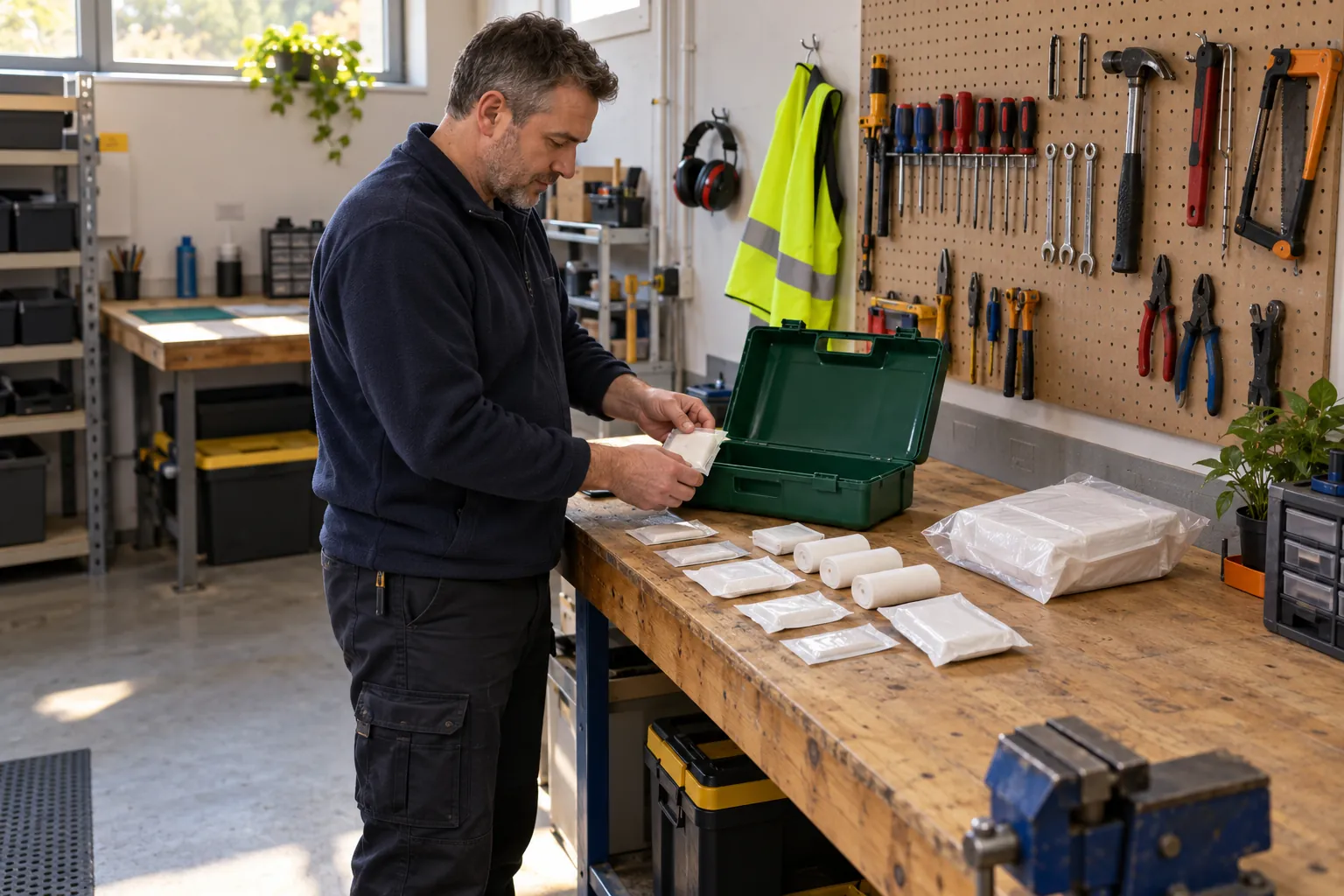
The appointed person, or a named first aider, normally does the checks; in a building with a facilities team it may be the site manager or caretaker. Each kit needs a named owner and cover for when they are away: L74 paragraph 27 asks employers to plan cover for the planned and unplanned absences of first aiders and appointed persons.
Restocking soon after use is where most kits fail, because the person who uses the last plaster rarely says so. Keep a refill pack on site, say on the notice who to tell, and ask whoever uses a kit to report it the same day.
06
Keeping a record of kit checks
No regulation requires a log of first aid kit checks. A record is still the only way to show that "examined frequently and restocked soon after use" happened. L74 paragraph 9 makes the same point about the needs assessment: it need not be written down, but a record lets employers "demonstrate to a safety representative or an HSE or local authority inspector how they decided on their level of first-aid provision", and Appendix 1 is a form for recording that provision, kit contents included. A check record, for each kit, shows:
- which kit, by building, floor and room;
- when it was checked, and by whom;
- what was missing, short-dated or damaged;
- what was restocked, and when.
Paragraph 30 asks employers to review first aid needs periodically. The check records feed that review: a kit short of the same item every month may hold the wrong contents for its area.
07
Where the record fails, and where SiteClara fits
The usual kit record is a sheet taped inside the lid with a column of monthly ticks in the same pen, sometimes filled in ahead. It cannot show when the box was opened, who looked, or whether the plasters used on Tuesday were replaced, and an emptied box is usually found by the next person who needs it.
SiteClara records the check at the kit. A printed QR poster, with an optional NFC tag behind it, goes beside each first aid box, so each kit is its own location. The person checking scans the code or taps the tag on their own phone, with no app to install, sees the check due there, and marks it done or explains what stopped them, such as items out of stock, with the time, their name and a photo of the open box when one is asked for. Anyone who finds a kit used up can report it there, and it goes onto the team's list of jobs until someone restocks the box and closes it.
Each day a supervisor reviews what was due, done and missed, records the reason a check was missed, and approves a daily report that goes to nominated management or client contacts at 8am the next morning, so an unchecked kit or an open restock shows the next day rather than at the next audit. SiteClara is the working record of the checks; your needs assessment, first aid records and accident book stay where they are.
08
Questions people ask
What are the legal requirements for a first aid kit in the UK?
In England, Wales and Scotland, regulation 3(1) of the Health and Safety (First-Aid) Regulations 1981 requires an employer to provide equipment and facilities that are "adequate and appropriate in the circumstances" for giving first aid to employees who are injured or become ill at work; it sets no list of contents. HSE's L74, First aid at work says the minimum is "a suitably stocked and properly identified first-aid container" for each work site, with the contents decided by your first aid needs assessment. Northern Ireland has its own Health and Safety (First-Aid) Regulations (Northern Ireland) 1982.
What are the 10 essential items in a first aid kit?
HSE sets no list of ten: for low-risk work such as desk-based work, its page What to put in your first aid kit suggests a minimum kit of a first aid leaflet, individually wrapped sterile plasters of assorted sizes, sterile eye pads, individually wrapped triangular bandages, safety pins, large and medium-sized sterile unmedicated wound dressings, and disposable gloves. Appendix 2 of HSE's L74, First aid at work gives the quantities, such as 20 plasters and at least three pairs of gloves, and says "There is no mandatory list of items to be included in a first-aid container".
How often should a first aid kit be checked?
HSE sets no fixed interval: HSE's L74, First aid at work says the contents should be "examined frequently and restocked soon after use", and its page What to put in your first aid kit says to check your kit regularly and replace expired items. A sensible routine is a monthly check of every kit and a check after every use.
Can you keep paracetamol in a work first aid kit?
HSE recommends against it: paragraph 42 of HSE's L74, First aid at work says "First aid at work does not include giving tablets or medicines to treat illness" and "It is recommended that tablets and medicines should not be kept in the first-aid container." The only exception is aspirin given to a casualty with a suspected heart attack, in line with accepted first aid practice.
Does a workplace first aid kit have to meet BS 8599?
No. HSE's page What to put in your first aid kit says "By law, your kit doesn't have to meet this standard but you should check it contains what you've identified in your needs assessment."
09
Further reading, and a list to take away
The Regulations are short and on legislation.gov.uk. HSE's L74 is free to download and holds the detail: the needs assessment, the suggested contents in Appendix 2 and the record form in Appendix 1. HSE's simple guidance pages cover the kit and the appointed person, BSI publishes BS 8599-1, and HSENI covers Northern Ireland.
Before the next check, make sure that:
- your needs assessment says how many kits, where, and what each holds;
- every floor and higher-risk area has a kit within easy reach;
- each kit is marked with a white cross on green and kept dry and dust-free;
- first aid notices name the current first aiders and say where the kits are;
- each kit has a named checker, with cover, checking frequently and after use;
- nothing is past its date and no tablets are kept in the box;
- mobile staff have travelling kits and a way to restock them;
- each check is recorded by kit, date and person, apart from any record of people treated.
Sources
Every document this guide quotes or links to, in the order it first cites them.
- Regulation 3(1) of the Health and Safety (First-Aid) Regulations 1981 legislation.gov.uk
- Regulation 4 legislation.gov.uk
- First aid at work: The Health and Safety (First-Aid) Regulations 1981, Guidance on Regulations hse.gov.uk
- Appointing someone to take charge of first aid hse.gov.uk
- First aid at work hseni.gov.uk
- Basic advice on first aid at work (INDG347) hse.gov.uk
- What to put in your first aid kit hse.gov.uk
- BS 8599-1:2019+A1:2026, Workplace first aid kits – Contents of first aid kits and provision of Automated External Defibrillators (AEDs) in the workplace – Specification knowledge.bsigroup.com
- First aid frequently asked questions hse.gov.uk
Related guides
 Premises and facilities managementAccident book: who must keep one, what goes in it, and how to keep it lawfullyWho must keep an accident book in the UK, what each entry must record, whether it can be online, how long to keep it, and how to handle it under UK GDPR.
 Premises and facilities managementDefibrillator checks: how to keep a workplace AED ready, and show that it isHow to check a workplace defibrillator in the UK: the weekly status check, pads and battery expiry, the cabinet and signs, The Circuit, and keeping a record.
 Premises and facilities managementRIDDOR reporting: what must be reported, by when, and by whomRIDDOR reporting explained: the reportable injuries, the over-seven-day rule, the 10 and 15 day deadlines, how to report to HSE and who in a building must report.
 Premises and facilities managementHealth and safety inspection checklist: what to look at, and what to do nextHow to run a workplace health and safety inspection: the legal basis, what to walk and look at, how often, recording findings and actions, and involving staff.