Premises and facilities management
Near miss reporting: what counts, what to record, and what happens next
Near miss reporting is the way people in a workplace tell the person responsible for health and safety about an event that could have injured someone but did not, which HSE's guidance HSG245 defines as an event that, while not causing harm, has the potential to cause injury or ill health.
Also written for Ireland · United States · Canada · Australia · New Zealand · South Africa
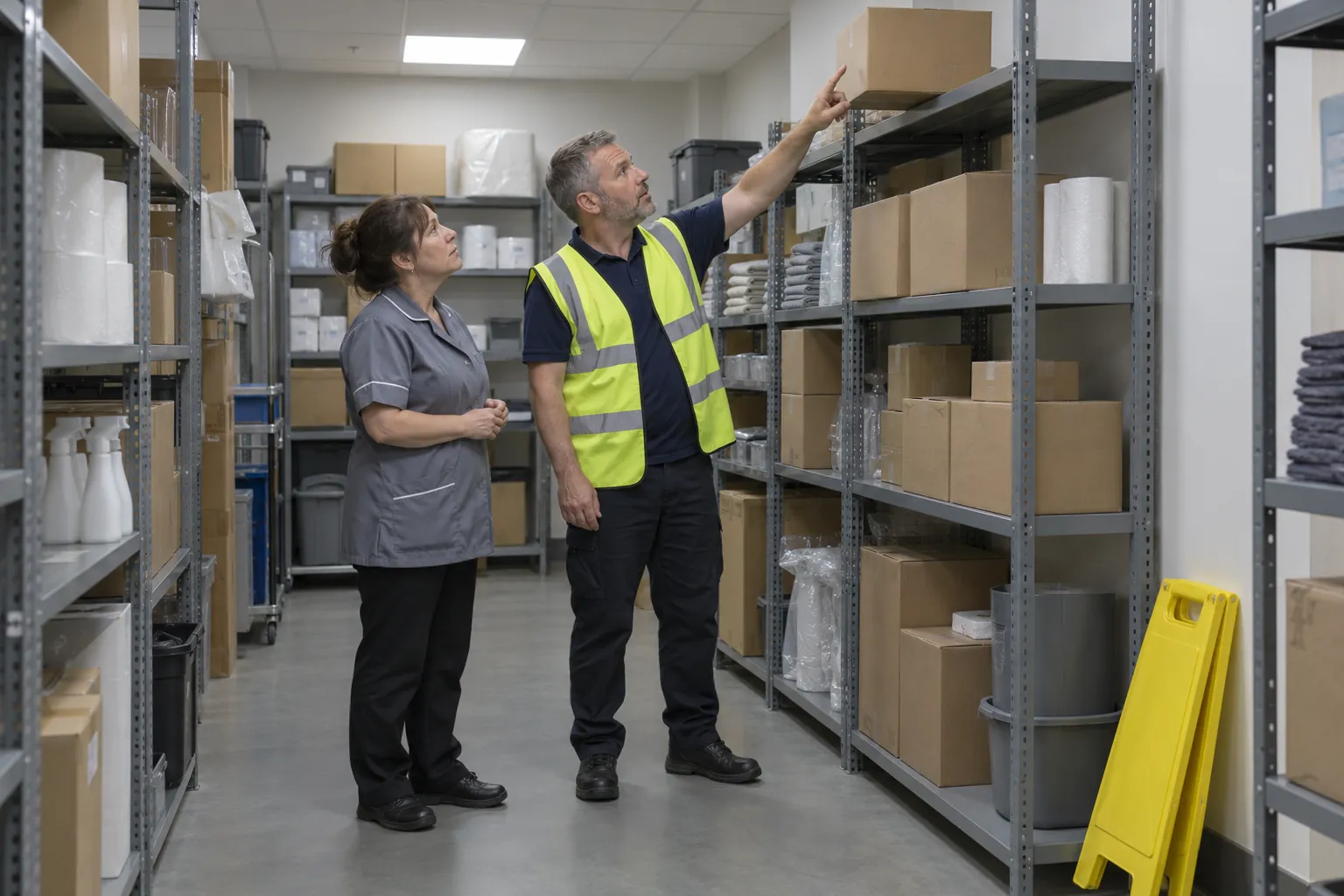
In Great Britain most near misses are reported only within the organisation: the law requires a report to HSE only for the dangerous occurrences listed in Schedule 2 to RIDDOR 2013, but the Management of Health and Safety at Work Regulations 1999 expect employers to monitor and review their safety arrangements, and near misses are among the cheapest warnings they will ever get. This guide covers what counts as a near miss, when one must be reported to HSE, what a near miss report form should record, how to decide what to investigate, and how to get people to report at all.
01
What a near miss is, and the law behind reporting one
HSE's workbook Investigating accidents and incidents (HSG245, published in 2004) groups everything worth investigating under the term adverse event and divides it into three kinds:
- an accident: an event that results in injury or ill health;
- a near miss: an event that, while not causing harm, has the potential to cause injury or ill health. HSG245 counts dangerous occurrences as near misses too;
- an undesired circumstance: a set of conditions or circumstances that have the potential to cause injury or ill health, before anything has happened. HSG245's example is untrained nurses handling heavy patients.
So a ceiling tile that falls into an empty corridor is a near miss; a tile hanging loose over the corridor is an undesired circumstance, what most sites call a hazard. Both are worth reporting: HSG245 says it is often pure luck that determines whether an undesired circumstance turns into a near miss or an accident, and the value of investigating each is the same.
Some workplaces call a near miss a close call or a near hit. Whatever the name, it is an early warning: the hazard is still there for the next person.
No regulation in Great Britain requires a near miss log. The duty to report near misses within an organisation comes from the general framework:
- Regulation 5 of the Management of Health and Safety at Work Regulations 1999 requires every employer to make and give effect to arrangements for the effective planning, organisation, control, monitoring and review of its preventive and protective measures, and to record them where it employs five or more people. HSG245 says investigations form an essential part of that process.
- Regulation 14 of the Management of Health and Safety at Work Regulations 1999 requires every employee to inform their employer, or a colleague with specific responsibility for health and safety, of any work situation they would reasonably consider a serious and immediate danger, and of any matter they would reasonably consider a shortcoming in the employer's protection arrangements, unless it has already been reported. Many near misses are exactly that.
The one near miss the law requires you to report outside the organisation is a dangerous occurrence. Under regulation 7 of the Reporting of Injuries, Diseases and Dangerous Occurrences Regulations 2013 (RIDDOR), the responsible person must report a dangerous occurrence whether or not anyone was hurt. HSE describes these as certain incidents with a high potential to cause death or serious injury, listed in Schedule 2.
02
What counts as a near miss in a building, and which ones go to HSE
In an office, school, hall of residence or shopping centre, near misses are mostly ordinary:
- someone slips on a wet floor with no sign out and catches the handrail before falling;
- a box falls from a high storage shelf into an aisle nobody happened to be standing in;
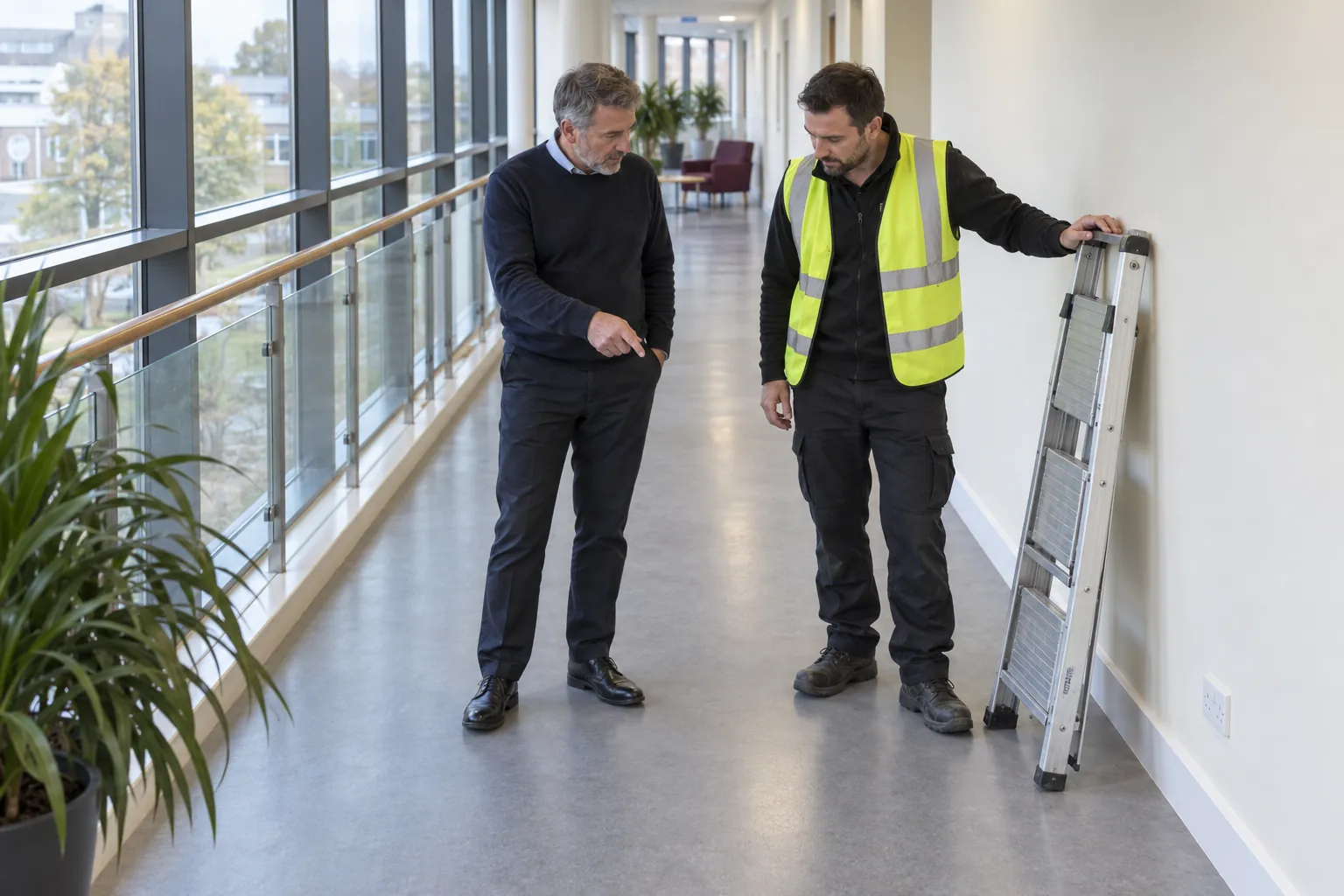
- a contractor's ladder is knocked over in a corridor while no one is on it;
- an extension lead scorches or trips the circuit while in use;
- a vehicle reversing in the service yard passes close behind someone on foot;
- a chemical decanted into an unlabelled bottle is nearly used for the wrong job.
Each needs the same handling: make it safe, tell the person responsible, record it and decide whether to look further. None is reportable to HSE.
Dangerous occurrences are different. Schedule 2 to RIDDOR 2013 lists them, and HSE's page on dangerous occurrences sets out those that apply to all workplaces. The ones most likely in an ordinary building are:
- Lifting equipment (paragraph 1): the collapse, overturning or failure of any load-bearing part of any lifting equipment, other than an accessory for lifting. HSE's page on dangerous occurrences says this covers lifting equipment whether it is used for lifting goods, materials or people, so the failure of a load-bearing part of a passenger lift is reportable even if the car was empty.
- Electrical incidents (paragraph 4): an explosion or fire caused by an electrical short circuit or overload, where the equipment is put out of action for more than 24 hours or the occurrence had the potential to cause a death.
- Scaffolding (paragraph 18): the complete or partial collapse of a substantial part of a scaffold more than 5 metres high, for example during facade or roof work.
- Structural collapse (paragraph 23): the unintentional collapse or partial collapse of any structure involving a fall of more than 5 tonnes of material, or of any floor or wall of a place of work, arising from or in connection with ongoing construction work, including demolition, refurbishment and maintenance.
A dangerous occurrence is reported like a specified injury: Schedule 1 to RIDDOR 2013 requires the responsible person to notify the enforcing authority by the quickest practicable means without delay and to send a report within 10 days, in practice through HSE's online forms. Outside specialist sites such as mines, quarries and offshore installations, regulation 3 of RIDDOR 2013 makes that the person who, by carrying on an undertaking, was in control of the premises where it happened; in a multi-let building that may be the landlord or managing agent for a lift in the common parts. Our guide to RIDDOR reporting covers the rest.
Under regulation 12 of RIDDOR 2013 a reportable dangerous occurrence must also be recorded, and the record kept for at least three years.
03
What a near miss report form should record
There is no prescribed near miss report form. HSE publishes a Near-miss Book (published February 2021) for recording them, and HSG245 includes an adverse event report and investigation form with worked examples, but a form you design for your own site is equally valid. It needs to be short enough that people use it and specific enough to act on. A good near miss report records:
- Where: the building, floor and exact location, such as "stairwell B, between first and second floors", not "the stairs".
- When: the date and time it happened, and when it was reported if that was later.
- What happened, in the reporter's own words: what they were doing, what went wrong, and what stopped it becoming an accident.
- What could have happened: the worst realistic outcome. This drives the decision on how far to investigate.
- What was done straight away: area cordoned off, spill cleaned up, equipment taken out of use, nothing.
- Who reported it, and how to contact them for more detail. A name helps, but an anonymous report is better than none.
- A photograph where one helps, taken once the area is safe.
- Who it went to, and the outcome: investigated, action taken, closed, with a date for each.
Keep personal details to what is needed: HSE's guidance on reporting accidents and ill health asks that incident records are stored confidentially in a secure place.
Make the form easy to reach where the risk is. A form in the safety manager's office collects few reports from the car park at 6am. Whether it is paper, an email address or a digital form, it should be available on every shift, to contractors as well as employees, and take a minute to complete.
04
What happens after a near miss is reported
HSG245 sets out the steps after any adverse event, near misses included. Take prompt emergency action and make the area safe; preserve the scene where that matters; note the people, equipment and witnesses involved; and report the event to the person responsible for health and safety, who decides what further action is needed. A dangerous occurrence goes to the enforcing authority straight away: HSG245 says not to wait until you have finished investigating before you report it.
Not every near miss needs a full investigation, but every one needs a decision. HSG245's rule is that it is the potential consequences and the likelihood of the event recurring that should determine the level of investigation, not simply the harm suffered this time. You must consider the worst potential consequence: its own example is a scaffold collapse that injured nobody but had the potential to cause major or fatal injuries. It sets out four levels:
- Minimal: the relevant supervisor looks into the circumstances and tries to learn lessons that will prevent it happening again.
- Low: a short investigation by the supervisor or line manager into the immediate, underlying and root causes.
- Medium: a more detailed investigation by the supervisor or line manager, the health and safety adviser and employee representatives.
- High: a team-based investigation under the supervision of senior management or directors.
HSG245 adds that several similar events may be worth investigating together even if each alone is not, and that it is best practice to investigate all adverse events that may affect the public.
The investigation follows HSG245's four steps: gather the information, analyse it, identify the risk control measures, and make and carry out an action plan. It warns that an investigation concluding operator error was the sole cause is rarely acceptable, because underneath human error lie causes such as inadequate training and supervision or poor equipment design.
Close the loop. HSG245 says the action plan should feed into a review of the risk assessment, the results should be communicated to everyone who needs to know, and progress should be monitored, and that these last steps are often overlooked. A near miss is closed when the cause has been dealt with and the person who reported it has been told what happened.
05
How to get people to report near misses
The hardest part of near miss reporting is the reporting. Nobody was hurt, the moment has passed, and the person who noticed may worry about getting a colleague into trouble. A programme with few reports usually means people do not report, not that nothing happens.
HSG245 points to what makes the difference:
- No blame. Investigations should be conducted with accident prevention in mind, not placing blame. HSG245 says apportioning blame before an investigation has started makes people defensive and uncooperative, and that witnesses to a near miss are more likely to be helpful and tell the truth than witnesses to an accident.
- Involvement. HSG245 says that for an investigation to be worthwhile the management and the workforce must be fully involved, and that where there is full cooperation and consultation with union representatives and employees, the number of accidents is half that of workplaces without such involvement.
- Visible results. Employees cooperate more with new precautions when they were involved and can see problems dealt with. Tell the reporter what was done.
Safety representatives have a role here in law. Under regulation 4 of the Safety Representatives and Safety Committees Regulations 1977, a trade union safety representative's functions include investigating potential hazards and dangerous occurrences at the workplace, whether or not employees have drawn them to their attention, and examining the causes of accidents. Share near miss reports with them.
Practical measures help:
- make reporting quick, at the place where it happened, on any shift;
- accept reports from contractors, agency staff and visitors;
- never set a target for fewer near misses, which teaches people to stop reporting them;
- deal with the simple ones fast: a loose carpet edge fixed the same day does more for reporting than a poster.
In a building with several employers, a near miss often belongs to someone else's hazard. A cleaner who nearly slips on water from a leaking roof light should be able to report it and know it will reach whoever maintains the roof. Write down in the site's health and safety arrangements who receives near misses on the premises, and who passes them on to each contractor.
06
Where the record fails, and what SiteClara does about it
Most near miss systems fail before the form. The person who nearly fell mentions it to whoever is passing, who means to pass it on. The form is in a drawer in the site office, or on an intranet the cleaning and security teams cannot reach. A report that does arrive sits in an inbox with no owner and no date, and the same wet entrance produces the same near miss a month later. When an accident finally happens there, nobody can show that the hazard was reported, to whom, or what was done.
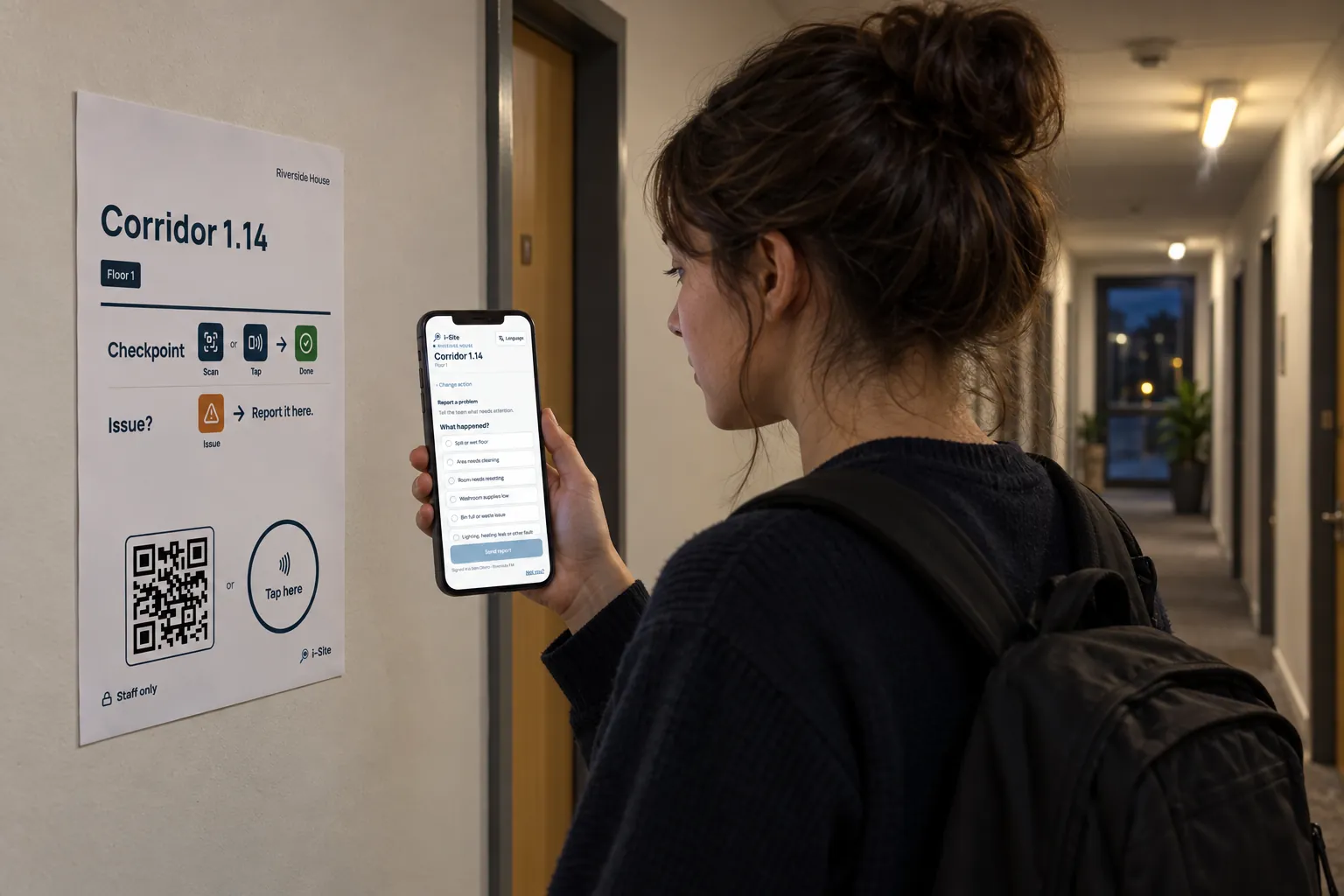
SiteClara records reported issues and routine checks at the location. A printed QR poster, with an optional NFC tag behind it, sits at each place a team looks after, such as an entrance, a stairwell, a washroom or a car park. Staff scan or tap on their own phone, with no app to install, and report what they found, with a photo when it helps; where a location's tag is set to Open, a visitor can report there too. The report carries the location, the time and, for staff, the named person, and goes onto the team's list of jobs until someone closes it. The same scan shows the checks due there, to mark done or to explain what stopped them.
Each day the supervisor reviews what was reported, done and still open, and approves a report that goes to nominated management or client contacts at 8am the next morning. A hazard reported from a tag has a time, a place, an owner and a closing time, and a premises manager can see the same location coming up again.
07
Questions people ask
Does a near miss have to be reported?
Within the organisation, usually yes: regulation 14 of the Management of Health and Safety at Work Regulations 1999 requires every employee to tell their employer of any work situation they would reasonably consider a serious and immediate danger, and of any matter they would reasonably consider a shortcoming in the employer's protection arrangements, unless it has already been reported. Outside it, a near miss goes to HSE only if it is a dangerous occurrence under RIDDOR 2013.
Does a near miss need to be reported to RIDDOR?
Only if it is a dangerous occurrence. HSE's page Dangerous occurrences describes these as certain incidents with a high potential to cause death or serious injury, and regulation 7 of RIDDOR 2013 requires the responsible person to report one whether or not anyone was hurt. Any other near miss is recorded and dealt with inside the organisation.
How should a near miss be reported?
HSE's Investigating accidents and incidents (HSG245) sets out the steps after any adverse event: take prompt emergency action and make the area safe, preserve the scene, note the names of the people, equipment and witnesses involved, and report it to the person responsible for health and safety, who decides what further action is needed. HSE's Near-miss Book was produced to help employers and employees record the details.
What is the difference between a near miss and a hazard?
A near miss is an event that happened and could have caused harm but did not; a hazard is something with the potential to cause harm before any event. HSE's Investigating accidents and incidents (HSG245) calls a set of conditions or circumstances with the potential to cause injury or ill health an undesired circumstance, and says it is often pure luck that determines whether one turns into a near miss or an accident.
08
Further reading, and a list to take away
HSE's Investigating accidents and incidents (HSG245) is free to download with blank and worked investigation forms; it was written under the 1995 RIDDOR regulations, so take reporting categories and deadlines from the 2013 Regulations and HSE's RIDDOR pages. HSE's introduction to managing health and safety puts near misses in Plan, Do, Check, Act: as part of your monitoring, investigate incidents, including accidents, near misses and dangerous occurrences.
Check that your near miss reporting:
- is written into the health and safety arrangements, naming who receives reports;
- can be done in a minute, at the location, on every shift, by contractors and visitors as well as employees;
- records where, when, what happened, what could have happened and what was done straight away;
- picks out dangerous occurrences at once, so they reach HSE within the RIDDOR deadlines;
- sets the depth of investigation by the worst potential consequence, not by luck;
- is blame-free, and tells the reporter what happened next;
- feeds patterns by location and type into the risk assessment review, and keeps each report open until the cause is dealt with.
Sources
Every document this guide quotes or links to, in the order it first cites them.
- Investigating accidents and incidents hse.gov.uk
- Regulation 5 of the Management of Health and Safety at Work Regulations 1999 legislation.gov.uk
- Regulation 14 of the Management of Health and Safety at Work Regulations 1999 legislation.gov.uk
- Regulation 7 of the Reporting of Injuries, Diseases and Dangerous Occurrences Regulations 2013 legislation.gov.uk
- Management of Health and Safety at Work Regulations (Northern Ireland) 2000 legislation.gov.uk
- Schedule 2 to RIDDOR 2013 legislation.gov.uk
- Dangerous occurrences hse.gov.uk
- Schedule 1 to RIDDOR 2013 legislation.gov.uk
- Regulation 3 of RIDDOR 2013 legislation.gov.uk
- Regulation 12 of RIDDOR 2013 legislation.gov.uk
- Near-miss Book hse.gov.uk
- Reporting accidents and ill health hse.gov.uk
- Regulation 4 of the Safety Representatives and Safety Committees Regulations 1977 legislation.gov.uk
- Introduction to managing health and safety hse.gov.uk
Related guides
 Premises and facilities managementRIDDOR reporting: what must be reported, by when, and by whomRIDDOR reporting explained: the reportable injuries, the over-seven-day rule, the 10 and 15 day deadlines, how to report to HSE and who in a building must report.
 Premises and facilities managementAccident book: who must keep one, what goes in it, and how to keep it lawfullyWho must keep an accident book in the UK, what each entry must record, whether it can be online, how long to keep it, and how to handle it under UK GDPR.
 Premises and facilities managementHealth and safety inspection checklist: what to look at, and what to do nextHow to run a workplace health and safety inspection: the legal basis, what to walk and look at, how often, recording findings and actions, and involving staff.
 Premises and facilities managementFault reporting system: how faults are reported, prioritised and closedHow a fault reporting system for a building should work: how occupants report faults, how facilities teams log and prioritise them, and how a fault is closed.