Cleaning
Care home cleaning: the schedule, the checks and the evidence CQC asks for
Care home cleaning in England is a legal duty under Regulation 15 of the Health and Social Care Act 2008 (Regulated Activities) Regulations 2014, which requires a registered provider to keep its premises and equipment clean and to maintain standards of hygiene appropriate to what they are used for.
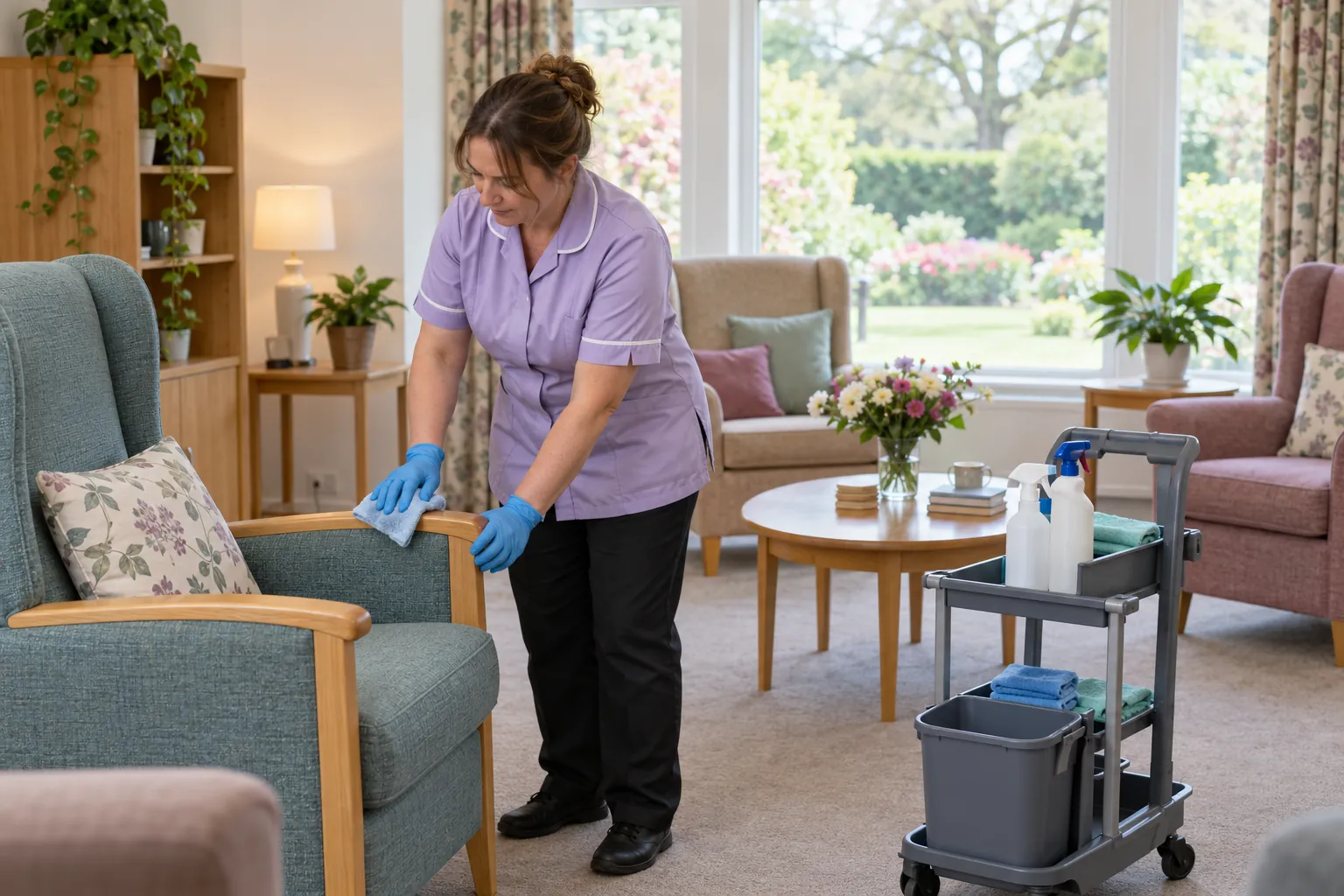
Scotland, Wales and Northern Ireland set the same outcome in their own regulations. This guide is for the care home manager, the head of housekeeping and the cleaning contractor who serves them: what the law and the infection prevention and control (IPC) guidance say, what a care home cleaning schedule has to cover, who does what, and what good evidence looks like when an inspector asks.
01
What the law says about cleaning a care home
In England, two of the fundamental standards apply. Regulation 15 of the Health and Social Care Act 2008 (Regulated Activities) Regulations 2014 says premises and equipment used by the service provider must be clean, and that the registered person must maintain standards of hygiene appropriate for the purposes for which they are being used. Regulation 12, safe care and treatment, includes assessing the risk of, and preventing, detecting and controlling the spread of, infections, including those that are health care associated.
The Care Quality Commission's guidance on Regulation 15 says premises and equipment must be kept clean and cleaning must be done in line with current legislation and guidance, and that providers must comply with the Department of Health's guidance on the prevention and control of infections. CQC cannot prosecute for a breach of Regulation 15, but it can take regulatory action.
That guidance is the Department of Health and Social Care's Health and Social Care Act 2008: code of practice on the prevention and control of infections (updated 13 December 2022), which applies to adult social care in England. Its criterion 2 is the cleaning criterion: the provision and maintenance of a clean and appropriate environment in managed premises that facilitates the prevention and control of infections. Under it, a specific individual has responsibility for oversight and management of cleaning, the cleaning arrangements detail the standards of cleanliness required for the setting, and a schedule of cleaning responsibility and frequency is available on request. Its adult social care appendix adds that care homes aim to feel like home, and cleaning must allow for that.
The rest of the United Kingdom reaches the same place by its own route:
- Scotland. Regulation 4 of the Social Care and Social Work Improvement Scotland (Requirements for Care Services) Regulations 2011 requires, where necessary, appropriate procedures for the prevention and control of infection. The Care Inspectorate regulates, and ARHAI Scotland's Care Home Infection Prevention and Control Manual is the practice guide the Scottish Government expects care homes to adopt locally.
- Wales. Regulation 56 of the Regulated Services (Service Providers and Responsible Individuals) (Wales) Regulations 2017 requires arrangements for satisfactory standards of hygiene and the appropriate disposal of general and clinical waste, and policies and procedures for the control of infection that the service actually follows. Care Inspectorate Wales regulates.
- Northern Ireland. Regulation 27 of the Residential Care Homes Regulations (Northern Ireland) 2005 requires that all parts of the home are kept clean and reasonably decorated, and regulation 27(2)(d) of the Nursing Homes Regulations (Northern Ireland) 2005 says the same for a nursing home. The Regulation and Quality Improvement Authority (RQIA) inspects.
Cleaning products, from general-purpose detergents to the chlorine-releasing chemicals used on sanitary fittings, bring a second duty everywhere in the UK: under regulation 6 of the Control of Substances Hazardous to Health Regulations 2002 an employer must not carry out work liable to expose employees to a hazardous substance without a suitable and sufficient risk assessment, and without putting into practice the steps that assessment identifies.
02
What a care home cleaning schedule has to cover
No regulation in England sets how often each room in a care home must be cleaned. The provider decides, and has to be able to show its reasons. The UK Health Security Agency's Infection prevention and control: resource for adult social care (updated 1 March 2024) says that where workers are responsible for cleaning, all should understand:
- whose responsibility it is to clean the different areas;
- how often each area is cleaned;
- the method of cleaning, including the products to use;
- the method, frequency and responsibility for cleaning equipment, with reference to the manufacturer's guidance;
- the training required for cleaning;
- how cleaning standards will be monitored;
- the arrangements for cleaning outside the usual frequencies;
- how cross-contamination is prevented, for example by colour coding of cleaning materials;
- how to dispose safely of items such as cleaning cloths and gloves.
In practice the schedule is a list of places with a frequency, a method and an owner against each. A care home cleaning checklist built on it usually runs through:
- Residents' bedrooms and en suites: daily cleaning of floors, sanitary fittings and touched surfaces, a deep clean on a cycle and when a room is vacated, working around the resident's own furniture and belongings.
- Communal bathrooms, toilets and assisted bathrooms: a set routine for their use and cleaning, as the adult social care resource advises for shared facilities, at a frequency that follows how much they are used.
- Communal areas such as lounges, dining rooms and corridors: tables and surfaces around meals, and touch points such as door handles, handrails, light switches and call points, more than once throughout the day.
- The sluice and the laundry: commodes, bedpans and urinals, the washer and sink; clean and used linen kept apart.
- The kitchen, under food hygiene law as well, which a hygiene audit covers in its own right.
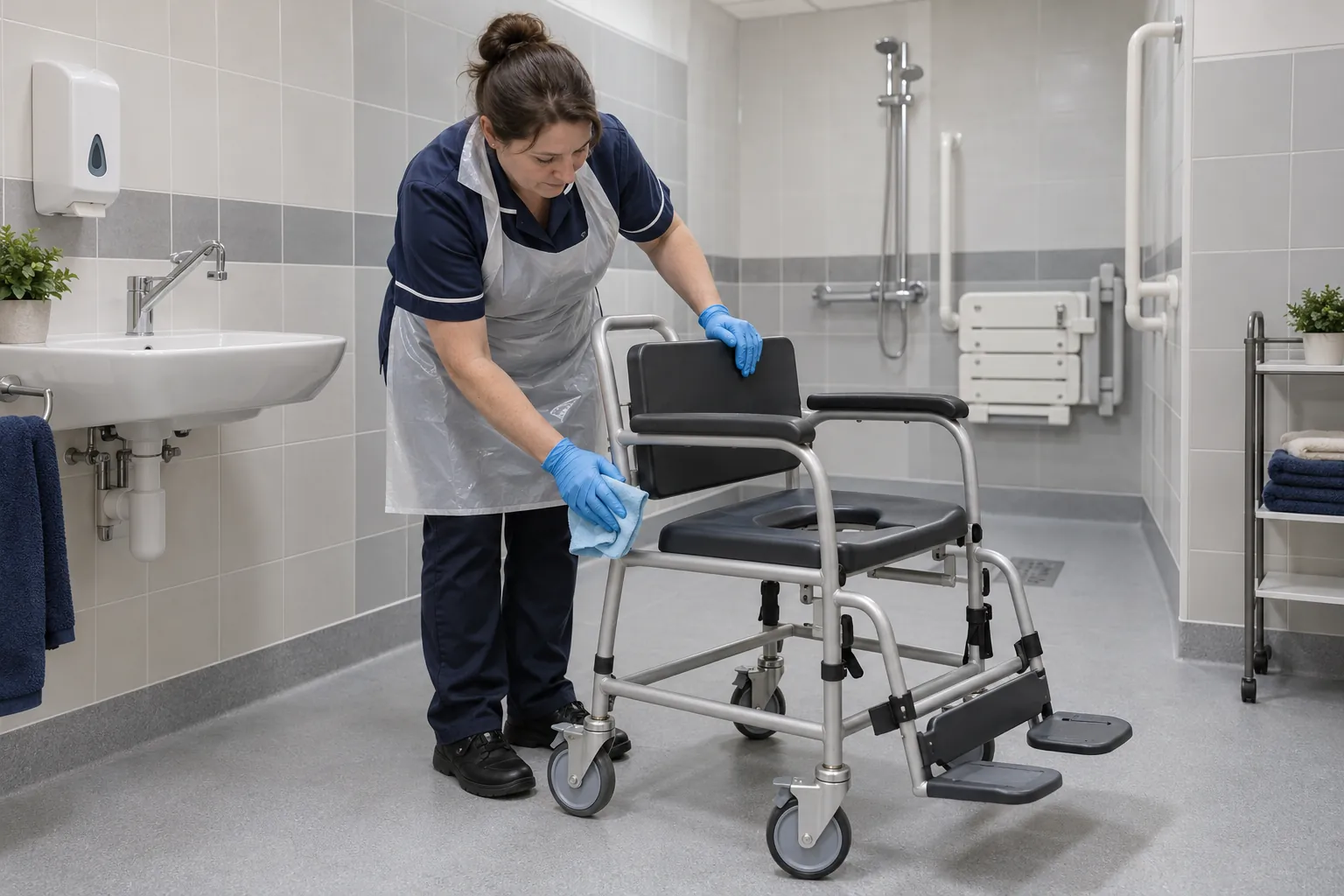
- Shared equipment: hoists, wheelchairs, shower chairs, pressure cushions and the cleaning equipment itself.
- Periodic deep cleaning: curtains, carpets, high-level dusting, mattresses and windows, each with a date, so the next deep clean is planned rather than remembered.
The frequencies are the home's own, set by risk: how many people share a space and how often it is touched. NHS England's National infection prevention and control manual, chapter 1 puts it simply: cleaning protocols should include responsibility for, frequency of, and method of environmental decontamination. Write those three things down for every line of the schedule and most of the inspector's questions are answered.
03
Equipment, spills, laundry and outbreaks
NHS England's manual, whose principles it says should be applied across all care settings including social care, recommends a fresh solution of general-purpose neutral detergent in warm water for routine cleaning, and says 1,000ppm available chlorine should be used routinely on sanitary fittings. The environment should be visibly clean and free from non-essential items. Scotland's care home manual says routine disinfection of the environment is not recommended, that disinfectants are for decontaminating sanitary fittings, and that household bleach should not be used because the required dilution cannot be guaranteed.
Equipment is cleaned by risk. The adult social care resource sorts reusable equipment into three levels:
- Low risk: items that touch intact skin or do not touch people at all. Cleaning, with disinfection if an increased risk of infection is suspected.
- Medium risk: items that touch intact mucous membranes or are contaminated with particularly virulent or readily transmissible pathogens, such as commodes, urinals, bedpans and thermometers. Cleaning, followed by disinfection or sterilisation if used for more than one person.
- High risk: devices used in close contact with broken skin or mucous membranes, or entering a sterile area of the body. Follow the manufacturer's instructions, for example a sterile, single-use wound dressing.
The same resource says reusable care equipment must be decontaminated after each use. So the commode, the hoist and the shower chair each need a named owner on the schedule.
Spills of blood and body fluids must be cleaned immediately, with people kept away until they are removed, and chlorine-releasing agents must not be used directly on a urine spill. Laundry goes into separate containers for clean and used or infectious items; in a care home, used linen goes into an impermeable bag immediately on removal from the bed, and infectious laundry is washed separately at the right temperature and never by hand.
04
Who does what: the lead, the housekeeper and the care team
The code of practice asks for a designated lead for cleaning who is responsible for all aspects of cleaning services, and says the person in charge of any area has direct responsibility for ensuring cleanliness standards are maintained there. In a small home that is often the registered manager; in a larger one, a head of housekeeping or domestic services manager reporting to the manager. Scotland's care home manual says the same in fewer words: the care home manager is responsible for managing the cleaning service.
The work is usually split three ways:
- The housekeeping or domestic team, the home's housekeepers and cleaners, cleans the building to the schedule, restocks soap and paper towels, and reports repairs that stop a surface being cleaned.
- Care staff clean care equipment between uses, deal with spills as they happen, and handle used linen. These tasks cannot wait for the domestic shift.
- Night staff cover what happens overnight: spills, a commode, an extra clean in a room after an episode of illness. The schedule needs a night line, or the morning team inherits it unrecorded.
Training is part of the duty. The adult social care resource lists the training required for cleaning among the things every worker should understand, and workers should be provided with the protective equipment their cleaning tasks need. Scotland's manual adds that staff should be aware of the cleaning schedules, clear on their own responsibilities, and should report cleanliness or maintenance problems to the person in charge.
Where cleaning is contracted out, the provider still holds the duty. The code's section on cleaning services expects clear roles, agreed routines, enough resources, the infection prevention team, or equivalent local expertise, consulted when the cleaning protocols for a contract are being prepared, and a process for asking for extra cleaning. A contractor's cleaning specification for a care home should name each of those, and say who records what.
05
How cleaning is checked, and the evidence an inspector looks for
A schedule shows what was planned. The evidence shows what happened. The adult social care resource lists audit among the administrative controls, asks for leadership arrangements that say how infection prevention standards will be monitored, and says the annual statement of a residential setting should cover audits and the actions that followed. The code itself expects the schedule of cleaning responsibility and frequency to be available on request.
A care home cleaning audit is usually a short, regular walk of a sample of rooms against a standard tool, scored as the share of items that pass, with the failures turned into actions. The National standards of healthcare cleanliness 2025 are written for healthcare organisations, not care homes, but the code's criterion 2 says that, for all healthcare settings, arrangements for cleaning equipment should be based on their responsibilities framework or equivalent standards, and their method, auditing high-risk areas more often than low-risk ones, translates well. The hygiene audit guide covers scoring and action plans in detail.
Between audits, the evidence that holds up is plain:
- a dated record of each scheduled clean, with the name of the person who did it and the time, made when it was done;
- the cleans that were missed, with a reason, rather than gaps or ticks added later;
- extra cleans requested and done, especially after illness or a spill;
- equipment cleaning for shared items such as hoists and commodes;
- outbreak cleaning at the increased frequency, for the dates it applied;
- repairs reported because a surface could not be cleaned, and when they were closed;
- audit results, the actions taken and a recheck showing they held.
A record helps most when it agrees with what an inspector sees in the building. Keep personal information off cleaning records: name the room, not the resident.
06
Where the cleaning record fails, and where SiteClara fits
The weak point in most care homes is not the schedule but the record of it. A chart on the back of a bathroom door, initialled at the end of a shift or the end of the week, cannot show when a clean was done or by whom, and a clean that was missed because a resident was resting in the room is usually never recorded as missed. Problems are mentioned to whoever is passing, and the leaking tap in an en suite is reported more than once before anyone fixes it.
SiteClara records routine checks at the place they happen. A printed QR poster, with an optional NFC tag behind it, sits at each location with a scheduled check: a bathroom, the sluice, a lounge, a corridor. Housekeepers and care staff scan or tap on their own phone, with no app to install, see the checks due there, and mark each one done or explain what stopped them. The time and the named person are recorded as it happens, with a photo when one is asked for, and a reported problem goes onto the team's list of jobs until someone closes it.
The supervisor or head of housekeeping sees what is due, done and missed, and records the reason a check was missed. Each day they review it, add a note and approve a report that goes to nominated management or client contacts, by default at 8am the next morning once approved, showing what was reported, what was completed, what is still open and how scheduled checks went. That gives the home a working record made at the time, which the manager can set beside audits and the annual statement.
07
Questions people ask
What are the responsibilities of a cleaner in a care home?
A care home cleaner or housekeeper cleans the areas the schedule gives them, by the method and with the products it names, and reports problems they cannot put right. The UK Health Security Agency's resource for adult social care says workers responsible for cleaning should understand whose responsibility each area is, how often and how it is cleaned, the training required, how standards are monitored, and how to prevent cross-contamination.
What is the most effective way to control infections in a care home?
No single measure works alone. NHS England's National infection prevention and control manual, chapter 1 sets out ten standard precautions to be used by all staff, in all care settings, at all times, and says hand hygiene is considered one of the most important ways to reduce the transmission of infectious agents. The UK Health Security Agency's resource for adult social care adds that hand hygiene removes many pathogens and stops them moving between people.
What are the main laws that govern infection prevention and control in a care home?
In England, the UK Health Security Agency's Infection prevention and control: resource for adult social care names the Health and Safety at Work etc Act 1974, COSHH, and the Health and Social Care Act 2008 and its regulations, including the Health and Social Care Act 2008 (Regulated Activities) Regulations 2014. By law the Care Quality Commission must take account of the code of practice on the prevention and control of infections, which applies to adult social care in England, when it makes registration decisions.
What are the 10 standard infection control precautions?
NHS England's National infection prevention and control manual, chapter 1 lists them as patient placement and assessment for infection risk; hand hygiene; respiratory and cough hygiene; personal protective equipment; safe management of care equipment; safe management of the care environment; safe management of linen; safe management of blood and body fluid spillages; safe disposal of waste, including sharps; and occupational safety, prevention of exposure, including sharps injuries. It says they are to be used by all staff, in all care settings, at all times, for all patients. Cleaning a care home is mostly the environment, equipment, linen and spills.
Why is infection control important in a care home?
The UK Health Security Agency's resource for adult social care says preventing and reducing the transmission of infectious diseases is essential to ensuring people stay healthy, and that high standards of IPC reduce the opportunities for infections to spread and for resistance to develop.
08
Further reading, and a list to take away
Start with the Code of practice on the prevention and control of infections and the resource for adult social care in England, ARHAI Scotland's Care Home Infection Prevention and Control Manual, and the Health and Safety Executive's Health and safety in care homes (HSG220), second edition 2014, for the wider risks to staff and residents.
Before your next inspection, check that:
- one named person leads on cleaning, and each area has someone in charge of it;
- the schedule gives every area and every piece of shared equipment a frequency, a method and an owner, nights included;
- products and dilutions match the guidance, and COSHH assessments are in date;
- colour coding is in use and understood;
- outbreak and isolation frequencies are written down before they are needed;
- each clean is recorded when it is done, by name, and a missed clean is recorded with its reason;
- audits are regular, their actions are closed and rechecked, and the annual statement reports them.
Sources
Every document this guide quotes or links to, in the order it first cites them.
- Regulation 15 of the Health and Social Care Act 2008 (Regulated Activities) Regulations 2014 legislation.gov.uk
- Regulation 12 legislation.gov.uk
- Guidance on Regulation 15 cqc.org.uk
- Health and Social Care Act 2008: code of practice on the prevention and control of infections gov.uk
- Regulation 4 of the Social Care and Social Work Improvement Scotland (Requirements for Care Services) Regulations 2011 legislation.gov.uk
- Care Home Infection Prevention and Control Manual nipcm.hps.scot.nhs.uk
- Regulation 56 of the Regulated Services (Service Providers and Responsible Individuals) (Wales) Regulations 2017 legislation.gov.uk
- Regulation 27 of the Residential Care Homes Regulations (Northern Ireland) 2005 legislation.gov.uk
- Nursing Homes Regulations (Northern Ireland) 2005 legislation.gov.uk
- Regulation 6 of the Control of Substances Hazardous to Health Regulations 2002 legislation.gov.uk
- Infection prevention and control: resource for adult social care gov.uk
- National infection prevention and control manual, chapter 1 england.nhs.uk
- National standards of healthcare cleanliness 2025 england.nhs.uk
- Health and safety in care homes hse.gov.uk
Related guides
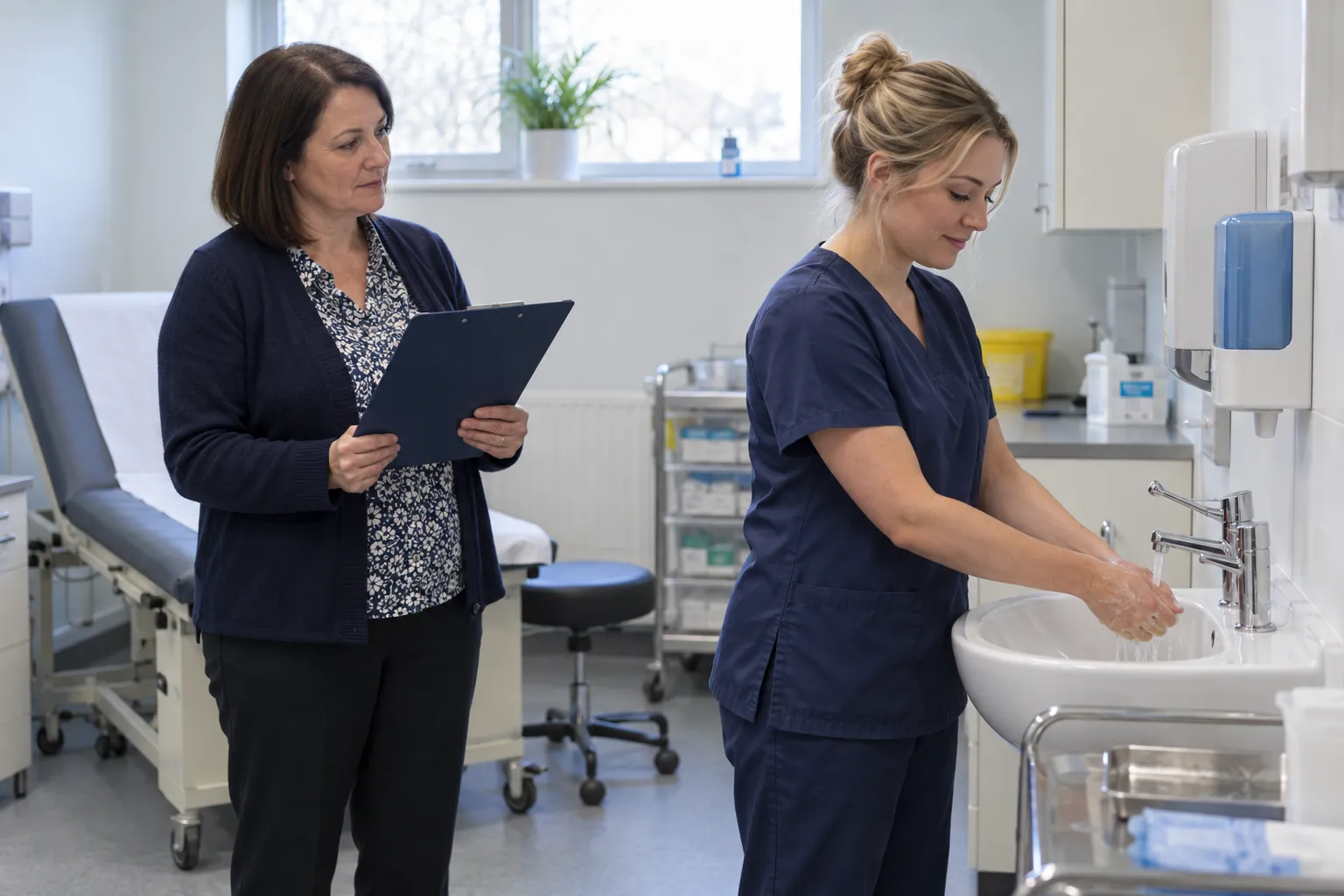 CleaningHygiene audit: what is checked, who does it, and what happens nextHow hygiene and infection prevention audits work in care, healthcare, schools and food areas: what is audited, by whom, how it is scored and what follows.
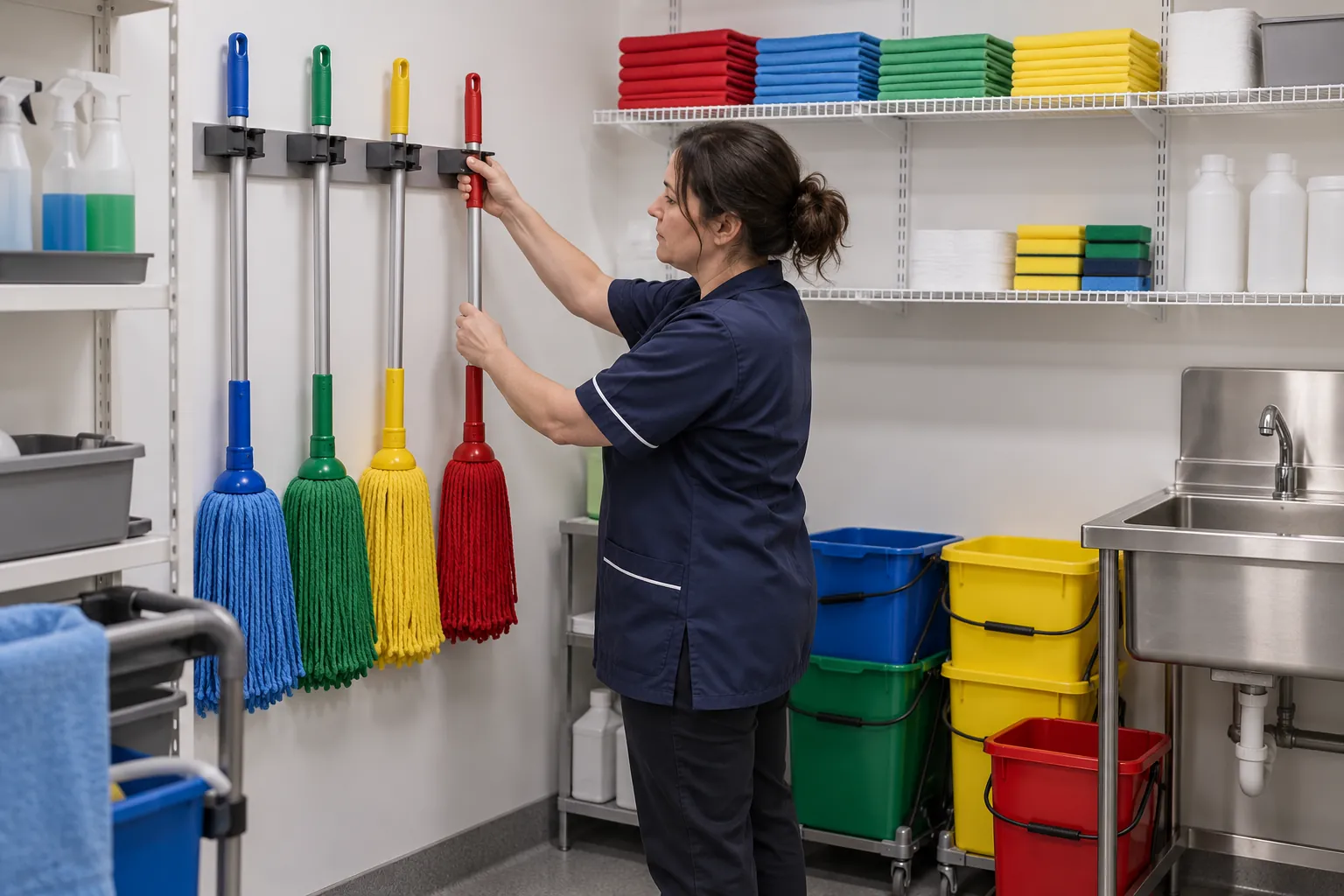 CleaningCleaning colour coding: the four colours, whose scheme they are, and how to keep to themThe UK cleaning colour code explained: red, blue, green and yellow, whose scheme it is, what COSHH does not say, and how to check colour coding is kept on site.
 CleaningCleaning specification: what it should say, and how to show it is metWhat a cleaning specification should contain, input and output standards, setting frequencies by area, and how to show the specification is being delivered.
 Fire and water checksFire safety in care homes: the law, the routine checks and the drillsFire safety in UK care homes: who is responsible, horizontal evacuation, the daily to annual checks, night-time drills and the records the law and guidance expect.