Fire and water checks
Fire safety in care homes: the law, the routine checks and the drills
Fire safety in care homes in England and Wales is the legal duty of the responsible person under the Regulatory Reform (Fire Safety) Order 2005, usually the registered provider as employer, who must assess and record the fire risk, keep the fire precautions maintained and plan an evacuation the home's own staff can carry out at any hour, including at night.
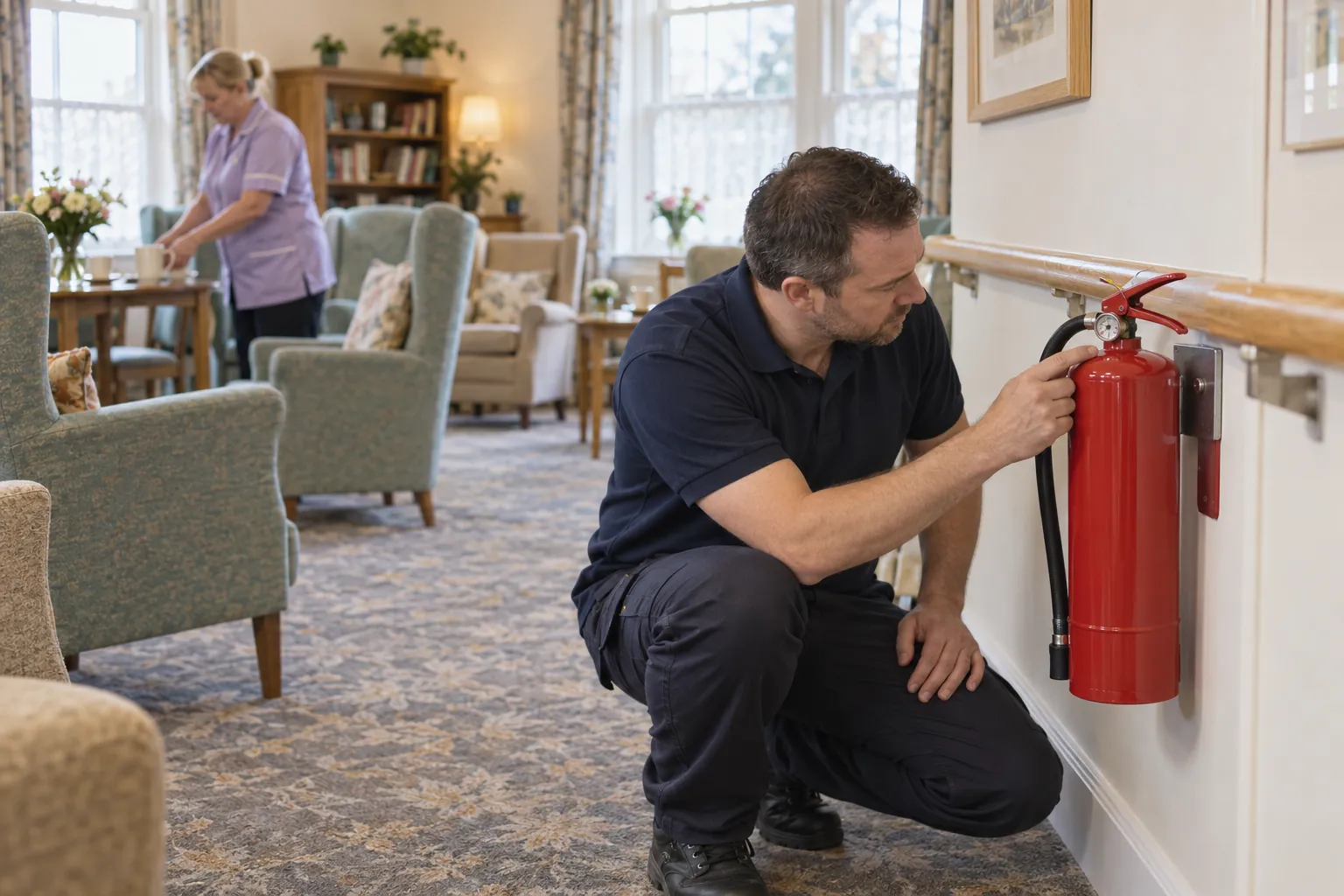
Scotland has equivalent duties under the Fire (Scotland) Act 2005, and Northern Ireland under the Fire Safety Regulations (Northern Ireland) 2010. This guide is for care home managers and maintenance staff: the law and the official guidance, the checks from daily to annual, drills with night staffing, and the records to keep.
01
The law on fire safety in care homes, and who it falls on
In England and Wales a care home is non-domestic premises covered by the Regulatory Reform (Fire Safety) Order 2005. Article 3 makes the responsible person the employer, where the workplace is to any extent under their control, and otherwise the person in control of the premises for a business or other undertaking, or the owner. In practice that is the registered provider, with the registered manager running fire safety day to day. Where the building's owners are a separate landlord, both can hold duties for the parts they control.
The Order's core legal requirements for a care home are these:
- Assess and record the risk. Article 9 requires a suitable and sufficient fire risk assessment, reviewed regularly. Since 1 October 2023 every responsible person must record the assessment and each review, including its findings, the measures taken or to be taken, and any group identified as especially at risk. In a care home that group is the residents, many of them vulnerable people who need assistance to escape.
- Keep escape routes usable. Article 14 requires routes to emergency exits and the exits themselves to be kept clear at all times, and emergency doors not to be locked or fastened so that they cannot be easily and immediately opened.
- Plan for an emergency. Article 15 requires appropriate procedures, including safety drills, and enough competent persons to carry out the evacuation.
- Maintain the precautions. Article 17 requires the premises and the fire safety equipment to be subject to a suitable system of maintenance and kept in efficient working order and good repair.
- Train the staff. Article 21 requires adequate safety training at induction and when risks change, repeated periodically where appropriate, during working hours.
- Appoint competent help. Article 18 requires one or more competent persons to assist with the preventive and protective measures: people with sufficient training and experience or knowledge and other qualities to do so properly.
In England, regulation 15 of the Health and Social Care Act 2008 (Regulated Activities) Regulations 2014, one of the fundamental standards, also requires a registered provider's premises and equipment to be clean, secure, suitable for their purpose, properly used, properly maintained and appropriately located. The fire and rescue service enforces the Order; the Care Quality Commission inspects the care.
In Scotland, section 53 of the Fire (Scotland) Act 2005 requires each employer to assess the workplace for fire risk and take the fire safety measures needed, and section 54 places duties on anyone with control of relevant premises. In Northern Ireland the duties are in the Fire Safety Regulations (Northern Ireland) 2010.
02
Progressive horizontal evacuation, and the staff it depends on
The government guide for these buildings, Fire safety risk assessment: residential care premises, is published under article 50 of the Order and applies to England. It is written for permanently staffed premises providing residential care where some or all of the residents might need assistance to get out in a fire. It describes three evacuation strategies:
- Single stage evacuation: everyone leaves at once to a place of total safety, suitable where residents are predominantly independent.
- Progressive horizontal evacuation: residents are moved from the area affected by fire, through a fire-resisting barrier, to an adjoining protected area on the same level, where they wait in safety or move on down a protected route. Other than small premises where residents can leave quickly to open air, the guide says care premises should develop this strategy.
- Delayed evacuation: exceptionally, where it is not desirable or practical to move a resident at once, for example because of a medical condition or treatment, they stay in their room, which needs enhanced structural fire protection, while the fire is dealt with or they are prepared for evacuation, with an evacuation plan still in place.
Horizontal evacuation relies on the sleeping areas being divided into protected areas, separated on the same level by walls and doors giving at least 30 minutes of fire resistance, each with at least two exits to adjoining areas. That is why the corridor fire doors matter so much in a care home: they are the barrier the plan moves people through.
The guide says the home must not depend on the fire and rescue service to evacuate residents safely. The number of beds in each sub-compartment should depend on the minimum number of staff awake and available, normally the night-time level, and the provider should be able to show the enforcing authority, for example by a fire drill, that it always has enough staff to carry out the emergency plan without outside help. London Fire Brigade's advice for residential care homes names staffing that does not support the evacuation strategy, especially at night, as a common concern.
Each resident's needs are part of the plan. The guide's staff training covers evacuation for residents who need assisted escape, and the Scottish guidance's staff training covers the personal evacuation needs unique to each resident. In practice that means knowing who can walk with a prompt, who needs a wheelchair or an evacuation aid, and who may not respond to the alarm. Many homes write these down as a personal emergency evacuation plan (PEEP) for each resident, reviewed when their care needs change.
03
The routine fire safety checks in a care home
The residential care guide gives examples of checks, saying they are not prescriptive. You, or a person you nominate, can carry out the routine checks; servicing may need a competent engineer.
- Daily. Security devices on fire exits do not impede escape; doors on escape routes swing freely and close fully; escape routes are clear of obstructions and combustible materials; the fire alarm panel shows the system active; emergency lighting units look in good repair, where practicable; safety signs are legible. The guide also says to establish a routine for closing all compartmentation corridor fire doors at night.
- Weekly. Test the fire detection and warning system following the manufacturer's or installer's instructions, and check that fire extinguishers and hose reels are in place and in apparent working order. The guide's example checklist asks whether staff heard the alarm and whether linked systems such as magnetic door holders released. See the weekly fire alarm test.
- Monthly. Test the emergency lighting when it will not be needed straight afterwards, and check that all fire doors are in good working order, closing correctly, with frames and seals intact.
- Six-monthly. A competent person tests and maintains the emergency lighting and the fire detection and warning system.
- Annually. A competent person tests and maintains all firefighting equipment, fire alarms and other installed systems, and the structural fire protection and compartmentation are inspected.
Scotland's Fire safety: existing care homes, practical guidance (February 2022) sets the weekly test as activating a manual call point, usually with a test key, using a different call point each week.
The residential care guide says all residential care homes should have automatic fire detection that actuates the warning system; detectors can sense smoke, heat, a combination of both, or carbon monoxide. The category and design, for which the guide points to the British Standard BS 5839-1, are for the fire risk assessor and the installer; the routine checks keep what is installed working.
04
Fire doors, smoking, emollients and the hazards particular to care
Fire doors wedged open. Self-closing corridor doors can be an obstacle to residents, and the residential care guide suggests closers with an electromagnetic hold-open function that release the door when the alarm sounds, adding that such doors should be closed at night. London Fire Brigade lists doors wedged open, letting fire spread through the building, among the problems it finds. The fire door checks guide covers gaps, seals and closers.
Smoking. London Fire Brigade lists smoking among the common fire risks in care homes (smoking-related fires are 13% of those it records there), advises against supporting smoking in bedrooms and, where smoking is allowed, suggests strict control such as supervised smoking. The residential care guide adds deep, substantial ashtrays emptied daily into a metal bin taken outside, never into plastic sacks left indoors, and inspections of smoking areas once vacated at night.
Emollients. The Medicines and Healthcare products Regulatory Agency's Drug Safety Update on emollients and the risk of severe and fatal burns (December 2018) warns that clothing, bedding or bandages in contact with an emollient, with or without paraffin, can catch fire quickly, and that washing at high temperature reduces the build-up but does not remove it. That links the care plan to the smoking policy and the laundry.
Electrical equipment. The residential care guide calls electrical equipment a significant cause of accidental fires, naming overloaded sockets, coiled cables, poorly maintained electric blankets and combustible materials placed too close to equipment that gives off heat. It says equipment should be installed and maintained in a safe manner by a competent person, and that portable equipment, including items staff bring in, should be visually inspected and portable appliance tested at intervals suited to its type and use, pointing to the Health and Safety Executive's guidance.
Oxygen. The residential care guide's training list includes the risks of bottled or piped oxygen, and London Fire Brigade asks carers to learn the risks of specialist healthcare equipment and emollient creams, and publishes a separate note on oxygen therapy covering oxygen cylinders. Where a resident uses oxygen, the fire risk assessment should say so.
05
Fire drills, training and the records to keep
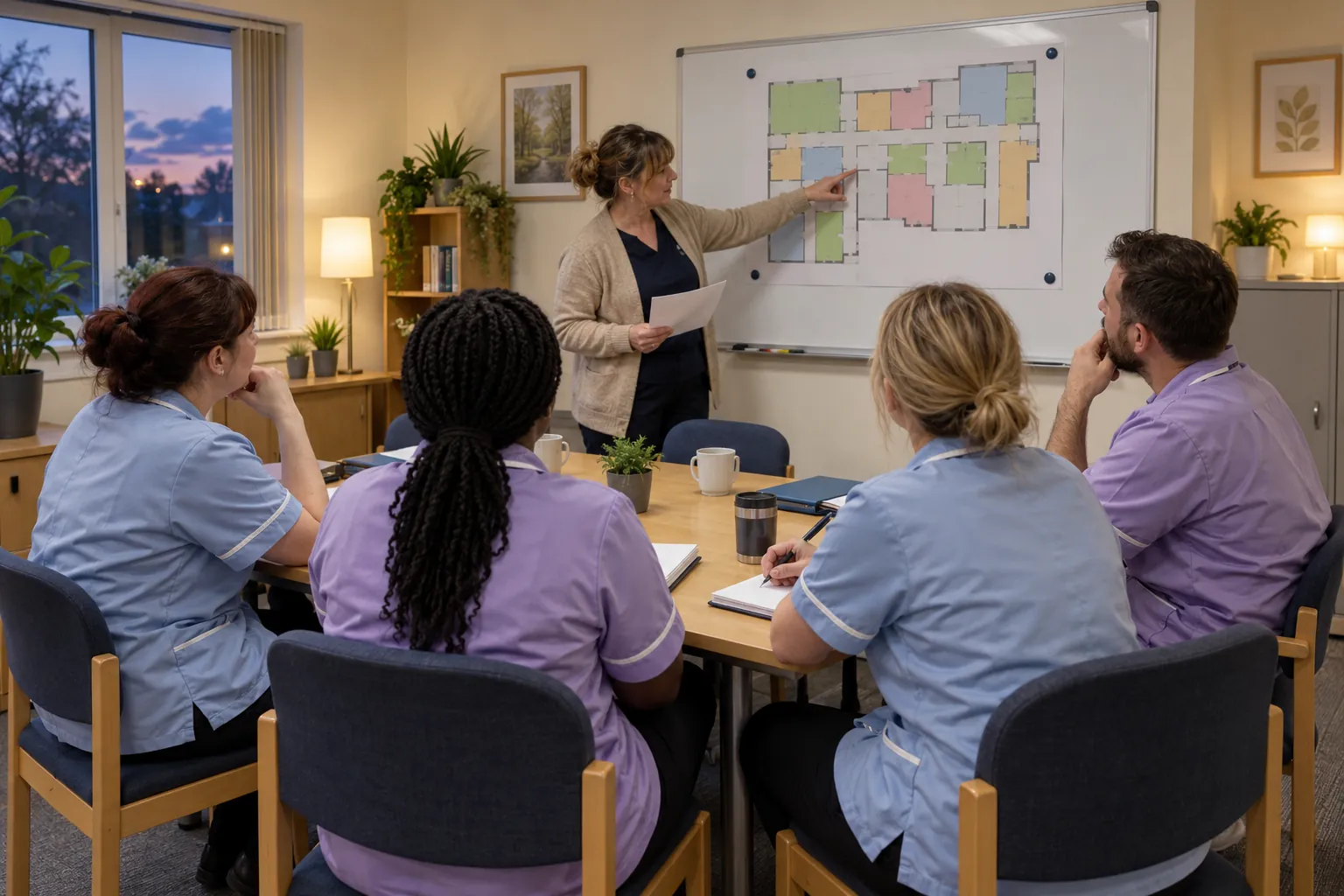
In England the residential care guide says a fire drill should be carried out at least annually or as the fire risk assessment determines, and more often with high staff turnover. Its suggested objectives include testing the procedure with minimum staff levels and familiarising residents with it, and it says properly simulated drills include residents, or a significant number of them, where their condition permits. It advises one drill at night or under simulated night-time conditions, including night staffing, and including regular respite residents in some drills. Observers watch the time taken to move residents who are not fully mobile.
Scotland's guidance is firmer: drills at least twice a year, every member of staff taking part at least once a year, and some drills when staffing is at its minimum. It also says each home should have one named individual with overall responsibility for co-ordinating fire safety management. The fire drill procedure guide covers running a drill step by step.
Fire safety training runs at induction, when the plan or responsibilities change, and often enough that staff stay familiar with the procedures. The residential care guide's training list includes keeping fire doors closed, using protected areas for horizontal evacuation, assisted escape, and drills with and without residents; the Scottish guidance adds manual handling training for staff who move residents during an evacuation.
The residential care guide says the quality of records may be regarded as a good indicator of the overall quality of safety management, and suggests a log book of all maintenance and testing. Its list of fire safety records includes:
- the significant findings of the fire risk assessment and the action taken;
- checks of escape routes, including final exit locks and electromagnetic devices;
- weekly alarm tests, maintenance by a competent person, and false alarms;
- emergency lighting tests and maintenance;
- training given and evacuation drills held;
- alterations, tests, repairs and maintenance of fire safety systems, including fire doors;
- near misses, lessons learned and the remedial action taken.
The Scottish guidance says maintenance and testing records can be electronic or on paper and should be kept for at least three years for possible audit by the enforcing authority. See the fire safety log book guide.
06
Where the record fails, and what SiteClara does about it
In a care home the fire checks compete with care. The night carer meant to close the corridor doors at ten is with a resident who has fallen; the weekly alarm test is done at whichever call point is nearest; the fire door that will not close fully is mentioned at handover and nobody owns it. The log book shows a test signed each week, the same call point every time, and nothing about the door.
SiteClara is built for the routine checks and the jobs that come out of them. A printed QR poster, with an NFC tag behind it if staff prefer to tap, sits at each point the maintenance team or night staff check: the fire alarm panel, the corridor fire doors between protected areas, the final exits. Staff scan or tap with their own phone, with no app to install, see the checks due there and mark each one done, or explain what stopped them. The time and the named person are recorded as it happens, with a photo when one helps, such as a failed closer or an exit blocked by a hoist.
A fault found on a round is reported at that point and goes onto the team's list of jobs until someone closes it. The supervisor sees which checks are due, done and missed, records why one was missed, and can escalate a job to the building manager. Each day the supervisor approves a report that goes to nominated management or client contacts the next morning, showing what was completed and what is still open.
07
Questions people ask
Who is responsible for fire safety in a care home?
The responsible person under article 3 of the Regulatory Reform (Fire Safety) Order 2005: the employer where the workplace is under their control, otherwise the person in control of the premises or the owner. In a care home that is usually the registered provider, with the registered manager running fire safety day to day.
What are the new fire regulations for care homes in England?
Since 1 October 2023, as Check your fire safety responsibilities under Section 156 of the Building Safety Act 2022 explains, every responsible person under the Order must record the fire risk assessment in full, including all the findings, and the fire safety arrangements for the premises. They must also record the name of any fire risk assessor they employ, take reasonably practicable steps to identify any other responsible persons for the premises, and pass relevant fire safety information to whoever takes over from them.
What are the 5 steps of fire safety?
GOV.UK's Fire safety in the workplace: fire risk assessments gives five steps for a fire risk assessment: identify the fire hazards; identify people at risk; evaluate, remove or reduce the risks; record your findings, prepare an emergency plan and provide training; and review and update the assessment regularly.
How often should fire drills be carried out in care homes?
In England, Fire safety risk assessment: residential care premises says at least annually or as the fire risk assessment determines, and advises one drill at night or under simulated night-time conditions with night staffing levels. In Scotland the practical guidance for existing care homes says at least twice a year, with every member of staff taking part at least once a year.
What type of fire alarm does a care home need?
Fire safety risk assessment: residential care premises says all residential care homes should have automatic fire detection, and points to a category L1 system under BS 5839-1 for larger homes, particularly those with more than ten residents above the ground floor or where a significant proportion of residents depend on staff assistance to escape in the event of a fire. The fire risk assessment decides what a particular building needs.
08
Further reading, and a care home fire safety checklist
In England, start with Fire safety risk assessment: residential care premises. In Scotland, read Fire safety: existing care homes, practical guidance (2022). London Fire Brigade's residential care homes page is a short read for managers, and your local fire and rescue service will advise on your evacuation strategy.
A checklist for the manager and the maintenance team:
- the fire risk assessment is recorded, reviewed after changes to the building, residents or staffing, and names vulnerable residents as especially at risk;
- the evacuation strategy works at night-time staffing, and a drill has shown it;
- each resident's evacuation needs are written down and reviewed when their care changes;
- escape routes, exits and the panel are checked daily, and corridor fire doors closed at night on a set routine;
- the alarm is tested weekly at a different call point, with door holders checked;
- emergency lighting and fire doors are checked monthly, with servicing six-monthly and annually;
- smoking, emollients and oxygen are in the fire risk assessment and the care plans;
- drills include night conditions and minimum staffing, and their problems become actions with an owner;
- faults found on any check are logged, owned and closed.
Sources
Every document this guide quotes or links to, in the order it first cites them.
- Regulatory Reform (Fire Safety) Order 2005 legislation.gov.uk
- Article 9 legislation.gov.uk
- Article 14 legislation.gov.uk
- Article 15 legislation.gov.uk
- Article 17 legislation.gov.uk
- Article 21 legislation.gov.uk
- Article 18 legislation.gov.uk
- Regulation 15 of the Health and Social Care Act 2008 (Regulated Activities) Regulations 2014 legislation.gov.uk
- Section 53 of the Fire (Scotland) Act 2005 legislation.gov.uk
- Section 54 legislation.gov.uk
- The Fire Safety Regulations (Northern Ireland) 2010 legislation.gov.uk
- Fire Safety (England) Regulations 2022 legislation.gov.uk
- Specialised housing guidance nfcc.org.uk
- Fire safety risk assessment: residential care premises gov.uk
- London Fire Brigade's advice for residential care homes london-fire.gov.uk
- Fire safety: existing care homes, practical guidance gov.scot
- Drug Safety Update on emollients and the risk of severe and fatal burns gov.uk
- Check your fire safety responsibilities under Section 156 of the Building Safety Act 2022 gov.uk
- Fire safety in the workplace: fire risk assessments gov.uk
- Fire safety: existing care homes, practical guidance gov.scot
Related guides
 Fire and water checksPersonal emergency evacuation plans: who needs one, what goes in it, and keeping it trueWhat a PEEP is, when the law requires one at work and in high-rise flats, how to write and review it, and the checks the plan depends on.
 Fire and water checksFire drill procedure: planning, running and recording a fire drillHow to plan and run a fire drill in a UK workplace, how often the guidance says to hold one, what the law requires, and what the fire drill record should show.
 Fire and water checksWeekly fire alarm test: how to do it, and what to recordWeekly fire alarm test: how to carry out the test BS 5839-1 recommends, rotating call points, what to record, and what only a competent person can do.
 Fire and water checksFire safety checks in the workplace: what to check, how often, and who does itThe routine fire safety checks a UK workplace needs, from daily escape routes to the weekly alarm test, who does each one, and what the record should show.