Premises and facilities management
Ladder inspection: the daily check, the recorded inspection, and the tag that shows it
Ladder inspection at work in Great Britain has two layers: a pre-use check by the user at the start of each working day, and a detailed visual inspection by a competent person at fixed intervals, recorded under regulation 12 of the Work at Height Regulations 2005.

The pre-use check stops a damaged ladder being climbed today; the recorded inspection shows the employer is keeping every ladder and stepladder in a safe condition over time. This guide covers the law, a ladder inspection checklist for both layers, how often and by whom, ladder tagging and registers, and what to do with a ladder that fails.
01
The law on ladder inspection
Ladders at work in Great Britain are covered by the Work at Height Regulations 2005, regulation 12 (inspection of work equipment). The Regulations define a ladder as including a fixed ladder and a stepladder, and regulation 12 applies to the equipment listed in their schedules, ladders among them. It requires every employer to ensure that work equipment exposed to conditions causing deterioration which is liable to result in dangerous situations is inspected at suitable intervals, and each time exceptional circumstances liable to jeopardise its safety have occurred, so that any deterioration can be detected and remedied in good time.
Three further parts of regulation 12 matter for ladders:
- Who inspects. An inspection means such visual or more rigorous inspection by a competent person as is appropriate for safety purposes, including any testing appropriate for those purposes.
- The record. The result of an inspection must be recorded and kept until the next inspection is recorded.
- Equipment that moves between organisations. Work equipment must not leave the employer's undertaking, or be used there if it was obtained from another undertaking, unless it is accompanied by physical evidence that the last inspection was carried out.
Ladders also have rules of their own. Schedule 6 of the Work at Height Regulations (requirements for ladders) says a ladder may be used for work at height only if a risk assessment has shown that more suitable work equipment is not justified because of the low risk and either the short duration of use or existing features on site which cannot be altered. It also requires a stable, firm surface and a secure handhold for the user. Regulation 5 (competence) requires anyone involved in work at height or in the equipment used for it, including its organisation, planning and supervision, to be competent or supervised by a competent person while being trained.
Ladders are work equipment too, so the general duty in regulation 5 of the Provision and Use of Work Equipment Regulations 1998 (maintenance), usually called PUWER, applies: work equipment must be maintained in an efficient state, in efficient working order and in good repair. Northern Ireland has its own Work at Height Regulations (Northern Ireland) 2005.
The reason it matters is stated plainly in HSE's foreword to LA455, the current ladder guidance described below: falls when working at height remain the most common kind of workplace fatality, accounting for around a quarter of all worker deaths and 8% of all non-fatal injuries every year, with many involving a fall off a ladder.
02
Pre-use checks and detailed visual inspections
HSE's Safe use of ladders and stepladders pages, and LA455 Safe use of ladders and stepladders: a brief guide, produced by the Ladder Association in co-operation with HSE, split ladder inspection into two layers. LA455 was released in July 2021 and replaces HSE's old leaflet INDG455; the current version is Version 1, Rev 1 (09/26).
- The pre-use check is carried out by the person using the ladder, at the beginning of the working day, and again after something has changed, for example when the ladder has been dropped or moved from a dirty area to a clean one. It is for the user's immediate benefit and, in the guidance's words, does not need to be recorded. Any problem is reported to a manager.
- The detailed visual inspection is the employer's responsibility. It is similar to a pre-use check, can be done on site by a competent employee, and should be carried out at fixed intervals, in accordance with the manufacturer's instructions, and recorded.
HSE's guidance on inspecting the condition of ladders puts the employer's side as a test: only use ladders or stepladders that have no visible defects, have an up-to-date record of the detailed visual inspections carried out regularly by a competent person, are suitable for the intended use, and have been maintained and stored in accordance with the manufacturer's instructions.
First, ask whether a ladder is the right equipment at all. HSE's guidance on how and when to use a ladder at work says that, as a guide, if a task would mean staying up a leaning ladder or stepladder for more than 30 minutes at a time, it is recommended you use other equipment.
03
A ladder inspection checklist
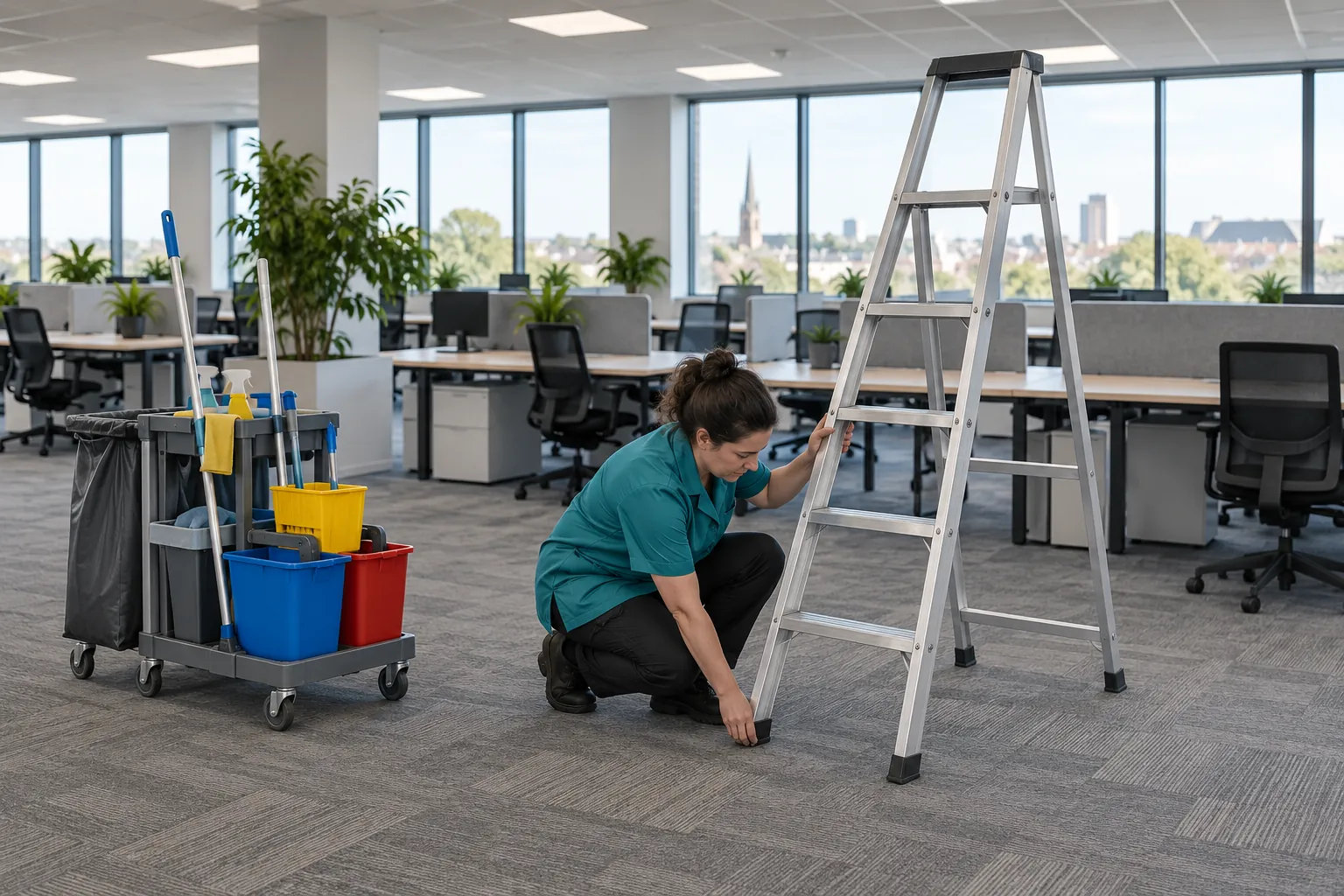
HSE's guidance on how to check your ladder is safe before you use it gives the pre-use check. The user should have access to the manufacturer's instructions, and should look at:
- the stiles: not bent or damaged, as the ladder could buckle or collapse;
- the feet: not missing, worn or damaged, and clean enough that the feet themselves, not soil, chippings or embedded stones, are in contact with the floor;
- the rungs: not bent, worn, missing or loose;
- any locking mechanism: working properly, with no bent, worn or damaged components or fixings, and any locking bars fully engaged;
- the stepladder platform: not split or buckled;
- the steps or treads on a stepladder: not contaminated and slippery, with no loose fixings.
If any of these is found, the guidance is simple: do not use the ladder, and tell the person in charge of the work.
The Ladder Association's guidance on inspecting a ladder lists what a detailed visual inspection looks for:
- damaged or worn ladder feet;
- twisted, bent or dented stiles;
- cracked, worn, bent or loose rungs;
- missing or damaged tie rods;
- cracked or damaged welded joints, loose rivets or damaged stays.
Telescopic ladders need their section locks checked before every use, in addition to the normal checks, and some important parts are inside where they cannot be seen. Combination ladders need their locking mechanism checked before use and again whenever the set-up changes. Stability devices and other accessories are checked and inspected in accordance with the manufacturer's instructions.
A useful inspection record, ladder by ladder, gives each ladder a unique reference and shows where it is kept, its type and the standard it is marked to, the date of the inspection, who carried it out, the result, any defect and what was done about it, and when the next inspection is due.
04
How often ladders are inspected, and who does it
Neither the regulations nor HSE's guidance names a number of months for ladder inspections. Regulation 12 says suitable intervals, and after exceptional circumstances; the guidance says fixed intervals, in accordance with the manufacturer's instructions. Figures such as every three or six months that appear in suppliers' checklists are a choice, not a legal limit. Set each interval from the manufacturer's instructions and how hard the ladder is used, write it down, and keep to it.
A ladder that has fallen, been struck or come back from loan needs inspecting outside the cycle.
Construction is the one place the regulations set a clock. Regulation 12 requires a working platform used for construction work, from which a person could fall 2 metres or more, to have been inspected in position within the previous 7 days, and HSE's ladder guidance says ladders that are part of a scaffold system still have to be inspected every seven days as part of the scaffold inspection.
In an ordinary non-domestic building the inspector is usually the site or premises manager, the caretaker, a maintenance technician, or the cleaning or security provider's supervisor for that provider's own ladders. Contractors usually bring their own ladders and, as employers, are responsible for inspecting them; a building can still ask to see a contractor's inspection record before work starts. Under regulation 14 (duties of persons at work), anyone working under another person's control must report to that person any activity or defect relating to work at height that they know is likely to endanger themselves or someone else.
05
Ladder tagging, registers, standards and a ladder that fails
Ladder tagging is attaching a tag or label to each ladder that shows its reference and its inspection status: when it was last inspected, by whom, and when the next is due. No regulation requires a tag as such. What the law requires is the record of each inspection, and physical evidence of the last inspection when a ladder leaves your organisation or arrives from another, such as a hired ladder or one borrowed from another contractor on site. A tag is one way to provide that evidence where the user can see it, so long as the register behind it is kept too. A tag that says inspected is only as good as the inspection behind it.
A ladder register is the list behind the tags: every ladder and stepladder in the building, its reference, where it lives, its type, and its inspection history.
Standards. BS EN 131 is the British and European standard for portable ladders: step, extending and combination. According to the Ladder Association's guide to ladder standards, it was substantially revised, with the revised standard in force from January 2019; Part 2 (requirements, testing, marking) is currently BS EN 131-2:2010+A3:2025, Ladders – Requirements, testing, marking. The Ladder Association's STEP guidance explains that ladders to the revised standard are classed as Professional or Non-Professional, both with the same 150 kg maximum total load; Non-Professional ladders are intended and designed for use only by domestic users in their homes and, in its words, are not intended or suitable for use in the workplace. The old British Standards BS 2037 and BS 1129 have been withdrawn, but product standards are not retrospective, so ladders made to them to the correct classification for work (the industrial Class 1, not the domestic Class 3) may still be used while in good condition, inspected regularly and with the inspection recorded.
A ladder that fails. Take it out of use immediately, mark it so nobody picks it up, and record the damage found. The Ladder Association's inspection course teaches repair and disposal procedures; follow the manufacturer's instructions on what can be repaired and by whom, and if a ladder cannot be made safe, dispose of it so it cannot find its way back into the store. Record the replacement on the register.
06
Where the record fails, and where SiteClara fits
Ladder inspection records fail in familiar ways. A sheet in the caretaker's office is filled in for every ladder in one sitting, in the same pen. Tags say inspected in March and nobody can show what was looked at. A defect spotted on a pre-use check is mentioned to whoever was passing, and the ladder is back in the store by the afternoon. The routine stops when the one person who did it leaves.
SiteClara records the check where the ladders are kept. A printed QR poster, with an optional NFC tag behind it, goes in each ladder store, plant room or cleaners' cupboard, so each store is its own location with its own scheduled check, such as the detailed visual inspection on the interval you set. The person inspecting scans the code or taps the tag on their own phone, with no app to install, sees the check due there, and marks it done or explains what stopped them, with the time, their name and a photo when one is asked for. Anyone who finds a damaged ladder can report it at the store with a photo, and it goes onto the team's list of jobs until someone deals with it and closes it.
Each day a supervisor reviews what was due, done and missed, records the reason a check was missed, and approves a daily report that goes to nominated management or client contacts at 8am the next morning, so a missed inspection shows the next day. SiteClara is the working record of who checked, where and when; your ladder register and the inspection record regulation 12 requires remain your own.
07
Questions people ask
What are the legal requirements for ladders in the UK?
In Great Britain, Schedule 6 of the Work at Height Regulations 2005 (requirements for ladders) allows a ladder to be used for work at height only if a risk assessment has shown that more suitable work equipment is not justified because of the low risk and either the short duration of use or features on site that cannot be altered, and requires it to stand on a surface that is stable, firm and strong enough safely to support it. Regulation 12 (inspection of work equipment) requires ladders exposed to conditions causing deterioration which is liable to result in dangerous situations to be inspected by a competent person at suitable intervals, with the result recorded and kept until the next inspection is recorded.
Are ladder tags a legal requirement in the UK?
No regulation requires a tag as such. Regulation 12 of the Work at Height Regulations 2005 requires the result of each inspection to be recorded, and a ladder that leaves your undertaking, or comes from another, to be accompanied by physical evidence that its last inspection has been carried out; a tag is one common way to show that.
How often do ladders have to be inspected?
HSE's guidance on inspecting the condition of ladders says a ladder should have a pre-use check each working day, and a detailed visual inspection at fixed intervals, in accordance with the manufacturer's instructions, with the result recorded. The law says suitable intervals and names no number of months.
Who is responsible for inspecting a ladder before it is used?
The person using the ladder should carry out the pre-use check at the beginning of the working day, according to HSE's guidance on how to check your ladder is safe before you use it. The detailed visual inspections, and their record, are the employer's responsibility.
Do ladders on scaffolding have to be inspected every 7 days?
Yes, ladders that are part of a scaffold system have to be inspected every seven days as part of the scaffold inspection, according to HSE's guidance on inspecting the condition of ladders. Regulation 12 of the Work at Height Regulations 2005 sets the 7-day rule for working platforms used for construction work from which a person could fall 2 metres or more.
What is the 4:1 rule for ladder safety?
It is the 1-in-4 rule in HSE's guidance on types of ladder and using them safely: a leaning ladder should be one unit out at the base for every four units up, which sets it at an angle of 75°.
08
Further reading, and a list to take away
HSE's Safe use of ladders and stepladders pages are the starting point, with LA455 as the printable version from the Ladder Association. HSE's Working at height (INDG401), a brief guide, covers the wider duties, including when a ladder is not the right choice.
Before the next inspection round, check that:
- every ladder and stepladder in the building is on a register with its own reference;
- each one has a recorded detailed visual inspection, with an interval set from the manufacturer's instructions;
- the people who inspect are competent, and named, with a deputy;
- users know how to do the pre-use check correctly and that a defective ladder is not used;
- a damaged ladder is taken out of use, marked and recorded the same day;
- hired and contractors' ladders arrive with evidence of their last inspection;
- work ladders are to BS EN 131 Professional, or older ladders of the correct class still in good, inspected condition;
- the risk assessment still shows a ladder is the right equipment for the task.
Sources
Every document this guide quotes or links to, in the order it first cites them.
- Work at Height Regulations 2005, regulation 12 (inspection of work equipment) legislation.gov.uk
- Schedule 6 of the Work at Height Regulations (requirements for ladders) legislation.gov.uk
- Regulation 5 (competence) legislation.gov.uk
- Regulation 5 of the Provision and Use of Work Equipment Regulations 1998 (maintenance) legislation.gov.uk
- Work at Height Regulations (Northern Ireland) 2005 legislation.gov.uk
- Safe use of ladders and stepladders hse.gov.uk
- LA455 Safe use of ladders and stepladders: a brief guide ladderassociation.org.uk
- Inspecting the condition of ladders hse.gov.uk
- How and when to use a ladder at work hse.gov.uk
- How to check your ladder is safe before you use it hse.gov.uk
- Ladder Association's guidance on inspecting a ladder ladderassociation.org.uk
- Ladders and Stepladders Inspection course ladderassociation.org.uk
- Regulation 14 (duties of persons at work) legislation.gov.uk
- Ladder Association's guide to ladder standards ladderassociation.org.uk
- BS EN 131-2:2010+A3:2025, Ladders – Requirements, testing, marking knowledge.bsigroup.com
- STEP guidance ladderassociation.org.uk
- Types of ladder and using them safely hse.gov.uk
- Working at height (INDG401) hse.gov.uk
Related guides
 Premises and facilities managementHealth and safety inspection checklist: what to look at, and what to do nextHow to run a workplace health and safety inspection: the legal basis, what to walk and look at, how often, recording findings and actions, and involving staff.
 Premises and facilities managementLOLER inspection: the thorough examination, the report, and the checks in betweenLOLER inspection in the UK: the 6 and 12 month thorough examination of lifts and lifting equipment, who can do it, the report, defects and the checks in between.
 Premises and facilities managementPAT testing: what the law requires, how often, and who can do itWhat PAT testing is, what the Electricity at Work Regulations 1989 require, how often to check and test each kind of equipment, who can do it, and what to record.
 Premises and facilities managementCaretaker duties: what the job involves, and how to show it was doneCaretaker duties in halls, churches, offices, flats and schools: opening and locking, routine checks, minor repairs, cleaning and working alone safely.