Premises and facilities management
PUWER inspection: what regulation 6 requires, who inspects, and what to record
A PUWER inspection is a check of work equipment by a competent person, visual or more rigorous and with testing where appropriate, that regulation 6 of the Provision and Use of Work Equipment Regulations 1998 requires where safety depends on how the equipment is installed, or where it is exposed to conditions causing deterioration that is liable to result in dangerous situations, with the result recorded and kept until the next inspection.
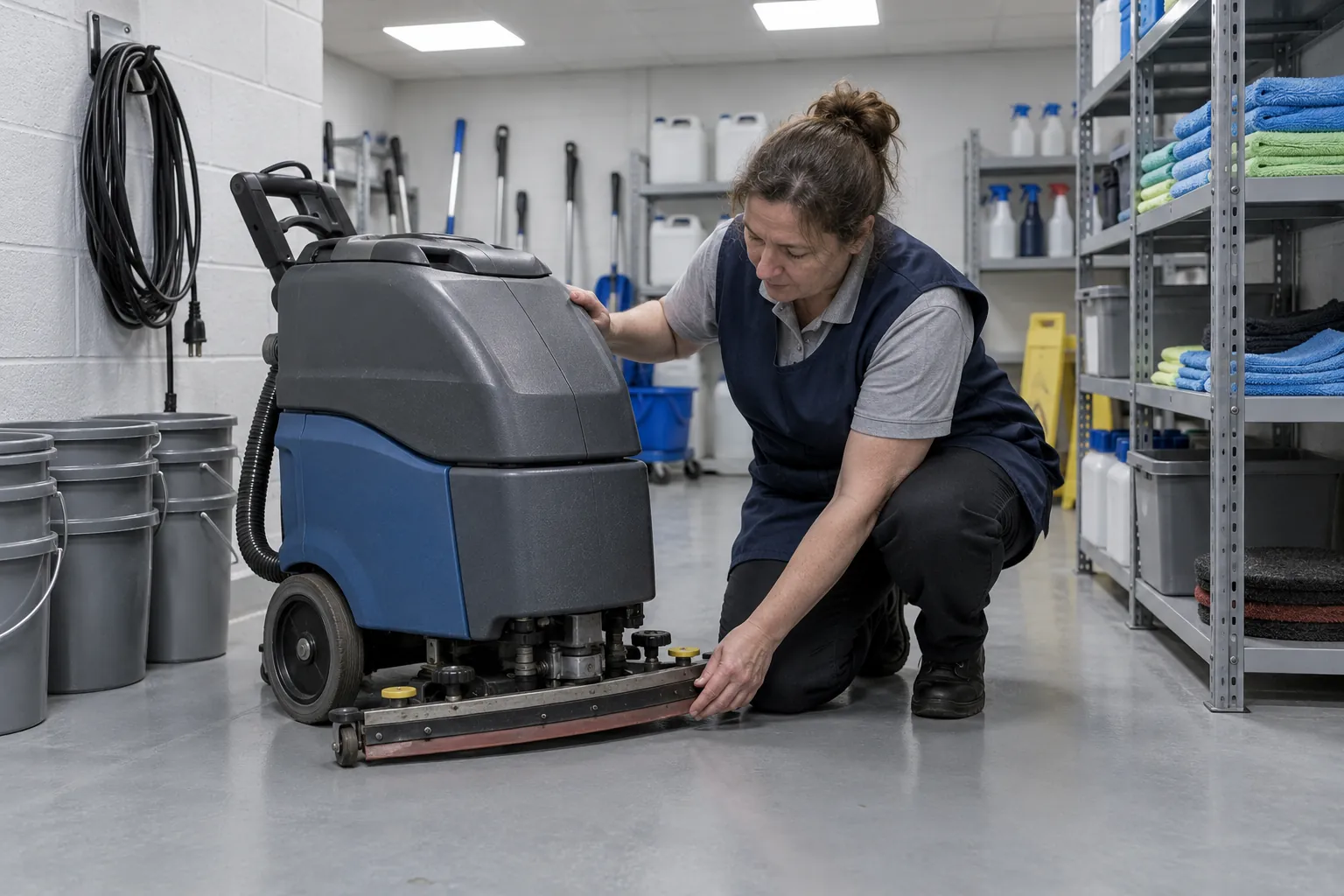
In a building, the equipment to consider is what the cleaning, maintenance, grounds and kitchen teams rely on: scrubber dryers and pressure washers, workshop machines, mowers, guillotines and food slicers. This guide covers the law, which equipment needs inspecting, who can carry out a PUWER inspection, how often, what the record should say, and the checks around it.
01
What a PUWER inspection is, and the law behind it
PUWER is the Provision and Use of Work Equipment Regulations 1998 (SI 1998/2306), regulation 6 (inspection). It requires every employer to ensure that work equipment is inspected:
- after installation, where its safety depends on the installation conditions: before first use, and after assembly at a new site or in a new location, to make sure it has been installed correctly and is safe to operate;
- at suitable intervals, where it is exposed to conditions causing deterioration which is liable to result in dangerous situations, so that any deterioration can be detected and remedied in good time;
- after exceptional circumstances liable to jeopardise its safety, each time they occur.
Regulation 6(3) requires the result of each inspection to be recorded and kept until the next inspection is recorded. Regulation 6(4) says equipment may not leave the undertaking, or be used in it when it comes from someone else's, unless it is accompanied by physical evidence that the last inspection was carried out.
Regulation 2 of PUWER (interpretation) defines an inspection as such visual or more rigorous inspection by a competent person as is appropriate for the purpose, including testing where appropriate, and work equipment as any machinery, appliance, apparatus, tool or installation for use at work.
Besides employers, under regulation 3 of PUWER (application) the duties also fall on a relevant self-employed person (one whose work is of a kind prescribed under the Health and Safety at Work etc. Act 1974), and on anyone who has control to any extent of work equipment or the way it is used, to the extent of their control. HSE's Approved Code of Practice, Safe use of work equipment (L22, fourth edition, 2014), says people in control of non-domestic premises who provide work equipment used by other people at work should comply with PUWER. PUWER applies in Great Britain; Northern Ireland has the Provision and Use of Work Equipment Regulations (Northern Ireland) 1999, with inspection in regulation 6.
02
Which work equipment needs a PUWER inspection
Not all of it, though the scope of PUWER is wide. HSE's page on inspection of work equipment says not all work equipment needs formal inspection and, in many cases, a quick visual check before use will be sufficient. L22 draws the line at significant risk: where the risk assessment identifies a significant risk to the operator or other workers from the installation or use of the equipment, a suitable inspection should be carried out. A significant risk is one which could result in an imminent failure that could lead to a major injury.
L22 says equipment unlikely to need an inspection includes office furniture, hand tools and non-powered machinery, and that inspection may not be necessary if safety is guaranteed through maintenance. Machines where people approach the danger zone in normal operation, such as paper-cutting guillotines, may need one. In an ordinary non-domestic workplace, the equipment to consider includes:
- cleaning machines: scrubber dryers, rotary floor machines and pressure water cleaners (L22 gives pressure water cleaners as an example of work equipment);
- workshop machines: pillar drills, bench grinders and saws;
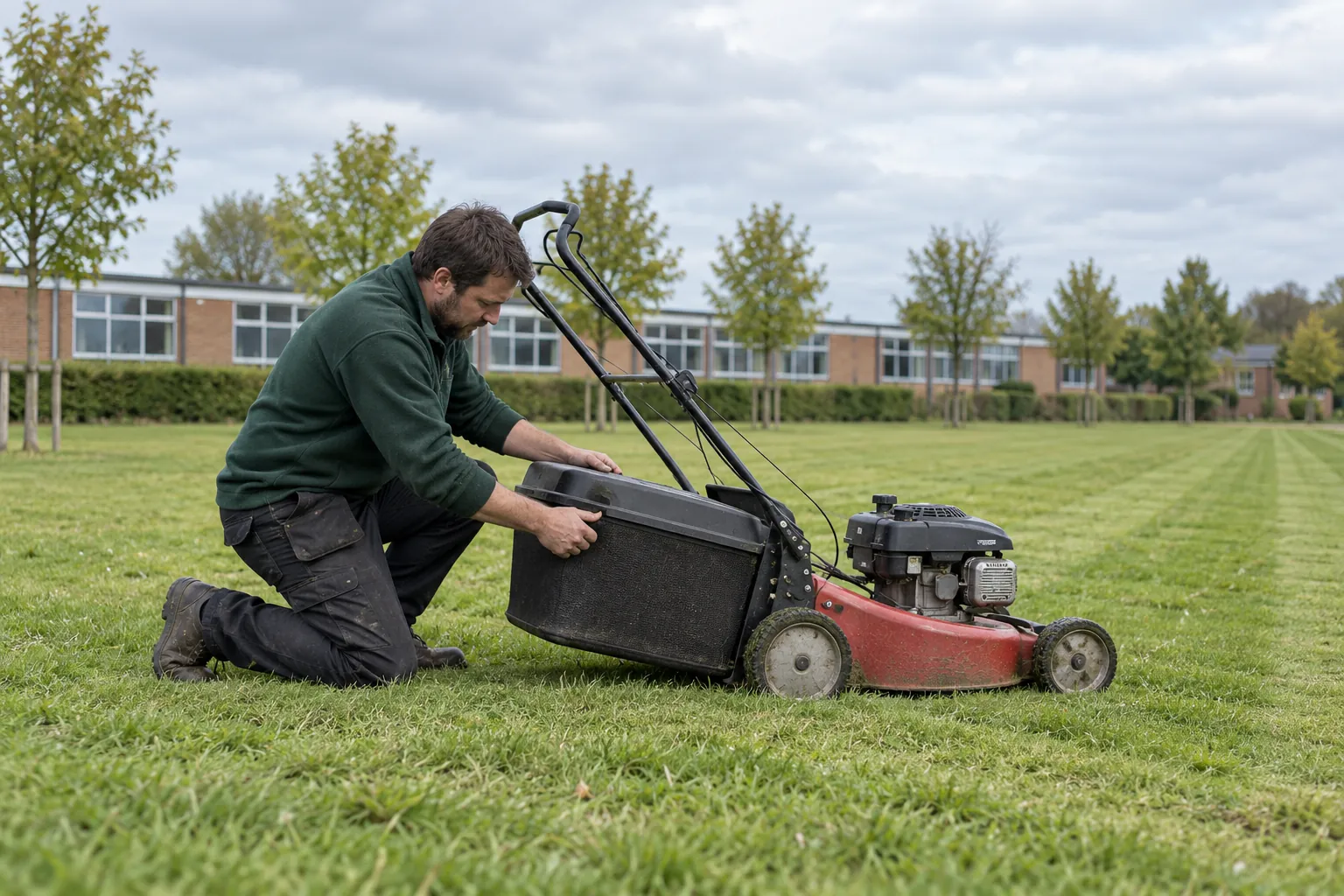
- grounds equipment: mowers, hedge trimmers and strimmers, used outdoors where wear is faster;
- reprographics and kitchen machines: guillotines, food slicers and mixers;
- waste equipment: compactors and balers in loading bays.
Whether each item needs a formal inspection, and how often, is a judgement for the risk assessment, not a rule of its type. A floor machine used for an hour a week on carpet is not the same risk as one run every night on a wet kitchen floor.
Electrical safety is a separate duty: regulation 4(2) of the Electricity at Work Regulations 1989 requires systems to be maintained so as to prevent danger so far as is reasonably practicable, and HSE's inspection page counts portable appliance testing among the more extensive examinations (see PAT testing).
03
Who can carry out a PUWER inspection, and how often
A competent person. HSE's inspection page says equipment can be inspected by anyone who has sufficient knowledge and experience of it to know what to look at, what to look for, and what to do if they find a problem.
L22 separates two jobs that need not be done by the same person:
- Deciding the nature of the inspection: what it should include, how it should be done and when. L22 says experienced in-house employees, such as a department manager or supervisor, may be able to do this.
- Carrying out the inspection: L22 says this can generally be done by an in-house employee who knows the key components, can find faults, and knows what to do about them (reporting faults, making a record, who to report to), given appropriate information, instruction and training.
Where that competence is not available in-house, L22 says the help of another body with relevant competence will be needed; in a building that is often the manufacturer, the supplier or a specialist inspection company. The actions of others, such as hire companies, can help, but L22 says they do not reduce the employer's own duty.
PUWER sets no fixed inspection interval. HSE says the frequency should be determined through risk assessment, taking account of the manufacturer's recommendations, industry advice and your own experience. L22 bases it on how quickly the equipment is likely to deteriorate and so give rise to a significant risk: equipment in frequent use in a harsh outdoor environment is likely to need inspecting more often than equipment used occasionally indoors. HSE adds that intervals can be increased if the inspection history shows negligible deterioration, or shortened where experience shows this is necessary.
An exceptional circumstance calls for an inspection whatever the schedule says. L22 lists major modifications, refurbishment or repair work; known or suspected serious damage; and a substantial change in the nature of use, for example after an extended period of inactivity.
04
What the inspection covers, and a PUWER checklist for the record
L22 says an inspection should include, where appropriate, visual checks, functional checks and testing. It will vary from a simple external look to a detailed inspection with some dismantling or testing, but it should always include the safety-related parts necessary for safe operation, such as overload warning devices and limit switches. A PUWER checklist for building equipment usually asks, alongside what the manual and risk assessment call for:
- is the equipment complete, stable and in good condition, free of damage, wear and corrosion?
- is the guarding in place and secure, and do interlocks stop the machine when a guard is opened?
- do the start, stop and emergency stop controls work?
- are the cable, plug, hose and any pressure parts free of defects and leaks?
- are warnings and markings present and legible?
- has anything changed since the last inspection: a repair, a new location, a different use?
There is no prescribed form. L22 says records can be handwritten or stored electronically, from a pre-printed form to an entry in a diary, and although no law states what they must contain, they should include:
- the type and model of equipment, and any identification mark or number;
- its normal location;
- the date of the inspection, and who carried it out;
- any faults, any action taken, and to whom the faults were reported;
- the date when repairs or other necessary action were carried out.
HSE's inspection page adds that an electronic record should be held securely and made available on request to any enforcing authority, and that records are not normally required for the simplest pre-use checks.
For the physical evidence regulation 6(4) asks for, L22 says a large item can travel with a copy of its last inspection record, and smaller items can carry a tag, colour code or label, so that a user can see whether an inspection has been done, whether it is current, and link back to the record. That matters when a cleaning contractor brings its own machines onto a client's site, or a hire company delivers one.
05
Around the inspection: pre-use checks, maintenance and training
L22 keeps the duties apart. It says inspection does not normally include the checks that are part of maintenance, and for regulation 6 does not include an operator's pre-use check; inspections need to be recorded, pre-use checks do not.
- Pre-use checks. The operator looks over the cable, the guard and the controls before use. No record is required, but a fault found must go somewhere: HSE's page on maintenance of work equipment recommends a procedure for workers to report damaged or faulty equipment.
- Maintenance. Regulation 5 of PUWER (maintenance) requires work equipment to be maintained in an efficient state, in efficient working order and in good repair, with any maintenance log for machinery kept up to date. L22 says no log is required, though one is recommended for high-risk equipment, and that where safety-critical parts could fail, planned preventative or condition-based maintenance is needed. A service visit is not automatically the regulation 6 inspection: if it is meant to be one, agree what it covers and make sure the result is recorded.
- Training. Regulation 9 of PUWER (training) requires everyone who uses work equipment, and every employee who supervises or manages its use, to have received adequate training for purposes of health and safety.
Shared buildings need agreement. The contractor's floor machines are its own to inspect, but the building's guillotine, workshop and mower may belong to the landlord, the occupier or another contractor. L22 says that where several dutyholders share the use of equipment, they must agree among themselves that one of them takes responsibility for ensuring it complies with PUWER. For each item that needs inspecting, a building should be able to show:
- where it is, who owns it, and who inspects it;
- what the inspection covers, how often, and who decided;
- the last result, kept until the next is recorded;
- each fault, who it was reported to, and when it was put right;
- faults reported between inspections, and when the item was taken out of use and returned.
06
Where the record fails, and what SiteClara does about it
The PUWER inspection itself is rarely the gap; the record around it is. The engineer services the scrubber dryer and leaves a sticker, but nobody on site knows what was found. The weekly guard check in the workshop becomes a column of initials filled in at the end of the month. An operative finds a split cable on a floor machine, mentions it to whoever is nearby, and the next shift uses it anyway.
SiteClara records the routine checks where the equipment lives. A printed QR poster, with an optional NFC tag behind it, goes in the cleaners' store, the workshop or the grounds shed. Staff scan or tap with their own phone, with no app to install, see the checks due there, such as the weekly check of the floor machines' guards and cables, and mark each one done or explain what stopped them. The time and the named person are recorded as it happens, with a photo when the check asks for one. A fault reported at the poster goes onto the team's list of jobs until someone closes it.
The supervisor sees what is due, done and missed, records the reason a check was missed, and approves a daily report that goes to nominated management or client contacts at 8am the next morning, showing what was reported, completed and still open.
07
Questions people ask
Are PUWER inspections a legal requirement?
Yes, where regulation 6 applies. Regulation 6 of the Provision and Use of Work Equipment Regulations 1998 requires an inspection after installation where safety depends on it, and at suitable intervals and after exceptional circumstances where equipment is exposed to conditions causing deterioration that is liable to result in dangerous situations, with the result recorded. Equipment whose failure cannot lead to significant risk may need only maintenance and a check before use.
Is a PUWER assessment mandatory?
PUWER does not use the term, but the risk assessment behind it is mandatory. Regulation 3 of the Management of Health and Safety at Work Regulations 1999 requires a suitable and sufficient assessment of the risks, with the significant findings recorded where there are five or more employees, and L22 says a significant risk from work equipment calls for a suitable inspection. See our risk assessment guide.
What is the difference between LOLER and PUWER?
PUWER covers all work equipment; LOLER adds duties for equipment that lifts or lowers loads. HSE's PUWER overview says lifting equipment must also meet the requirements of LOLER. Regulation 6(5) of PUWER takes it out of PUWER inspection; instead, where it is exposed to conditions causing deterioration, regulation 9 of the Lifting Operations and Lifting Equipment Regulations 1998 requires a thorough examination at least every 6 months for equipment lifting people and for lifting accessories, and at least every 12 months for other lifting equipment, unless an examination scheme sets other intervals.
What are the 5 hazards PUWER specifies?
Regulation 12 of PUWER (protection against specified hazards) lists articles or substances falling or being ejected; rupture or disintegration of parts; the equipment catching fire or overheating; the unintended or premature discharge of any article, gas, dust, liquid or vapour; and unintended or premature explosion. Exposure must be prevented or, where that is not reasonably practicable, adequately controlled, so far as is reasonably practicable by measures other than personal protective equipment or information, instruction, training and supervision.
What is not covered by PUWER?
HSE's Approved Code of Practice, Safe use of work equipment (L22), says livestock, substances such as cement and water, structural items such as walls, stairs and roofs, and private cars are not work equipment. It also says that providing work equipment for use by members of the public, such as lifts provided for the public in a shopping centre, carries no PUWER duties, though the Health and Safety at Work etc. Act 1974 still protects them.
08
Where to read the official guidance, and a list to take away
Start with HSE's pages on inspection of work equipment and maintenance of work equipment, then the leaflet Providing and using work equipment safely: A brief guide (INDG291). The Regulations, Approved Code of Practice and guidance are all in the L22 Approved Code of Practice, free to download from HSE; regulation 6 and its guidance are in paragraphs 80 to 106.
Before the next inspection, check that:
- every powered or safety-critical item on site is listed in an equipment register, with its owner and location;
- the risk assessment says which items need a formal inspection;
- a competent person has decided what each inspection covers and how often;
- the people inspecting are trained, and know what to look at, what to look for and what to do;
- lifting equipment and ladders are on their own LOLER and work-at-height regimes;
- each result is recorded and kept at least until the next;
- every fault has an owner and a date it was put right;
- contractors' and hired equipment arrives with evidence of its last inspection.
Sources
Every document this guide quotes or links to, in the order it first cites them.
- Provision and Use of Work Equipment Regulations 1998 (SI 1998/2306), regulation 6 (inspection) legislation.gov.uk
- Regulation 2 of PUWER (interpretation) legislation.gov.uk
- Regulation 3 of PUWER (application) legislation.gov.uk
- Safe use of work equipment (L22, fourth edition, 2014) hse.gov.uk
- Provision and Use of Work Equipment Regulations (Northern Ireland) 1999 legislation.gov.uk
- Inspection of work equipment hse.gov.uk
- Regulation 9 of the Lifting Operations and Lifting Equipment Regulations 1998 legislation.gov.uk
- Regulation 12 of the Work at Height Regulations 2005 legislation.gov.uk
- Regulation 4(2) of the Electricity at Work Regulations 1989 legislation.gov.uk
- Maintenance of work equipment hse.gov.uk
- Regulation 5 of PUWER (maintenance) legislation.gov.uk
- Regulation 9 of PUWER (training) legislation.gov.uk
- Regulation 3 of the Management of Health and Safety at Work Regulations 1999 legislation.gov.uk
- HSE's PUWER overview hse.gov.uk
- Regulation 12 of PUWER (protection against specified hazards) legislation.gov.uk
- Providing and using work equipment safely: A brief guide (INDG291) hse.gov.uk
Related guides
 Premises and facilities managementLOLER inspection: the thorough examination, the report, and the checks in betweenLOLER inspection in the UK: the 6 and 12 month thorough examination of lifts and lifting equipment, who can do it, the report, defects and the checks in between.
 Premises and facilities managementLadder inspection: the daily check, the recorded inspection, and the tag that shows itLadder inspection in the UK: the daily pre-use check, the recorded detailed visual inspection, a checklist, how often, who is competent, and ladder tagging.
 Premises and facilities managementPAT testing: what the law requires, how often, and who can do itWhat PAT testing is, what the Electricity at Work Regulations 1989 require, how often to check and test each kind of equipment, who can do it, and what to record.
 Premises and facilities managementRisk assessment: the five steps, and the checks that keep it trueWhat a workplace risk assessment is, what regulation 3 requires, HSE's five steps, what to write down, when to review it, and dynamic risk assessment on site.