Security patrols
Security guard duties and responsibilities: what the job involves, and how it is checked
A security guard's duties and responsibilities are to protect people, property and premises from harm, theft and unlawful activity by patrolling, controlling access, monitoring alarms and cameras, responding to emergencies and reporting what happens.

This guide sets out the duties and responsibilities of a security guard or security officer in the United States, how state licensing shapes the role, how duties differ between posts, what a guard may not do, and how a client or supervisor can tell the work is being done.
01
What a security guard is, and the state license behind the job
In the United States, security guard and security officer describe the same job; many companies prefer "officer," and many state laws still say "guard." The Bureau of Labor Statistics sums up the work in its Occupational Outlook Handbook entry for security guards: guards typically patrol property, monitor alarms and video-surveillance systems, control building access by employees and visitors, and write reports on what they observed while on duty. It also notes that because many buildings are open 24 hours a day, guards often work around the clock, in rotating shifts that include nights.
Most guards work for contract security companies that supply officers to clients; others are proprietary, or in-house, employed by the organization whose facility they protect. Either way, the job is licensed by the state, not the federal government. The BLS notes that most states require guards to be licensed in the state where they work, typically at least 18 years old, with a background check and completed training, and that armed guards face more stringent checks and entry requirements than unarmed guards.
The rules differ a great deal from state to state. Three large examples:
- California. The Bureau of Security and Investigative Services (BSIS) registers guards, a registration usually called a guard card. Under Business and Professions Code section 7583.6, every applicant completes a course in the exercise of the power to arrest and the appropriate use of force, then at least 32 hours of training in security officer skills within six months of registration (16 of them within the first 30 days), and eight hours of review or practice every year. The BSIS security guard fact sheet adds that a guard must have a valid, current registration card on their person while on duty.
- New York. The Department of State registers guards under the Security Guard Act, Article 7-A of the General Business Law. Its security guard training requirements are an 8-hour pre-assignment course before applying, a 16-hour on-the-job training course within 90 days of employment, and an 8-hour annual in-service course every calendar year, with a 47-hour firearms course before armed registration.
- Florida. The Department of Agriculture and Consumer Services licenses unarmed officers with a Class "D" license, and section 493.6303, Florida Statutes, requires at least 40 hours of professional training at a licensed school before an applicant can be licensed.
Texas, Illinois and most other states have their own boards and hour counts, and a handful regulate guards lightly or only at the city or county level. Check the licensing board in the state, and sometimes the city, where the post is before assuming a guard is properly credentialed.
02
The core duties of a security guard
New York's statute gives a useful short definition. Under General Business Law section 89-f, a security guard principally performs one or more of: protection of individuals and property from harm, theft or other unlawful activity; deterrence, observation, detection and reporting of incidents to prevent unlawful or unauthorized activity; street patrol service; and response to, but not installation or service of, a security system alarm. The security guard job description varies by post, but in practice the duties and responsibilities look much the same everywhere:
- Maintaining a visible presence. A guard in uniform at the front desk or walking the parking lot is the simplest deterrent a property has.
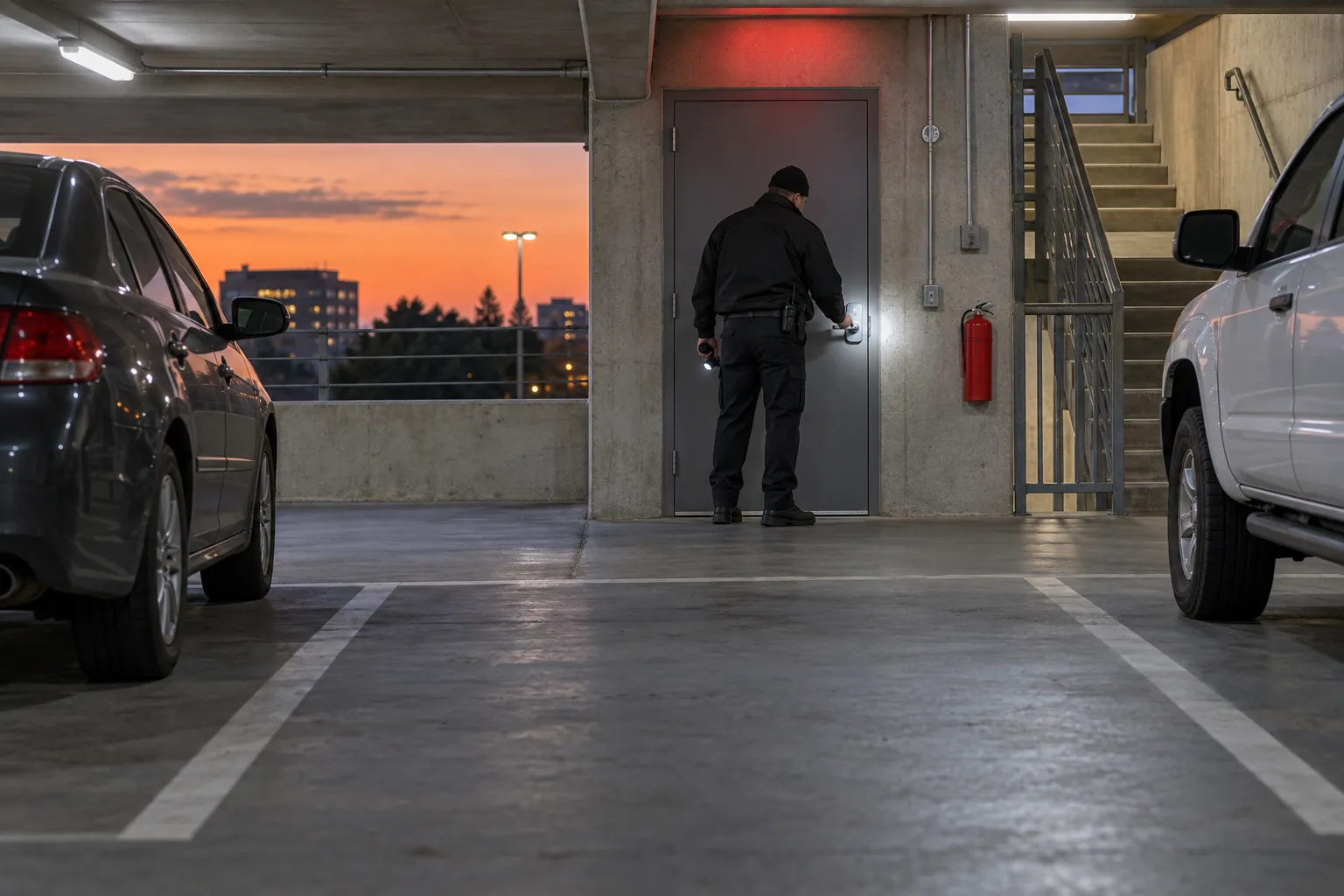
- Patrolling the premises, building and grounds, on set routes and at set times, and at irregular times too, checking doors, windows, gates, stairwells, roof hatches, loading docks and emergency exits.
- Access control: checking badges and credentials, signing in visitors, vendors and contractors, issuing and recovering keys and access cards, and refusing entry to people who should not be there.
- Monitoring security systems: CCTV, intrusion alarms, access control panels and, where the post includes it, the fire alarm control panel.
- Responding to alarms and incidents: checking alarm activations, dealing with trespassers, disputes and suspicious behavior, and calling 911 when the situation calls for police, fire or EMS.
- Emergency response: following the guard's part of the building's emergency action plan and procedures during a fire, medical emergency, severe weather, power outage or evacuation, and meeting first responders on arrival.
- Report writing: the daily activity report (DAR), incident reports, patrol records, key and visitor logs, and the pass-down log for the next shift.
- Reporting hazards and maintenance issues: broken locks, failed lighting, leaks, blocked exits and slip hazards, to the facility manager or building engineer who can fix them.
- Customer service: as the first point of contact for many visitors, giving directions, answering questions and assisting people calmly.
- Shift change: passing on open issues, keys out, alarms in trouble and anything that needs watching.
Behind every item on that list is one aim: the safety and security of the people who use the property, and a record that shows what was done to keep it that way.
03
How the responsibilities vary from post to post
Security guards have different responsibilities in different settings, and the site's post orders are where those differences, and the procedures the guard must follow, are written down. Some common posts:
- Office buildings and multi-tenant properties: a lobby or concierge post that is as much about visitor management, badges, deliveries and elevators as about guarding, with lock-up rounds in the evening and tenant satisfaction as part of the measure.
- Retail: a visible presence at the entrance and on the sales floor, supporting staff with difficult customers, following the store's loss prevention policy on shoplifting, and securing the store at close.
- Construction sites and vacant properties: perimeter patrols, gate control, checking equipment and materials, and deterring trespass and theft, often overnight.
- Warehouses and industrial sites: guard shack duties, truck and trailer checks at the gate, and patrols of large yards and buildings.
- Hospitals, campuses and public buildings: open properties with many entrances, where the work leans toward de-escalation, escorts and helping people rather than keeping them out.
- Residential and HOA properties: gatehouse access, amenity checks, parking enforcement under the association's rules, and responding to residents' calls.
- Events: crowd management, bag checks as a condition of entry, and working alongside off-duty police and event staff.
Additional duties may include a fire watch when a sprinkler or fire alarm system is impaired, lone worker checks, alarm response for a portfolio of properties, or reception and mailroom work. Whatever they are, they belong in the post orders, and the guard should have read them before the first shift.
04
What a security guard cannot do
Part of understanding the role is knowing its limits. A guard card or license is permission to work in private security; it does not make the holder a police officer.
- No police powers. A private security guard generally has the same arrest powers as any other private person in that state. In California, for example, Penal Code section 837 lets a private person arrest another for a public offense committed or attempted in their presence, or for a felony in the circumstances it sets out. Other states word this differently, and many employers forbid guards to detain anyone at all.
- Force within the law and the post orders. Any use of force must be lawful in the state and allowed by the employer's policy, which is often stricter than the law. California makes the appropriate use of force part of the training every guard completes before registration.
- Searches by consent. A bag check is usually a condition of entry that a person can decline, and refusing entry is the remedy.
- Exits stay usable. Security never outranks egress. Under OSHA's exit route rule, 29 CFR 1910.36, employees must be able to open an exit route door from the inside at all times without keys, tools or special knowledge, and exit route doors must be free of any device or alarm that could restrict emergency use if the device or alarm fails. Chaining or padlocking an exit while people are inside is never a security measure. (Federal OSHA covers most private employers; in the states that run OSHA-approved State Plans, the state's own rule applies, and local fire codes add their own requirements.)
- No work outside the license. An unarmed guard cannot carry a firearm on duty, and in many states a baton, pepper spray or other weapon, without the separate permit the state requires.
Guards who understand these limits are safer and more effective. When a situation goes beyond them, the guard's job is to observe, report and call the police. A guard who is unsure should ask the supervisor before acting, not after.
05
How duties are set, and how they are checked
The duties at any post should come from three documents: the security services contract, which sets the scope of service and the hours of coverage; the security assessment, which identifies the risks the security measures address; and the post orders, which tell the officer exactly what to do, when and how, including patrol routes and times, who to call for each kind of incident, and how to report. Where the building has an emergency action plan, the guard's part in it belongs in the post orders too. OSHA's emergency action plan standard, 29 CFR 1910.38, applies where another OSHA standard requires a plan, and lists its minimum elements, including procedures for reporting a fire or other emergency, for evacuation and exit route assignments, and for accounting for all employees afterward.
Workplace violence is part of many posts. OSHA's workplace violence page defines it as any act or threat of physical violence, harassment, intimidation or other threatening behavior at the work site, and notes there is currently no specific federal OSHA standard for it. Some states have gone further; California's workplace violence prevention plan requirement is one. The guard's role in the employer's plan should be written down, not assumed.
The security supervisor, site supervisor or account manager then checks the work. The usual methods are:
- Site inspections, announced and unannounced, including nights and weekends, to check that the officer is alert, in uniform, carrying the guard card or license where the state requires it, and following the post orders.
- Report review: reading daily activity reports, incident reports and the pass-down log for completeness, and for patterns that point to a change in what the property needs.
- Patrol evidence: a guard tour record showing each checkpoint was visited, when and by whom.
- Client feedback and KPIs: complaints, response times, incidents handled, and patrols completed against those scheduled.
- Training and license records: expiration dates, state-required annual training, site orientation, CPR and first aid, and any post-specific training.
Good guards need more than a license. Communication skills, customer service skills, professionalism, sound judgment and the ability to stay calm and handle difficult situations are what make security work effective, and the best way to show them is a clear, honest record of what happened on each shift.
06
Where the record fails, and where SiteClara fits
Most of what a good security guard does leaves no trace. A patrol that finds nothing is written up as "all secure," and a client who never sees a problem may start to wonder what the contract is paying for. The DAR written at 6 a.m. for the whole night, the broken door closer noted in the report but never passed to maintenance, and the round nobody can prove was walked are where confidence in a security contract erodes.
SiteClara gives the routine duties a record. A printed QR poster, with an optional NFC tag behind it, sits at each checkpoint on the patrol: a gate, an emergency exit, a mechanical room, a parking garage level. The officer scans the code or taps the tag on their own phone, with no app to install, and marks the scheduled check done, or says what stopped them, such as a locked door. The time and the named officer are recorded as it happens, with a photo when one helps. A hazard or maintenance issue found on the round is reported there and goes onto the team's list of jobs until someone closes it.
The security supervisor sees what is due, done and missed, and can record why a check was missed; a job that needs the building manager can be escalated to them to answer. At the end of the day the supervisor reviews the totals and photos, adds a note and approves the daily report, which goes to nominated management or client contacts at 8 a.m. the next morning, showing what was reported, what is still open and how the scheduled checks went.
07
Questions people ask
What are the main duties of a security guard?
The main duties of a security guard are to patrol property, enforce the employer's rules, monitor alarms and video surveillance, respond to emergencies, deter criminal activity, control access by employees and visitors, conduct security checks over a set area, and write reports on what they observed on duty. That is the list in the Bureau of Labor Statistics' Occupational Outlook Handbook entry for security guards; the post orders at each site say how those duties apply there.
What is a security guard not allowed to do?
A security guard is not allowed to act as a police officer: a private guard generally has only the arrest powers of any other private person in that state. In California, Penal Code section 837 limits a private person's arrest to a public offense committed or attempted in their presence, a felony the person arrested has committed, or a felony that has in fact been committed where there is reasonable cause to believe that person committed it. A guard also may not carry equipment the registration does not cover: Business and Professions Code section 7583.12 bars a guard from carrying or using a firearm without a valid firearm qualification card as well as the guard registration card, and the BSIS security guard fact sheet says anyone who carries a baton on duty must complete a course at a Bureau-approved baton training facility, and anyone who carries tear gas must complete a tear gas training course. Employers' post orders often restrict guards further.
Can a security guard legally handcuff someone?
A security guard can restrain someone only as part of a lawful arrest, and then only as much as is reasonable. In California, Penal Code section 835 says a person arrested "may be subjected to such restraint as is reasonable for his arrest and detention," and Penal Code section 847 requires a private person who arrests someone to take them before a magistrate or deliver them to a peace officer without unnecessary delay. Other states word this differently, and many employers forbid guards to handcuff or detain anyone, so the post orders decide what a guard may do at a given site.
08
Further reading, and a list to take away
The Bureau of Labor Statistics' Occupational Outlook Handbook describes the job, its work environment and the usual route in. Each state's licensing board publishes its own training hours, license classes and rules: in California the Bureau of Security and Investigative Services, in New York the Department of State, in Florida the Department of Agriculture and Consumer Services, and elsewhere the board named in the state's private security statute. OSHA publishes the exit route and emergency action plan standards and its guidance on workplace violence, and its State Plans page shows whether federal OSHA or a state program covers a given workplace.
Before a guard starts at a new post, check that:
- they hold the right state registration or license for the work, armed or unarmed, and it is current;
- their state-required training is complete, including any on-the-job hours due within the first weeks;
- they have read the post orders and signed that they understand them;
- they know the patrol routes, the checkpoints and the times;
- they know who to call for each kind of incident, and their part in the emergency action plan;
- they know how to write the DAR, incident reports and the pass-down log, and who reads them;
- they understand what they may and may not do, including arrests, force, searches and emergency exits;
- their supervisor has a plan for site inspections and report review.
Sources
Every document this guide quotes or links to, in the order it first cites them.
- Occupational Outlook Handbook entry for security guards bls.gov
- Business and Professions Code section 7583.6 leginfo.legislature.ca.gov
- BSIS security guard fact sheet bsis.ca.gov
- Security guard training requirements dos.ny.gov
- Section 493.6303, Florida Statutes flsenate.gov
- General Business Law section 89-f nysenate.gov
- Penal Code section 837 leginfo.legislature.ca.gov
- 29 CFR 1910.36 osha.gov
- OSHA-approved State Plans osha.gov
- Emergency action plan standard, 29 CFR 1910.38 osha.gov
- Workplace violence page osha.gov
- Business and Professions Code section 7583.12 leginfo.legislature.ca.gov
- Penal Code section 835 leginfo.legislature.ca.gov
- Penal Code section 847 leginfo.legislature.ca.gov
Related guides
 Security patrolsSecurity post orders: what they should say, and how to know they are followedSecurity post orders in the US: what they are, what state rules say, what to include, how to write, sign and review them, and how to check they are followed.
 Security patrolsSecurity daily activity report: what to include, and how to write one that holds upThe security daily activity report (DAR): what to record, how to write entries that hold up, how it differs from an incident report, and how to review and keep it.
 Security patrolsSecurity supervisor duties: running the shift, and knowing the posts are coveredSecurity supervisor duties in the US: running the shift, post inspections, training and license checks, incidents, emergencies, and proving the work was done.
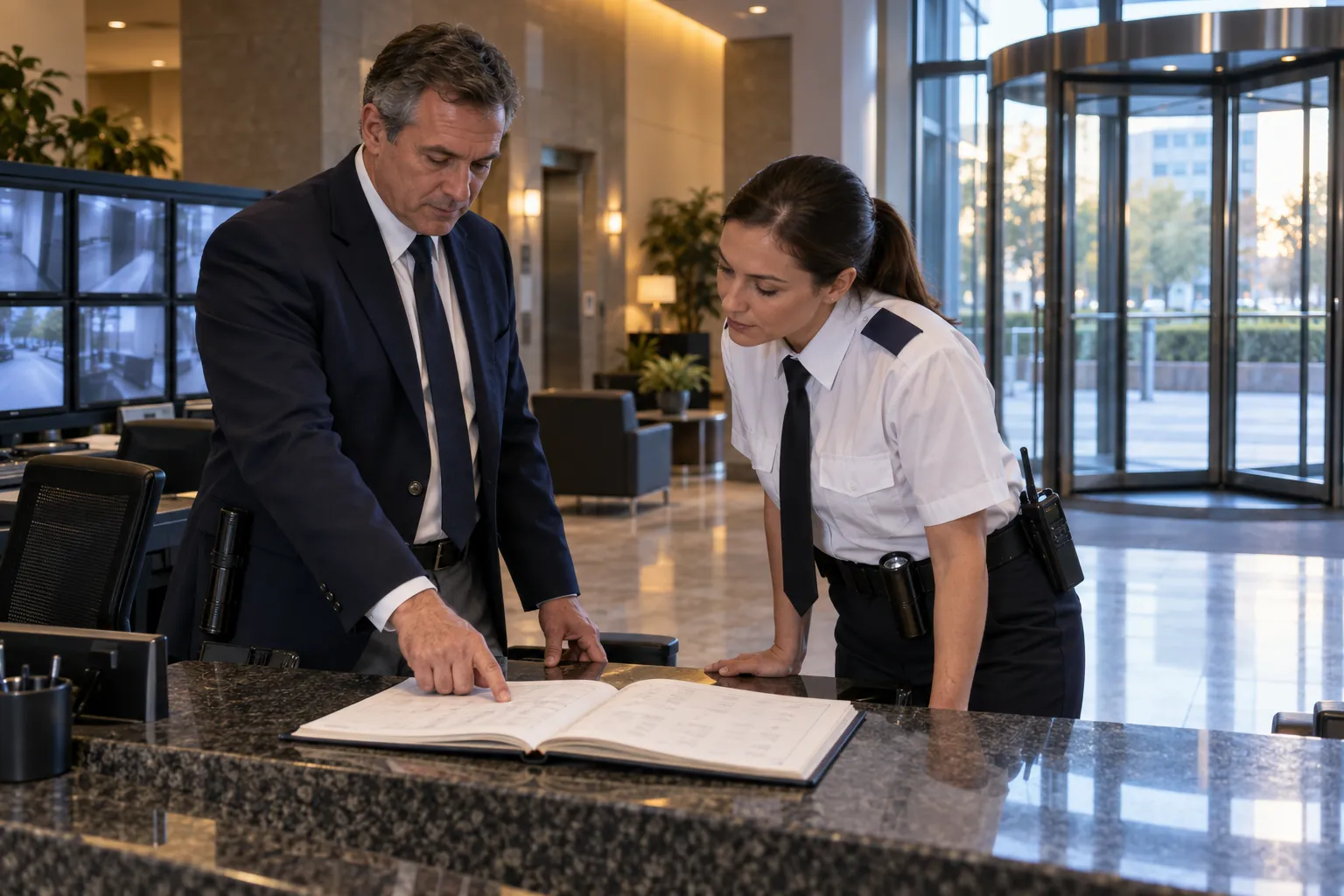 Security patrolsSecurity pass-down log: what to hand over, and how to make the shift change stickThe security pass-down log: what the outgoing officer hands over, how to run the shift change, how to write entries that stay useful, and how to review and keep it.