Cleaning
ATP testing: what the reading tells you, and how to run a program that means something
ATP testing is an on-the-spot check of surface cleanliness: a swab collects adenosine triphosphate (ATP), the energy molecule found in living cells and organic residue, and a portable handheld luminometer shows how much is there as a reading in relative light units (RLU).
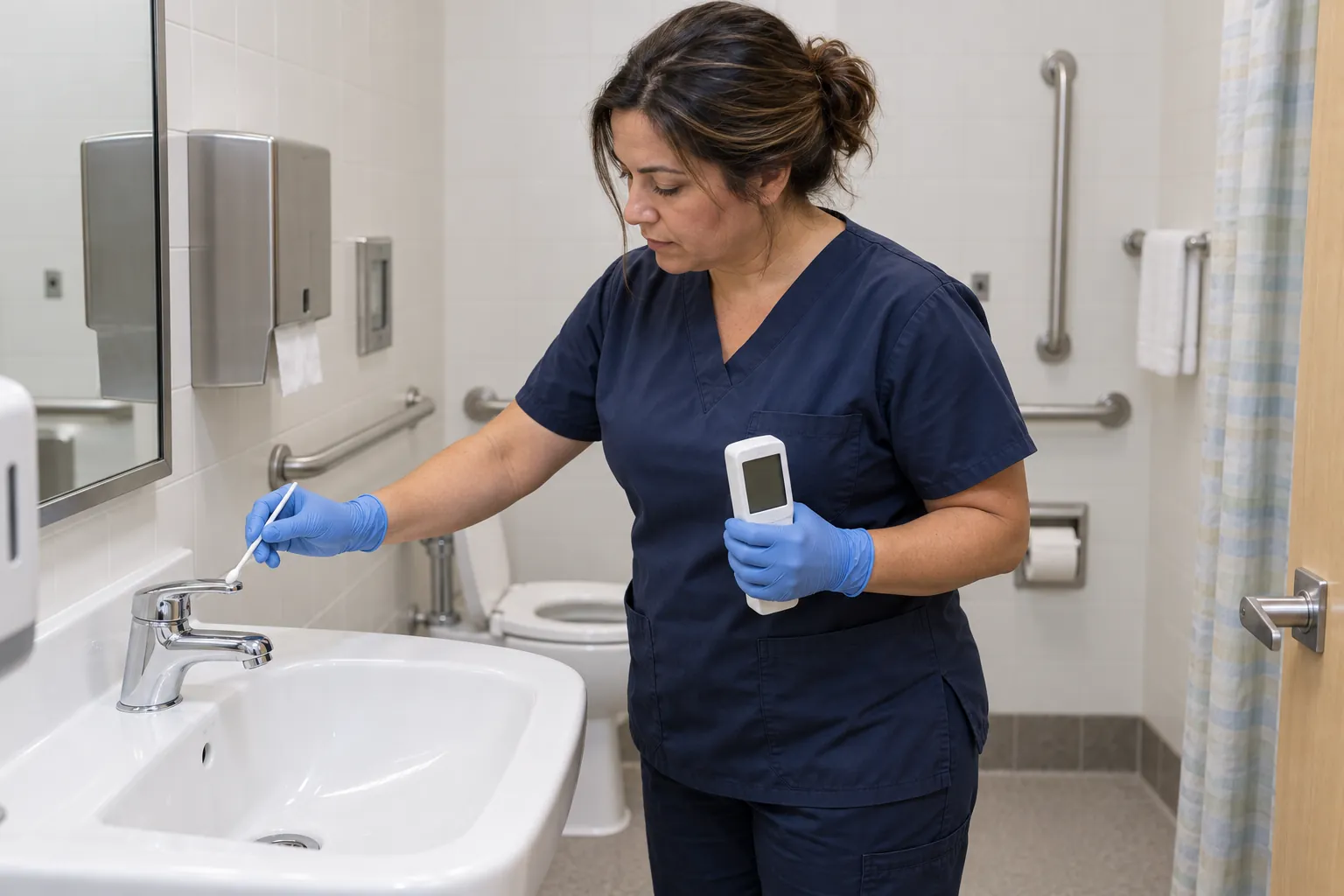
Hospitals and food plants use it to verify cleaning, and the same method can serve schools, food service and janitorial programs, but the number is useful only if everyone understands what it measures and what it cannot. This guide covers how ATP testing works, what the CDC says about it, how to choose surfaces, limits and frequencies, and how to record the results so they improve the cleaning rather than just filling a spreadsheet.
01
What ATP testing is, and what the guidance says
Adenosine triphosphate (ATP) is the molecule living cells use to carry energy. It is present in bacteria, but also in food residue, skin cells, body fluids and other organic soil. An ATP test uses a swab to collect whatever is on a set area of a surface, then mixes it with a reagent containing luciferase, the enzyme that makes fireflies glow. The more ATP there is, the more light the reaction gives off. A handheld luminometer measures that light and shows it as a number in relative light units (RLU), usually within a few seconds.
The CDC describes the method in its toolkit Options for Evaluating Environmental Cleaning (December 2010), written for hospitals monitoring terminal room cleaning. It notes that the luciferase assay "has been used to evaluate cleanliness of food preparation surfaces for more than thirty years," that a specialized swab samples "a standardized surface area," and that "the total amount of ATP, both microbial and non-microbial, is quantified and expressed as relative light units." The CDC's Best Practices for Environmental Cleaning in Healthcare Facilities in Resource-limited Settings (2019, written with the Infection Control Africa Network) advises facilities to "use objective (e.g., ATP bioluminescence) over subjective methods (e.g., assessments of cleanliness), if resources allow."
No federal regulation requires ATP testing in an ordinary building. The legal duties are about the outcome. OSHA's sanitation standard, 29 CFR 1910.141, says "all places of employment shall be kept clean to the extent that the nature of the work allows." Where employees are exposed to blood or other potentially infectious materials, the Bloodborne Pathogens standard, 29 CFR 1910.1030, requires the employer to "determine and implement an appropriate written schedule for cleaning and method of decontamination" based on the location, the surface, the soil and the work done there. In the 21 states and Puerto Rico that run OSHA-approved State Plans covering private employers, the State Plan's rule applies instead; State Plans must be at least as effective as federal OSHA, and some go further. Seven other plans cover only state and local government workers.
Food plants have a stricter frame. Under FDA's current good manufacturing practice rule, 21 CFR 117.35, food-contact surfaces "must be cleaned as frequently as necessary to protect against allergen cross-contact and against contamination of food." ATP testing is often used to verify a sanitation step before production, but it is not the environmental monitoring in 21 CFR 117.165, which is testing "for an environmental pathogen or for an appropriate indicator organism." ATP detects organic residue in general, not a named organism.
02
What an ATP reading tells you, and what it does not
An RLU figure is a measure of how much organic material is left on a surface. That is a good proxy for whether a surface was cleaned, and a poor proxy for whether it is safe. The CDC toolkit sets out the limits plainly, and anyone reading an ATP report should know them:
- It measures all ATP, not just germs. A high reading "may represent either a viable bioburden, organic debris including dead bacteria or a combination of both." A surface can be disinfected and still read high because residue was left behind.
- Low is meaningful; high needs a second look. The CDC notes that very low readings are typically associated with low aerobic colony counts, the bacteria a culture would grow. A high reading tells you something is there, not what it is.
- It does not identify pathogens. An ATP swab cannot tell you whether C. difficile, MRSA or norovirus is present. Culture or specific tests do that, in the circumstances where they are warranted.
- It does not measure disinfection. Whether a disinfectant stayed wet for its contact time is not something ATP can show. The CDC's facility guidance, When and How to Clean and Disinfect a Facility, tells you to "leave the disinfectant on the surface long enough to kill the germs," and only observation and training prove that happened.
- Numbers are not comparable between brands. According to the toolkit, "readout scales vary more than 10 fold and sensitivity varies between commercially available systems." A limit of 150 RLU on one luminometer means nothing on another.
- Chemicals and moisture interfere. High concentrations of bleach may quench the reaction and lower the reading, so if a bleach-based disinfectant is used, "it is important that the surface is dry before using the ATP tool." Other environmental factors can push readings up or down.
The CDC's conclusion on thresholds is the one most programs skip past: "it is unclear whether 'threshold values' for a clean hospital surface can be established using existing methods," which suggests a program needs pre-cleaning readings for each object to judge the cleaning accurately. Manufacturers publish suggested pass and fail limits for their own systems, and those are a reasonable place to start, but a site's own baseline is what makes the figures mean something.
Its strength, despite these limits, is a fast, objective number that a custodian and a supervisor can see together while the surface is still in front of them.
03
Setting up an ATP testing program: surfaces, limits and frequency
An ATP program is a sampling plan, not a device. Before the first swab, write down what will be tested, where on each object, how often, by whom, and what counts as a pass. The CDC toolkit's approach for hospitals scales down well to schools, offices, fitness centers and food service.
- Choose the surfaces. Pick the high-touch objects that matter most in each area type. The CDC's Environmental Checklist for Monitoring Terminal Cleaning lists, for a patient room, bed rails, the tray table, call box, telephone, bedside table drawer pull, chair, IV pole, sink, light switch and door knob, and in the toilet area the handrails, the toilet seat, the flush handle and the bedpan cleaner. In a school or office the equivalents are restroom faucets and flush handles, door push plates, elevator buttons, breakroom counters, cafeteria tables and shared desks.
- Fix the spot on each object. For direct methods such as ATP, the toolkit says the primary hand-touch area should be evaluated, "taking particular care to evaluate exactly the same area of the object before and after cleaning." Use the swab area the manufacturer specifies every time; a bigger area gives a bigger number.
- Set limits from a baseline. Swab the chosen surfaces before and after cleaning for a few weeks. The spread of ATP levels tells you what this building achieves and where a pass limit can sensibly sit. Keep separate limits where surfaces differ, for example a stainless-steel faucet and a laminate tray table.
- Decide the sample size. The toolkit suggests that a baseline of every listed surface in a 10 to 15% sample of representative patient rooms is reasonable in a 150-bed hospital, dropping to a 5% sample per cycle once the thoroughness of cleaning passes 80%, and that smaller hospitals can monitor all listed surfaces in at least 15 rooms. Aim to detect a meaningful change, not every small wobble.
- Set the frequency. The CDC's Level II program calls for objective monitoring "at least three times a year," with the sample sized to detect a 10 to 20% change in performance. Nothing stops a facility or a contract from swabbing its highest-risk areas more often, for example weekly or monthly. The same CDC best-practices guide recommends direct performance observation of cleaning staff "at least weekly," more often with new staff.
- Plan the retest. Decide in advance what happens on a fail: re-clean, swab again, record both readings, and note the cause.
Test surfaces that were actually due to be cleaned. Failing a weekly-cleaned desk the day before its clean teaches staff that the numbers are unfair.
04
Who swabs, and how results turn into better cleaning
The CDC is clear that monitoring should be independent of the people being measured. Whatever method a hospital uses, the toolkit says, monitoring should "be performed by hospital epidemiologists, infection preventionists or their designees who are not part of the actual ES cleaning program." Outside healthcare the same principle applies: a janitorial supervisor swabbing their own team's work is useful for coaching, but the figures a client relies on should come from someone else, or at least from joint checks where both sides are present.
The toolkit also warns that neither the monitoring system nor its use should create a Hawthorne effect, where people clean differently because they know they are being watched. If the luminometer only ever appears after an announced clean, the readings measure test days. Vary the timing and test without notice where the program allows it.
The feedback matters more than the swab. The CDC's educational guidance is built around a non-punitive program: explain to environmental services staff why the surfaces matter, show them how the monitoring works, share results, highlight what was cleaned well, and recognize good performance beyond the department. Its 2019 best-practices guide recommends real-time feedback and coaching during or after observations, a regular verbal debrief such as monthly, and performance reviews, usually annually.
Where cultures come in, keep them for their proper purpose. The CDC's Guidelines for Environmental Infection Control in Health-Care Facilities (2003) say that "routine environmental-surface sampling (e.g., surveillance cultures) in health-care settings is neither cost-effective nor warranted," reserving it for outbreak investigation, research, hazard monitoring and quality assurance, such as checking the effect of a change in infection-control practice or that equipment performs to specification.
05
Recording ATP results so the figures hold up
An ATP reading with no context is just a number. Each test entry should hold:
- the date and time of the swab, and the time the surface was last cleaned;
- the building, room or area, and the exact object and spot;
- whether it is a before-cleaning or after-cleaning reading;
- the reading in RLU, the luminometer model, and the pass limit that applies to that surface;
- the product used on the surface, and whether it was dry when swabbed;
- who took the swab, and who cleaned the area;
- on a fail: the re-clean, the retest reading, and the likely cause (missed surface, wrong cloth, not enough dwell time, heavy use since the clean).
Keep the luminometer's own checks, such as calibration or verification with the manufacturer's control, alongside the results, so a run of odd readings can be traced to the device rather than the cleaning.
Report trends by type of surface, not only by room. The CDC toolkit groups its surfaces into five categories, High Touch I, II and III, bathroom surfaces and equipment surfaces, because "cleaning practice within an institution is more likely to vary between types of objects than by patient units." If flush handles fail every month while tray tables pass, the problem is a task, not a person, and the fix is training or a changed procedure. The toolkit's measure of thoroughness, the TDC score, is simply the number of objects cleaned divided by the number evaluated, times 100.
In a janitorial contract, write the program into the quality control plan: which system, which surfaces, what limits, how many swabs a month, who takes them, and what happens on a fail. Without that, a provider and a client can argue over readings from two different luminometers with two different scales.
Keep ATP results with the cleaning record. A failed restroom faucet means much more when you can see that the noon check was missed, or that it was done minutes before the swab.
06
Where the record fails, and what SiteClara does about it
ATP testing checks a small sample of surfaces, and says nothing about the rest of the building or the week. The daily cleaning record beside it is usually weaker still: a log sheet on the restroom door initialed for the whole shift in one go, a checklist completed from memory at the end of the night, a failed swab that was re-cleaned but never retested on paper. When a reading fails, nobody can say when the surface was last cleaned or by whom, so the result cannot be tied to anything that can be fixed.
SiteClara records the routine checks at the location. A printed QR poster, with an optional NFC tag behind it, sits at each place a check is scheduled. Staff scan or tap on their own phone, with no app to install, see the checks due there, and mark each one done or say what stopped them. The time and the named person are recorded as it happens, with a photo when the check asks for one, and a problem someone reports goes onto the team's list of jobs until it is closed.
The supervisor sees what is due, done and missed across the day, and records the reason a check was missed. Each day they review it, add a note and approve a report that goes to the facility's nominated contacts the next morning at 8:00 by default. When an ATP swab fails, that record shows when the area was last checked and by whom, which is the context the reading needs.
07
Questions people ask
What does ATP testing tell you?
ATP testing tells you how much organic material is left on a surface, not which germs are there. The CDC's toolkit Options for Evaluating Environmental Cleaning says "the total amount of ATP, both microbial and non-microbial, is quantified and expressed as relative light units." Very low readings are typically associated with low aerobic colony counts, while very high readings "may represent either a viable bioburden, organic debris including dead bacteria or a combination of both."
What is ATP testing used for?
In cleaning, ATP testing is used to check how effectively a surface was cleaned and to give staff an objective figure to learn from. The CDC's toolkit Options for Evaluating Environmental Cleaning notes that it "has been used to evaluate cleanliness of food preparation surfaces for more than thirty years," and that in hospitals it has been used "to broadly document significant improvement in daily cleaning."
How is ATP testing used in hospitals?
Hospitals use ATP testing as one of the objective ways to monitor environmental cleaning, especially of high-touch surfaces in patient rooms after terminal cleaning. The CDC's toolkit Options for Evaluating Environmental Cleaning calls for objective monitoring in its Level II program "at least three times a year," with a sample big enough to detect a 10 to 20% change in performance, and says the ATP tool is likely to need pre-cleaning readings for each object to assess cleaning accurately.
How is ATP testing used in the food industry?
Food plants use ATP testing to verify that food-contact surfaces were cleaned before production, in support of FDA's rule in 21 CFR 117.35 that they "must be cleaned as frequently as necessary to protect against allergen cross-contact and against contamination of food." It does not replace environmental monitoring under 21 CFR 117.165, which is testing "for an environmental pathogen or for an appropriate indicator organism" where contamination of a ready-to-eat food with an environmental pathogen is a hazard requiring a preventive control.
08
Further reading, and a list to take away
The CDC's toolkit Options for Evaluating Environmental Cleaning sets out ATP, fluorescent markers and cultures side by side, with the terminal cleaning checklist and a scoring worksheet. The CDC's Best Practices for Environmental Cleaning in Healthcare Facilities in Resource-limited Settings covers monitoring, feedback and audit within a whole cleaning program. For food plants, read FDA's 21 CFR 117.35 on sanitary operations; for restaurants and cafeterias, the FDA Food Code 2022 is a model code that states and localities adopt, so check the version your health department enforces.
Before you start or review an ATP testing program, check that:
- everyone reading the results knows ATP measures organic residue, not pathogens or disinfection;
- the surfaces and the exact spot on each object are written down;
- pass limits come from a before-and-after baseline on your own system;
- results are never compared across luminometer brands;
- the sample size and frequency are written into the plan or the contract;
- someone independent of the cleaning team takes at least some of the swabs;
- every fail has a re-clean, a retest and a cause recorded;
- results are shared with custodians as coaching, not punishment;
- readings sit beside a cleaning record that shows when each area was last done, and by whom.
Sources
Every document this guide quotes or links to, in the order it first cites them.
- Options for Evaluating Environmental Cleaning cdc.gov
- Best Practices for Environmental Cleaning in Healthcare Facilities in Resource-limited Settings cdc.gov
- 29 CFR 1910.141 ecfr.gov
- Bloodborne Pathogens standard, 29 CFR 1910.1030 ecfr.gov
- 21 CFR 117.35 ecfr.gov
- 21 CFR 117.165 ecfr.gov
- When and How to Clean and Disinfect a Facility cdc.gov
- Guidelines for Environmental Infection Control in Health-Care Facilities (2003) cdc.gov
- FDA Food Code 2022 fda.gov
Related guides
 CleaningTerminal cleaning: how to do it, and how to show it was doneWhat terminal cleaning is, when it is done, the CDC steps in order, the products for C. diff and C. auris rooms, and how a hospital checks the clean was thorough.
 CleaningHigh-touch surfaces: a cleaning routine you can show was doneHigh-touch surfaces as the CDC describes them: which ones to list area by area, how often to clean and disinfect them, the right method, and a record that holds up.
 CleaningJanitorial quality control: how to inspect, score and fix the cleaningHow janitorial quality control works: QA versus QC, building a cleaning inspection checklist, APPA appearance levels, sampling, scoring and corrective action.
 CleaningCleaning, sanitizing and disinfecting: what each one does, and when a building needs itCleaning, sanitizing and disinfecting defined by the CDC, EPA and FDA Food Code: when each is needed, how to do it right, and what the record should show.