Cleaning
Terminal cleaning: how to do it, and how to show it was done
Terminal cleaning is the full cleaning and disinfection of every surface in a patient room after the patient is discharged or transferred, so that no contamination passes to the next patient.
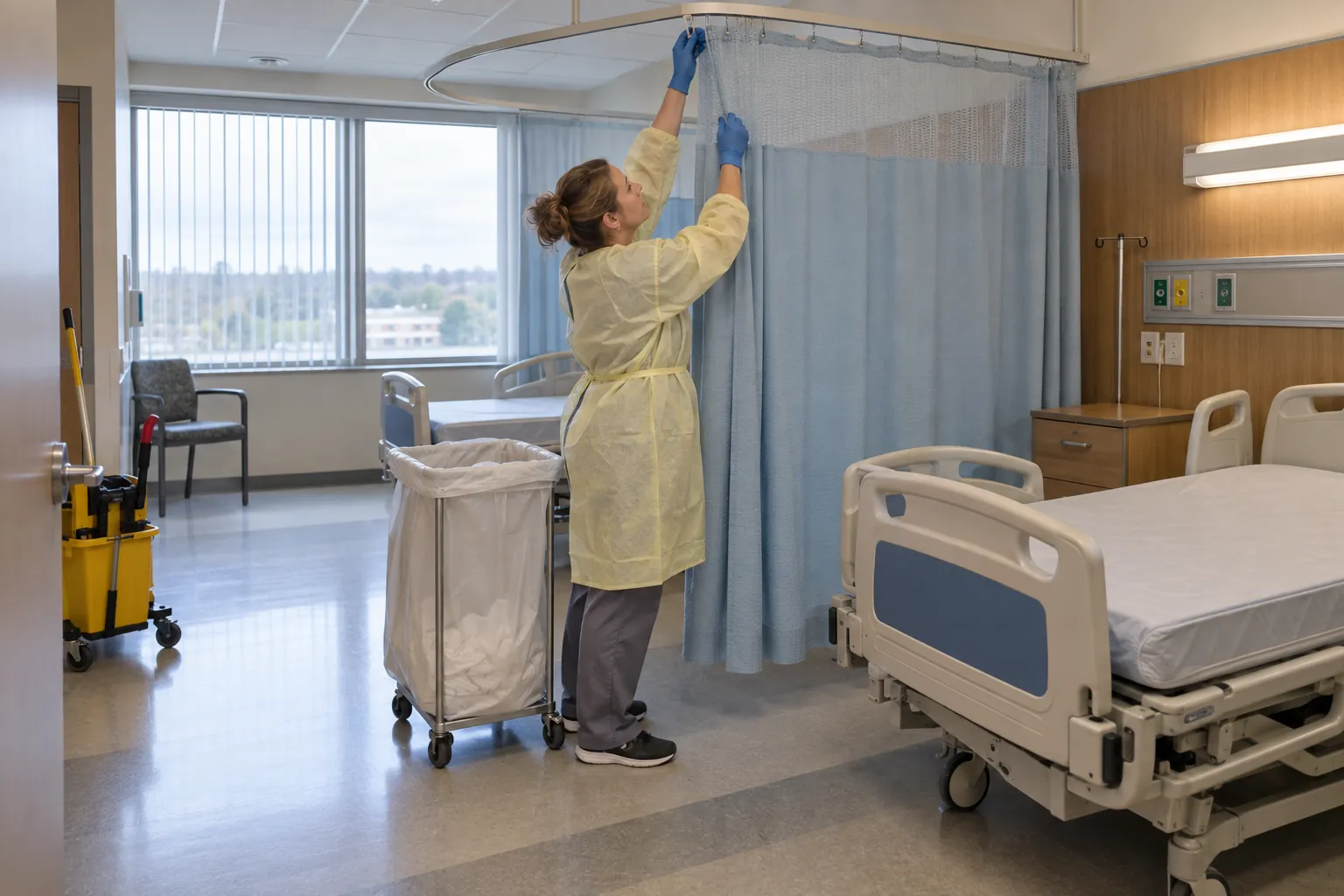
It is also the end-of-day clean of an operating room. This guide covers what the CDC means by terminal cleaning, the federal rules behind it, the steps in order, the products for rooms that held C. diff or C. auris, who does what, and how a hospital checks that the clean was thorough.
01
What terminal cleaning is, and the rules behind it
Terminal cleaning is the thorough cleaning and disinfection of a patient room, or a procedure room, when its use comes to an end: after a patient is discharged or transferred, or after the last case of the day in an operating room. It differs from daily cleaning in scope. Daily cleaning works around an occupied room; terminal cleaning reaches everything.
The CDC's Environmental Cleaning Procedures, part of the best practices it wrote with the Infection Control Africa Network for resource-limited settings, gives the clearest definition in CDC material: terminal cleaning of inpatient areas "occurs after the patient is discharged/transferred, includes the patient zone and the wider patient care area and aims to remove organic material and significantly reduce and eliminate microbial contamination to ensure that there is no transfer of microorganisms to the next patient."
No federal rule uses the words terminal cleaning or sets a checklist for it. The duty sits in broader requirements:
- Hospitals. For a hospital in Medicare or Medicaid, 42 CFR 482.42, the Condition of Participation for infection prevention and control, requires programs that "demonstrate adherence to nationally recognized infection prevention and control guidelines," and at 482.42(a)(3) a program that includes "maintaining a clean and sanitary environment to avoid sources and transmission of infection."
- Nursing homes. 42 CFR 483.80, Infection control, requires a long-term care facility to "establish and maintain an infection prevention and control program designed to provide a safe, sanitary, and comfortable environment."
- Worker protection. OSHA's Bloodborne Pathogens standard, 29 CFR 1910.1030, requires at (d)(4)(i) that the employer "determine and implement an appropriate written schedule for cleaning and method of decontamination based upon the location within the facility, type of surface to be cleaned, type of soil present, and tasks or procedures being performed in the area." A terminal cleaning procedure is part of that written schedule. In a state with an OSHA-approved State Plan, the state's equivalent standard applies instead.
The nationally recognized guideline behind most programs is the CDC and HICPAC Guidelines for Environmental Infection Control in Health-Care Facilities (2003, updated 2019). It says that horizontal surfaces with infrequent hand contact, such as window sills and hard floors, "require cleaning on a regular basis, when soiling or spills occur, and when a patient is discharged from the facility." Accreditors such as The Joint Commission survey against their own paid standards; work from your current copy.
02
When terminal cleaning is done, and what it covers
Terminal cleaning is triggered by an event rather than the clock. The usual triggers are these:
- Discharge or transfer of an inpatient, before the bed is released for the next admission.
- A patient on transmission-based precautions leaving the room, when the clean follows the precautions and the organism, with the product and the PPE they call for.
- The last case of the day in an operating or procedure room, after the between-case cleans.
The CDC procedures set out the general terminal cleaning process for an inpatient room in six steps:
- "Remove soiled/used personal care items (e.g., cups, dishes) for reprocessing or disposal."
- "Remove facility-provided linens for reprocessing or disposal."
- "Inspect window treatments. If soiled, clean blinds on-site, and remove curtains for laundering."
- "Reprocess all reusable (noncritical) patient care equipment"
- "Clean and disinfect all low- and high-touch surfaces, including those that may not be accessible when the room/area was occupied (e.g., patient mattress, bedframe, tops of shelves, vents), and floors."
- "Clean (scrub) and disinfect handwashing sinks."
Step five is where terminal cleaning earns its name: the mattress, the bed frame, the tops of shelves and the vents are reached. In practice, the mattress cover is also looked over while the bed is stripped, any tear is reported for repair or replacement, and the bathroom is done in full. The CDC's environmental guidelines add privacy curtains to the picture: the edges of privacy curtains are listed among the high-touch surfaces in patient-care areas, and the CDC procedures ask for privacy and window curtains to come down for laundering after a patient on Contact, Droplet or Airborne Precautions.
03
Terminal cleaning steps: the order, and the products
The order of work matters as much as the list. The CDC procedures give three strategies that apply to every terminal clean:
- Clean to dirty. "Terminal cleaning should start with shared equipment and common surfaces, then proceed to surfaces and items touched during patient care that are outside of the patient zone, and finally to surfaces and items directly touched by the patient inside the patient zone."
- High to low. "Proceed from high to low to prevent dirt and microorganisms from dripping or falling and contaminating already cleaned areas." Floors come last.
- Systematic. "Proceed in a systematic manner to avoid missing areas – for example, left to right or clockwise."
Cleaning comes before disinfection. The CDC's recommended approach to C. difficile is "meticulous cleaning followed by disinfection using EPA-registered products specific for inactivating C. difficile spores," and the same sequence holds for every room: soil removed first, then the disinfectant applied to a clean surface and left for its contact time.
The product follows the organism, and EPA keeps the lists:
- Routine discharge. An EPA-registered hospital disinfectant chosen under the hospital's policy and used to its label.
- C. difficile. The CDC's clinical guidance for C. diff infection prevention says: "Perform terminal cleaning after CDI patient transfer/discharge with a C. difficile sporicidal agent." EPA's List K names the products registered as effective against C. diff spores. See the guide on C. diff cleaning.
- Candida auris. The CDC's infection control guidance for C. auris recommends "thorough routine (at least daily) and terminal cleaning and disinfection of patients' rooms and areas where patients receive care," with an EPA-registered hospital-grade disinfectant effective against C. auris, from EPA's List P. It warns that "products solely dependent on quaternary ammonia compounds (QACs) are NOT effective."
EPA's advice on both lists is the same: "Follow the label directions … carefully including the contact time," and check that the label carries directions for that specific organism, because a product's directions can differ from one pathogen to the next.
04
Who does what, from discharge to a released bed
A terminal clean crosses several teams, and most of the delays and misses happen at the handoffs. A workable division looks like this:
- Nursing or the unit tells EVS that the room is vacated, and whether the patient was on precautions and for what; removes or hands over patient belongings; and cleans the equipment the hospital has agreed is nursing's.
- The EVS technician does the clean to the written procedure, with the right product, PPE and contact time, and reports damage found on the way, such as a torn mattress cover or a broken fixture.
- The EVS lead or supervisor assigns discharges by priority, inspects a share of finished rooms, and releases or holds the bed.
- The infection preventionist sets the standard, chooses or approves the products with EVS, and runs the independent checks of thoroughness.
- Bed management or patient flow watches the time from discharge to a clean bed.
- Facilities and clinical engineering repair what cleaning cannot fix, and take away equipment that cannot be cleaned where it stands.
Shared equipment is where rooms lose track. The CDC's C. diff guidance asks hospitals to "clean and disinfect all shared equipment prior to use with another patient, including toilets, wheelchairs and gurneys," and to "use dedicated patient-care equipment such as blood pressure cuffs and stethoscopes." Its C. auris guidance adds: "Label disinfected equipment and separate it from dirty equipment."
The OSHA standard protects the healthcare workers doing the work. Under 29 CFR 1910.1030(d)(4)(ii), all equipment and environmental and working surfaces must be "cleaned and decontaminated after contact with blood or other potentially infectious materials"; and broken glassware that may be contaminated "shall not be picked up directly with the hands" but with a brush and dust pan, tongs or forceps. Staff with occupational exposure need bloodborne pathogens training at initial assignment and at least annually.
05
Checking a terminal clean was thorough
A clean room and a disinfected room can look exactly the same. That is why the CDC's C. diff guidance asks hospitals to "create daily and terminal cleaning protocols and checklists for patient-care areas and equipment" and to routinely audit the "adequacy of room cleaning using methods described in 'Options for Evaluating Environmental Cleaning.'"
The CDC's Options for Evaluating Environmental Cleaning toolkit encourages all hospitals "to develop programs to optimize the thoroughness of high touch surface cleaning as part of terminal room cleaning at the time of discharge or transfer of patients." Its Environmental Checklist for Monitoring Terminal Cleaning lists the priority sites to evaluate in each room, marking each cleaned or not cleaned:
- in the room: bed rails and controls, the tray table, the IV pole grab area, the call box or button, the telephone, the bedside table handle, the chair, the room sink, the light switch and the inner door knob;
- in the bathroom: the inner door knob or plate, the light switch, the handrails by the toilet, the sink, the toilet seat, the flush handle and the bedpan cleaner;
- where present: IV pump controls, multi-module monitor controls, touch screen and cables, and the ventilator control panel.
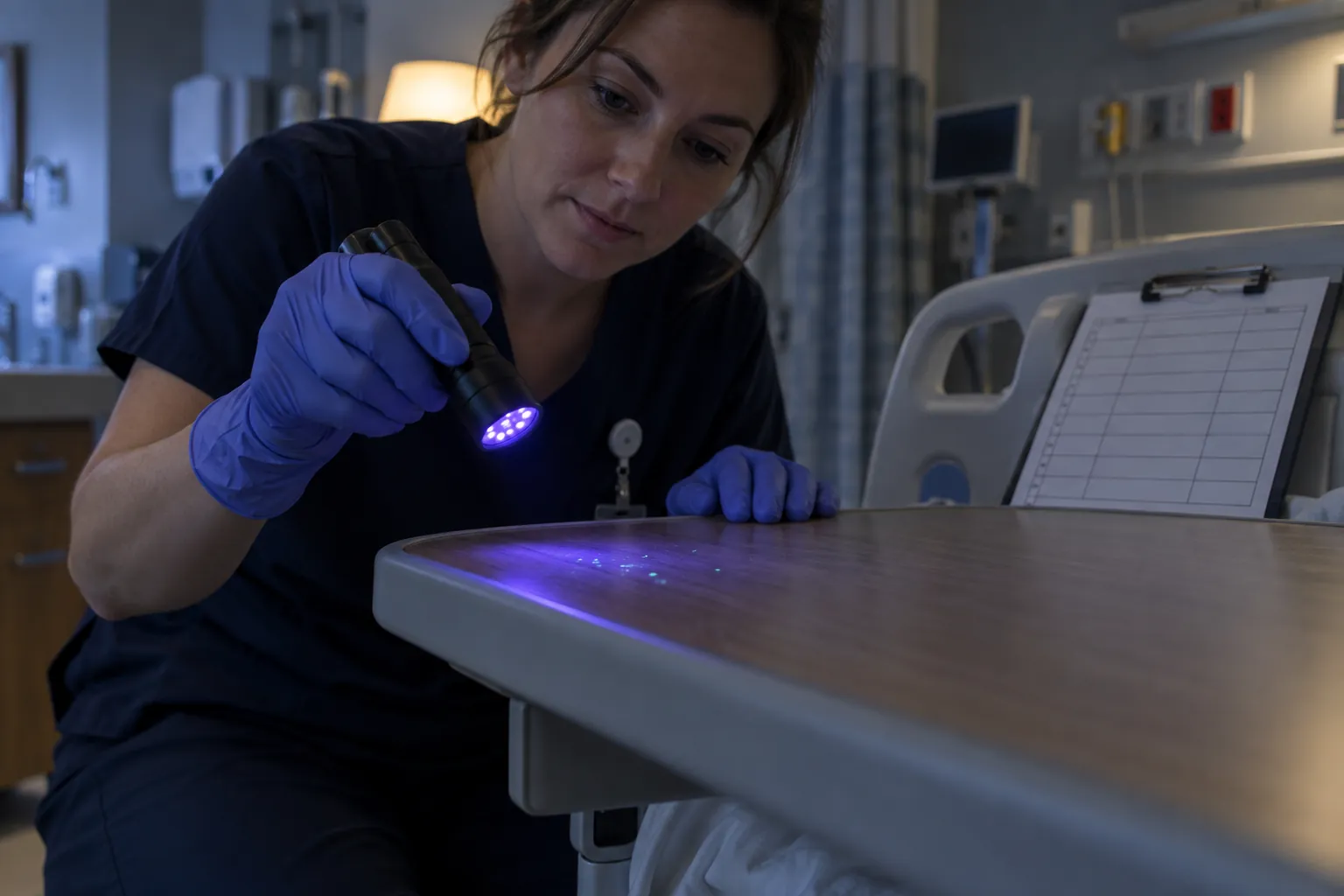
The checklist records which method was used: direct observation, fluorescent gel, swab cultures, ATP, or agar slide cultures. With fluorescent gel, a supervisor or infection preventionist marks a sample of those sites before the clean and checks under UV light afterward whether the marks were removed. ATP meters, which read organic residue on a surface, are covered in the guide on ATP testing.
The checklist's own footnote says hospitals "may choose to include identifiers of individual environmental services staff for feedback purposes." Results fed back to the technician improve the next clean; results used to catch people teach them to clean for the auditor.
An audit of a sample tells you how well rooms are cleaned. It does not tell you whether each discharge was actually cleaned, when, by whom, and with which product for which precautions. That is a record of every room, not a sample of some.
06
Where the terminal cleaning record fails, and what SiteClara does about it
The record of a terminal clean often lives in the bed board: a status that turns from dirty to clean when someone presses a button. It shows that the bed was released, not that the curtains came down after a Contact Precautions patient, that a sporicidal product was used after a C. diff discharge, or that the torn mattress the technician noticed was reported to anyone. Outside patient rooms, the soiled utility room and equipment storage are often on a sheet on the door, initialed for a whole shift at once.
SiteClara records checks at the place they happen. A printed QR code poster, with an optional NFC tag behind it, goes in each room or area where a check is scheduled. An EVS technician scans the code or taps the tag on their own phone, with no app to install, sees the checks set for that place, and marks each one done, or says what stopped them, such as a room still occupied. The hospital decides what the check asks for, so a terminal clean after precautions can ask whether the curtains were changed and which product was used, with a photo when one is asked for. The time and the named person are recorded as it happens. A problem found on the way, such as a damaged mattress cover or a leaking sink, goes onto the team's list of jobs until someone closes it.
The EVS supervisor sees what is due, done and missed, and records the reason when a check was missed. Each day they review the totals and photos and approve a report that goes the next morning to designated managers, such as the EVS director. It shows what was reported, completed and still open, and how the scheduled checks went, with the reasons for any that were not done.
07
Questions people ask
What is the difference between terminal cleaning and regular cleaning?
Timing and reach. The CDC's Environmental Cleaning Procedures define routine cleaning as the clean that "occurs while the patient is admitted, focuses on the patient zones and aims to remove organic material and reduce microbial contamination to provide a visually clean environment." Terminal cleaning "occurs after the patient is discharged/transferred, includes the patient zone and the wider patient care area," and aims to "significantly reduce and eliminate microbial contamination to ensure that there is no transfer of microorganisms to the next patient."
When is terminal cleaning performed in the OR?
After the last procedure of the day. The CDC's Environmental Cleaning Procedures set out the operating room clean "after the final procedure (i.e., terminal clean)," separate from the cleaning done between cases, and it reaches the entire floor, the fixed equipment and the sinks.
What type of disinfectant is used for terminal cleaning?
It depends on the organism. For a routine discharge, the CDC's Environmental Cleaning Procedures say to "clean and disinfect all low- and high-touch surfaces" and the floors without naming a product; where they do name one, for specialized patient areas, it is a facility-approved disinfectant. After a C. difficile patient, the CDC's clinical guidance for C. diff infection prevention says to "perform terminal cleaning after CDI patient transfer/discharge with a C. difficile sporicidal agent," such as a product on EPA's List K. After a Candida auris patient, the CDC's infection control guidance for C. auris recommends "an Environmental Protection Agency (EPA)–registered hospital-grade disinfectant effective against C. auris" from EPA's List P, and warns that products relying only on quaternary ammonium compounds are not effective.
What are the CDC guidelines for terminal cleaning?
There are three CDC sources. The Environmental Cleaning Procedures give the definition, the six steps for an inpatient room and the order of work: clean to dirty, high to low, and systematic. The Guidelines for Environmental Infection Control in Health-Care Facilities give the principles for healthcare facilities. The Options for Evaluating Environmental Cleaning toolkit gives the checklist for monitoring terminal cleaning, site by site.
08
Where to read more, and a terminal cleaning checklist to take away
The CDC's Environmental Cleaning Procedures give the steps and the order; the Guidelines for Environmental Infection Control in Health-Care Facilities give the principles; and the Options for Evaluating Environmental Cleaning toolkit and its checklist give the audit. The EPA lists, the CMS conditions and the OSHA standard are linked above.
Before your next survey or contract review, check that:
- a written terminal cleaning procedure exists for inpatient rooms, isolation rooms and operating rooms, as part of the cleaning schedule 29 CFR 1910.1030(d)(4)(i) requires;
- it works clean to dirty, high to low and in the same direction every time, and reaches the mattress, bed frame, vents and tops of shelves;
- curtains come down after Contact, Droplet or Airborne Precautions, and soiled curtains after any discharge;
- a List K sporicidal product is used after a C. diff patient and a List P product after a C. auris patient, each to its label and contact time, and quaternary-only products are not relied on for C. auris;
- the split between EVS and nursing for each item of bedside and shared equipment is written down, unit by unit;
- UV or vapor systems, if used, follow a complete manual clean and are never counted in place of one;
- thoroughness is checked objectively on the CDC checklist's sites, by someone outside the cleaning team, with the results fed back to the staff;
- every terminal clean and every routine check outside patient rooms leaves a record of when it was done and by whom, and missed ones are recorded as missed.
Sources
Every document this guide quotes or links to, in the order it first cites them.
- Environmental Cleaning Procedures cdc.gov
- 42 CFR 482.42, the Condition of Participation for infection prevention and control ecfr.gov
- 42 CFR 483.80, Infection control ecfr.gov
- Bloodborne Pathogens standard, 29 CFR 1910.1030 osha.gov
- Guidelines for Environmental Infection Control in Health-Care Facilities cdc.gov
- Clinical guidance for C. diff infection prevention cdc.gov
- EPA's List K epa.gov
- Infection control guidance for C. auris cdc.gov
- EPA's List P epa.gov
- Options for Evaluating Environmental Cleaning cdc.gov
- Environmental Checklist for Monitoring Terminal Cleaning cdc.gov
Related guides
 CleaningHospital environmental services: what EVS does, and how to show it was doneWhat hospital environmental services (EVS) does, the CDC, CMS and OSHA rules behind it, cleaning frequencies, who cleans what, and how cleaning is checked.
 CleaningPatient room cleaning: the daily clean, and how to show it was doneHow to clean an occupied patient room each day: what the CDC and CMS expect, the order of work, products for precautions rooms, who does what, and how it is checked.
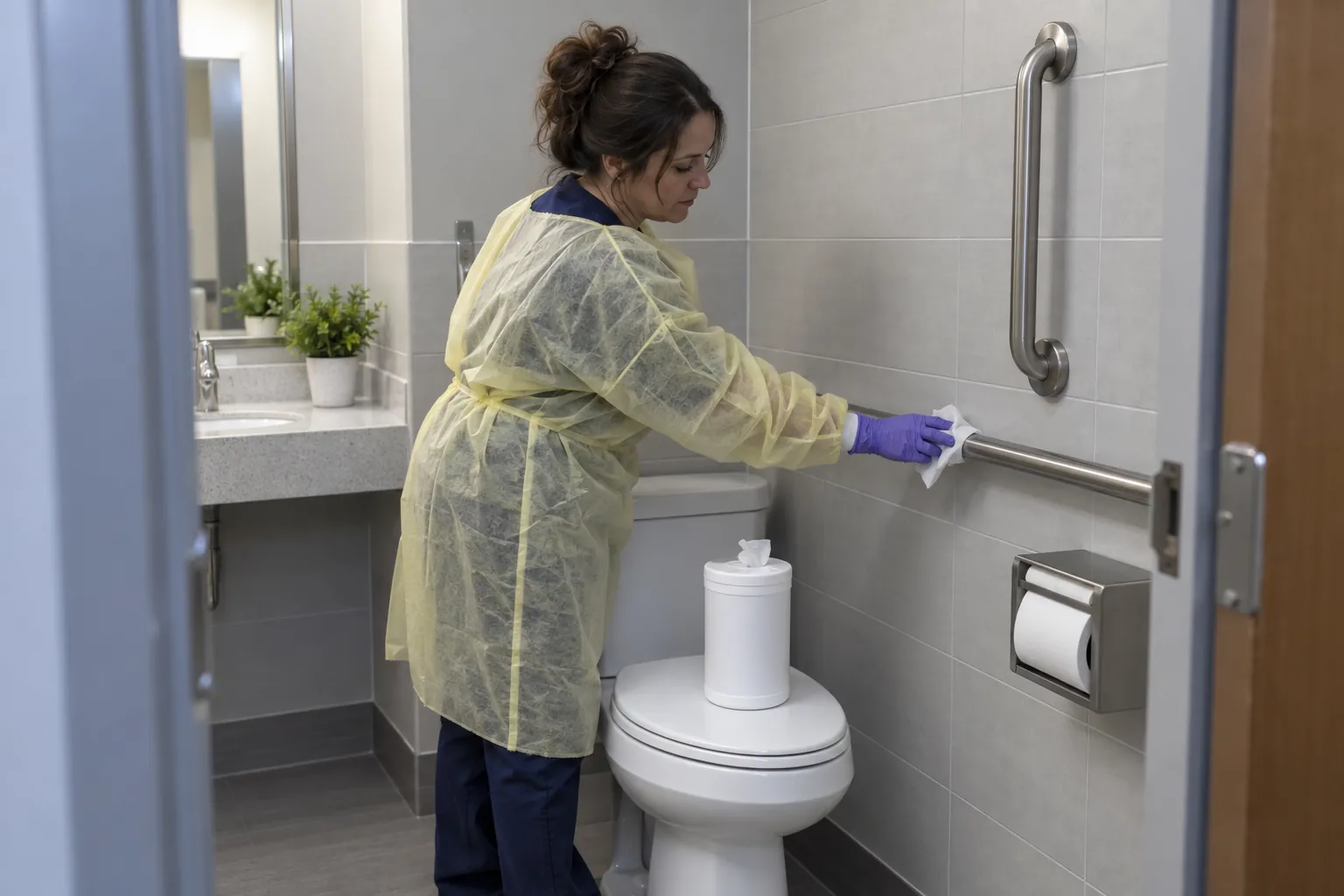 CleaningC. diff cleaning: killing the spores, and showing it was doneHow to clean for C. diff: why ordinary disinfectants miss the spores, choosing a List K product, daily and discharge cleans, and how to show each clean was done.
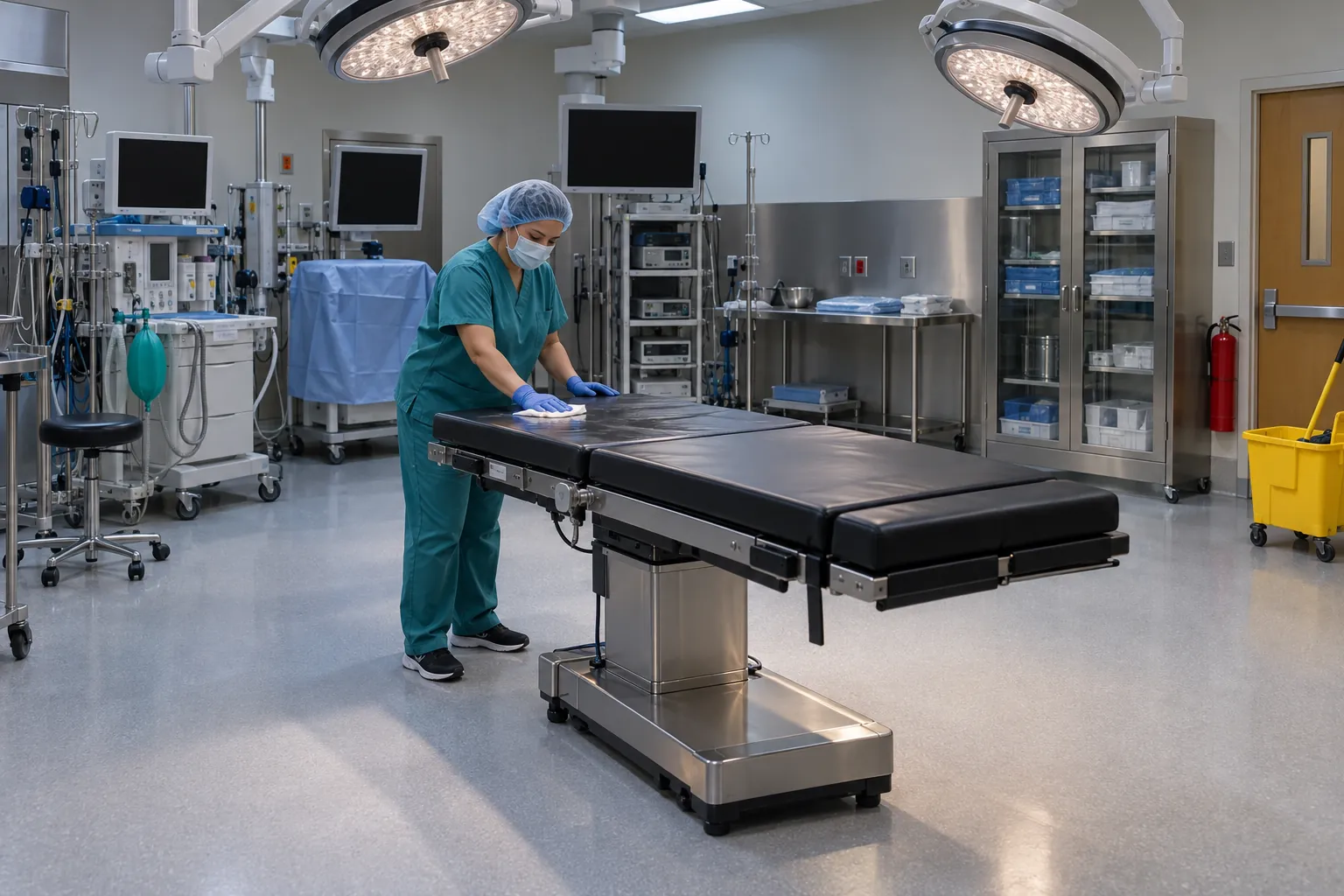 CleaningOperating room cleaning: turnover, terminal cleaning and the record behind themHow an operating room is cleaned before the first case, between cases and at the end of the day, the rules and guidelines behind it, and how to show it was done.