Cleaning
High-touch surfaces: a cleaning routine you can show was done
High-touch surfaces are the surfaces that many different people touch with their hands throughout the day, such as door handles, push plates, elevator buttons, stair rails, faucets and counters.
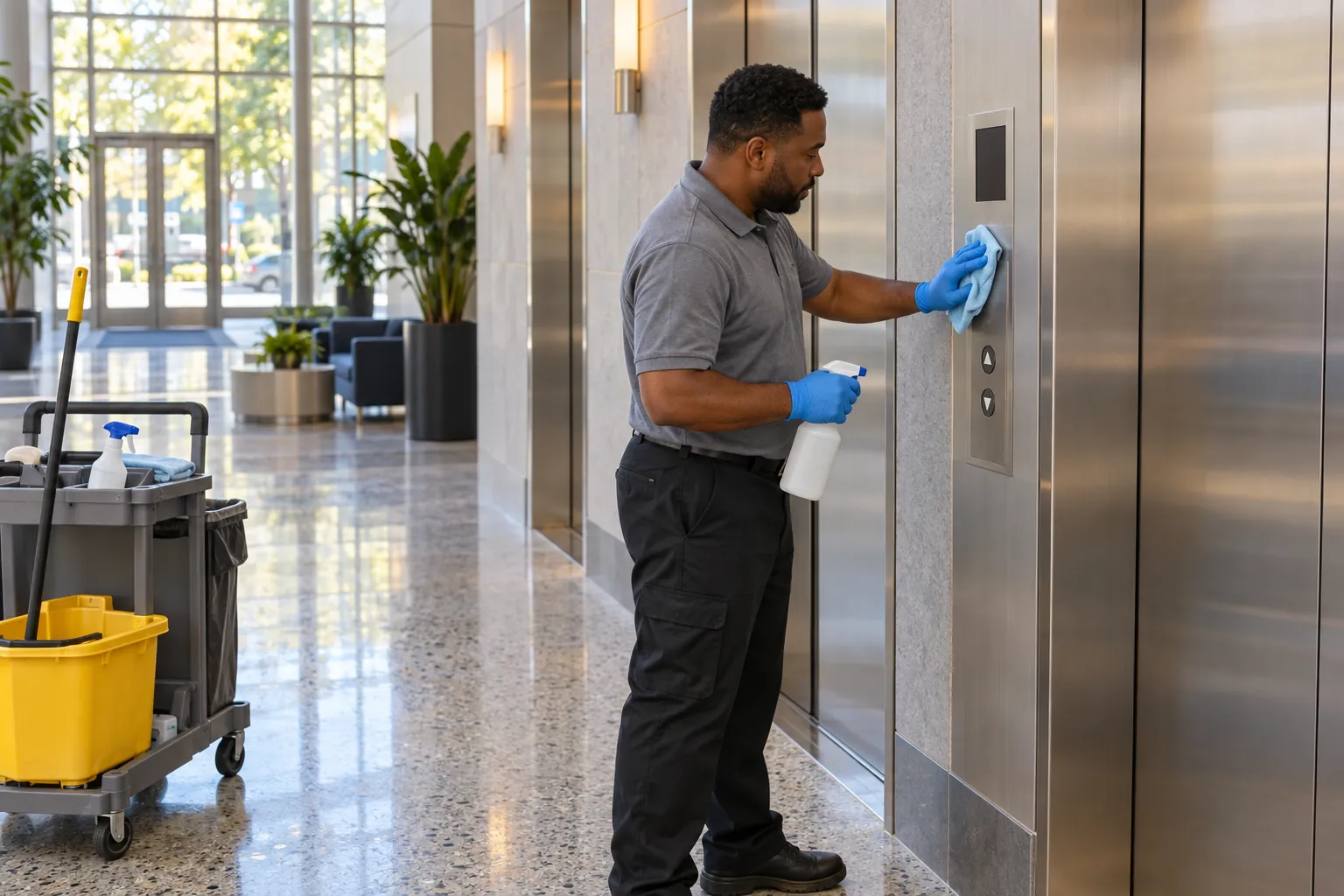
The CDC singles them out because they are more likely to spread germs than the rest of a room, and its healthcare guidance says they need more frequent and more rigorous cleaning than surfaces people rarely touch. This guide covers how to identify them in your building, how often to clean them, the method that works, and how to check and record the work so the schedule means something.
01
What counts as a high-touch surface, according to the CDC
There is no federal regulation that defines a high-touch surface or lists them for an office, school or retail store. The term comes from infection control guidance, and the CDC is the source most janitorial programs, facility managers and infection preventionists work from.
For ordinary buildings, the CDC's page When and How to Clean and Disinfect a Facility (last reviewed April 16, 2024) says simply that "high touch surfaces are more likely to spread germs", and gives as examples "pens, counters, shopping carts, door handles, stair rails, elevator buttons, touchpads, restroom fixtures, and desks". Its instruction is to "clean high-touch surfaces regularly", and to disinfect areas where people have obviously been ill, for example after vomiting on facility surfaces.
Healthcare guidance goes further. The CDC's Guidelines for Environmental Infection Control in Health-Care Facilities (2003) say that "high-touch housekeeping surfaces in patient-care areas (e.g., doorknobs, bedrails, light switches, wall areas around the toilet in the patient's room, and the edges of privacy curtains) should be cleaned and/or disinfected more frequently than surfaces with minimal hand contact." Surfaces with infrequent hand contact, such as window sills and hard floors, need cleaning on a regular basis, when soiling or spills occur, and at patient discharge.
The CDC's Environmental Cleaning Procedures (March 2024), part of its best practices for healthcare facilities in resource-limited settings, puts the principle in one line: "High-touch surfaces (e.g., bed rails) require more frequent and rigorous environmental cleaning than low-touch surfaces (e.g., walls)." The same idea holds in any building.
02
High-touch surfaces area by area
Every building has its own list. Stand in each area at a busy time and watch where hands go. The list below covers the surfaces most commonly touched in a commercial building and is the usual starting point.
- Entrances and lobbies: door handles and push plates, push bars, accessible door buttons, the reception counter, visitor sign-in tablets and pens, turnstiles and badge readers.
- Elevators and stairs: call buttons on every floor, the car's control panel, handrails in the car, stair handrails and the doors onto each landing.
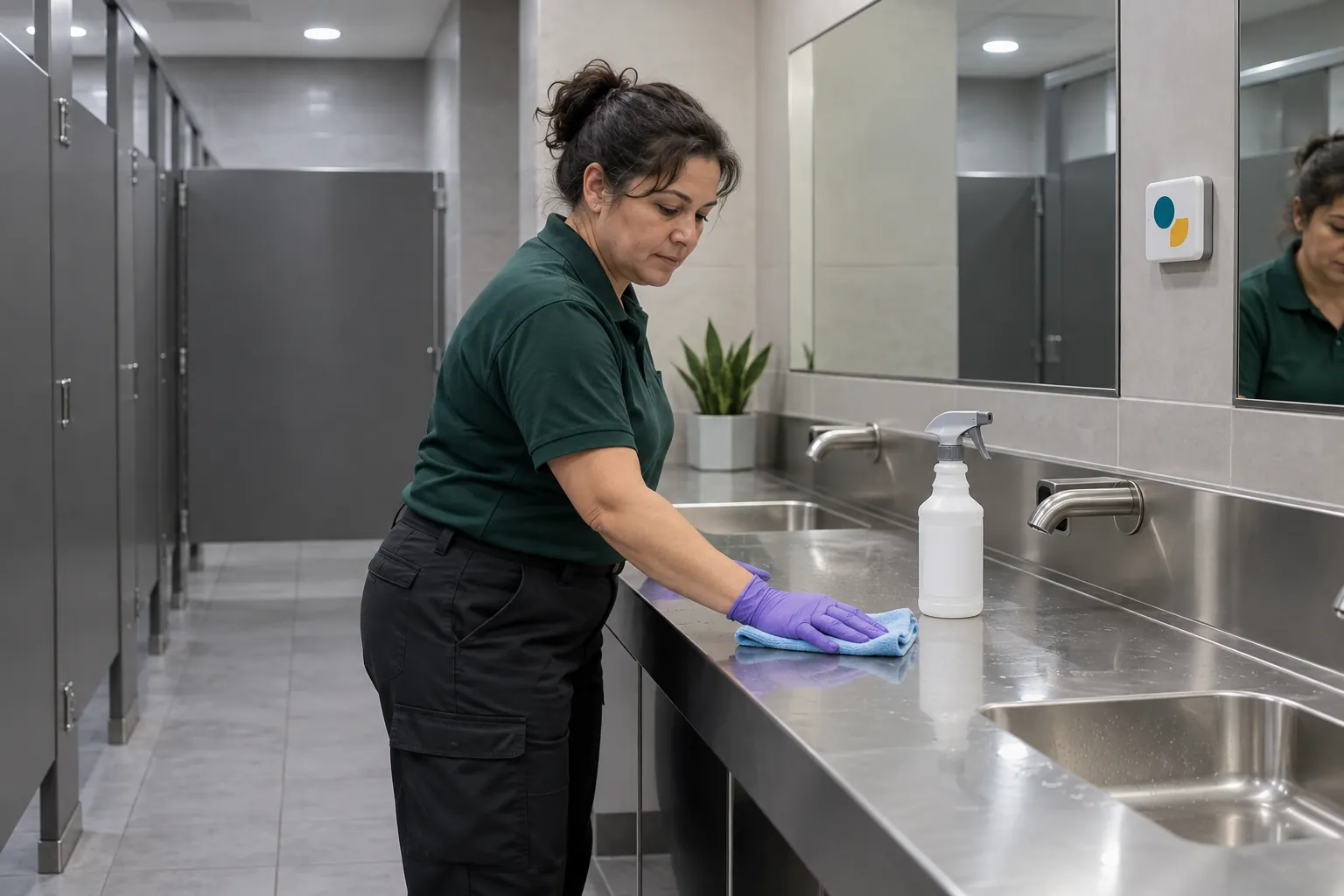
- Restrooms: door handles on both sides, stall latches, faucet handles, flush handles and buttons, soap and paper towel dispensers, hand dryer buttons, baby changing stations, the counter around the sinks.
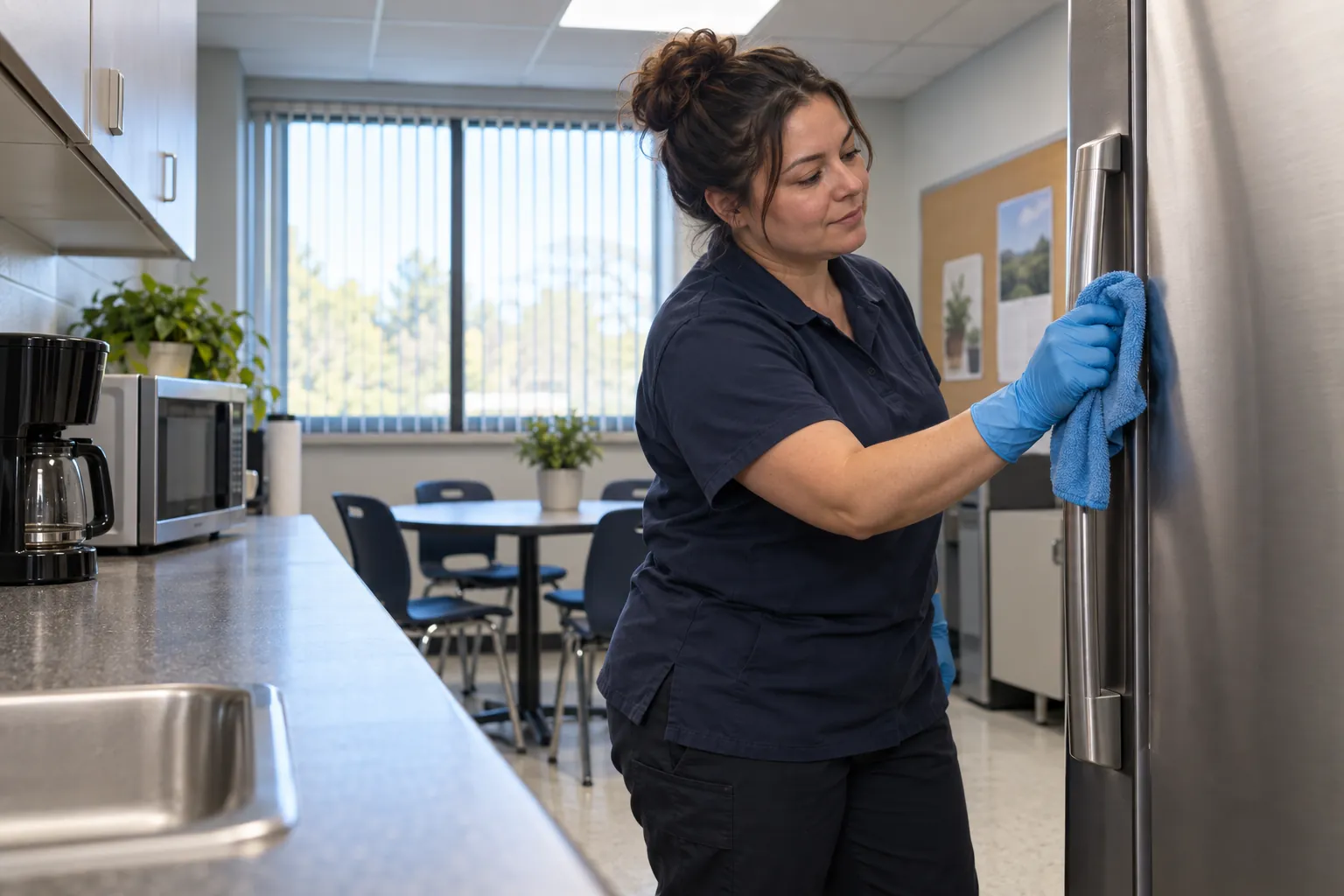
- Break rooms and kitchens: refrigerator, microwave and cabinet handles, coffee machine and water dispenser buttons, vending machine keypads, faucets, tables and chair backs.
- Offices and shared desks: hot desks, shared keyboards and mice, desk phones, light switches, printer and copier control panels, the handles of shared storage.
- Conference and training rooms: tables, chair arms, remote controls, room booking panels, whiteboard markers and erasers, the handle on the door.
- Schools and child care: classroom door handles, desks and tables, shared supplies, cafeteria tables, water bottle fillers and drinking fountains, gym equipment, playground hand-holds near the doors.
- Retail and hospitality: shopping carts and baskets, checkout counters, card terminals, self-checkout screens.
- Healthcare patient areas: the CDC's list includes bedrails, IV poles, sink handles, bedside tables, counters where medications and supplies are prepared, the edges of privacy curtains, patient monitoring equipment such as keyboards and control panels, wheelchair handles, call bells, doorknobs and light switches.
Write the list down for each area and keep it with the cleaning schedule, so a custodian covering a shift does not have to guess. In a large building, group it by route, so the day porter's rounds follow the path people take.
Review the list when the building changes: a new kiosk, card reader or hot-desking room adds surfaces no schedule picks up on its own.
03
How often to clean high-touch surfaces
Outside healthcare, no federal rule sets a frequency. OSHA's general sanitation standard, 29 CFR 1910.141, requires that "all places of employment shall be kept clean to the extent that the nature of the work allows" and that washing facilities be "maintained in a sanitary condition". It states the outcome and leaves the schedule to the employer. Many states run their own OSHA-approved state plans, which may add to the federal rule, so check whose standard covers your site.
Where employees have occupational exposure to blood or other potentially infectious materials, the Bloodborne Pathogens standard, 29 CFR 1910.1030, is more specific. The employer must "determine and implement an appropriate written schedule for cleaning and method of decontamination based upon the location within the facility, type of surface to be cleaned, type of soil present, and tasks or procedures being performed in the area." Contaminated work surfaces must be decontaminated with an appropriate disinfectant after completion of procedures, "immediately or as soon as feasible when surfaces are overtly contaminated or after any spill of blood or other potentially infectious materials", and at the end of the work shift if the surface may have become contaminated since the last cleaning.
For healthcare, the CDC's resource-limited settings guidance gives frequencies that many U.S. programs will recognize as a floor rather than a target. Its tables set high-touch surfaces and floors in general inpatient wards and outpatient waiting areas at least once daily, consultation and examination rooms at least twice daily, shared patient toilets at least twice daily for high-touch and frequently contaminated surfaces, and intensive care units twice daily and as needed. U.S. hospitals set their own frequencies through their infection prevention program.
For an office, school or store, set the frequency by traffic and risk:
- At least daily for every listed high-touch surface, usually in the main janitorial shift.
- Several times a day for the busiest surfaces: entrance doors, elevator buttons, restroom fixtures, break room handles. This is typically the day porter's round, timed around the building's peaks, such as after the morning arrival, after lunch and mid-afternoon.
- After each use or each group for shared equipment where the next person touches exactly what the last one did: gym equipment, a shared workstation between shifts, a conference room between bookings.
- Immediately after a body fluid spill, visible soiling or someone being ill on a surface, using the building's spill procedure.
- More often during outbreaks of illness in the building, such as norovirus.
Write the frequency against each area, not once for the building. "High-touch surfaces cleaned three times daily" means little; "Second floor restrooms: fixtures, dispensers, handles and stall latches at 10:00, 13:00 and 15:30" is something a custodian can do and a supervisor can check.
04
How to clean and disinfect high-touch surfaces properly
A quick dry wipe moves germs from one handle to the next. Method matters as much as frequency.
- Clean first. The CDC says to clean hard surfaces "with soap and water or with cleaning products appropriate for use on the surface." Cleaning removes most germs on its own, and a disinfectant does not work properly on a soiled surface. For when disinfecting is needed on top, see cleaning vs. sanitizing vs. disinfecting.
- Disinfect where the setting or an incident calls for it, with an EPA-registered product for the germ you are dealing with. The EPA's page Selected EPA-Registered Disinfectants says "the only way to accurately identify a product is by the EPA registration number", and that users must read the label to check the product is approved for the intended use site.
- Keep the surface wet for the contact time. The EPA says "the surface should be visibly wet for the entire contact time", and that if it dries early the product should be reapplied. Contact times on labels vary, so the time belongs on the schedule next to the product, not in the custodian's memory.
- Work clean to dirty and top to bottom. The CDC's cleaning procedures say to "proceed from cleaner to dirtier areas to avoid spreading dirt and microorganisms", "from high to low", and "in a systematic manner to avoid missing areas", for example clockwise around a room.
- Manage the cloths. Use fresh cloths at the start of each session, change a cloth when it is no longer saturated with solution, and never double-dip a used cloth back into the solution. Microfiber cloths and color coding, so the restroom cloth never reaches the break room, help keep this straight.
- Follow the manufacturer for electronics. Touchscreens, keypads and card terminals often need a specific product or method; check the manufacturer's instructions before you add them to the round.
- Use the product safely. The CDC says to increase air circulation, wear the PPE listed in Section 8 of the product's Safety Data Sheet, and "do not mix products or chemicals with each other as this could be hazardous." OSHA's Hazard Communication standard, 29 CFR 1910.1200, requires training on the hazardous chemicals in the work area.
Two failures are common: spraying and wiping straight away, so the disinfectant never reaches its contact time, and a round that misses the surfaces nobody thinks of, such as the underside of a push bar or the call button on a quiet floor. A written list and a trained, checked method fix both.
05
Checking the work, and what a good record shows
Healthcare shows the method for checking. The CDC's Considerations for Reducing Risk: Surfaces in Healthcare Facilities (April 2024) asks facilities to standardize setting-specific cleaning protocols, train all environmental services personnel on hire and at least annually, keep a record of competency, "perform routine audits of adherence to cleaning and disinfection procedures", and share the monitoring data with the staff who do the work. It suggests monitoring "in addition to direct observation (e.g., fluorescent markers, ATP assays)."
Any building can use the same three tools at the scale that suits it:
- Direct observation: a supervisor watches a round, or part of one, against the written list and method. It checks technique, which no test can.
- Fluorescent markers: a small, nearly invisible mark is placed on selected high-touch surfaces before cleaning, and checked with a UV light afterward. If the mark is still there, the surface was not wiped. It shows coverage, not cleanliness.
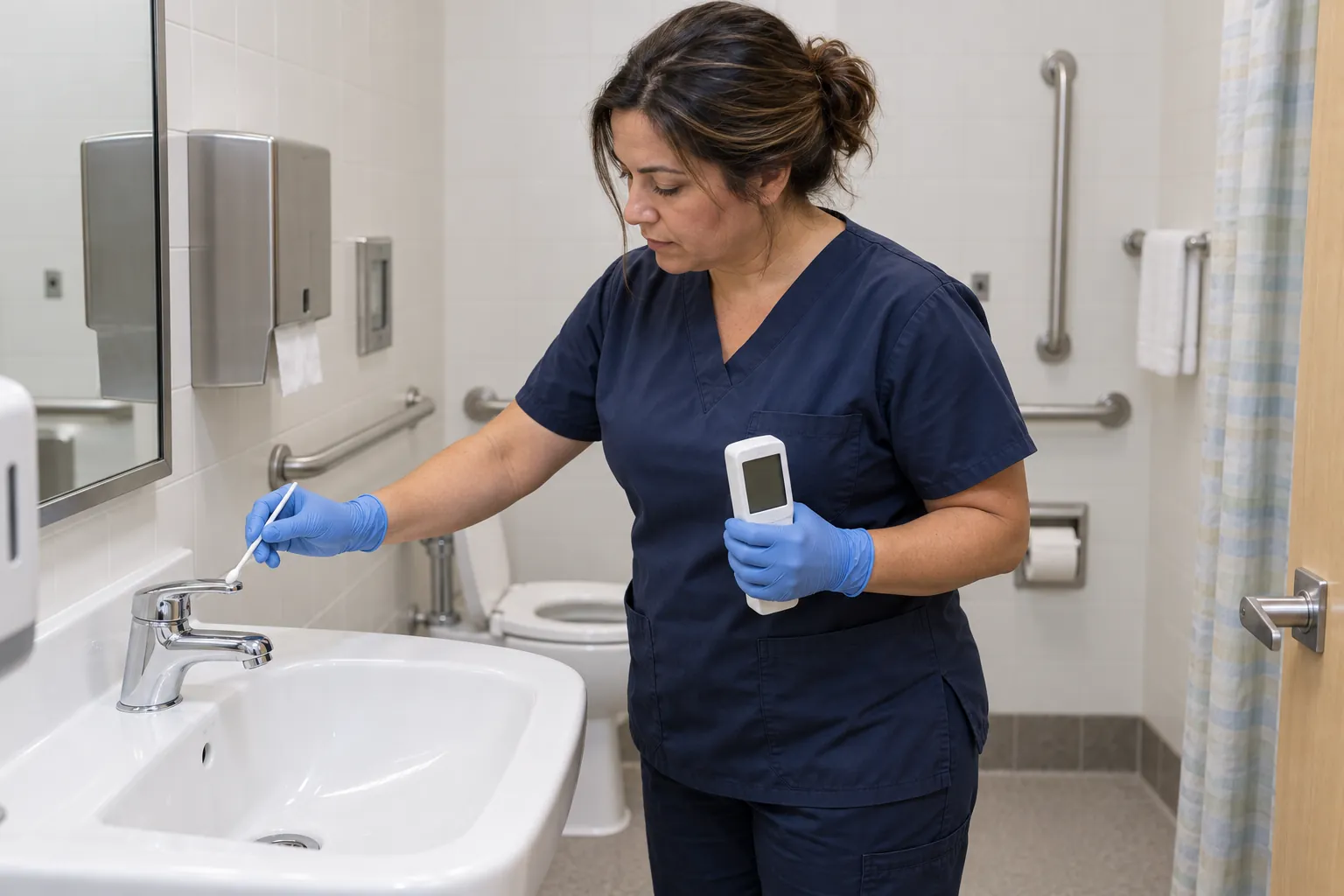
- ATP testing: a swab and a handheld meter measure organic residue on a surface. It gives a number, which is useful for trends and for settling arguments, but it measures residue, not germs. See ATP testing for setting it up.
Checks only improve cleaning when the results go back to the team, with retraining where a surface is repeatedly missed.
Alongside the checks, the routine itself needs a record. For each round, a good record shows:
- which area and which list of surfaces the round covered;
- the time it was done, recorded at the time and not filled in at the end of the shift;
- the name of the person who did it;
- any round that was missed, and why;
- anything found on the way that needs someone else, such as an empty soap dispenser, a broken door closer or a spill, and whether it was fixed;
- the product used where disinfection is part of the round, if the client or the setting requires it.
It is also what protects a janitorial contractor when a tenant says the restrooms were never cleaned on Tuesday.
06
Where the high-touch record fails, and what SiteClara does about it
Most high-touch rounds are recorded on a sheet taped inside a restroom door or kept on a clipboard at the janitor's closet. It has a column of times and initials, often filled in for the whole day at once, and it says nothing about which surfaces were done. The day porter's afternoon round of the elevator lobbies is recorded nowhere. The broken soap dispenser noticed at 11:00 was mentioned to whoever was passing and was still broken at 16:00. When a tenant complains, the answer comes from memory.
SiteClara records the checks at the place they happen. A printed QR code poster, with an optional NFC tag behind it, goes in each area on the round, such as a restroom, an elevator lobby or a break room. A custodian or day porter scans the code or taps the tag on their own phone, with no app to install, sees the checks set for that place, and marks each one done, or says what stopped them. The building writes the checks, so a restroom check can list the fixtures, dispensers, handles and latches, and ask for a photo when one is useful. The time and the named person are recorded as it happens. A problem found on the way goes onto the team's list of jobs until someone closes it.
The janitorial supervisor sees what is due, done and missed, and records the reason when a round was missed. Each day they review the totals and photos and approve a report that goes the next morning to nominated managers, such as the facility manager or the client, showing what was reported, what was completed and what is still open, and how the scheduled checks went.
07
Questions people ask
What are some examples of high-touch surfaces?
For ordinary buildings, the CDC's When and How to Clean and Disinfect a Facility gives "pens, counters, shopping carts, door handles, stair rails, elevator buttons, touchpads, restroom fixtures, and desks" as examples. Light switches, push plates, faucet and flush handles, dispensers, shared keyboards and the handles in break rooms belong on most lists too.
How do you treat high-touch areas?
Clean them more often than the rest of the room. The CDC's When and How to Clean and Disinfect a Facility says to "clean high-touch surfaces regularly", using soap and water or cleaning products appropriate for the surface, and to disinfect areas where people have obviously been ill, for example after vomiting on facility surfaces, with an EPA-registered product used as its label directs.
What are some examples of high-touch areas in patient rooms?
The CDC's Environmental Cleaning Procedures list bedrails, IV poles, sink handles, bedside tables, counters where medications and supplies are prepared, edges of privacy curtains, patient monitoring equipment such as keyboards and control panels, transport equipment such as wheelchair handles, call bells, doorknobs and light switches. The CDC's Guidelines for Environmental Infection Control in Health-Care Facilities (2003) add the wall areas around the toilet in the patient's room, and say these surfaces should be cleaned or disinfected more frequently than surfaces with minimal hand contact.
What does high-touch mean?
In cleaning, a high-touch surface is one that hands touch often, which the CDC's When and How to Clean and Disinfect a Facility says makes it "more likely to spread germs". A low-touch surface is one with little hand contact: the CDC's Environmental Cleaning Procedures contrast bed rails with walls, and say high-touch surfaces "require more frequent and rigorous environmental cleaning than low-touch surfaces".
08
Further reading, and a list to take away
For ordinary buildings, start with the CDC's When and How to Clean and Disinfect a Facility. For healthcare, read the CDC's Guidelines for Environmental Infection Control in Health-Care Facilities (2003), Considerations for Reducing Risk: Surfaces in Healthcare Facilities and Environmental Cleaning Procedures. For products, use the EPA's Selected EPA-Registered Disinfectants and the product label. For the employer's duties, read OSHA's sanitation and Bloodborne Pathogens standards, and check whether your state runs its own plan.
Before you rely on a high-touch surface routine, check that:
- each area has a written list of its high-touch surfaces, made from watching where hands actually go;
- each area has its own frequency, set by traffic and risk, with the busiest surfaces on the day porter's round;
- the method is written: clean first, disinfect where needed with an EPA-registered product, and keep it wet for the label's contact time;
- cloths are fresh, changed often, never double-dipped and color coded by area;
- electronics are cleaned the way their manufacturer says;
- staff are trained on the method and the chemicals, and the training is recorded;
- rounds are recorded at the time, by name, with missed rounds and their reasons;
- problems found on a round go to someone who closes them;
- the work is checked by observation, and by fluorescent markers or ATP where the setting warrants it, with the results shared with the team;
- the list is reviewed whenever the building changes.
Sources
Every document this guide quotes or links to, in the order it first cites them.
- When and How to Clean and Disinfect a Facility cdc.gov
- Guidelines for Environmental Infection Control in Health-Care Facilities (2003) cdc.gov
- Environmental Cleaning Procedures cdc.gov
- 29 CFR 1910.141 osha.gov
- Bloodborne Pathogens standard, 29 CFR 1910.1030 osha.gov
- Selected EPA-Registered Disinfectants epa.gov
- Hazard Communication standard, 29 CFR 1910.1200 osha.gov
- Considerations for Reducing Risk: Surfaces in Healthcare Facilities cdc.gov
Related guides
 CleaningCleaning, sanitizing and disinfecting: what each one does, and when a building needs itCleaning, sanitizing and disinfecting defined by the CDC, EPA and FDA Food Code: when each is needed, how to do it right, and what the record should show.
 CleaningATP testing: what the reading tells you, and how to run a program that means somethingHow ATP testing works, what a reading in RLU does and does not tell you, what the CDC says about using it, and how to run and record an ATP program that holds up.
 CleaningRestroom cleaning log: what to record, and how to make it believableWhat a restroom cleaning log should record, how often to check, the OSHA and Food Code rules behind it, and how to keep a log a client or inspector will believe.
 CleaningCommon area cleaning: what it covers, how often, and how to show it was doneWhat common area cleaning covers in apartment, condo and commercial buildings, how often, the OSHA and code rules behind it, and how to show each visit happened.