Cleaning
Janitorial quality control: how to inspect, score and fix the cleaning
A cleaning inspection checklist lists, for each area type in a building, the elements to check (fixtures, floors, dispensers, trash) and the result each must show, so that a supervisor or client can judge whether the cleaning meets the agreed standard.
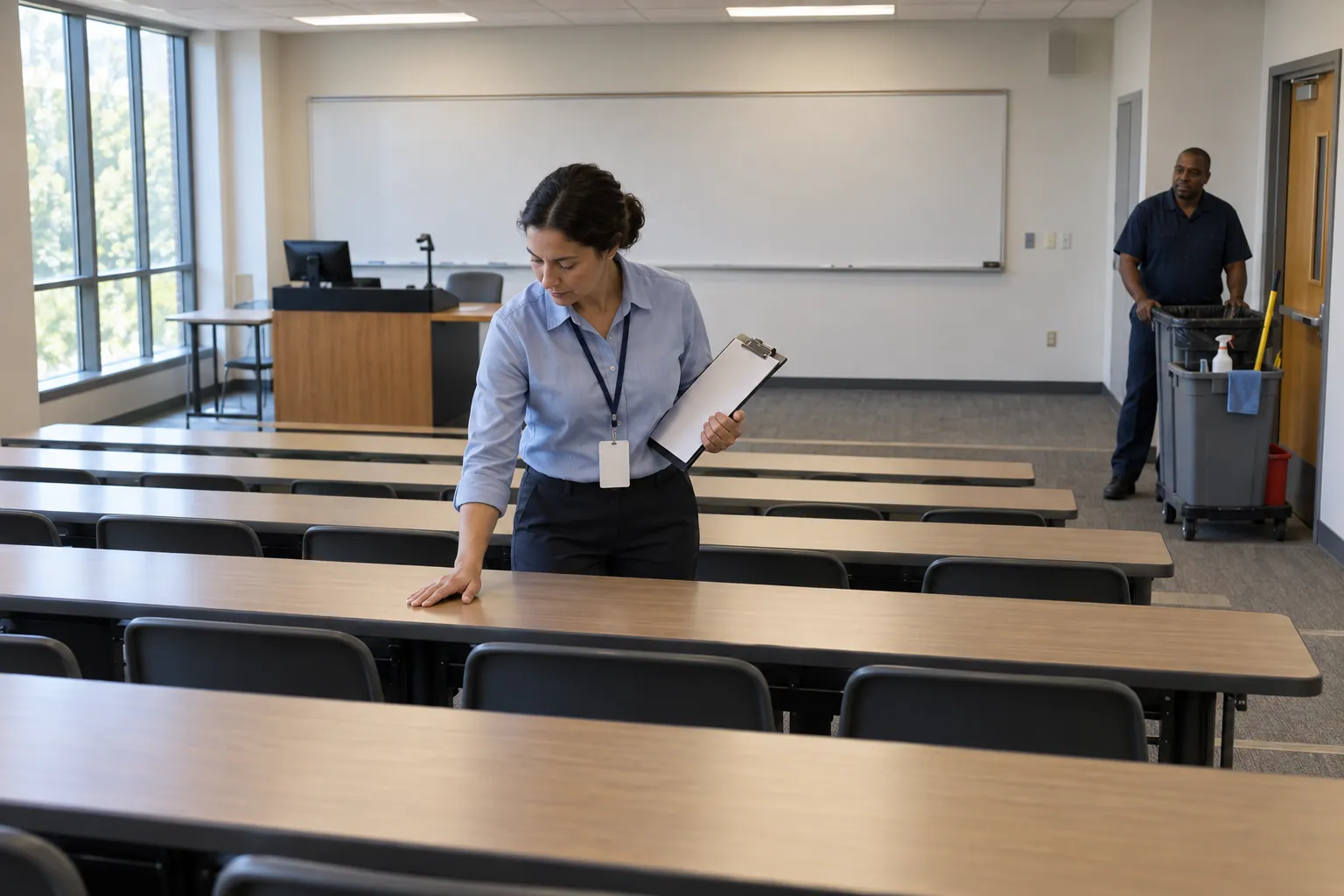
It is the working tool of janitorial quality control, the routine of checking the cleaning and fixing it when it falls short. Quality control is what separates a building that looks good on the day of the walkthrough from one that looks good every day. This guide covers the difference between quality assurance and quality control, what belongs on a cleaning inspection checklist, how to sample and score, how hospitals test cleaning objectively, and how corrective action closes the loop.
01
Quality assurance and quality control in janitorial work
The two terms are often used as if they meant the same thing. They are related, but they do different jobs.
- Quality assurance (QA) is the system that makes good cleaning likely: a clear scope of work, trained custodians, written procedures, the right equipment and chemicals, enough labor hours for the square footage, and supervision. It is about preventing failures.
- Quality control (QC) is the checking: inspections of the finished work, records of what was done, and corrective action when something falls short. It is about finding failures and fixing them.
Quality control is part of quality assurance, not a substitute for it. A janitorial contractor with thorough inspections and an untrained crew will find the same deficiencies every week; one with good training and no inspections will never know when standards slip.
There is no single federal rule called janitorial quality control, but the outcome it protects is required. Under federal OSHA's walking-working surfaces standard, 29 CFR 1910.22, employers must keep "all places of employment, passageways, storerooms, service rooms, and walking-working surfaces" in "a clean, orderly, and sanitary condition," and must inspect walking-working surfaces "regularly and as necessary." The OSHA sanitation standard, 29 CFR 1910.141, adds that places of employment "shall be kept clean to the extent that the nature of the work allows" and that washing facilities "shall be maintained in a sanitary condition." In the states that run their own OSHA-approved State Plans, the state's equivalent rule applies instead; federal OSHA says there are 22 State Plans covering private and public employers and seven covering only state and local government workers, and each must be at least as effective as federal OSHA.
Industry standards supply the method. ISSA's Cleaning Industry Management Standard (CIMS) is a management standard for cleaning organizations, open to both building service contractors (BSCs) and in-house service providers, with a Green Building option; ISSA describes it as a way to "build a proven management system that drives quality and consistency." APPA's Operational Guidelines for Educational Facilities: Custodial links staffing and task frequencies to five appearance levels across every space type on campus, and many schools and colleges use those levels as the yardstick for inspections. Some janitorial companies also hold ISO 9001, the general quality management system standard.
02
What belongs on a cleaning inspection checklist
A cleaning inspection checklist is different from the cleaning checklist the custodian works through. The cleaning checklist says what to do (empty trash, damp mop, restock dispensers); the inspection checklist says what the result must look like, element by element, so a supervisor or a client can judge it. Build one checklist per area type, from your own scope of work, rather than one long list for the whole building.
Typical area types and the elements to inspect:
- Restrooms: fixtures (toilets, urinals, sinks), partitions and doors, mirrors, floors and floor drains, dispensers stocked (soap, paper towels, toilet paper, seat covers), trash and sanitary receptacles emptied, odor.
- Offices and open work spaces: trash and recycling, dusting of desks and horizontal surfaces as the scope allows, carpet vacuumed, hard floors free of dust and spots, glass partitions, light switches and door handles.
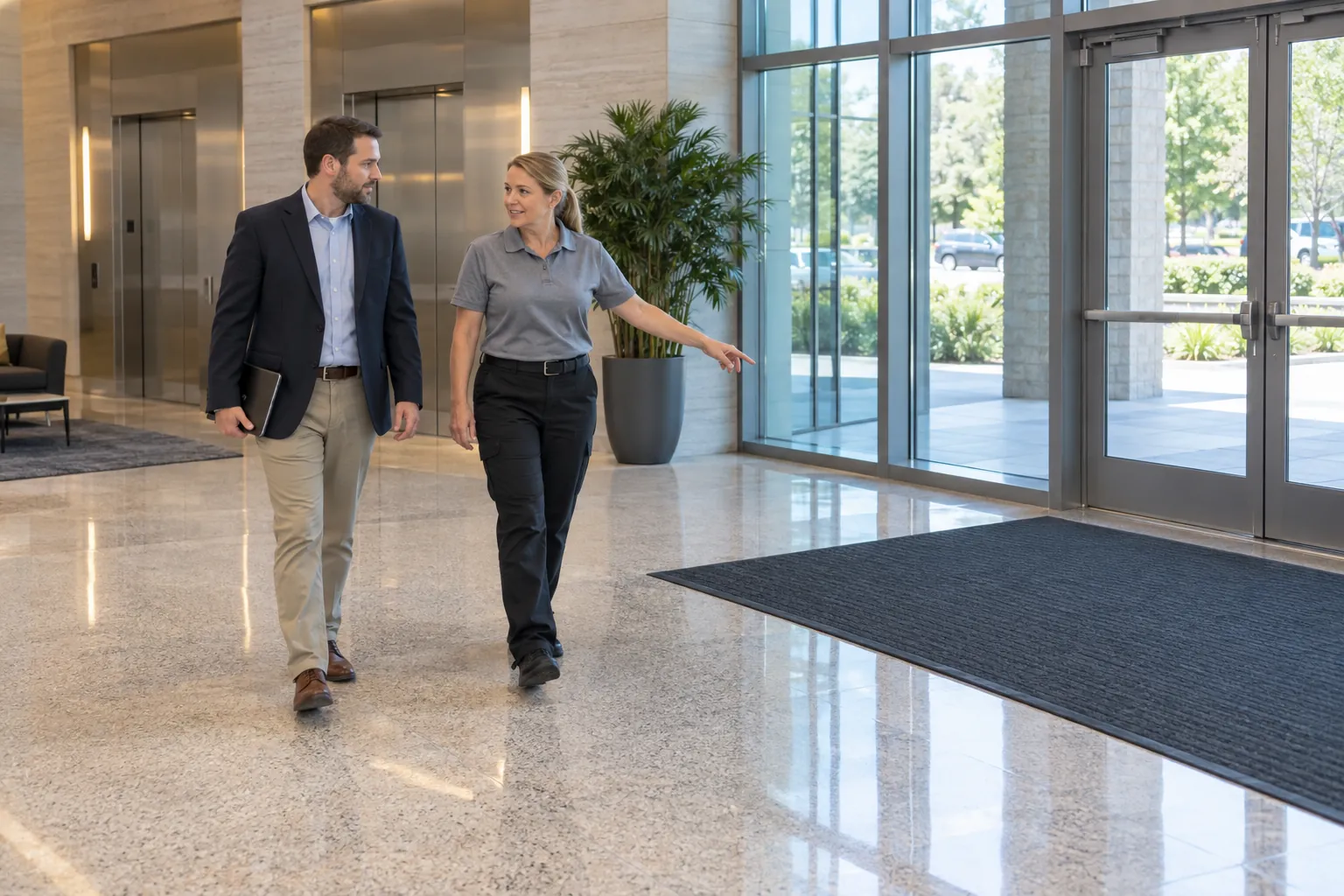
- Entrances, lobbies and reception: entrance glass, the reception desk and counter, walk-off mats, floors, elevator interiors and tracks, drinking fountains, ash urns and trash cans outside the door.
- Breakrooms and kitchenettes: counters, sinks, microwave inside and out, refrigerator handles, tables and chairs, trash.
- Classrooms: desks and tables, whiteboards, floors, trash, high-touch points.
- Corridors and stairwells: floors and edges, handrails, stair treads and landings, baseboards, spot cleaning of walls.
- Janitor closets: equipment clean and stored, chemicals labeled and dilution equipment working, mop heads changed.
Each element needs a clear standard of cleanliness, not "clean." "Floor free of dirt, gum and streaks, edges and corners included" can be judged the same way by two inspectors; "floor acceptable" cannot. Many facilities borrow APPA's appearance-level wording so that the checklist, the staffing plan and the contract all describe the same target. APPA's levels, as listed in Alan Bigger's Facilities Manager article Operational Guidelines for Educational Facilities – Custodial (January/February 2013), are:
- Level 1, Orderly Spotlessness
- Level 2, Ordinary Tidiness
- Level 3, Casual Inattention
- Level 4, Moderate Dinginess
- Level 5, Unkempt Neglect
Keep checklists short enough to use. An inspection form with a hundred elements per room will be completed quickly and badly; one with ten well-chosen elements will be completed properly. A free template downloaded from the internet is a starting point at best: the elements should come from your own scope, for the rooms in your building, at the frequencies your contract pays for.
03
Running inspections: who, how often and how to sample
Regular inspections are the core of janitorial quality control. To be worth the time, they need to be consistent, representative and honest.
- Inspect against the standard, not an impression. Each element passes or fails against the written standard. "Looks fine" is not a result.
- Sample fairly. Inspect a spread of rooms across floors and area types, and include the ones cleaned last in the shift, not only the ones by the elevator.
- Vary the timing. A restroom inspected at 6 a.m. tells you about the night crew, not about 2 p.m. Some unannounced inspections, some at busy times, show the building occupants actually experience. Where a day porter covers the daytime, inspect their route too.
- Match frequency to risk and traffic. Restrooms, breakrooms and entrances need inspecting more often than a storage room. Healthcare, food service and schools need more still.
- Walk it together. A joint walkthrough with the facility manager or property manager, perhaps monthly, removes arguments about the score and shows both sides the same thing.
- Separate inspector from cleaner. The janitorial supervisor, an account manager or a quality manager inspects; the custodian who cleaned the room does not score it.
Scores, the usual measure of cleaning performance, are the percentage of inspected elements that pass, or an average appearance level by area type. Record deficiencies by element and location, not only the overall score: a steady 92% hides whether the same 8% fails every time. A score also means little without a target, so agree one with the client and put it in the contract or the service level agreement, together with how the sample is drawn.
Read the result against the resources. APPA's guidelines connect the square footage one custodian cleans with the appearance level that can reasonably be expected. The 2013 APPA article gives the example of a custodian cleaning 17,000 cleanable square feet of hard-floored classroom space, where the expectation is Level 2, and notes that if a quality assurance assessment finds the space cleaned at Level 5, "there is a misalignment of expectations." An inspection that keeps failing may be telling you about the staffing plan, not the crew.
04
Hospitals and other high-risk areas: testing cleaning objectively
Visual inspection is the norm in offices, schools and retail. In hospitals, environmental services (EVS) departments go further, because surfaces near the patient can carry pathogens that look clean. The CDC's toolkit Options for Evaluating Environmental Cleaning (December 2010, on a CDC page dated September 10, 2025) encourages all hospitals to develop programs "to optimize the thoroughness of high touch surface cleaning as part of terminal room cleaning." It describes two levels:
- Level I: a joint infection prevention and EVS program with defined expectations, structured education of EVS staff, and regular documented monitoring, which may include competency evaluations and patient satisfaction results.
- Level II: objective monitoring of how thoroughly high-touch objects are cleaned, expressed as a thoroughness of disinfection cleaning (TDC) score, the number of objects cleaned divided by the number evaluated, times 100. The toolkit calls for monitoring at least three times a year, with the results built into EVS staff education "in a non-punitive manner."
The toolkit weighs the objective methods, and each has limits:
- Direct observation can assess individual performance, but is hard to keep up outside a research setting, and an observer who is recognized changes what is seen.
- Swab and agar slide cultures measure microbes, but cost more, take time to return results, and need pre-cleaning levels to judge the cleaning itself.
- Fluorescent markers, a gel that dries transparent on high-touch objects before cleaning, show whether the object was physically wiped.
- ATP testing measures organic residue with a swab and a handheld luminometer. The toolkit notes that readings include non-microbial material, that high concentrations of bleach may reduce the signal, and that it is unclear whether a threshold for a clean hospital surface can be set. See our guide to ATP testing.
Whatever the method, the toolkit says monitoring should be done by infection preventionists or their designees "who are not part of the actual ES cleaning program." The same principle of independence is worth copying in any building.
Two other rules bear on quality in high-risk areas. The OSHA bloodborne pathogens standard, 29 CFR 1910.1030, requires employers with occupational exposure to "determine and implement an appropriate written schedule for cleaning and method of decontamination," so an inspection there checks that the schedule was followed, not only that the room looks clean. And a disinfected surface is only disinfected if the product was used as labeled: the EPA's page on selected EPA-registered disinfectants says "the surface should be visibly wet for the entire contact time," which may mean reapplying. Watching a custodian's technique, including dwell time and color-coded cloths, is part of quality control that no end-of-shift look can replace.
05
Corrective action, trends and the client
An inspection that finds a deficiency is only useful if the deficiency is fixed and does not come back. Every failure needs:
- Immediate rework, within a time set by its priority. An unstocked restroom in a busy lobby cannot wait for the next shift.
- A named owner and a date for anything that cannot be fixed on the spot, such as a floor that needs stripping and refinishing.
- Verification: someone checks it has been done, rather than treating the item as closed when it is checked off.
- A root cause for anything that recurs: too few labor hours, a missing product, a training gap, a route that grew, a new tenant with different traffic, or a task nobody was told about.
Fix the cause, not only the symptom. If the same breakroom fails every Monday, the answer may be a change to the weekend schedule rather than a word with the Monday crew.
Complaints and work orders belong in the same loop. A simple way for occupants to report a spill or an empty dispenser tells you how the service feels to the people using it, which an inspection at a fixed time cannot. Treat each complaint as a free inspection: log it, fix it, record how long it took, and look for the pattern.
A monthly quality report to clients usually shows inspection scores by area type, the deficiencies found and closed, complaints and response times, and what is changing as a result. Choose a few measures and keep them steady from month to month; our guide to janitorial KPIs covers which ones are worth tracking. Share the results with the cleaning teams as well as clients, and say when they improve: the CDC toolkit's insistence that monitoring stay non-punitive applies well beyond hospitals.
06
Where the quality record fails, and what SiteClara does about it
Many janitorial quality control programs are strong on inspection and weak on everything between inspections. The monthly walkthrough is written up; the daily record of what was done lives on a log sheet on the back of the restroom door, initialed for the whole shift at the end of it, and a reported spill goes to whoever was passing. When a facility manager asks whether a deficiency found on Thursday was reworked, or whether the restroom checks happened on Friday afternoon, the answer is often a recollection rather than a record.
SiteClara records the routine checks where they happen. A printed QR poster, with an optional NFC tag behind it, sits at each location. Custodians scan or tap it on their own phone, with no app to install, see the scheduled checks due there, and mark each one done or say what stopped them, with a photo when one is asked for. A problem reported there goes onto the team's list of jobs until someone closes it, so a deficiency found on an inspection has an open job, an owner and a closing time rather than a note in a margin.
The supervisor sees what is due, done and missed, records why a check was missed, and can escalate a job to the building manager. The approved daily report goes to nominated contacts, such as the facility manager or the client, at 8 a.m. the next morning, showing what was reported, what was completed, what is still open and how the scheduled checks went, for example 12 of 12 completed.
07
Questions people ask
What is a standard cleaning checklist?
No federal rule sets one standard cleaning checklist, so each checklist should come from the building's own scope of work. The closest federal model is the CDC Environmental Checklist for Monitoring Terminal Cleaning, written for hospital rooms: it lists 17 priority high-touch surfaces, from bed rails and tray tables to light switches, door knobs, the bathroom sink and the toilet flush handle, and marks each one cleaned, not cleaned or not present in the room. The same layout, a fixed list of elements with a result for each, works for offices and schools.
What are the 5 basic cleaning principles?
Lists of five vary, but the CDC's Environmental Cleaning Procedures, written for healthcare facilities with limited resources, gives five rules for every cleaning procedure: conduct a visual preliminary site assessment, proceed from cleaner to dirtier, proceed from high to low, proceed in a methodical, systematic manner so no area is missed, and immediately attend to body fluid spills. The same page says checklists and other job aids "are also required to ensure that cleaning is thorough and effective."
08
Further reading, and a list to take away
Federal OSHA publishes the walking-working surfaces standard, the sanitation standard and the bloodborne pathogens standard; check the State Plans page to see whether your state's own rules apply. ISSA publishes the Cleaning Industry Management Standard. APPA sells the Custodial Operational Guidelines, the source of the five appearance levels. The CDC publishes Options for Evaluating Environmental Cleaning with a terminal cleaning checklist, and the EPA's Selected EPA-Registered Disinfectants page explains disinfectant labels and contact time. For how standards fit together, see our guide to cleaning standards in the US.
To check your own janitorial quality control, ask whether:
- each area type has a written standard, and the crew has seen it;
- the cleaning inspection checklist is short enough to be completed properly;
- the target appearance level and inspection frequency are written into the scope of work;
- inspections are sampled fairly, some unannounced, some at busy times and some joint with the client;
- the person inspecting is not the person who cleaned;
- deficiencies are recorded by element and location, not only as a score;
- every corrective action has an owner, a date and a verification;
- recurring failures are traced to a cause, including labor hours;
- in high-risk areas, disinfectant contact time and written cleaning schedules are checked, not assumed;
- there is a record of work done between inspections, as well as the inspections themselves.
Sources
Every document this guide quotes or links to, in the order it first cites them.
- 29 CFR 1910.22 osha.gov
- OSHA sanitation standard, 29 CFR 1910.141 osha.gov
- OSHA-approved State Plans osha.gov
- Cleaning Industry Management Standard (CIMS) cims.issa.com
- Operational Guidelines for Educational Facilities: Custodial appa.org
- Operational Guidelines for Educational Facilities – Custodial www1.appa.org
- Options for Evaluating Environmental Cleaning cdc.gov
- OSHA bloodborne pathogens standard, 29 CFR 1910.1030 osha.gov
- Selected EPA-registered disinfectants epa.gov
- CDC Environmental Checklist for Monitoring Terminal Cleaning cdc.gov
- Environmental Cleaning Procedures cdc.gov
Related guides
 CleaningJanitorial KPIs: what to measure, and how to know the numbers are trueThe janitorial KPIs worth tracking, how to define and target them, how federal contracts measure cleaning, and how KPIs look green while the building is not clean.
 CleaningJanitorial scope of work: what it should say, and how to show it is metWhat a janitorial scope of work should cover, how to set cleaning frequencies by room type, output versus input standards, and how to show the work is being done.
 CleaningJanitorial supervisor duties: what the job involves, and what good looks likeWhat a janitorial supervisor does: the core duties, a typical night shift, the OSHA rules behind the work, inspecting the cleaning and reporting to the client.
 CleaningCleaning standards in the US: a map, and how to chooseA map of US cleaning standards: OSHA, CDC and CMS rules for healthcare, the FDA Food Code, EPA disinfectant labels, APPA levels, CIMS and GS-42, and how to choose.