Premises and facilities management
Deferred maintenance: what it is, how to measure the backlog, and what cannot wait
Deferred maintenance is repair and routine maintenance work that should have been done when it was due and was put off to a later date: the roof patched instead of replaced, the air handler run past its service interval, the work order left open for a year.
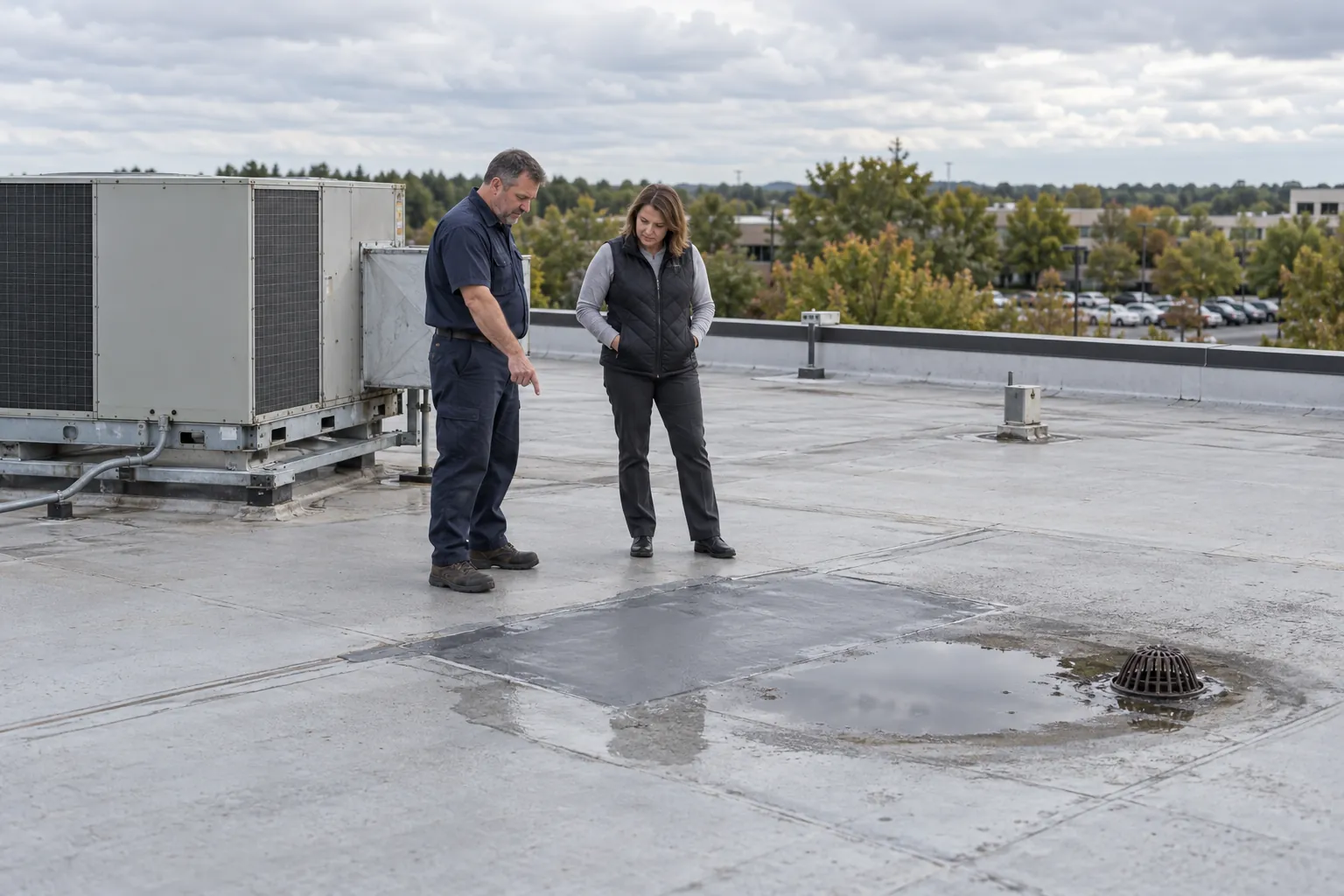
Every facility has some. The question is whether you know what it is, what it would cost to put right, and which items are quietly turning into failures. This guide covers the definitions the public sector reports against, how a backlog is measured, what the law says cannot be put off, and how to keep the record behind the number honest.
01
What deferred maintenance is, and who has to report it
The clearest definition in American practice is the federal one. Statement of Federal Financial Accounting Standards 42, Deferred Maintenance and Repairs (SFFAS 42), issued by the Federal Accounting Standards Advisory Board, says deferred maintenance and repairs are "maintenance and repairs that were not performed when they should have been or were scheduled to be and which are put off or delayed for a future period." It defines maintenance and repairs as "activities directed toward keeping fixed assets in an acceptable condition," including preventive maintenance and the replacement of parts, systems or components, and it excludes work that expands an asset's capacity or upgrades it to serve needs different from, or significantly greater than, its current use. That exclusion matters: a new wing or a bigger chiller is a capital improvement, not a deferred repair.
APPA, the association of educational facilities professionals, draws a second line. Its Body of Knowledge chapter Deferred Capital Renewal and Deferred Maintenance describes deferred maintenance as preventive, predictive or corrective maintenance that assets and systems should have had but have not, such as work order backlogs, needed repairs and leaking roofs, and deferred capital renewal as major maintenance or capital projects that went unfunded in earlier budget cycles, such as failed air handling units and equipment past its life cycle. Keeping the two apart makes the budget conversation easier.
No federal law requires a private building owner to measure deferred maintenance. The duty to report it falls on public bodies:
- Federal agencies report it under SFFAS 42 as required supplementary information: their maintenance policies, how they rank and prioritize the work, the factors they use to decide what condition is acceptable, beginning and ending balances by category of property, and an explanation of significant changes. The National Park Service's By the Numbers infrastructure page is a public example: it says that at the end of fiscal year 2025 an estimated $24 billion in repair need existed on roads, buildings, utility systems and other structures across the park system.
- State and local governments follow the Governmental Accounting Standards Board. Under GASB Statement No. 34, a government may choose the "modified approach" for eligible infrastructure assets, meaning networks such as roads, bridges and water systems, instead of depreciating them. To use it, the government keeps an up-to-date inventory, performs condition assessments, and reports each year's estimated cost of keeping the assets at its disclosed condition level against what it actually spent. Buildings, except those that are an ancillary part of a network, are not infrastructure under the Statement.
- Everyone else, from a hospital system to a property manager or an HOA, measures it because boards, owners and lenders ask, and because a capital plan is only as good as the list behind it.
GASB's tentative board decisions on infrastructure assets, last updated on November 10, 2025, would keep the modified approach and extend the comparison of estimated and actual spending to 10 fiscal years, effective for fiscal years beginning after June 15, 2028. GASB says these decisions are tentative and do not change current accounting.
02
What gets deferred in practice
Deferred maintenance is rarely one decision. It is a string of small ones: the filter change skipped for an emergency, the roof inspection moved to next quarter, the cracked sidewalk slab marked with paint and left. The backlog usually sits in the same places:
- Roofs and the envelope: membranes past their life, failed flashing, blocked drains, windows and doors that no longer seal.
- HVAC and mechanical: air handlers, boilers, chillers and pumps run to failure, filters changed late.
- Plumbing: leaking valves, corroded piping, restroom fixtures out of service.
- Electrical: panels, switchgear and emergency lighting that have not been serviced, and lighting left dark.
- Vertical transportation: elevator and escalator repairs put off between inspections.
- Interiors: worn flooring, damaged doors and hardware, stained ceiling tiles.
- Site and grounds: paving, sidewalks, site lighting and drainage.
- Fire and life safety systems: the category that should never be on a deferred list at all, and the one section 04 is about.
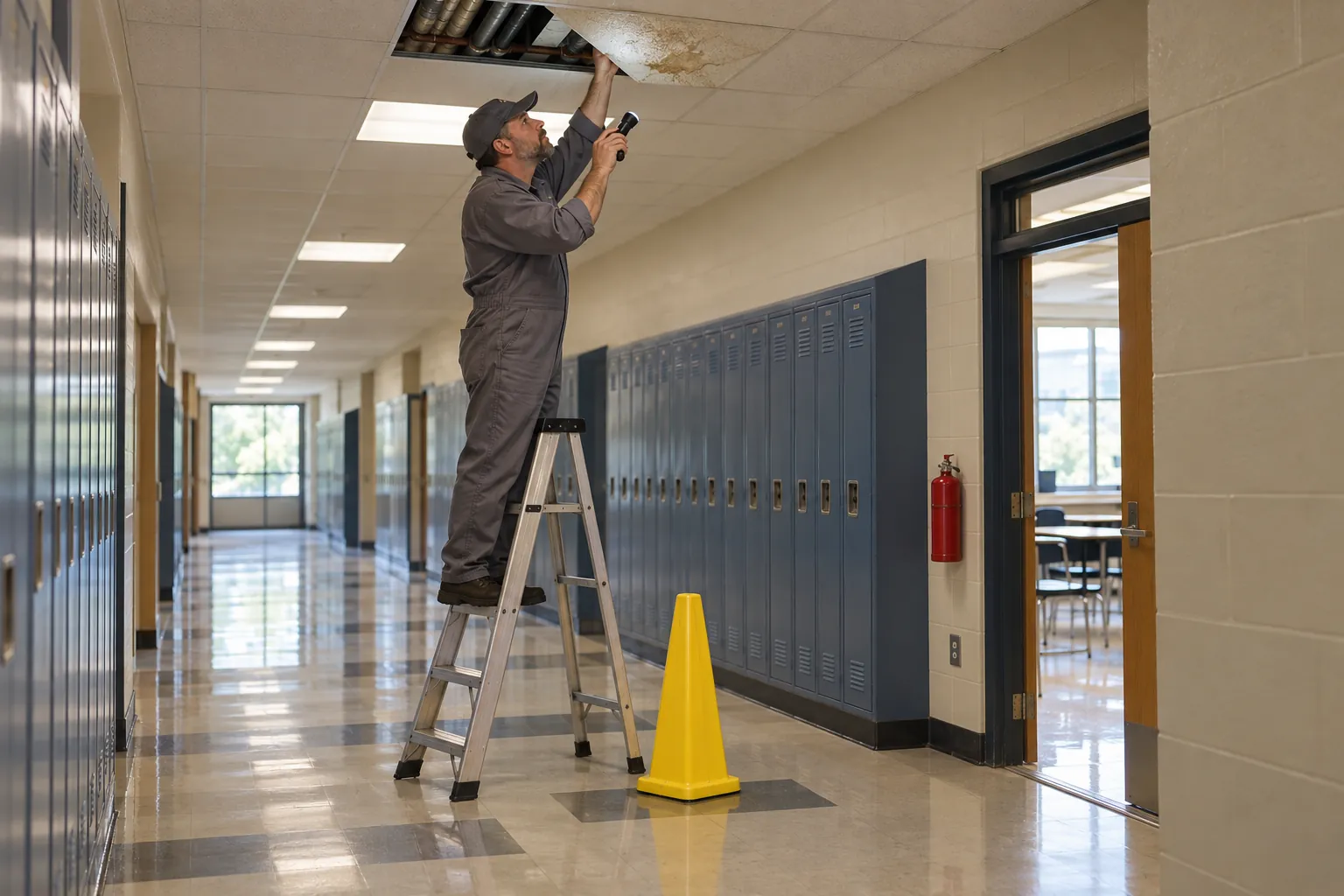
Some of the backlog is known and costed, from a condition assessment. Much of it is not. It lives in open work orders nobody closed, in items a custodian or day porter mentioned to a supervisor, and in things everyone walks past. A stained ceiling tile is cosmetic; the leak above it is deferred maintenance that will become a roof replacement or a mold remediation if it is left.
If the item is maintenance or repair that should have been done and was not, it belongs on the list, costed or not. If it is an upgrade, it belongs in the capital plan. Mixing the two makes the backlog look larger and the building look worse maintained than it is.
03
Measuring the backlog: condition assessments and the FCI
SFFAS 42 names three ways to measure deferred maintenance: condition assessment surveys, life-cycle cost forecasts, and other methods similar to either. It describes condition assessment surveys as "periodic visual (i.e., physical) inspections" to determine current condition and the estimated cost to correct any deficiencies. It does not require the whole portfolio to be inspected every year; assessments may run on a calendar cycle or on a frequency based on risk. GASB Statement No. 34 is stricter for governments using the modified approach: complete condition assessments at least every three years, documented so that "different measurers using the same methods would reach substantially similar results."
A facility condition assessment (FCA) walks each building system by system, rates condition, estimates remaining life and prices the corrective work. The resulting list of deficiencies is the backlog.
The most common single figure built from it is the Facility Condition Index (FCI). An article in APPA's Facilities Manager magazine, The Facilities Condition Index as a Measure of the Conditions of Public Universities as Perceived by the End Users (September/October 2006), gives the usual formula: the deferred maintenance backlog of a building divided by its current replacement value, DM/CRV = FCI. The same article says the replacement value can be anything from professionally detailed plans to "building officials' best guess," and that the backlog figure "is also obtained in a variety of ways at the discretion of the owner or owner's representative," from detailed condition analysis to educated guesses. It calls the lack of control over these inputs "a serious concern over the validity of the data that make up the FCI." An FCI compares buildings in one portfolio measured the same way; across institutions that measure differently it tells you much less.
Whatever method you use, keep a backlog register that records, for each item:
- What and where: the system or component, the building, floor and room or zone.
- When it was found, and by whom: an assessment, an inspection, a work order, a report from staff.
- Condition and consequence: what happens if it is left, and how soon.
- Priority, from your own written ranking (see section 04).
- Estimated cost and the basis of the estimate.
- Interim measures in place, such as a barricade, a bucket under the leak or a closed room, and when they were last checked.
- Status: planned, funded, in progress, done, or deliberately accepted and why.
SFFAS 42 also asks for consistency: once condition standards, assessment methods and reporting formats are chosen, apply them the same way unless a change is necessary, and document the rationale and its effect on the estimate when you do change. A backlog that drops because the method changed is not progress.
04
What cannot wait: safety, life safety and triage
Deferral is a budget decision, but some conditions the law requires to be kept safe now.
For walking and working surfaces in general industry, OSHA's 29 CFR 1910.22 requires that they be "inspected, regularly and as necessary, and maintained in a safe condition," and that hazardous conditions be "corrected or repaired before an employee uses the walking-working surface again. If the correction or repair cannot be made immediately, the hazard must be guarded to prevent employees from using the walking-working surface until the hazard is corrected or repaired." Where a repair involves the structural integrity of the surface, a qualified person must perform or supervise it. A broken stair tread can wait for a permanent fix only once it is guarded.
For exits, OSHA's 29 CFR 1910.37 requires that exit routes be "free and unobstructed," adequately lighted, and marked, and that "safeguards designed to protect employees during an emergency (e.g., sprinkler systems, alarm systems, fire doors, exit lighting) must be in proper working order at all times."
Check which rules apply to you. OSHA's State Plans page lists 22 State Plans covering private and public sector workers and seven covering only state and local government workers; in states without a plan, public employers are outside OSHA. Fire codes are adopted locally, and the authority having jurisdiction decides what applies. None of them has a category for "deferred."
A written priority scheme keeps these items off the long list and gives everything else an order. A common one runs:
- Life safety and code: fire alarm, sprinkler and emergency lighting faults, blocked exits, trip and fall hazards, electrical hazards. Fix or make safe now.
- Mission critical: a failure that would close a building, a floor or a service.
- Asset preservation: work that stops a larger failure, such as roofs, envelope, drainage and mechanical plant.
- Functional and appearance: finishes and fixtures.
SFFAS 42 expects federal entities to disclose how they rank and prioritize maintenance. Whatever your sector, writing the scheme down means the decision to defer an item is visible, and a decision to defer a safety item is visibly not allowed.
05
Reducing the backlog and reporting it
The cheapest deferred maintenance is the kind that never accumulates. The National Center for Education Statistics' Planning Guide for Maintaining School Facilities (NCES 2003-347) describes "breakdown maintenance," doing nothing to equipment until it breaks, and says it "defers repairs and allows damage to accumulate, compounding an organization's problems." Its test of a good plan is simple: "preventive work orders outnumber emergency work orders." The test works in any building.
In practice, backlogs come down in three ways at once:
- Stop adding to it. Keep preventive maintenance tasks on schedule for the systems that fail expensively, and look at every missed preventive task as a new line on the backlog, not a skipped chore.
- Catch small things early. Custodians, day porters, security officers and building engineers walk the building every day. A leak, a failed light, a door that no longer latches or a loose handrail reported the same day is a work order; found at the next assessment, it is a line on the backlog with a larger number beside it.
- Fund the rest in order. Use the priority scheme and the costed register to build the case for capital renewal, so facility managers can show what each item will cost if it is left, and schedule it into the capital plan.
Report the backlog to whoever funds the building: the board, the owner, the district or the trustees. A useful report shows the total and the trend, the split by priority, what was added and retired, where interim measures are in place, and any change of method. SFFAS 42 asks federal entities to explain significant changes from the prior year; that is worth doing everywhere. The backlog is an estimate: it rises as buildings age and as you look harder, and falls as work is done or items are reclassified, so the trend and the reasons matter more than any single figure.
06
Where the record fails, and what SiteClara does about it
The condition assessment is thorough, and three years old. In between, the backlog grows through things nobody wrote down: the ceiling stain the day porter mentioned to whoever was passing, the fire door propped because it stopped latching, the roof drain checks initialed at the end of the week for every day at once. When the ceiling comes down, nobody can say when the leak was first seen or who was told.
SiteClara works on the routine checks and reports in the shared spaces of a building. A printed QR poster goes at each location, such as a mechanical room, a restroom, a roof access, a stairwell or a parking level, with an optional NFC tag behind it. Staff scan the code or tap the tag on their own phone, with no app to install, and sign in with a link. They see the checks due at that location, such as drains clear, exit lights lit, door closing and latching, no sign of leaks, and mark each one done, or say what stopped them. A problem is reported there with a photo and goes onto the team's list of jobs until someone closes it, so the leak has a date, a place, a photo and a name from the first day.
The supervisor sees what is due, done and missed, and can record why a check was missed; a job that needs the building manager can be escalated to them to answer. Each day the supervisor reviews and approves a report that goes to nominated management or owner contacts at 8 a.m. the next morning, showing what was reported, completed and still open, and how the scheduled checks went. Over months, that record shows which problems were found early and dealt with and which were left open.
07
Questions people ask
What does deferred maintenance mean?
It means maintenance and repairs that were due and were put off. The federal standard, SFFAS 42, Deferred Maintenance and Repairs, defines deferred maintenance and repairs as "maintenance and repairs that were not performed when they should have been or were scheduled to be and which are put off or delayed for a future period," and leaves out work that expands an asset's capacity or upgrades it for a different or much greater use.
What is an example of deferred maintenance?
APPA's Body of Knowledge chapter Deferred Capital Renewal and Deferred Maintenance gives three: a three-month backlog of preventive maintenance work orders, air handler components that need repair, and a leaky but repairable roof dripping into a collection and drainage system. It treats a failed air handling unit, an air compressor past its life cycle and a chiller running at 50% capacity because of age and wear as deferred capital renewal instead.
What is deferred maintenance expense?
Deferred maintenance is work that has not been done yet, so the figure is an estimate of what that work would cost rather than an expense already incurred. In federal accounting, SFFAS 42 has it reported as required supplementary information, with beginning and ending balances and a narrative, and notes that an earlier standard moved it there from a disclosure in the notes to the financial statements. One of the measurement methods it allows compares forecasts of maintenance and repairs expense with the actual maintenance and repairs expense to arrive at the deferred amount.
08
Where to read more, and a list to take away
Read SFFAS 42 for the definitions; its reporting requirements are a good template outside government too. State and local finance teams should read the modified approach in GASB Statement No. 34 with the current codification, and follow GASB's infrastructure assets project. For safety items, read OSHA's 29 CFR 1910.22 and 29 CFR 1910.37, your state plan if you have one, and your local fire code.
To keep deferred maintenance under control, check that:
- every building has a condition assessment, on a set cycle or on a risk-based frequency, done the same way each time;
- the backlog register records what, where, when found, by whom, consequence, priority, cost and interim measures;
- a written priority scheme puts life safety and code items first, and no safety item sits on the deferred list unguarded;
- missed preventive maintenance is logged as it happens, not discovered at the next assessment;
- staff who walk the building have one clear way to report a problem the same day, and each report becomes a job that is closed and recorded;
- the backlog is reported to whoever funds the building, with the trend, what was added and retired, and the reason for any change of method;
- public bodies know whether they report under FASAB or GASB.
Sources
Every document this guide quotes or links to, in the order it first cites them.
- Statement of Federal Financial Accounting Standards 42, Deferred Maintenance and Repairs files.fasab.gov
- Deferred Capital Renewal and Deferred Maintenance appa.org
- National Park Service's By the Numbers infrastructure page nps.gov
- GASB Statement No. 34 storage.gasb.org
- Tentative board decisions on infrastructure assets storage.gasb.org
- The Facilities Condition Index as a Measure of the Conditions of Public Universities as Perceived by the End Users www1.appa.org
- 29 CFR 1910.22 osha.gov
- 29 CFR 1910.37 osha.gov
- OSHA's State Plans page osha.gov
- Planning Guide for Maintaining School Facilities nces.ed.gov
Related guides
 Premises and facilities managementPreventive maintenance checklist: what to check in a commercial building, how often, and how to prove itA preventive maintenance checklist for commercial buildings: HVAC, electrical, fire and life safety, plumbing, how often, and what the record should show.
 Premises and facilities managementReactive maintenance: how to run it well, and keep it in proportionHow to run reactive maintenance in a US facility: work order priorities, response times, what OSHA expects, the cost against preventive work, and vendors.
 Premises and facilities managementBuilding maintenance checklist: what the code expects, how often to check, and who does itA building maintenance checklist for US commercial buildings, built on the International Property Maintenance Code: daily to annual tasks, who does each, the record.
 Premises and facilities managementFacility manager duties: what the job covers, and how to show it is doneFacility manager duties across buildings and vendors: OSHA's General Duty Clause, exits, lockout, contractors, the inspection calendar and a record you can show.