Premises and facilities management
Facility manager duties: what the job covers, and how to show it is done
Facility manager duties are overseeing the safety, maintenance and daily operations of an organization's buildings, grounds and equipment, and keeping the services people rely on in them safe, compliant, working and within budget.

Most facility managers do this through a team of technicians, custodians and outside vendors. This guide sets out the duties most facility manager job descriptions share, the federal rules that sit behind them, how the work divides between in-house staff and contractors, and what a record that stands up looks like.
01
What a facility manager is, and the duties behind the role
The International Facility Management Association's page on what facility management is adopts the ISO definition: facility management is "an organizational function which integrates people, place and process within the built environment with the purpose of improving the quality of life of people and the productivity of the core business." The facility manager, sometimes called a facilities manager, facilities director or director of operations, leads that function. Where a building engineer or chief engineer runs the mechanical plant of one building, a facility manager usually answers for a set of services across a building, a campus or a portfolio: maintenance, custodial and janitorial, security, grounds, moves and space, and the compliance that sits under all of them.
The Bureau of Labor Statistics groups the job with administrative services managers in its Occupational Outlook Handbook entry for administrative services and facilities managers. It says facilities managers "oversee buildings, grounds, equipment, and supplies", that the work covers "operations, maintenance, and planning and managing projects", and that they "continually monitor facilities to ensure that the premises are safe, secure, and well maintained." It also notes that facilities managers "often are on call to address problems that arise at all hours."
Most of the legal duties a facility manager carries out belong in law to the employer or the building owner. The facility manager is how the organization meets them. For a private employer under federal OSHA, the starting point is the Occupational Safety and Health Act of 1970, Section 5. Section 5(a)(1), the General Duty Clause, requires each employer to furnish "employment and a place of employment which are free from recognized hazards that are causing or are likely to cause death or serious physical harm to his employees." Section 5(a)(2) adds that the employer "shall comply with occupational safety and health standards", and the standards a facility manager meets most often are in 29 CFR Part 1910:
- 29 CFR 1910.22, Walking-working surfaces, which requires surfaces to be "inspected, regularly and as necessary, and maintained in a safe condition", and hazardous conditions to be corrected or repaired before an employee uses the surface again, or guarded until they are if the repair cannot be made immediately;
- 29 CFR 1910.37, Maintenance, safeguards, and operational features for exit routes: exit routes "must be free and unobstructed", and safeguards such as sprinkler systems and fire doors must be "in proper working order at all times";
- 29 CFR 1910.38, Emergency action plans, which sets what a plan must contain wherever another OSHA standard requires one;
- 29 CFR 1910.147, The control of hazardous energy (lockout/tagout), for anyone servicing or maintaining equipment that could start up or release stored energy;
- OSHA injury and illness recordkeeping under 29 CFR Part 1904, which in many organizations the facility manager keeps or feeds.
02
Facility manager duties and responsibilities in practice
Facility manager job descriptions vary with the organization and the portfolio, whether a commercial office building, a school, a hospital or a campus, but the same duties and tasks appear in nearly all of them:
- Life safety and code compliance: knowing which inspections, tests and certificates each building needs (fire alarm, sprinklers, fire extinguishers, emergency lighting, elevators, boilers, backflow preventers), making sure each happens on time, and keeping the reports where an inspector can see them.
- Workplace safety: safe premises and safe work in them, including the emergency action plan, lockout/tagout for maintenance staff, hazard communication for cleaning and maintenance chemicals, and injury reporting.
- Maintenance and operations: preventive maintenance of HVAC, electrical, plumbing, roofing and the building automation system, and reactive repairs through a work order process. This is often called hard services.
- Soft services: janitorial and custodial, day porters, security officers, reception, mail, waste and recycling, pest control and grounds, often delivered by outside vendors.
- Vendors and contracts: writing scopes of work, running bids and RFPs, managing contracts, checking certificates of insurance, and holding vendors to agreed service levels.
- Budgets: the operating budget, the capital plan for roofs, chillers, boilers and paving, and the backlog of deferred maintenance that builds when capital is short.
- Space, moves and projects: allocating space, planning moves, adds and changes, and managing renovations and tenant improvements with architects and general contractors.
- Accessibility: under the ADA, the Department of Justice's guidance for businesses that are open to the public says they must "remove architectural barriers in buildings when it is readily achievable to do so", which lands on the facility manager's desk in any building the public uses.
- Emergency preparedness and business continuity: what happens when power, water, heat or access fails, who is called, and how the building is secured after hours.
- Energy and sustainability: utility use, water, waste diversion and any benchmarking your city or state requires.
- Reporting: telling leadership whether the portfolio is safe, compliant and on budget, and what it needs next.
In a small organization one person does all of this with a maintenance technician and a handful of vendors. In a large one, a director of facilities oversees a facility manager for each campus, a chief engineer runs the plant, and a help desk takes the requests.
03
In-house staff, vendors, and who is responsible for what
How the duties divide depends on the delivery model, and a facility manager needs to know which one they are working in.
- Self-performed: the organization employs its own maintenance technicians, custodians and engineers, and the facility manager supervises them directly.
- Single-service contracts: separate vendors for janitorial, security, HVAC, elevators, fire protection and landscaping, each managed by the facility manager.
- Integrated facility management: one provider delivers most services under a single facilities management contract, and the facility manager sets the scope and checks performance.
- Property management: in leased buildings, the landlord's property manager and building engineer run the base building, and the tenant's facility manager looks after the tenant's own space.
Outsourcing moves the work, not the responsibility. OSHA's Multi-Employer Citation Policy (CPL 2-0.124) says that "on multi-employer worksites (in all industry sectors), more than one employer may be citable for a hazardous condition that violates an OSHA standard." It describes a controlling employer as one with "general supervisory authority over the worksite, including the power to correct safety and health violations itself or require others to correct them", and expects that employer to "exercise reasonable care to prevent and detect violations on the site." For a facility manager, that means checking vendors at intervals that fit the risk and their track record, and acting on what the checks find.
Write down, for each building and each service, who does the work, who checks it, where the record is kept, and who is told when something goes wrong. Compliance failures often come from gaps in that table, especially at the boundary between two vendors, where each assumes the other has it.
04
The working week and the compliance calendar
The week is mostly service delivery: walking buildings, work orders, complaints, vendors and invoices. Behind it sits a compliance calendar, set out in our building compliance checklist, which is the backbone of the role. The exact frequencies come from the codes your AHJ has adopted and from the manufacturer, but a typical calendar includes:
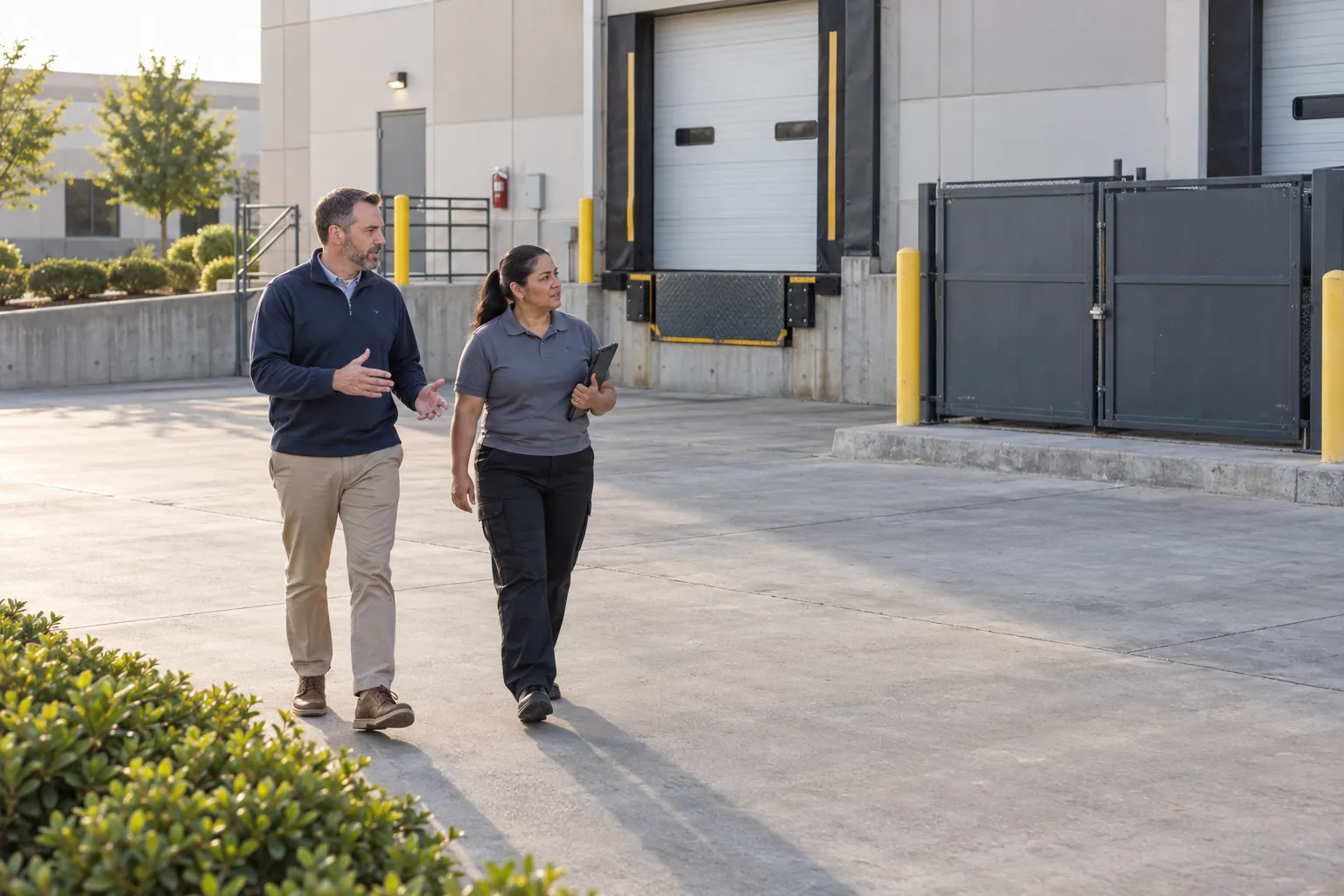
- Daily and weekly: walk-throughs of exits, stairwells, restrooms, loading docks and mechanical rooms; floors and walking surfaces checked and spills cleared, as 1910.22 expects; boiler and chiller logs kept by the engineering staff; plumbed eyewash stations and emergency showers activated weekly, as the ANSI/ISEA Z358.1 standard sets out, where the building has them.
- Monthly: fire extinguisher visual checks, exit sign and emergency lighting checks, and generator run tests.
- Periodic: inspection, testing and maintenance of fire alarm and sprinkler systems by licensed contractors under the NFPA standards your jurisdiction adopts (such as NFPA 72 for fire alarms and NFPA 25 for water-based systems), elevator inspections by the state or city, backflow testing for the water purveyor, and boiler inspections.
- Annual reviews: the emergency action plan, the periodic inspection of lockout/tagout procedures that 1910.147 requires "at least annually", and, where the building has one, the Legionella water management program, for which the CDC publishes a Toolkit: Developing a Legionella Water Management Program and notes that "many buildings need a WMP".
- The OSHA calendar: under 29 CFR 1904.32, the annual summary on Form 300A must be posted "no later than February 1 of the year following the year covered by the records" and kept up "until April 30". Under 29 CFR 1904.1, a company that "had 10 or fewer employees at all times during the last calendar year" does not need to keep the records unless OSHA or the Bureau of Labor Statistics tells it in writing that it must, but every employer must report serious incidents: a work-related fatality within eight hours, and an in-patient hospitalization, amputation or loss of an eye within 24 hours, under 29 CFR 1904.39.
Many teams keep this calendar in a tool such as a CMMS or integrated workplace management system; smaller ones often use a spreadsheet. Either way, the facility manager rarely does these checks personally. The duty is to make sure each one has an owner, happens on time, and leaves a record that someone other than the person who did it can find and trust.
05
Education, credentials, and what good evidence looks like
There is no single route into the job. The BLS Handbook says facilities managers "typically need a bachelor's degree", although "some people enter the occupation with a high school diploma", and that they should have "experience in business operations, project management, and building maintenance" before moving into management. People arrive from the trades, building engineering, the military, construction, property management and hospitality. On certification, the Handbook says that "although it is not required, professional certification may give candidates an advantage when applying for jobs." IFMA offers three credentials: the Facility Management Professional (FMP), the Sustainability Facility Professional (SFP) and the Certified Facility Manager (CFM). Salary varies widely with the sector, the region and the size of the portfolio; the BLS Handbook publishes current pay data for the occupation.
The skills that matter most are organization, vendor and budget management, a working knowledge of building systems, and the ability to explain risk to people who are not specialists. A facility manager who can say plainly what is compliant, what is not, and what it will cost to fix is more useful to leadership than one who reports everything as green.
Good evidence of the duties being done is not a thick binder. It is being able to answer, quickly and with a record behind each answer:
- Which inspections and tests are due in the next 90 days, and which are overdue?
- Were last week's routine checks done in every building, and by whom?
- Which work orders are open, how old are they, and who owns each one?
- Are the vendors delivering what their contracts say, measured the same way each month? (See facility management KPIs.)
- Where is the money going against budget, and what capital needs are coming?
06
Where the record fails, and what SiteClara does about it
A facility manager usually has good records of what licensed contractors certify and weak records of what happens every day. The fire extinguisher tags are punched, but the restroom sheet on the back of the door was initialed for the whole shift at once, the janitorial vendor keeps its checklists in its own closet, the security officer's rounds are in a notebook, and a leak mentioned to whoever was at the front desk never became a work order. When leadership asks whether the routine checks were done across every building last month, the honest answer is often an assurance rather than a record.
SiteClara records that routine work at the place it happens. A printed QR poster at each location, such as a restroom, mechanical room, exit stairwell, loading dock or dumpster enclosure, with an optional NFC tag behind it, lets custodial, security or maintenance staff scan the code or tap the tag on their own phone, with no app to install. They see the scheduled checks due there and mark each one done, or say what stopped them, with a photo when one is asked for. A problem found there goes onto the team's list of jobs until someone closes it, and the supervisor's queue groups open jobs by building and floor. A supervisor can escalate a job to the building's manager, who can answer it.
Each day the supervisor reviews the day's checks and photos, gives a reason for any check that was missed, and approves a report, which goes to the facility manager and other nominated contacts at 8 a.m. the next morning. It shows what was reported, what was completed, what is still open and how the scheduled checks went. Where a janitorial vendor and a security vendor work in the same building, each can run its own staff, forms and approval.
07
Questions people ask
What do facility managers get paid?
The Bureau of Labor Statistics Occupational Outlook Handbook pay data for administrative services and facilities managers says "the median annual wage for facilities managers was $106,660 in May 2025", half earning more and half less. The Handbook notes that earnings vary with experience, responsibility, performance, tenure and geographic area, and its pay tables show that the median differs by industry.
What qualifications does a facility manager need?
The Occupational Outlook Handbook entry on how to become an administrative services or facilities manager says they "typically need a bachelor's degree and related work experience", and that facilities managers should have "experience in business operations, project management, and building maintenance, such as from having worked as a general maintenance and repair worker or a cost estimator." A credential such as IFMA's Certified Facility Manager is optional: "although it is not required, professional certification may give candidates an advantage when applying for jobs."
Is an administrative services manager the same as a facility manager?
They are grouped together but are not the same job. The Occupational Outlook Handbook entry on what administrative services and facilities managers do says both "plan, direct, and coordinate activities that help an organization run efficiently". Administrative services managers handle office support services such as recordkeeping and mail, while facilities managers "oversee buildings, grounds, equipment, and supplies." Where one person manages both, the job description combines admin and facility manager duties.
08
Further reading, and a list to take away
OSHA publishes the general industry standards, the recordkeeping rules and its enforcement directives, and a state plan publishes its own. The BLS Handbook describes the job and the routes into it, IFMA its credentials, and ISO 41001, Facility management – Management systems, is the international standard for the discipline. For fire and life safety, your local fire marshal and the NFPA codes your jurisdiction adopts are the authority.
If you are writing a facility manager job description, or starting in the role, check that you know:
- every building, system and service you are responsible for, and those you are not;
- whether federal OSHA or a state plan covers your workforce, and which fire and building code editions your AHJ enforces;
- the compliance calendar for each building, and who owns each line of it;
- which services are self-performed and which are contracted, and how each contract measures performance;
- how you check the vendors you control, and how often;
- where each routine check is recorded, and how you would know it was missed;
- how problems are reported, and how you know each one is closed;
- the budget, the capital plan, and what leadership expects to see from you and how often.
Sources
Every document this guide quotes or links to, in the order it first cites them.
- International Facility Management Association's page on what facility management is ifma.org
- Occupational Outlook Handbook entry for administrative services and facilities managers bls.gov
- Occupational Safety and Health Act of 1970, Section 5 osha.gov
- 29 CFR 1910.22, Walking-working surfaces osha.gov
- 29 CFR 1910.37, Maintenance, safeguards, and operational features for exit routes osha.gov
- 29 CFR 1910.38, Emergency action plans osha.gov
- 29 CFR 1910.147, The control of hazardous energy (lockout/tagout) osha.gov
- OSHA injury and illness recordkeeping osha.gov
- OSHA-approved State Plans osha.gov
- Businesses that are open to the public ada.gov
- Multi-Employer Citation Policy (CPL 2-0.124) osha.gov
- Toolkit: Developing a Legionella Water Management Program cdc.gov
- 29 CFR 1904.32 osha.gov
- 29 CFR 1904.1 osha.gov
- 29 CFR 1904.39 osha.gov
Related guides
 Premises and facilities managementBuilding engineer duties: what the job covers, and how to show it is doneBuilding engineer duties in a commercial building: running the plant, rounds and logs, lockout, refrigerant and boiler rules, vendors, and a record that holds up.
 Premises and facilities managementFacility management KPIs: how to choose them, and how to keep them honestHow to choose facility management KPIs: examples from FCI to EUI and work order metrics, input and outcome measures, data sources, definitions and gaming.
 Premises and facilities managementFacilities management contract: what to put in it, and how to make it workWhat a US facilities management contract should cover: scope, pricing, performance standards and inspection, worker transition rules, safety, and exit.
 Premises and facilities managementBuilding compliance checklist: OSHA, the fire code and the ADA in one US buildingBuilding compliance checklist for US commercial buildings: OSHA, the fire code, elevators, water, asbestos and the ADA, who holds each duty and how often it is due.