Premises and facilities management
Building maintenance checklist: what the code expects, how often to check, and who does it
A building maintenance checklist is a schedule of the routine tasks that keep a building safe and in working order, from inspections and tests to cleaning, servicing and repairs, set out by system, by frequency from daily to annual, and by who does each one.
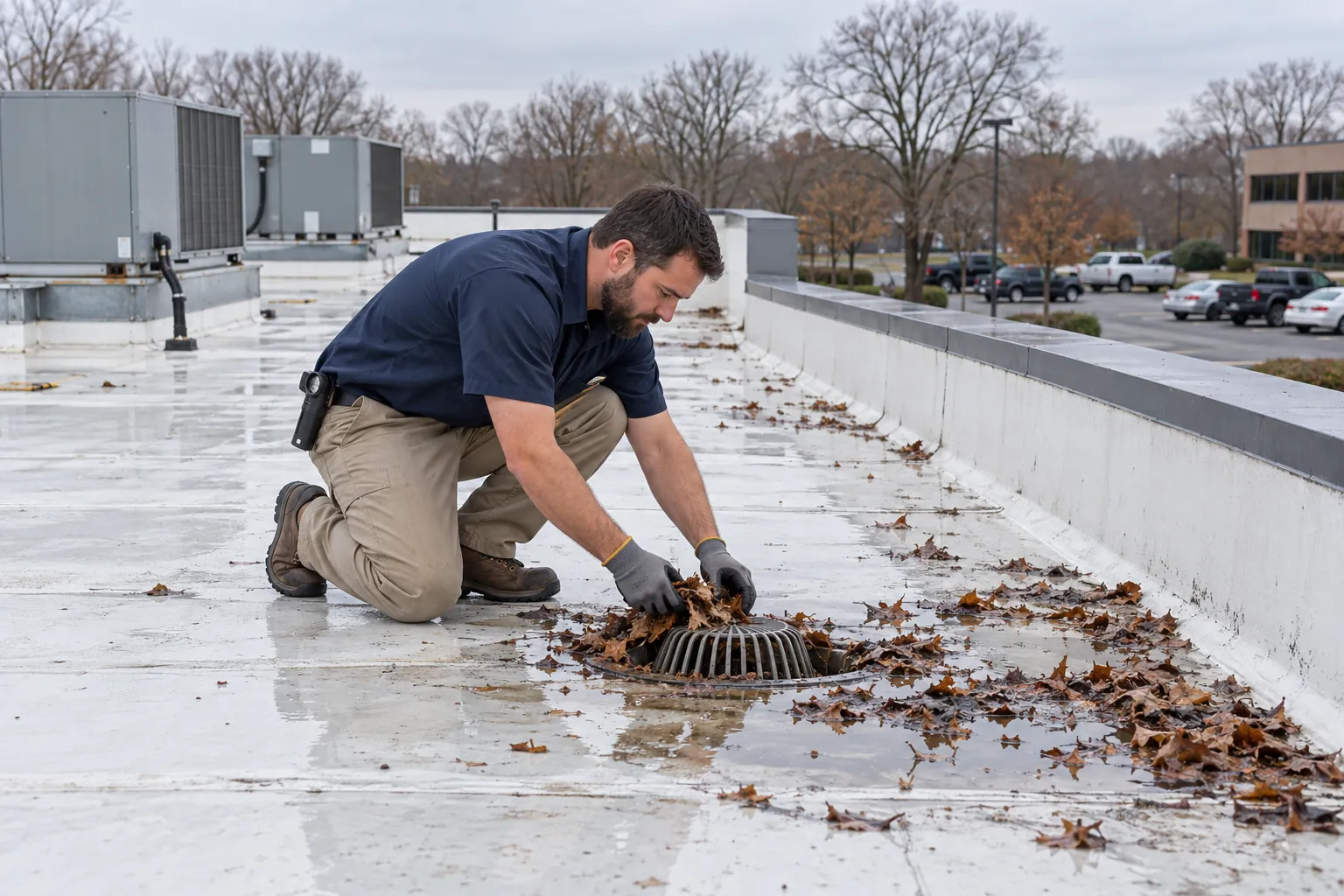
It turns the owner's duty to keep a property in good repair into specific tasks on specific days. This one is written for US commercial buildings, schools, churches, retail and multi-tenant properties. It follows the International Property Maintenance Code, which many cities and counties adopt, adds the OSHA rules that apply wherever people work, and marks the items that need a licensed contractor or qualified technician rather than the custodial or engineering staff.
01
The duty behind a building maintenance checklist
In most of the United States, the rule that says an existing building must be kept in repair is a property maintenance code, and the model most jurisdictions start from is the International Code Council's International Property Maintenance Code (IPMC), 2024 edition, Chapter 1. Section 101.2 says it applies "to all existing residential and nonresidential structures and all existing premises," and sets minimum standards for "light, ventilation, space, heating, sanitation, protection from the elements, a reasonable level of safety from fire and other hazards, and for a reasonable level of sanitary maintenance."
Two sentences carry most of the weight for a facility team. Section 102.2 says that "Equipment, systems, devices and safeguards required by this code or a previous regulation or code under which the structure or premises was constructed, altered or repaired shall be maintained in good working order," and that "the owner or the owner's authorized agent shall be responsible for the maintenance of buildings, structures and premises." And in IPMC Chapter 3, General Requirements, Section 301.2 says "The owner of the premises shall maintain the structures and exterior property in compliance with these requirements and the code under which the building was constructed."
The IPMC is a model code. It becomes law only where a state, county or city adopts it, often an earlier edition and usually with local amendments; the model text even leaves blanks, such as the dates of the heating season, for the jurisdiction to fill in. The code official who enforces it is the authority having jurisdiction (AHJ), so check which code and edition your city or county enforces.
Wherever people are employed, federal workplace law applies as well. Section 5(a)(1) of the Occupational Safety and Health Act, the general duty clause, requires each employer to "furnish to each of his employees employment and a place of employment which are free from recognized hazards." 29 CFR 1910.22 requires that "Walking-working surfaces are inspected, regularly and as necessary, and maintained in a safe condition." OSHA's State Plans page notes that "There are currently 22 State Plans covering both private sector and state and local government workers, and seven State Plans covering only state and local government workers," so in a state such as California, check the state rule rather than assuming 29 CFR applies word for word.
Who owns the checklist depends on the building. In an owner-occupied building it is usually the facility manager or the chief building engineer. In a multi-tenant office or retail center, the property manager keeps the common areas, the roof and the central plant for the owner, and each tenant keeps its own space as the lease sets out. Whoever it is, the checklist should name them.
02
What a building maintenance checklist covers
The IPMC's own chapters make a sensible outline, because they are what a code official will walk through on an inspection. A complete checklist for a commercial building covers:
- Exterior property areas (IPMC Section 302): grading and drainage, sidewalks, driveways and parking spaces, fences and walls, rodent harborage, graffiti.
- The exterior structure (Section 304): foundation and exterior walls, the roof, flashing, gutters and downspouts, windows, skylights and doors, canopies, signs, fire escapes, exterior stairs, balconies, handrails and guards, and the address numbers.
- The interior structure (Section 305): structural members, interior surfaces and paint, stairs and walking surfaces, handrails and guards, interior doors.
- Rubbish, garbage and pests (Sections 308 and 309): containers, trash rooms and dumpster enclosures, and pest elimination in the shared areas.
- Plumbing (IPMC Chapter 5, Plumbing Facilities and Fixture Requirements): restrooms, drinking fountains, fixtures, water heaters, and backflow protection on hose bibbs and janitor sink faucets.
- Mechanical, electrical and elevators (IPMC Chapter 6, Mechanical and Electrical Requirements): heating, HVAC equipment, electrical hazards, receptacles and luminaires, elevators and escalators.
- Fire safety (IPMC Chapter 7, Fire Safety Requirements): means of egress, fire doors and fire-resistance-rated construction, and the fire protection systems.
- Accessibility (Section 310): accessible features kept in good repair and "free from impediments to accessibility."
The tasks split into two kinds. Staff checks are the looking, testing and reporting that custodians, day porters and building engineers can do after basic training: walking the exit routes, checking a door closes and latches, reading a temperature, spotting a stained ceiling tile. Licensed or qualified work is inspection, testing, servicing and certification that needs a license, a certification or the manufacturer's training: an elevator inspection, a sprinkler inspection, a boiler service, a backflow test. In the lists below, items marked (L) need a licensed contractor or qualified technician, as your state or city defines it.
Set each task out by system and frequency, then put it on a schedule with a named person, so the checklist becomes the routine of the custodial and engineering teams rather than a document on a shelf.
This is the building-condition side of maintenance. The equipment side, from service intervals to work orders, belongs in a preventive maintenance checklist.
03
Daily and weekly checks
Daily, usually as a walkthrough at opening by the building engineer, a custodian or the day porter:
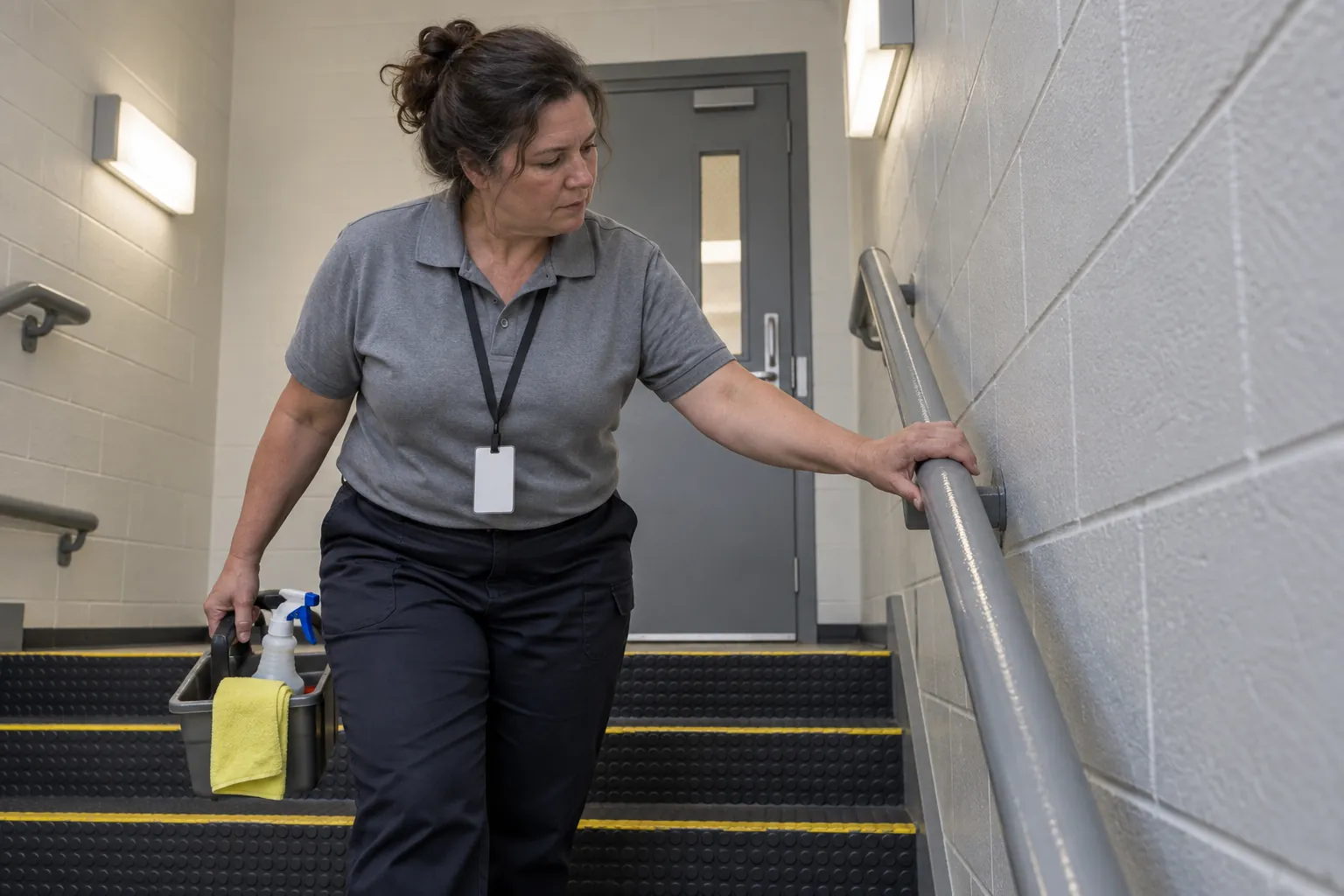
- exit routes, stairwells and corridors clear, and exit doors unlocked and opening without a key. 29 CFR 1910.37 says "Exit routes must be free and unobstructed," and IPMC 702.3 says egress doors must be "readily openable from the side from which egress is to be made without the need for keys, special knowledge or effort";
- exit signs lit and exit routes adequately lit;
- fire alarm panel showing normal, with no trouble or supervisory signals left unanswered;
- fire doors closed or on working hold-open devices, not wedged or blocked;
- entrances, lobbies and walkways free of spills, loose mats and trip hazards, with wet floor signs out in bad weather and snow and ice dealt with;
- restrooms working, stocked and free of leaks or blockages, with the floor clean and dry;
- heating or cooling keeping occupied areas comfortable. IPMC 602.4 asks for a minimum of 65°F in indoor occupiable work spaces while they are occupied, during the heating season the jurisdiction sets;
- elevators in service, and any fault reported;
- exterior doors, gates and windows secure at close.
Weekly:
- mechanical, electrical and boiler rooms walked for leaks, noises, smells and alarms, and kept free of storage;
- the emergency generator, where there is one, run and checked to the schedule the manufacturer and your fire code official set (L for load tests and servicing);
- swinging fire doors checked to close from the full-open position and latch by themselves. IPMC 703.4.3 requires them to do so; the weekly check is good practice, not a code requirement;
- parking lot, sidewalks and driveways walked for potholes, heaved slabs, broken curbs and failed lights;
- trash rooms, compactors and dumpster enclosures cleaned, and any sign of pests reported. IPMC Section 308 requires premises to be "free from any accumulation of rubbish or garbage," and Section 309 requires structures to be "kept free from insect and rodent infestation";
- little-used restroom fixtures and eyewash stations flushed where your water management program calls for it;
- building automation system (BAS) alarms and open work orders reviewed and followed up.
Found early, a dripping pipe or a blocked roof drain is a small repair; left, it becomes water damage to ceilings, finishes and equipment. These checks catch most tenant complaints, and they are the ones most often done without a record. A walkthrough that finds nothing wrong is still worth recording. Under 1910.22, a hazard found on a walking surface must be corrected before anyone uses it again or, if it cannot be, "guarded to prevent employees from using the walking-working surface until the hazard is corrected or repaired."
04
Monthly, quarterly and seasonal checks
Monthly:
- portable fire extinguishers visually inspected: in place, unobstructed, gauge in the green, pin and seal intact, tag current. 29 CFR 1910.157 says extinguishers "shall be visually inspected monthly"; see our guide to the monthly fire extinguisher inspection;
- emergency lighting and exit signs tested with the test button, at the frequency your fire code official enforces;
- roof drains, gutters and downspouts checked from a safe viewpoint, more often in fall. IPMC 304.7 requires them to be "maintained in good repair and free from obstructions";
- ceilings checked for stained tiles that point to a roof or pipe leak, and walls for peeling paint, which IPMC 305.3 says "shall be repaired, removed or covered";
- door hardware, closers and locks on main routes, and the operators on automatic doors;
- signage in place and legible, including exit signs and the address numbers IPMC 304.3 requires to be "plainly legible and visible from the street";
- accessible routes, ramps, restroom grab bars and door operators working and unobstructed.
Quarterly:
- HVAC filters checked and changed to the manufacturer's schedule or your preventive maintenance program (L where the equipment needs it);
- exterior envelope walked: walls, sealant joints around windows and doors, masonry, cladding, canopies and signs. IPMC 304.2 says joints "between the building envelope and the perimeter of windows, doors and skylights" must be kept "weather resistant and water tight";
- exterior stairs, balconies, fire escapes, decks and loading docks checked for rust, rot and loose anchors;
- a review of the work order backlog and repeat faults, to decide what should become planned work and what is turning into deferred maintenance.
Seasonal jobs depend on the climate: a fall winterization checklist in cold regions, a hurricane preparedness checklist before June on the Gulf and Atlantic coasts, and everywhere, heating checked before the first cold snap, cooling before the first hot spell, and drains after the leaves fall.
05
Annual items, licensed work, and what the record should show
Most of this part needs a licensed contractor or qualified technician. The site team books each visit, attends it, and makes sure any deficiency is fixed and closed out.
- Fire-resistance-rated construction (staff, with L for repairs): IPMC 703.3 says rated walls, firestops, shaft enclosures and similar elements "shall be visually inspected annually by the owner and repaired, restored or replaced where damaged, altered, breached or penetrated. Records of inspections and repairs shall be maintained." Look above accessible ceilings for new cable and pipe penetrations.
- Sliding and rolling fire doors (L): IPMC 703.6 requires them to be "inspected and tested annually to confirm operation and full closure," with records kept. Swinging fire doors are maintained under NFPA 80.
- Fire protection systems (L): IPMC Table 704.2 points each system to its standard, including NFPA 10 for portable extinguishers, NFPA 25 for water-based systems such as sprinklers and standpipes, and NFPA 72 for fire alarm systems. The frequencies come from the edition your AHJ has adopted. See our fire inspection checklist.
- Portable extinguisher maintenance (L): 1910.157(e)(3) requires an annual maintenance check, and the employer "shall record the annual maintenance date and retain this record for one year after the last entry or the life of the shell, whichever is less."
- Elevators and escalators (L): IPMC 606.1 requires maintenance to ASME A17.1, inspections and tests at the intervals in its Appendix N unless the AHJ says otherwise, and the current certificate of inspection displayed in the car, in the building office or in another approved spot. Check who performs the periodic inspection in your jurisdiction.
- Boilers, water heaters and fuel-burning equipment (L): serviced to the manufacturer's instructions; IPMC 603.1 requires them to be "maintained in a safe working condition." Check whether your state also requires a boiler inspection certificate.
- Backflow preventers (L): tested by a certified tester at the frequency your water utility or state sets.
- Water management: the CDC's Toolkit: Developing a Legionella Water Management Program says "Many buildings need a WMP to reduce the risk for Legionella growing and spreading within their water system and devices." Review the program each year and after any major change.
- Roof (L where access needs it): membrane, flashing, curbs, drains and scuppers, ideally spring and fall; see our roof inspection checklist.
- Electrical (L): a licensed electrician's inspection of panels and switchgear. IPMC 604.3 says that where the electrical system is a hazard because of, for example, "improper fusing" or "deterioration or damage," the code official "shall require the defects to be corrected to eliminate the hazard."
Over the longer term, a facility condition assessment every few years feeds a capital plan for the roof, the envelope, elevators and major HVAC equipment, and a realistic budget for maintenance costs, so that repairs are planned rather than paid for as emergencies.
What the record should show. For every task: what was checked, where, when, by whom, and what was found; for a deficiency, who it went to and when it was closed. IPMC 704.2.1 requires records of all fire protection system inspections, tests and maintenance, and the contractor's report covers most licensed items. It is the staff checks that most often leave no trace, and those are the ones asked about after a slip or a leak. For certificates and permits, see our building compliance checklist.
06
Where the checklist fails, and what SiteClara does about it
The licensed items usually have good records, because the contractor leaves a report, a tag or a certificate. It is the daily, weekly and monthly checks that fail: a clipboard sheet initialed for the whole week on Friday afternoon, and a problem found on Tuesday mentioned to whoever was walking by and forgotten. When something goes wrong, nobody can say when the check was last done, or by whom.
SiteClara records those routine checks where they happen. A printed QR poster goes at each location, such as a mechanical room, a roof hatch, a stairwell, a restroom or a parking level, with an NFC tag behind it if staff would rather tap. Staff scan the code or tap the tag on their own phone, with no app to install, see the checks due there, and mark each one done or say what stopped them. A problem is reported on the spot with a photo and goes onto the team's list of jobs until someone closes it, so the leak or the broken closer has a date, a place, a photo and a name from the first day.
The supervisor sees what was due, done and missed, and can record why a check was missed. Each day the supervisor reviews and approves a report that goes to nominated management, owner or client contacts at 8 a.m. the next morning, showing how the scheduled checks went, for example 12 of 12 completed.
07
Further reading, and a list to take away
The International Code Council publishes the International Property Maintenance Code, Chapter 3, which holds most of the owner's duties, to read free online; your city or county's website will say which edition it has adopted. OSHA publishes 29 CFR 1910.22 on walking-working surfaces and 29 CFR 1910.37 on exit routes, and the CDC's Legionella water management toolkit walks through building a water management program.
Before you adopt a building maintenance checklist, check that:
- it covers the exterior property, the exterior and interior structure, plumbing, mechanical and electrical, elevators and fire safety;
- it follows the code and edition your jurisdiction has actually adopted, with its amendments;
- each task has a frequency, and the frequency comes from a code, a standard, the manufacturer or your own risk assessment;
- licensed items are marked, booked and tracked to close-out;
- each task names who is responsible, and the lease is clear on what the tenant keeps;
- a deficiency found on a check has a route to someone who will fix it;
- the daily and weekly checks are recorded, not only the annual ones.
Sources
Every document this guide quotes or links to, in the order it first cites them.
- International Property Maintenance Code (IPMC), 2024 edition, Chapter 1 codes.iccsafe.org
- IPMC Chapter 3, General Requirements codes.iccsafe.org
- Section 5(a)(1) of the Occupational Safety and Health Act osha.gov
- 29 CFR 1910.22 osha.gov
- State Plans page osha.gov
- IPMC Chapter 5, Plumbing Facilities and Fixture Requirements codes.iccsafe.org
- IPMC Chapter 6, Mechanical and Electrical Requirements codes.iccsafe.org
- IPMC Chapter 7, Fire Safety Requirements codes.iccsafe.org
- 29 CFR 1910.37 osha.gov
- 29 CFR 1910.157 osha.gov
- Toolkit: Developing a Legionella Water Management Program cdc.gov
Related guides
 Premises and facilities managementPreventive maintenance checklist: what to check in a commercial building, how often, and how to prove itA preventive maintenance checklist for commercial buildings: HVAC, electrical, fire and life safety, plumbing, how often, and what the record should show.
 Premises and facilities managementBuilding compliance checklist: OSHA, the fire code and the ADA in one US buildingBuilding compliance checklist for US commercial buildings: OSHA, the fire code, elevators, water, asbestos and the ADA, who holds each duty and how often it is due.
 Premises and facilities managementCommon area inspection checklist: what to check, how often, and the record to keepA common area inspection checklist for apartment, condo and commercial buildings: what to check, how often, the codes and case law behind it, and the record to keep.
 Premises and facilities managementBuilding engineer duties: what the job covers, and how to show it is doneBuilding engineer duties in a commercial building: running the plant, rounds and logs, lockout, refrigerant and boiler rules, vendors, and a record that holds up.