Premises and facilities management
Preventive maintenance checklist: what to check in a commercial building, how often, and how to prove it
A preventive maintenance checklist is a scheduled list of the tasks that keep a building's assets working, saying what to inspect, test, lubricate, replace or give a cleaning, how often, and who does it, so the work happens before something breaks rather than after.
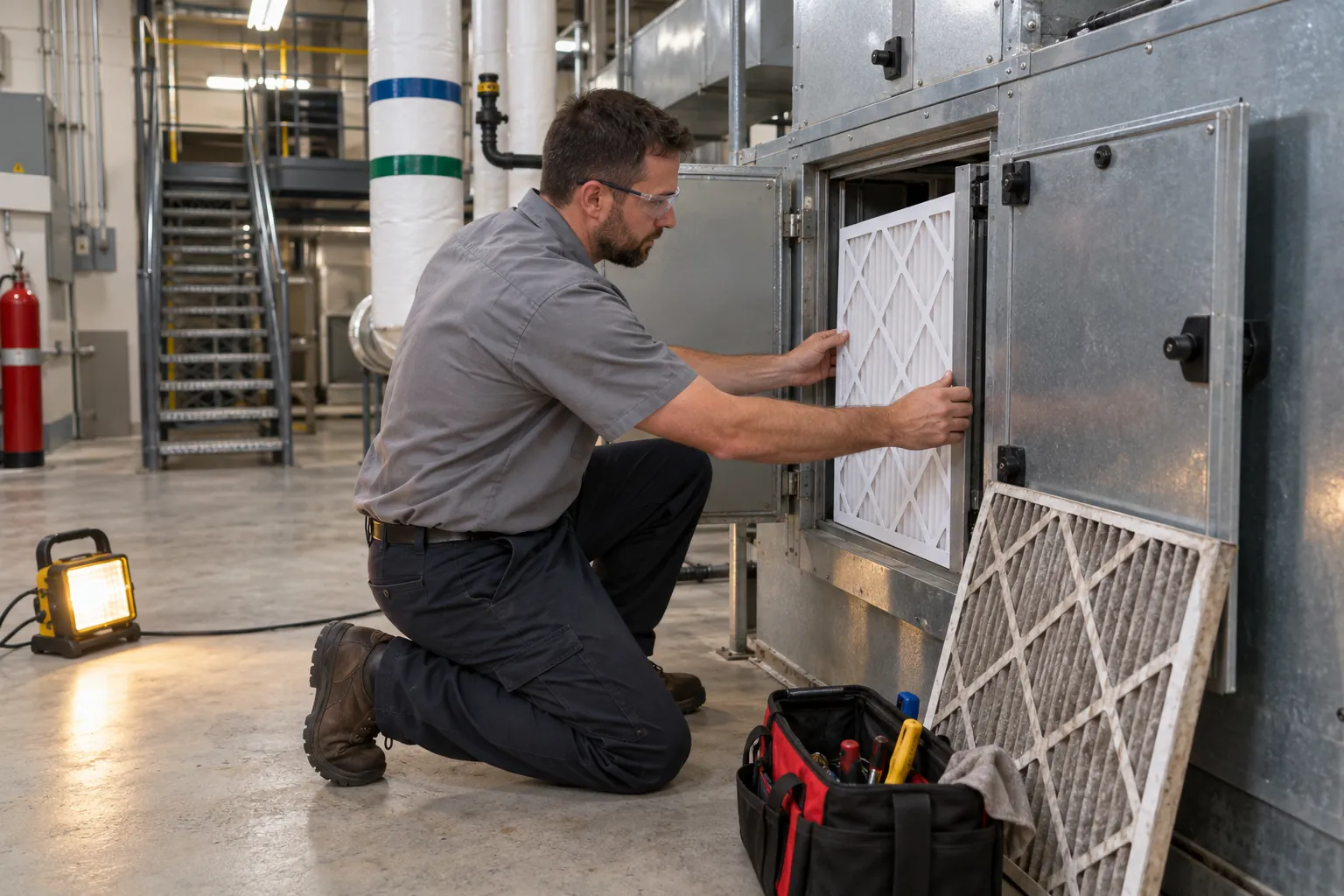
This guide explains where the duty to maintain comes from in the United States, what a PM checklist for a commercial building should cover, how to build one from your equipment and the manufacturers' instructions, a sample checklist by frequency, and what a record of the work should show.
01
What preventive maintenance is, and where the duty comes from
The U.S. Department of Energy's Federal Energy Management Program defines it in Chapter 5 of the O&M Best Practices Guide, Release 3.0: "Actions performed on a time- or machine-run-based schedule that detect, preclude, or mitigate degradation of a component or system with the aim of sustaining or extending its useful life through controlling degradation to an acceptable level." The same chapter contrasts it with reactive maintenance, the "run it till it breaks" mode. A preventive maintenance (PM) checklist is that schedule written down.
No federal law uses the phrase "preventive maintenance checklist," but the duty to keep a building and its equipment in working order is real, and it comes from several places at once:
- The general duty clause. Section 5(a)(1) of the Occupational Safety and Health Act says each employer "shall furnish to each of his employees employment and a place of employment which are free from recognized hazards that are causing or are likely to cause death or serious physical harm to his employees."
- Specific OSHA standards. 29 CFR 1910.22 requires that walking-working surfaces are "inspected, regularly and as necessary, and maintained in a safe condition." 29 CFR 1910.37 requires that safeguards such as sprinkler systems, alarm systems, fire doors and exit lighting be in proper working order at all times. 29 CFR 1910.303 says "Listed or labeled equipment shall be installed and used in accordance with any instructions included in the listing or labeling," which is one reason the manufacturer's instructions belong on your checklist.
- Fire and building codes. Inspection, testing and maintenance (ITM) of fire protection and life safety systems is set by codes such as the International Fire Code or NFPA 1 and the NFPA standards they reference. These are enforced by the local fire marshal or building official, the authority having jurisdiction (AHJ), in the edition and with the amendments that the state or city has adopted.
- Insurance, leases and warranties. A missed service can void a warranty or breach a lease.
Two traps are worth knowing before you cite anything. First, OSHA's own State Plans page says "There are currently 22 State Plans covering both private sector and state and local government workers, and seven State Plans covering only state and local government workers." If your building is in a state plan state, such as California, check the state's rule rather than assuming 29 CFR applies as written. Second, an NFPA document is a consensus standard until a jurisdiction adopts it or a contract calls it up; your AHJ decides which edition applies to your building.
One standard has changed status recently. NFPA 70B moved from the Recommended Practice for Electrical Equipment Maintenance to the NFPA 70B, Standard for Electrical Equipment Maintenance, with the 2023 edition effective on January 16, 2023, according to NFPA's article Beyond the NEC: NFPA 70B is a Critical Tool for Reliability and Electrical Safety. The same article explains that where the old document said what should be done, the standard says what must be done, and that part of its purpose is to provide "a means to establish a condition of maintenance of electrical equipment and systems for safety and reliability." Whether it binds your building still depends on adoption.
02
What a commercial building PM checklist covers
A preventive maintenance checklist for an office building, a school, a clinic or a retail center is built from what is actually in the building. Most include these systems:
- HVAC: air handlers, rooftop units, chillers, boilers, cooling towers, pumps and controls: filters, belts, coils, condensate drains, dampers, lubrication and controls. ASHRAE Standard 180-2018, Standard Practice for Inspection and Maintenance of Commercial Building HVAC Systems is the recognized baseline for this part of the list.
- Electrical: switchgear, panelboards, transformers, disconnects, lighting and the working space in front of the equipment, under an NFPA 70B program.
- Emergency and standby power: generators, automatic transfer switches, fuel, batteries and the emergency lighting they feed, under NFPA 110, Standard for Emergency and Standby Power Systems where adopted.
- Fire protection and life safety: sprinklers, standpipes and fire pumps (NFPA 25, Standard for the Inspection, Testing, and Maintenance of Water-Based Fire Protection Systems), fire alarm systems (NFPA 72, National Fire Alarm and Signaling Code), fire doors (NFPA 80, Standard for Fire Doors and Other Opening Protectives), portable fire extinguishers (NFPA 10, Standard for Portable Fire Extinguishers), exit signs and emergency lights, and kitchen hood suppression.
- Plumbing and water: water heaters, mixing valves, backflow preventers, sump pumps, drains, restroom fixtures, eyewash stations, and the flushing and temperature checks a Legionella water management program calls for.
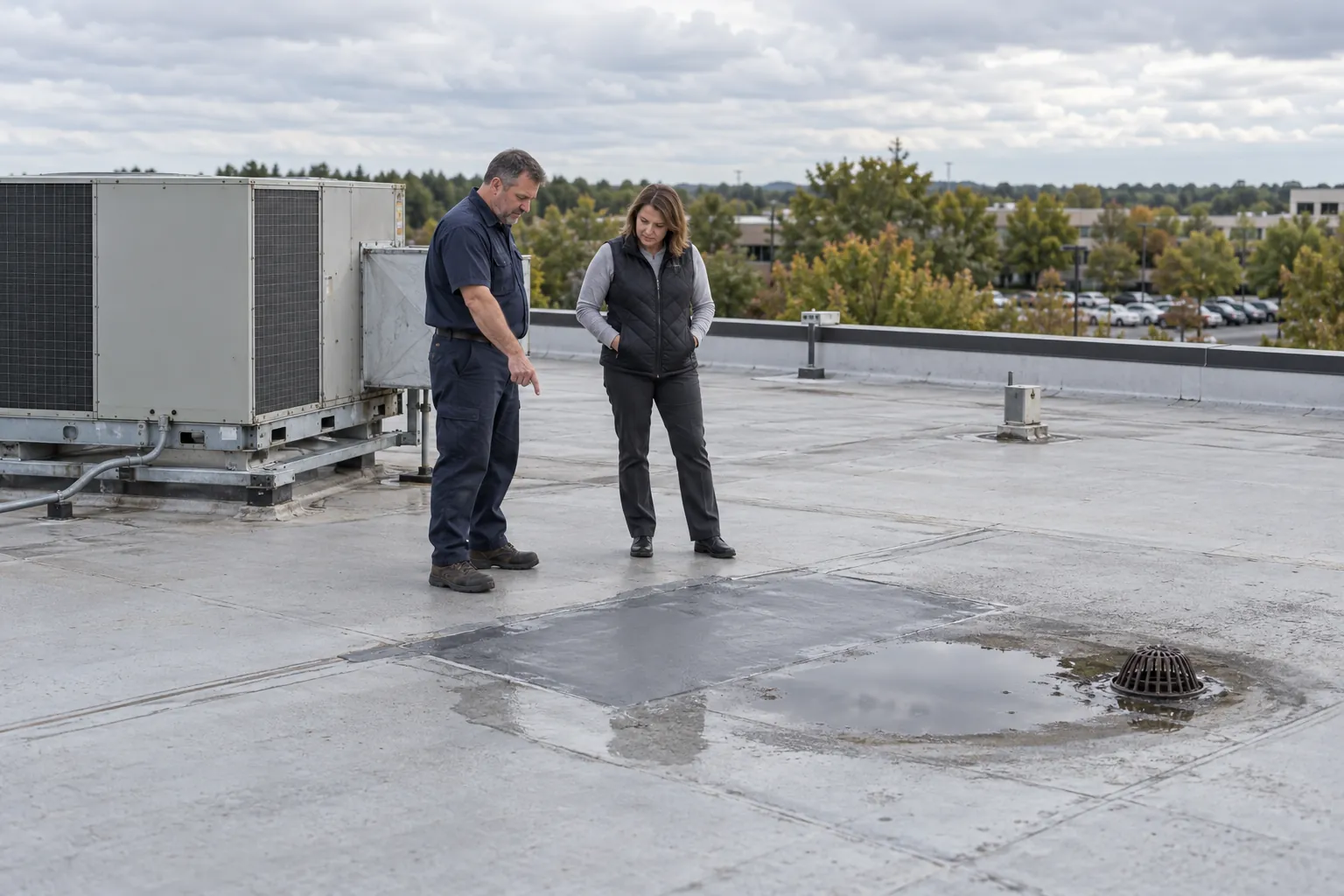
- Building envelope: roofs, roof drains and scuppers, gutters and downspouts, flashing, sealants, windows and exterior doors.
- Interior and egress: floors, stairs, handrails, ceiling tiles, door closers, panic hardware and clear exit routes.
- Vertical transportation: elevators and escalators, maintained by the elevator contractor and inspected under the state or city elevator program.
- Site and specialty equipment: parking, sidewalks, site lighting, storm drains, kitchen equipment, dock levelers and anything else particular to the building.
Not everything on that list is yours to do. Many items are the work of a licensed trade or a specialist contractor: the fire sprinkler contractor, the fire alarm company, the elevator mechanic, the generator vendor. The checklist should still name them, with the frequency and who is responsible, so the PM program is one list.
03
How to build a preventive maintenance checklist
A good checklist answers four questions for every item: what it is, where it is, what it needs, and how often. Building one is methodical work:
- Take an equipment inventory. Walk every floor, mechanical room, electrical room and roof. Record each asset's type, make, model, serial number, location and condition, and give it a tag number.
- Collect the manufacturers' instructions. The operation and maintenance (O&M) manuals set the service intervals, the lubricants and filters, and the warranty conditions.
- Identify the code-required ITM. For fire protection, life safety, emergency power and elevators, list the inspections and tests the adopted codes require, with the edition and the frequency, and confirm them with your AHJ or your fire protection contractor.
- Add the OSHA-driven items. Some OSHA standards set a frequency outright. Under 29 CFR 1910.157, for example, portable extinguishers "shall be visually inspected monthly" and must have "an annual maintenance check."
- Rank equipment by how critical it is to the building's operations and to safety. Criticality decides which discretionary tasks you do and how often.
- Write each task so a technician can complete it and someone else can check it. "Inspect AHU-3" tells a technician nothing. "Replace filters, check belt tension and wear, clear the condensate drain, record the supply air temperature" can be done and verified.
- Assign each task. Name the in-house building engineer, the maintenance technician or the contractor, and check that they are qualified for it.
- Build in safety. Where servicing could release energy, the work falls under 29 CFR 1910.147, The control of hazardous energy (lockout/tagout), which requires "a program consisting of energy control procedures, employee training and periodic inspections." The PM task should say which procedure applies.
- Put it on a calendar. Group tasks by building, trade and season so a technician is not sent back to the same mechanical room three times in a month.
Many facility teams hold the inventory and schedule in a computerized maintenance management system (CMMS), which generates the PM work orders, records their completion and keeps the maintenance data for each asset. A small building can run on a well-kept spreadsheet, provided someone owns it.
04
A sample preventive maintenance checklist by frequency
The frequencies below are typical examples, not requirements: take each interval from the manufacturer's instructions, the adopted code and your own equipment history.
Daily or each shift (the building engineer's rounds):
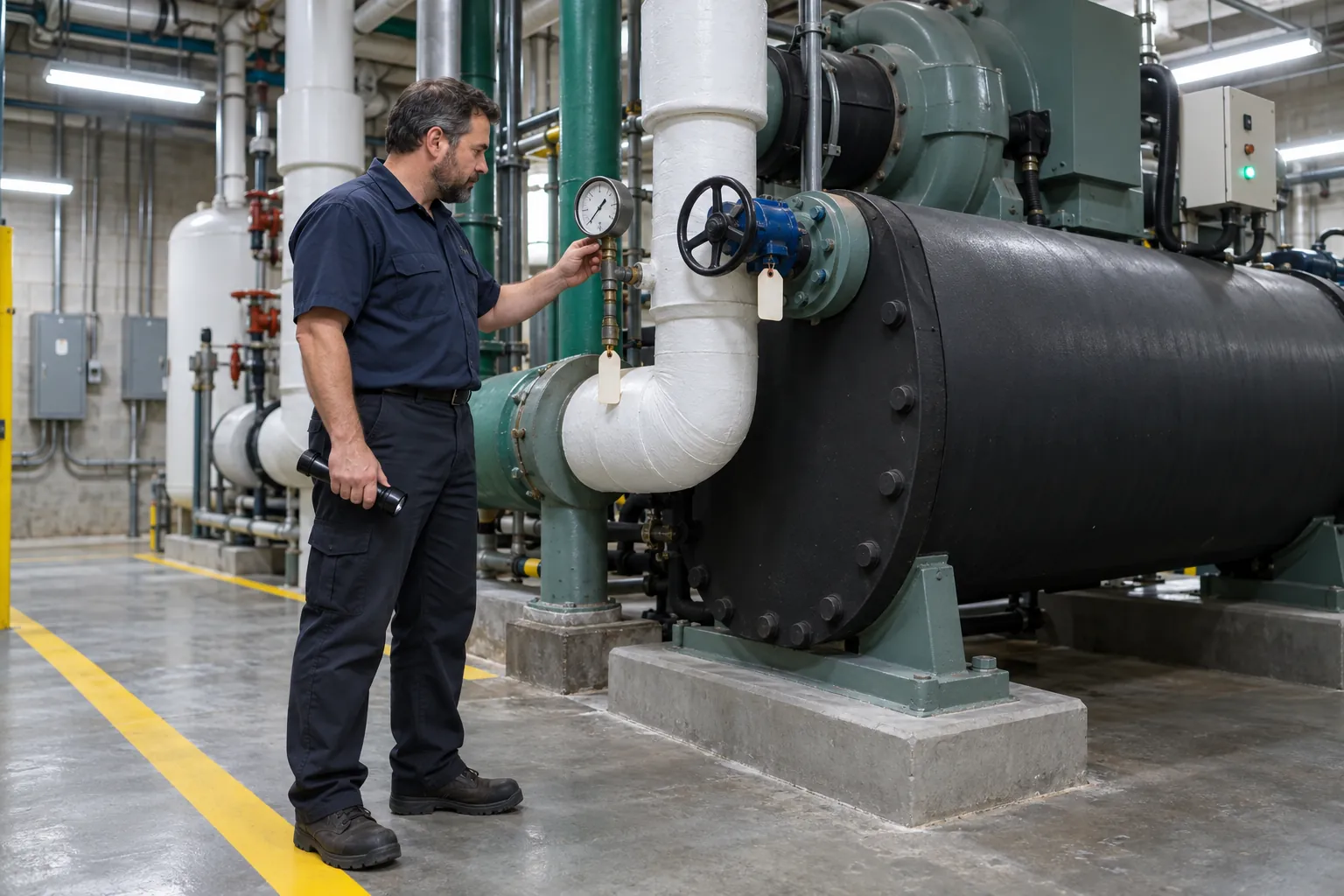
- walk the mechanical rooms for leaks, noise, vibration, smells and alarms;
- check building automation alarms and log boiler and chiller readings;
- check that exit routes, stairs and exit doors are clear and that exit signs are lit;
- follow up problems the custodial team has flagged.
Weekly:
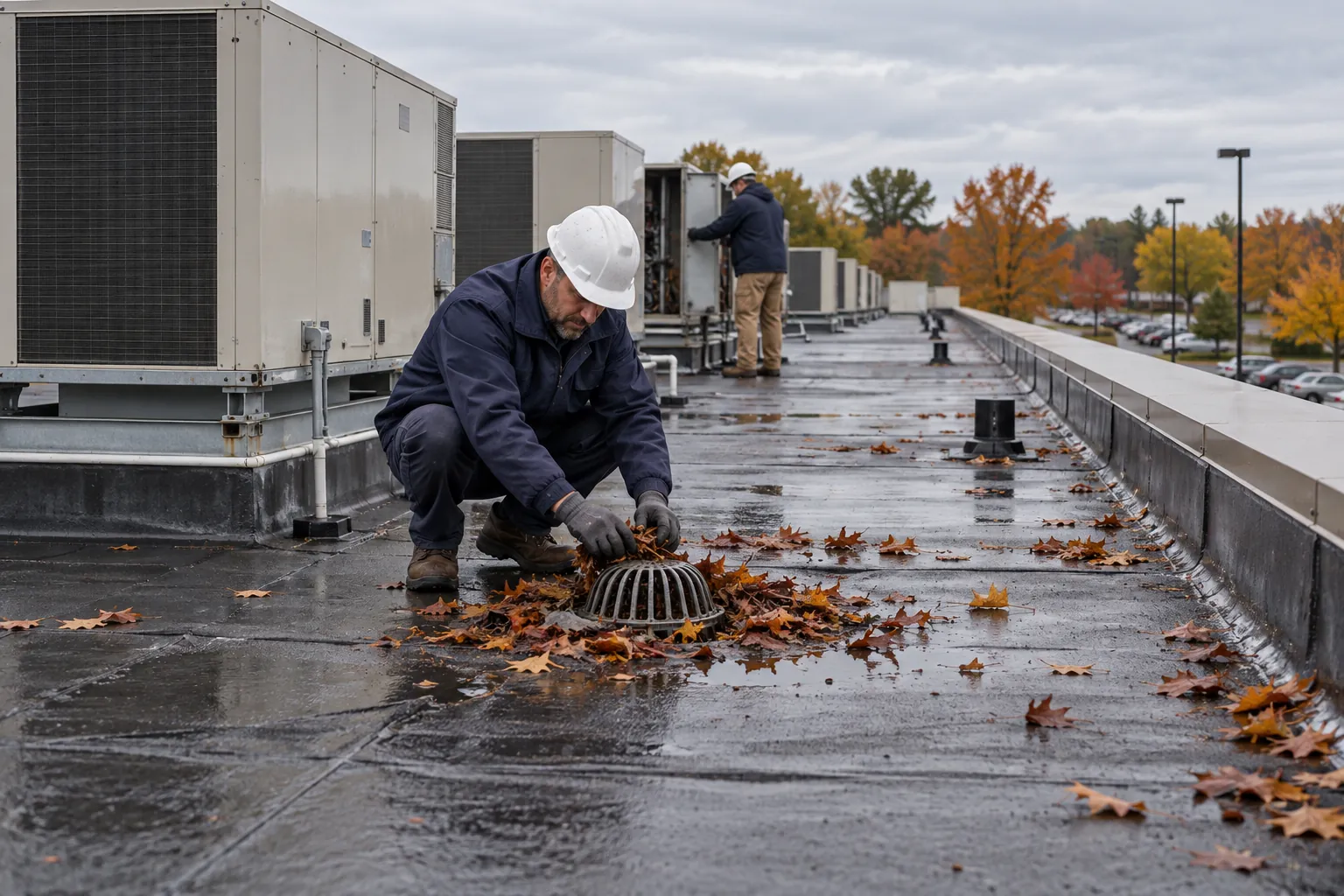
- look over rooftop units and roof drains for damage and blockages, and again after storms;
- check the fire alarm panel for trouble and supervisory signals, and sprinkler valves for position and security;
- flush little-used outlets and check water temperatures where the water management program requires it.
Monthly:
- visually inspect every portable fire extinguisher (a 29 CFR 1910.157 requirement) and record it;
- check the emergency lights and exit signs, and test them to the frequency your adopted code sets;
- run the emergency generator and transfer switch as its maintenance program and NFPA 110, where adopted, require;
- inspect and replace HVAC filters as the manufacturer and the pressure drop indicate;
- check eyewash stations, first aid supplies and the working space in front of electrical panels;
- check door closers, latches and panic hardware on fire doors and exit doors.
Quarterly and semiannually:
- check belt drives, bearings and couplings on fans and pumps, and lubricate as specified;
- clean condensate pans and drains, and check coils;
- inspect roofs, flashings, gutters and downspouts for cracks, damage and blockages before and after the wet or freezing season;
- test backflow preventers, sump pumps and water heater relief valves as local rules and the manufacturer require;
- have the sprinkler, fire alarm and fire door inspectors carry out the inspections and tests that the adopted editions of NFPA 25, NFPA 72 and NFPA 80 set.
Annually:
- the annual maintenance check on each portable extinguisher, with the date recorded;
- boiler and chiller servicing, and the jurisdictional boiler inspection where the state requires one;
- the electrical maintenance and diagnostic testing your NFPA 70B program sets for the distribution equipment, carried out by a qualified electrical contractor;
- the periodic inspection of each lockout/tagout energy control procedure, which 29 CFR 1910.147 requires "at least annually";
- a review of the checklist itself: new equipment added, retired equipment removed, and frequencies changed where the history says they should be.
05
What the record should show
A PM program is only as credible as its records. When an insurer, a fire inspector or an OSHA compliance officer asks whether a task was done, a checked box on a calendar is not enough. A useful record includes:
- The completed work order: the asset and its tag number, the task, the date, who did it, readings taken, what they found and what they did about it.
- Code reports: the inspection, testing and maintenance reports issued by the fire protection, fire alarm, elevator and generator contractors, filed against the system they cover and, where the jurisdiction requires it, submitted to the AHJ or its reporting service.
- Statutory records: for example, 29 CFR 1910.157 requires the employer to "record the annual maintenance date and retain this record for one year after the last entry or the life of the shell, whichever is less."
- Deficiencies and follow-up: every problem found on a PM visit, the corrective work order raised, and when it was closed. A pile of inspection reports listing deficiencies that were never corrected is worse evidence than no report at all.
- Completion against plan: PM work orders due, completed on time, completed late and still open, by month and by building.
A PM completion percentage on its own tells you little. The questions worth asking are which tasks were missed, whether any of them were code-required or safety-critical, and what happened to the deficiencies that were found.
Review the program at least once a year.
06
Where the record fails, and where SiteClara fits
PM records are usually strongest for the contractor's scheduled visit and weakest for the small, frequent checks in between: the engineer's daily round, the weekly look at the roof drains, the monthly walk past every extinguisher. Those live on a clipboard, initialed at the end of the week for every day at once, and a problem found on one is passed on to whoever was walking by.
SiteClara records those routine checks. A printed QR poster goes at each location, such as a mechanical room, an electrical room, a roof hatch, a stairwell or a parking level, with an NFC tag behind it if staff would rather tap. Staff scan the code or tap the tag on their own phone, with no app to install, see the checks due there, and mark each one done or say what stopped them. A problem is reported on the spot with a photo and goes onto the team's list of jobs until someone closes it, so the leak or the broken closer has a date, a place, a photo and a name from the first day.
The supervisor sees what was due, done and missed, and can record why a check was missed. Each day the supervisor reviews and approves a report that goes to nominated management or owner contacts at 8 a.m. the next day by default.
07
Questions people ask
What is a PM checklist?
A PM checklist is a preventive maintenance schedule written down as tasks: each piece of equipment, what to do to it, how often and who does it. Chapter 5 of the FEMP O&M Best Practices Guide, Release 3.0 defines preventive maintenance as actions performed "on a time- or machine-run-based schedule" to sustain or extend a component's useful life, and gives lubrication and filter changes as examples. The same chapter says studies put the savings over a purely reactive program at "as much as 12% to 18% on the average," while warning that preventive maintenance is labor intensive and can include maintenance that was not needed.
What are the 5 types of preventive maintenance?
There is no official list of five. Chapter 5 of the FEMP O&M Best Practices Guide, Release 3.0 describes four approaches to maintenance: reactive maintenance, the "run it till it breaks" mode; preventive maintenance, which is time-based; predictive maintenance, which bases the need for maintenance "on the actual condition of the machine rather than on some preset schedule"; and reliability centered maintenance, which recognizes that "all equipment in a facility is not of equal importance to either the process or facility safety." Most commercial building PM checklists are time-based, with condition readings recorded along the way.
08
Further reading, and a list to take away
Start with the definitions and the trade-offs between reactive, preventive and predictive maintenance in Chapter 5 of the FEMP O&M Best Practices Guide, Release 3.0. For the duties, read the OSHA standards cited above and check OSHA's State Plans page for your state. For HVAC, ASHRAE Standard 180; for electrical, NFPA 70B; for fire and life safety, the NFPA standards your AHJ has adopted. For water systems, the CDC's Toolkit: Developing a Legionella Water Management Program explains how a water management program reduces the risk of Legionella growing in a building's water systems.
To check that your preventive maintenance checklist is in order:
- every piece of equipment is on the inventory, verified on site, with a tag number and a location;
- every task comes from a named source: the manufacturer's instructions, an adopted code with its edition, an OSHA standard, the insurer, or a deliberate decision of your own;
- every code-required inspection and test is listed, with its frequency and the contractor responsible;
- each task is written so it can be verified, and names the lockout/tagout procedure where one applies;
- each task has a named owner who is qualified to do it;
- deficiencies found on PM visits become work orders that are tracked and closed;
- missed code-required or safety-critical tasks are reported by name, not buried in a completion percentage;
- the checklist is reviewed at least once a year and after any major equipment change.
Sources
Every document this guide quotes or links to, in the order it first cites them.
- Chapter 5 of the O&M Best Practices Guide, Release 3.0 www1.eere.energy.gov
- Section 5(a)(1) of the Occupational Safety and Health Act osha.gov
- 29 CFR 1910.22 osha.gov
- 29 CFR 1910.37 osha.gov
- 29 CFR 1910.303 osha.gov
- State Plans page osha.gov
- NFPA 70B, Standard for Electrical Equipment Maintenance nfpa.org
- Beyond the NEC: NFPA 70B is a Critical Tool for Reliability and Electrical Safety nfpa.org
- ASHRAE Standard 180-2018, Standard Practice for Inspection and Maintenance of Commercial Building HVAC Systems ashrae.org
- NFPA 110, Standard for Emergency and Standby Power Systems nfpa.org
- NFPA 25, Standard for the Inspection, Testing, and Maintenance of Water-Based Fire Protection Systems nfpa.org
- NFPA 72, National Fire Alarm and Signaling Code nfpa.org
- NFPA 80, Standard for Fire Doors and Other Opening Protectives nfpa.org
- NFPA 10, Standard for Portable Fire Extinguishers nfpa.org
- 29 CFR 1910.157 osha.gov
- 29 CFR 1910.147, The control of hazardous energy (lockout/tagout) osha.gov
- Toolkit: Developing a Legionella Water Management Program cdc.gov
Related guides
 Premises and facilities managementReactive maintenance: how to run it well, and keep it in proportionHow to run reactive maintenance in a US facility: work order priorities, response times, what OSHA expects, the cost against preventive work, and vendors.
 Premises and facilities managementBuilding maintenance checklist: what the code expects, how often to check, and who does itA building maintenance checklist for US commercial buildings, built on the International Property Maintenance Code: daily to annual tasks, who does each, the record.
 Premises and facilities managementDeferred maintenance: what it is, how to measure the backlog, and what cannot waitWhat deferred maintenance means under FASAB, GASB and APPA, how a backlog and FCI are measured, what OSHA says cannot wait, and how to keep the backlog honest.
 Premises and facilities managementBuilding engineer duties: what the job covers, and how to show it is doneBuilding engineer duties in a commercial building: running the plant, rounds and logs, lockout, refrigerant and boiler rules, vendors, and a record that holds up.