Premises and facilities management
Elevator maintenance: what the code requires, and what the building should check
Elevator maintenance in the United States is the scheduled examination, cleaning, lubrication, adjustment, testing and repair of each elevator under a written Maintenance Control Program, which the ASME A17.1/CSA B44 safety code adopted by state and city elevator laws requires, carried out by elevator personnel and recorded where they can see it on site.
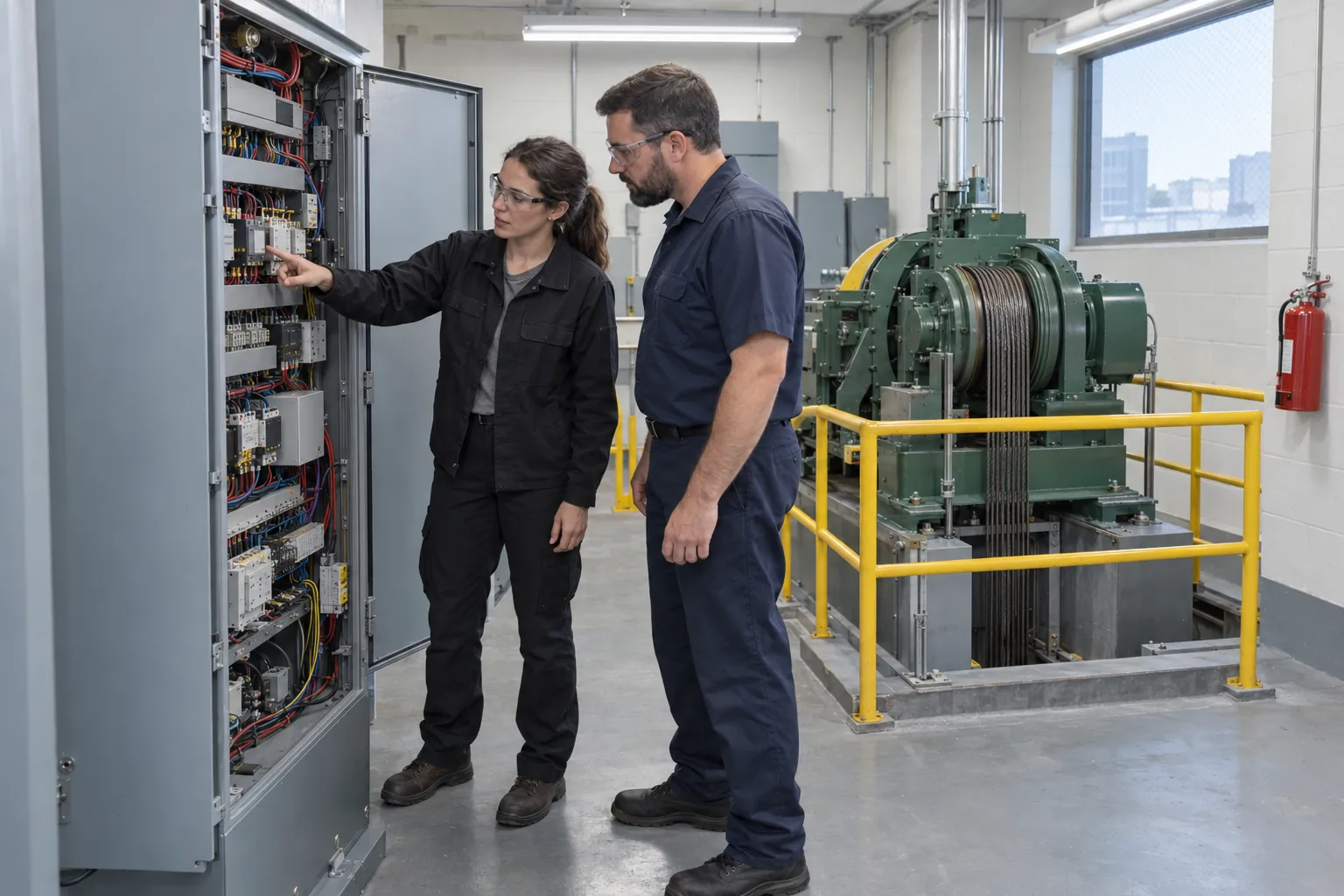
The owner is responsible for it, even when a contractor does the work. This guide covers what the code and the state require, how often elevators are inspected and tested, what a maintenance contract should say, the checks the building itself makes, and what the records should show.
01
What elevator maintenance is, and whose rule it is
No single federal rule sets an elevator maintenance schedule for an ordinary commercial building. Elevators are regulated by the states and by some cities and counties, which register each unit, inspect it, issue the permit or certificate that lets it run, and adopt a safety code. The code they adopt is ASME A17.1/CSA B44, Safety Code for Elevators and Escalators, which ASME describes as "the accepted guide throughout North America for the design, construction, installation, operation, inspection, testing, maintenance, alteration, and repair of elevators, escalators and related conveyances." ASME lists the 2025 edition as current, but a building is held to the edition its state or city adopted, with any local amendments, and the authority having jurisdiction (AHJ) decides.
State law puts the duty on the owner. In Washington, RCW 70.87.060 says "The owner or his or her duly appointed agent shall be responsible for the safe operation and proper maintenance of the conveyance after the department has issued the operating permit," and for the periodic tests the department requires. In Texas, the Texas Department of Licensing and Regulation's elevator FAQ for building owners says the owner "must obtain an inspection every 12 months," must obtain a Certificate of Compliance for each unit, and is responsible for "maintaining the equipment in compliance with the standards and codes adopted by the Commission, by rule." Hiring a maintenance contractor hands over the work, not the responsibility.
Section 8.6 of A17.1 is the maintenance part of the code. Its central requirement, quoted in the Illinois State Fire Marshal's summary of the Maintenance Control Program under ASME A17.1-2007, is that "A written Maintenance Control Program shall be in place to maintain the equipment in compliance with the requirements of 8.6." Each unit's code data plate shows the code edition in effect when it was installed or last altered.
02
What the maintenance control program covers
The Maintenance Control Program (MCP) is the written plan for each unit: what is examined, cleaned, lubricated, adjusted and tested, and how often. In the 2007 wording the Illinois summary quotes, the intervals "shall be based on" the equipment's age, condition and accumulated wear, its design and quality, usage, environmental conditions, improved technology and the manufacturer's recommendations for SIL rated devices. So the code sets no single visit frequency: a car in a busy office tower and one used on Sundays should not be on the same program. Good elevator maintenance follows the program, keeps the parts and the safety system reliable, and finds problems before they stop a car or trap someone.
Later editions say more about where the program lives. The Fairfax County, Virginia elevator industry round table of January 2025 quotes section 8.6.1.2.1 as requiring an MCP "for each unit," "provided by the person(s) and/or firm maintaining the equipment" and "viewable on-site by elevator personnel at all times." Where it is kept away from the machine room or other control space, directions for finding or viewing it must be posted on the controller or at the means necessary for test. Section 8.6.1.2.2, the same slides show, also requires hard copies on site for each unit of:
- up-to-date wiring diagrams of the electrical protective devices and critical operating circuits;
- procedures for inspections and tests not described in ASME A17.2, and for maintenance, repairs, replacements and adjustments;
- written checkout procedures.
Then there are the maintenance records, section 8.6.1.4. In the 2007 wording they "shall document compliance with 8.6" and include:
- a description of the maintenance tasks performed, with dates;
- descriptions and dates of examinations, tests, adjustments, repairs and replacements;
- descriptions and dates of call backs (trouble calls) or reports "that are reported to elevator personnel by any means, including corrective action taken";
- a written record of the findings on the firefighters' service operation required by 8.6.11.1.
The Fairfax slides add the later wording's retention rule: the records "shall be retained for the most recent 5 yr or from the date of installation or adoption of this Code edition, whichever is less or as specified by the authority having jurisdiction." For a hydraulic elevator, the ASME A17.2 inspection guide those slides quote also has the inspector check the record of oil usage where one is required.
03
Elevator inspections and tests: who does them, and how often
Maintenance is the contractor's routine. Inspection is the check that the routine is working, done by a state or city inspector or a licensed third-party inspector the jurisdiction accepts. The cycle is set by the state or city. RCW 70.87.120 says Washington's department "shall cause all conveyances to be inspected and tested at least once each year," and Texas requires an inspection every 12 months. The NYC Department of Buildings' elevator page says elevators in New York City "must be inspected and tested twice annually," with periodic inspections by an agency contracted by the department and category tests that owners arrange.
The contract and the inspection report use these names:
- Periodic inspection. The inspector's examination of the equipment, the machine room, the pit, the car and the records, using ASME A17.2 as the guide. Fairfax County's slides, citing the code's Appendix N, expect periodic inspections every 6 months.
- Category 1 test. An annual no-load test of the safety devices. The City of Phoenix's Elevator Testing Requirements (revised September 2025) says traction and hydraulic elevators need a Category 1 test annually, after which "a tag, signed and dated by the mechanic or company, is placed adjacent to or on the controller."
- Category 5 test. A full-load test every five years. Phoenix requires it for traction elevators, with signed and dated tags on the buffers and at the controller; New York City describes it as "Performed with rated load and speed every five years from date of installation."
The result is a certificate or permit, which the owner keeps current and on show. California's Cal/OSHA Elevator Unit page on elevator permits says "No elevator shall be operated without a valid, current permit issued by the Division" and that the permit, or a copy, "shall be posted conspicuously and securely in the elevator car." Texas requires the Certificate of Compliance to be displayed "in a publicly visible area of the building."
An inspection report that lists defects starts a clock. In Washington, RCW 70.87.120 allows a penalty "for failure to correct a violation within ninety days after the owner is notified in writing of inspection results," and for failing to tell the department in writing that all corrections are complete. The Cal/OSHA Elevator Unit's page for building and elevator owners is blunt about that notice: "the responsibility for this written notification of compliance of all requirements is yours, and do not rely on any other agreement."
04
What an elevator maintenance contract should say
Owners meet the duty through a maintenance contract with an elevator company; New York City requires owners to keep "a current maintenance contract with an approved elevator agency." Contracts vary from full maintenance, where the company carries the repairs and replacement parts the code requires, to narrower agreements that cover examinations and lubrication and bill repairs separately. California defines the full kind for its two-year permit: a full maintenance service contract must specify the company's responsibilities "in regard to all repairs and maintenance that may be necessary to keep the elevator in compliance with the Elevator Safety Orders" and "Require the elevator service company to service the elevator as frequently as necessary to effect safe operation but not less often than monthly." With that contract and a company holding a C-11 license, Cal/OSHA may issue a permit for up to two years instead of one.
Whatever the type, the contract should answer these questions in writing:
- The program. The company provides a Maintenance Control Program for each unit, keeps it viewable on site and updates it when equipment is altered.
- Visit frequency. How often each unit is examined, and why, given its age, condition, usage and environment.
- Records. Every visit, test, repair and call back with its corrective action, kept on site or viewable there, and left with the building if the contract ends.
- Tests. Who performs the Category 1 and Category 5 tests and the monthly firefighters' service test, who arranges the witnessing inspector and who files the report.
- Response times. For an entrapment, a car out of service and a routine call back, day and night, with the 24-hour number.
- Inspection defects. How quickly they are corrected and confirmed in writing, in time for the owner's notice to the jurisdiction.
- Reports to the owner. A regular summary of visits, call backs by unit and open items, so repeat faults and poor performance show.
Check the company's license where the state requires one. When the contract changes hands, walk the machine rooms with both companies and confirm the program, the diagrams and the records are still there.
05
The building's own checks: fire service, rides and the machine room
The building does not maintain the elevator, but it has duties of its own. The most specific is the monthly firefighters' service test. The State of Montana's Monthly Fire Service Test Log says "The building owner or his/her designee shall provide for a monthly test of Phase I and Phase II of the firefighters' emergency service operation for each elevator," and that the log "shall remain in the elevator machine room and shall be accessible for inspection by the authority having jurisdiction at all times." Phoenix says the operation "should be tested by trained personnel monthly" and that "A fire service test log shall be kept on site."
Local amendments change the detail. The Municipality of Anchorage's Firefighter's Emergency Operation Quarterly Test Log cites ASME A17.1-2019 section 8.6.11.1 with a local amendment and records the test each quarter. Its steps show what the test proves: the car returns nonstop to the primary landing on Phase I, the doors respond only to constant pressure on Phase II, and the car returns to normal operation afterward. Any "No" is a failure for the contractor to correct, with the corrective action recorded.
Beyond that test, a short ride check on the building's rounds catches problems early, and can help prevent a breakdown, without anyone touching the equipment:
- Does each car stop level with every landing, and do the doors reopen when something is in the way?
- Does the emergency phone connect, and does the acknowledgment light come on? The U.S. Access Board's guide to elevators and platform lifts explains that "The ASME A17.1 code requires a two-way means of emergency communication in elevator cars," with a visual signal "to acknowledge that the emergency call has been received."
- Is the current permit or certificate posted where the jurisdiction requires it?
- Is the machine room locked, dry and free of stored furniture, supplies and boxes?
- Is there water, oil or debris visible in the pit from the landing? Report it; do not go in.
Building staff stay out of the hoistway and the pit. OSHA's 1995 letter on whether elevator pits meet the definition of confined spaces explains that pits are generally confined spaces and that most become permit-required because they contain "electrical-mechanical hazard(s)." That is work for elevator personnel under their own procedures.
Keeping a car running matters for access too: under 28 CFR 36.211, Maintenance of accessible features, a public accommodation "shall maintain in operable working condition" its required accessible features, although "isolated or temporary interruptions in service or access due to maintenance or repairs" are allowed.
06
Where the record fails, and where SiteClara fits
The contractor's records are usually there, in the machine room or behind directions on the controller. The gaps are on the building side. The fire service test log has the same initials on every line, or a blank for the month the mechanic's visit slipped. A porter notices a car stopping an inch high at the fourth floor and mentions it to whoever is passing, so it never becomes a call back. The inspection report's defects sit in an email while the ninety days run.
SiteClara is a way to keep the building's side of that record. A printed QR poster, with an optional NFC tag behind it, goes where a check is due: an elevator lobby, the machine room, the engineering office. The engineer, officer or porter scans the code or taps the tag on their own phone, with no app to install, sees the checks due there, such as the ride check or the emergency phone call, and marks each one done or says what stopped them. The time and the named person are recorded as it happens, with a photo when one is asked for. A fault found on the round, such as a car not leveling, is reported on the spot and stays on the team's list of jobs until someone closes it, so it can go to the contractor as a call back rather than be lost.
The supervisor sees what was due, done and missed, with the reason where one was given, and can escalate a job that needs the building manager's answer. Each day the supervisor reviews the totals and photos, adds a note and approves a report that goes to designated management or client contacts at 8 a.m. the next morning, showing what was reported, what is still open and how the scheduled checks went.
07
Questions people ask
How often should elevators be serviced?
As often as the unit's Maintenance Control Program says, and A17.1 sets those intervals by the equipment's age, condition and wear, its design, its usage and its environment rather than by one fixed number. Some jurisdictions set a floor: for a two-year permit, Cal/OSHA's page on elevator permit requirements says a full maintenance contract must "Require the elevator service company to service the elevator as frequently as necessary to effect safe operation but not less often than monthly."
How often does an elevator need to be inspected?
As often as the state or city elevator program requires, and the cycle differs from place to place. Washington's RCW 70.87.120 says the department "shall cause all conveyances to be inspected and tested at least once each year," while the NYC Department of Buildings' elevator page says elevators there "must be inspected and tested twice annually," with a Category 1 test every year and a Category 5 test every five years.
What are the OSHA maintenance requirements for elevators?
OSHA does not set a maintenance schedule for the elevators in an occupied building; that comes from state and city elevator law and the A17.1 edition it adopts. OSHA's rules protect workers: on construction work, 29 CFR 1926.552, Material hoists, personnel hoists, and elevators, requires permanent elevators "under the care and custody of the employer and used by employees for work covered by this Act" to comply with ANSI A17.1-1965 and its addenda, and OSHA's confined space rules reach mechanics working in pits.
08
Where to read more, and a list to take away
ASME publishes A17.1/CSA B44; it is a paid document, so ask your contractor or state elevator program which edition and local amendments apply. Your state or city program sets the inspection cycle, the certificate and the reporting duties: Washington's RCW 70.87, the Texas owner FAQ and the NYC Department of Buildings show how they differ.
Before the next inspection, check that:
- you know which A17.1 edition and local amendments apply to each unit;
- each unit has a Maintenance Control Program viewable on site, with directions posted on the controller or at the means necessary for test if it is kept elsewhere;
- the maintenance records show visits, tests, repairs and every call back, for the most recent five years or since installation or the code's adoption if that is shorter, or as long as your AHJ requires;
- the firefighters' service test is done and logged for every elevator, with failures corrected;
- the Category 1 test is in date and the Category 5 test is scheduled where it applies;
- each permit or certificate is current and posted where the jurisdiction requires it;
- defects on the last inspection report are corrected and the written notice has gone in;
- faults found on building rounds reach the contractor as call backs.
Sources
Every document this guide quotes or links to, in the order it first cites them.
- ASME A17.1/CSA B44, Safety Code for Elevators and Escalators asme.org
- RCW 70.87.060 app.leg.wa.gov
- Texas Department of Licensing and Regulation's elevator FAQ for building owners tdlr.texas.gov
- Illinois State Fire Marshal's summary of the Maintenance Control Program under ASME A17.1-2007 sfm.illinois.gov
- Fairfax County, Virginia elevator industry round table of January 2025 fairfaxcounty.gov
- RCW 70.87.120 app.leg.wa.gov
- NYC Department of Buildings' elevator page nyc.gov
- City of Phoenix's Elevator Testing Requirements (revised September 2025) phoenix.gov
- Cal/OSHA Elevator Unit page on elevator permits dir.ca.gov
- Cal/OSHA Elevator Unit's page for building and elevator owners dir.ca.gov
- State of Montana's Monthly Fire Service Test Log bsd.dli.mt.gov
- Municipality of Anchorage's Firefighter's Emergency Operation Quarterly Test Log muni.org
- U.S. Access Board's guide to elevators and platform lifts access-board.gov
- 1995 letter on whether elevator pits meet the definition of confined spaces osha.gov
- 28 CFR 36.211, Maintenance of accessible features ecfr.gov
- 29 CFR 1926.552, Material hoists, personnel hoists, and elevators osha.gov
- RCW 70.87 app.leg.wa.gov
Related guides
 Security patrolsElevator entrapment: a procedure for the people who answer the callWhat security officers, engineers and property managers do when people are stuck in an elevator: the first minutes, who to call, what not to do, and what to record.
 Premises and facilities managementBuilding engineer duties: what the job covers, and how to show it is doneBuilding engineer duties in a commercial building: running the plant, rounds and logs, lockout, refrigerant and boiler rules, vendors, and a record that holds up.
 Premises and facilities managementPreventive maintenance checklist: what to check in a commercial building, how often, and how to prove itA preventive maintenance checklist for commercial buildings: HVAC, electrical, fire and life safety, plumbing, how often, and what the record should show.
 Premises and facilities managementFacilities management contract: what to put in it, and how to make it workWhat a US facilities management contract should cover: scope, pricing, performance standards and inspection, worker transition rules, safety, and exit.