Premises and facilities management
Facility management KPIs: how to choose them, and how to keep them honest
Facility management KPIs (key performance indicators) are the few measures an organization tracks to judge how well its buildings and facility services perform, such as preventive maintenance completion, work order response, facility condition, energy use, safety, costs and occupant satisfaction.
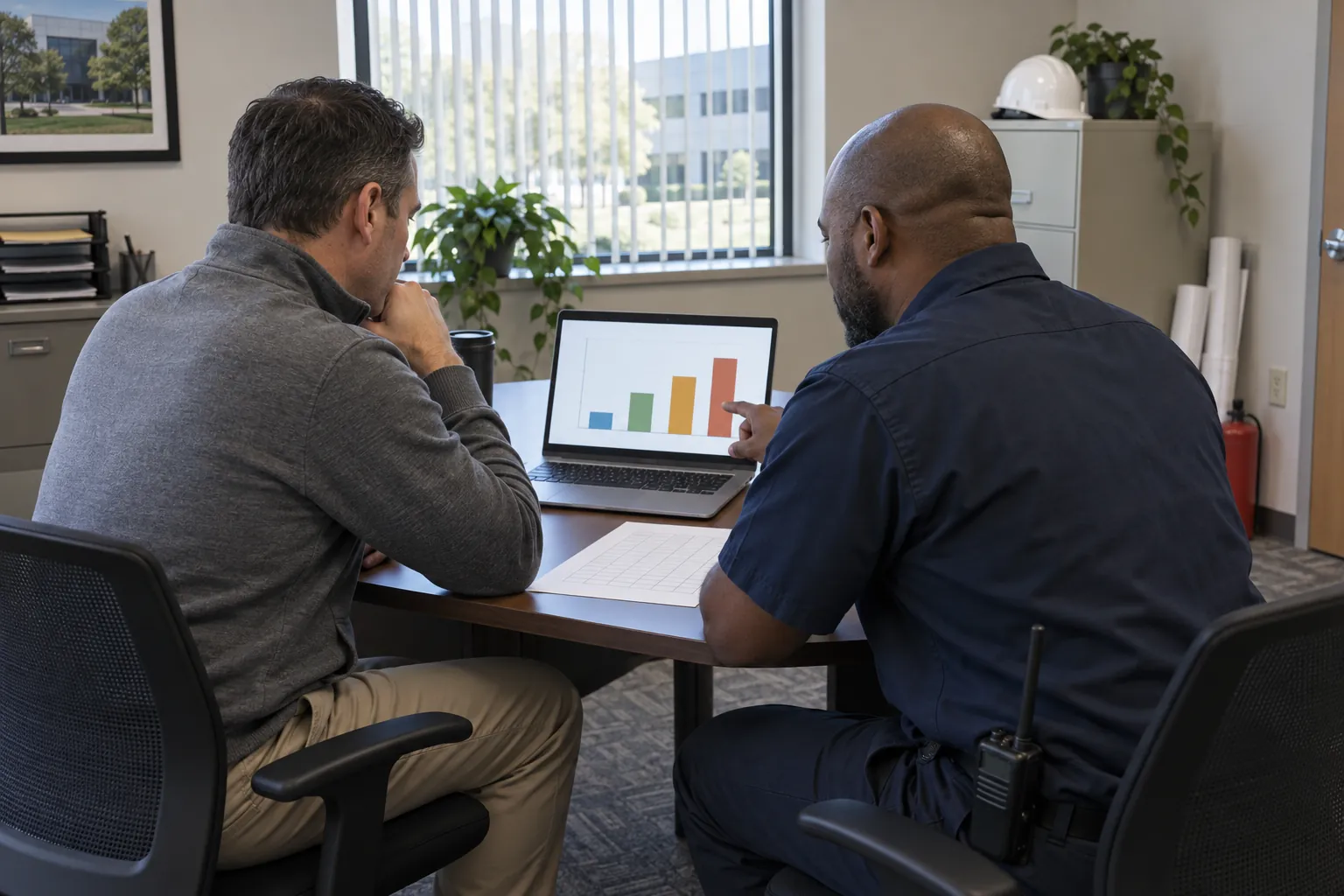
They are also how an outsourced FM or janitorial vendor shows it is earning its fee. Chosen well, a short list tells leadership what matters. Chosen badly, it rewards closing work orders rather than fixing problems. This guide covers the KPIs worth considering, the published definitions behind the common ones, where the data comes from, and how to keep the numbers from being gamed.
01
What facility management KPIs are
A key performance indicator is a measure chosen because it shows whether something important is being achieved: a metric with a purpose, a target and an owner attached. Facilities management metrics count what happened; a KPI compares a metric with a goal. In facility management, KPIs track two things. One is the services delivered in and around the buildings, such as maintenance, janitorial, security, grounds and the help desk. The other is the state of the portfolio itself: whether it is in good condition, safe, affordable to run and fit for the people who use it.
The International Facility Management Association's definition of facility management, which IFMA says follows the ISO standard, describes it as "an organizational function which integrates people, place and process within the built environment with the purpose of improving the quality of life of people and the productivity of the core business." If none of your KPIs says anything about the people in the building, the list measures activity, not results.
KPIs are not the same as service levels. A facility management SLA sets the standard for each piece of work, such as an emergency work order responded to within an hour; a KPI measures how often those standards are met, or tracks something broader, such as occupant satisfaction or operating cost per square foot. In an outsourced contract, KPIs often carry fee at risk or credits; for an in-house department, they are how facility performance is reported to the CFO, the board or the campus leadership.
No federal law sets a list of facility management KPIs for private buildings. Some measures, though, come with published definitions that are worth using as written, because they let you compare one year, one building or one vendor with another: the facility condition index as APPA defines it, energy use intensity as ENERGY STAR calculates it, and the injury and illness incidence rate as the Bureau of Labor Statistics computes it. For janitorial measures alone, see janitorial KPIs.
02
Facility management KPIs worth considering
These are examples, grouped by what they tell you. No organization needs all of them, and the right mix depends on the building type and the size of the portfolio.
- Code and regulatory compliance: required inspections and tests (fire alarm, sprinkler, extinguisher, elevator, backflow, boiler) completed on time, and deficiencies corrected within the agreed period. Many organizations treat any overdue item as an exception to explain individually, not a percentage to average away.
- Preventive maintenance completion: PM work orders completed within their scheduled window, as a share of those due. Pair it with a check that the tasks in each PM were actually done, not just that the work order was closed.
- Planned to reactive ratio: the balance of planned work and reactive maintenance, meaning corrective or emergency work orders. A rising share of reactive work often means PMs are being skipped or equipment is past its useful life.
- Work order response and completion: work orders acknowledged, attended and completed within target, by priority. Completion on its own says little; completion within the agreed time for that priority says more.
- First-time fix and repeat calls: work orders resolved on the first visit, and the same fault reported again within, say, 30 days.
- Backlog: open work orders and their age, and the value of deferred maintenance across the portfolio.
- Facility condition index: the cost of outstanding condition and code deficiencies divided by current replacement value (see below).
- Help desk: requests acknowledged within target, requesters kept informed, and satisfaction with completed requests.
- Janitorial and security delivery: scheduled cleaning, restroom checks and security rounds completed as specified, alongside inspection scores for quality.
- Safety: recordable injuries and illnesses among the FM workforce as an incidence rate, near misses reported, and open corrective actions from inspections.
- Occupant satisfaction: feedback on completed requests and a periodic occupant survey.
- Cost: operating spend against budget, and operating or maintenance cost per square foot.
- Energy and water: energy use intensity, water use per square foot, and the ENERGY STAR score where the building type has one.
03
Three KPIs with published definitions
Three widely used KPIs have published definitions; using them as written makes your figures comparable with others.
Facility condition index (FCI). APPA, the association for educational facilities leaders, defines the FCI in its page on deferred capital renewal and deferred maintenance as "the estimated cost to correct condition and code compliance deficiencies, divided by the current replacement value of the portfolio of managed assets," and calls it "the most commonly applied facilities metric in practice." A lower FCI means a portfolio in better condition. The weakness is the inputs. A 2006 study by Robert Quirk in APPA's Facilities Manager magazine, The Facilities Condition Index as a Measure of the Conditions of Public Universities as Perceived by the End Users, notes that the replacement value can range from professionally detailed replacement plans to "building officials' best guess," and the deferred maintenance value from a "detailed facilities condition analysis" to "educated guesses," and that "the lack of control over input of this data constitutes a serious concern over the validity of the data that make up the FCI." An FCI is only as honest as the facility condition assessment behind it, so say how and when the assessment was done.
Energy use intensity (EUI). ENERGY STAR explains what energy use intensity is: for properties in Portfolio Manager, the total energy consumed by the building in one year, in kBtu, divided by its total gross floor area, giving energy per square foot per year. Portfolio Manager reports both site and source EUI, and EPA uses source EUI as the basis for the ENERGY STAR score. The ENERGY STAR Portfolio Manager page describes the 1 to 100 score as comparing a building's energy performance "to similar buildings nationwide, normalized for weather and operating characteristics," where "a score of 50 represents median performance."
Injury and illness incidence rate. The Bureau of Labor Statistics sets out how to compute a firm's incidence rate: the number of OSHA recordable injuries and illnesses multiplied by 200,000, divided by the hours actually worked by all employees in the period. The 200,000 is "the equivalent of 100 employees working 40 hours per week, 50 weeks per year," which makes rates comparable between teams of different sizes. The count comes from the OSHA 300 log. Under 29 CFR 1904.1, a company with ten or fewer employees at all times during the last calendar year is partially exempt from keeping the log, and some low-hazard industries are too; under 29 CFR 1904.32, employers who keep it must review it each year, have a company executive certify the annual summary, and post the summary from February 1 to April 30. In a state that runs an OSHA-approved state plan, check the state's own recordkeeping rule. Where custodians or security officers are a vendor's employees, ask the vendor for its rate.
04
Balancing input, output and outcome measures
A useful way to choose the right facility management KPIs is to ask what kind of thing each one measures.
- Input measures count resources used: labor hours, technicians or custodians on site, dollars spent. They are easy to collect and say little about results.
- Output measures count work done: PMs completed, work orders closed, square feet cleaned, rounds walked, inspections carried out. They show delivery, and can be met by doing the task badly.
- Outcome measures show whether the building works for the people in it: equipment available when needed, occupants satisfied, inspections passed, repeat calls falling, FCI stable or improving. They matter most and are the hardest to measure.
A balanced set uses outputs to show the work was done, outcomes to show it made a difference, and inputs to manage cost. Pair measures that pull against each other: response time with first-time fix, PM completion with the reactive ratio, janitorial tasks completed with inspection scores. APPA's Operational Guidelines for custodial and grounds work each describe five service levels, and its maintenance guideline sets out a staffing framework, so staffing and frequency can be set against the level of service the organization has chosen to pay for.
Keep the list short. Five to ten core KPIs across the operation, reported every month, are easier to act on than forty. Tie each one to one of the organization's strategic goals, such as keeping critical equipment running or holding operating costs, so the list shows where to improve. Review the set each year and drop what has not changed a decision.
05
Data sources and written definitions
Every KPI needs a data source both sides trust, and a KPI is only as reliable as the record underneath it. The usual sources are:
- The CMMS or IWMS: work orders, PM schedules, asset records and timestamps, and usually the help desk.
- Inspection and testing records: fire and life safety reports from licensed contractors, elevator and boiler certificates, and the compliance calendar.
- Condition assessments: the facility condition assessment behind the FCI and the deferred maintenance list.
- Utility bills, meters and the building automation system: energy and water data, often entered in Portfolio Manager.
- The OSHA 300 log and hours worked, for the incidence rate.
- Quality inspections: janitorial inspection scores, security post inspections and safety walkthroughs.
- Records of routine checks and rounds: the day-to-day delivery of janitorial, porter, security and engineering rounds.
Then write each KPI down so that two people calculating it from the same data would get the same answer:
- the name, and the question it answers;
- exactly how it is calculated, including what is counted, what is excluded and which floor area is used;
- the data source, and who can inspect it;
- how often it is measured and reported;
- the target, and the threshold that triggers action;
- who owns it, and what happens when it is missed.
The KPIs belong in the facility management report, with the records behind each figure available on request.
06
Keeping the numbers honest
Once a measure becomes a target, people change their behavior to meet it, not always in the way intended. This is often called Goodhart's law, and facility management has plenty of examples:
- a response-time KPI rewards closing work orders quickly, so jobs are closed before the fault is fixed and reopened as new ones;
- priorities are downgraded after the event, so a missed emergency counts as a routine work order met;
- the clock is paused for "awaiting parts" or "no access" more often than parts were really late or access really refused;
- a PM is marked complete because the technician visited, whether or not every task on it was done;
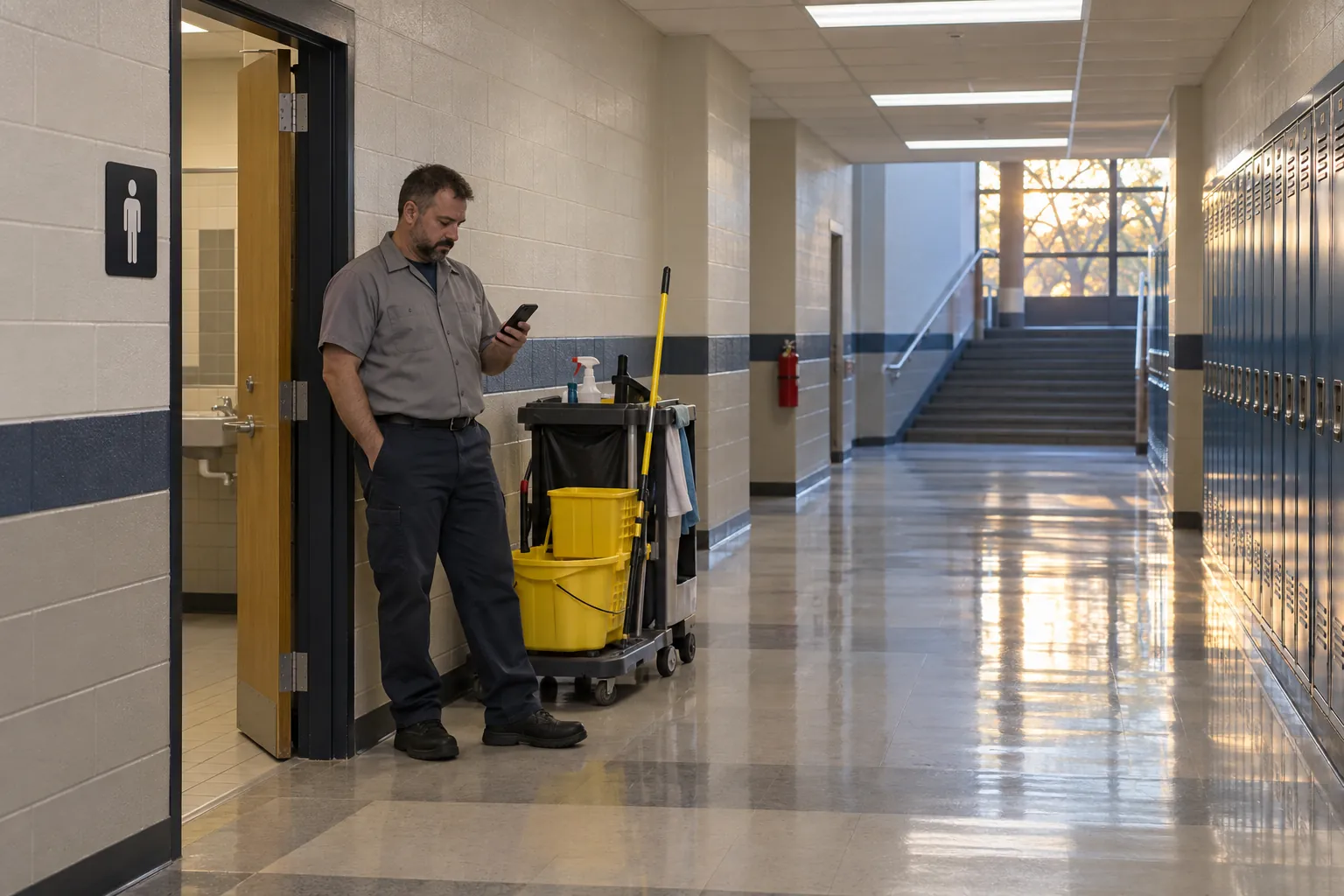
- a restroom check sheet is initialed for the whole shift at once, so janitorial delivery reads 100%;
- a cost KPI rewards deferring maintenance, which is cheaper this year and shows up later in the FCI.
The defenses are simple. Pair speed with quality. Count reopened work orders and repeat calls. Let requesters confirm a job is done before it closes. Audit a sample of completed work every month, in person. Report exceptions by name, not only percentages, and treat every overdue code inspection individually. And make sure the person reporting a KPI is not the only person who can see the data behind it.
07
Where the delivery data fails, and what SiteClara does about it
Maintenance KPIs usually rest on system data, because every work order passes through a help desk and a CMMS. Janitorial and security KPIs often do not. "Scheduled restroom checks completed" or "security rounds completed per post orders" are frequently worked out from paper sheets on the back of a door, or reported as 100% because nobody wrote down a miss. A KPI with no record behind it cannot be audited, and a vendor that reports 100% every month is rarely believed.
SiteClara records that routine work where it happens. A printed QR poster at each location, such as a restroom, lobby, mechanical room or loading dock, with an optional NFC tag behind it, lets custodial, security or engineering staff scan the code or tap the tag on their own phone, with no app to install. They see the scheduled checks due there and mark each one done, or say what stopped them, with a photo when one is asked for. A problem found there goes onto the team's list of jobs until someone closes it.
The supervisor sees what is due, done and missed, and gives the reason a check was missed. Each day the supervisor approves a report that goes to the facility manager and other nominated contacts at 8 a.m. the next morning, showing what was reported, what was completed, what is still open, and how the scheduled checks went, for example 12 of 12 completed. Those daily records are data that a KPI for janitorial or security delivery can be built on, and checked against.
08
Questions people ask
What is a KPI in facility management?
It is a measure used to track how well facility operations meet their objectives. IFMA's article KPI in Facility Management: Top Metrics Every Manager Should Be Tracking puts the difference this way: facilities management metrics "are single data points with no objective, unlike KPIs, which show how well a facility is meeting its objectives." The examples its members gave include customer satisfaction, cost per square foot, mean time to repair, the preventive to reactive maintenance ratio and critical equipment reliability.
What are the 11 core competencies of a facility manager?
IFMA's core competency course page lists them as finance and business, operations and maintenance, leadership and strategy, project management, real estate, sustainability, facility information and technology management, communications, risk management, occupancy and human factors, and performance and quality. IFMA says it identified these areas through a Global Job Task Analysis, a survey of facility managers worldwide.
What are the key skills for a facilities manager?
IFMA's 7 Key Skills Every Facility Manager Needs to Master covers seven of the eleven competencies: performance and quality, communications, occupancy and human factors, real estate, sustainability, risk management, and facility information and technology management. Performance and quality is the one closest to KPIs, which the article describes as "ensuring that all aspects of a building's operations, maintenance and performance meet both the organization's standards and industry benchmarks."
09
Further reading, and a list to take away
IFMA publishes its definition of facility management and its core competencies for the profession. APPA publishes the facility condition index definition and its Operational Guidelines for custodial, grounds and maintenance staffing and service levels. ENERGY STAR explains energy use intensity and the 1 to 100 score, and Portfolio Manager is where the data is entered. BOMA publishes the floor measurement standards that per-square-foot KPIs depend on. The Bureau of Labor Statistics explains how to compute an incidence rate, and OSHA publishes the recordkeeping rule in 29 CFR Part 1904; check whether your state runs its own plan.
Before you agree on a set of facility management KPIs, check that:
- each KPI answers a question someone will act on;
- the set mixes output and outcome measures, with speed paired against quality;
- code and regulatory inspections are reported item by item, not only as a percentage;
- every KPI has a written definition, a data source and an owner;
- published measures (FCI, EUI, incidence rate) are calculated as their owners define them;
- every per-square-foot figure names its floor area measure;
- the data can be inspected by someone other than the person reporting it;
- janitorial and security delivery measures are backed by records, not only inspection scores;
- there is a date to review the set and drop what is not used.
Sources
Every document this guide quotes or links to, in the order it first cites them.
- International Facility Management Association's definition of facility management ifma.org
- BOMA floor measurement standards boma.org
- Deferred capital renewal and deferred maintenance appa.org
- The Facilities Condition Index as a Measure of the Conditions of Public Universities as Perceived by the End Users www1.appa.org
- What energy use intensity is energystar.gov
- ENERGY STAR Portfolio Manager energystar.gov
- How to compute a firm's incidence rate bls.gov
- 29 CFR 1904.1 osha.gov
- 29 CFR 1904.32 osha.gov
- Operational Guidelines appa.org
- KPI in Facility Management: Top Metrics Every Manager Should Be Tracking blog.ifma.org
- Core competency course page ifma.org
- 7 Key Skills Every Facility Manager Needs to Master blog.ifma.org
Related guides
 Premises and facilities managementFacility management SLA: setting service levels you can actually checkHow to write a facility management SLA: help desk and work order priorities, PM, janitorial and security service levels, credits, and the records behind them.
 Premises and facilities managementFacility management report: what to include, and what makes it believableWhat a monthly facility management report should cover: life safety and code compliance, work orders, PM, janitorial and security, costs, and the records behind it.
 CleaningJanitorial KPIs: what to measure, and how to know the numbers are trueThe janitorial KPIs worth tracking, how to define and target them, how federal contracts measure cleaning, and how KPIs look green while the building is not clean.
 Premises and facilities managementDeferred maintenance: what it is, how to measure the backlog, and what cannot waitWhat deferred maintenance means under FASAB, GASB and APPA, how a backlog and FCI are measured, what OSHA says cannot wait, and how to keep the backlog honest.