Cleaning
Janitorial KPIs: what to measure, and how to know the numbers are true
Cleaning KPIs, or key performance indicators, are the measurable metrics a building owner or facility manager and a janitorial contractor use to judge whether cleaning meets the agreed standard, such as inspection scores, task completion rates, response times and repeat complaints.

Chosen well, a handful of them show whether the building is clean, whether the agreed service was delivered and whether problems are being fixed. Chosen badly, they produce a green dashboard and a steady stream of complaints. This guide covers which cleaning KPIs to use, how to define and target them, how federal contracts measure cleaning performance, and how to report the results.
01
What janitorial KPIs are, and where they come from
A key performance indicator (KPI) is a measurable metric that shows whether a service is meeting an agreed standard. It turns a judgment such as "the cleaning is fine" into performance data both sides can count and compare over time. In a commercial janitorial contract the KPIs usually sit in the service level agreement or the scope of work, each with a definition, a target, a measurement period and a source of evidence, and they are reviewed at regular meetings between the facility manager and the building service contractor (BSC), or between the facilities director and an in-house custodial department.
No federal law sets cleaning KPIs for an ordinary workplace. The legal duty is the outcome. Under federal OSHA's walking-working surfaces standard, 29 CFR 1910.22, employers must ensure that "all places of employment, passageways, storerooms, service rooms, and walking-working surfaces are kept in a clean, orderly, and sanitary condition," and that walking-working surfaces are "inspected, regularly and as necessary, and maintained in a safe condition." The OSHA sanitation standard, 29 CFR 1910.141, adds that "all places of employment shall be kept clean to the extent that the nature of the work allows." KPIs are how an owner shows it is managing that duty when the work is outsourced, and how a contractor shows it delivered what it was paid for.
Federal contracting shows the method most clearly. The Federal Acquisition Regulation, FAR 37.601, says performance-based contracts for services shall include a performance work statement (PWS), "measurable performance standards (i.e., in terms of quality, timeliness, quantity, etc.) and the method of assessing contractor performance against performance standards," and performance incentives where appropriate. FAR 37.603 adds that performance standards "shall be measurable and structured to permit an assessment of the contractor's performance." Under FAR 46.401, a quality assurance surveillance plan (QASP) should be prepared alongside the statement of work and should specify "all work requiring surveillance" and "the method of surveillance." That is what a good private KPI set needs too: what is measured, the standard, and how it is checked.
Healthcare shows the same logic applied to risk. The CDC's Options for Evaluating Environmental Cleaning encourages all hospitals "to develop programs to optimize the thoroughness of high touch surface cleaning" in terminal room cleaning, and describes a thoroughness of disinfection cleaning (TDC) score "calculated as # of objects cleaned / total # of objects evaluated X 100." Elsewhere the idea is the same: measure what matters most where the risk is highest.
02
The janitorial KPIs worth measuring
Most contracts need between five and ten KPIs. Fewer and something important goes unmeasured; more and nobody reads them. The cleaning KPIs worth tracking on almost any account are these:
- Inspection score: results from a structured cleaning inspection, as the percentage of inspected elements that pass, or as an APPA appearance level, reported by area type. It is the KPI most owners start with, and the one most open to argument unless the inspection method is agreed.
- Task completion rate: scheduled tasks and checks completed against those planned, for example restroom checks completed as a share of those scheduled. It measures whether the agreed service happened at all.
- Response time and completion time: how quickly a reported problem or work order is attended to and how quickly it is fixed, by priority. A spill in a lobby and a burned-out restroom light do not share a target.
- Complaints and repeat deficiencies: the number of complaints or callbacks per period, and how many concern a problem already raised. Repeat deficiencies often say more than the total.
- Project work completed: floor care (strip and wax, burnishing, carpet extraction), high dusting, window washing and other periodic work delivered against the project schedule.
- Labor hours and coverage: contracted hours delivered, and whether call-offs and vacancies were covered. A contract running short of hours will fail every other KPI eventually. See custodial staffing for how the hours are worked out.
- Training and safety: custodians with current orientation and training on the chemicals and equipment they use, safety data sheets available, and injuries, near misses and other incidents on the account, with how each was followed up.
- Customer satisfaction: a short periodic survey of tenants, staff or the owner's team, used alongside the other measures rather than instead of them.
Owners often also compare cost per square foot across buildings. That is a cost measure, not a measure of cleaning performance, and it belongs in a different report. So do productivity measures such as square feet cleaned per labor hour: they are useful tools for a contractor planning staffing and bids, but an owner should judge the contract on the result.
Specialist accounts add their own measures: a hospital's environmental services (EVS) department tracks room turnaround and objective scores such as ATP testing or fluorescent marker results. The principle is the same: pick the few metrics that show whether this building is safe, clean and served as agreed.
03
Defining each KPI and setting the target
Every KPI needs a written definition that both sides agree before the contract starts. For each one, set out:
- What is measured, precisely. "Restroom checks completed" needs to say whether a check done late counts, and how late.
- The source of the data: inspection forms, check records, the work order system, timekeeping.
- Who measures it, and whether the owner verifies it. A contractor grading its own work needs an independent check, such as joint inspections with the facility manager.
- The period: weekly, monthly or quarterly.
- The target, and the level below which it counts as a failure.
- What happens on a failure: a corrective action plan, a re-inspection, or a deduction or credit if the contract has them. In a federal contract, the QASP and the PWS set this out; in a private one it belongs in the SLA.
Set targets from a baseline, not from ambition. The first month of a new contract, or the last three months of an existing one, shows what the building actually achieves, and that is the benchmark to improve from. The CDC toolkit takes the same approach in hospitals, recommending that a baseline be measured before an improvement program and that ongoing monitoring use a sample large enough "to detect a 10-20% change in performance." A target of 100% on anything measured by human inspection will be missed, and a contract that fails a KPI every month soon stops taking it seriously. A target nobody ever misses is not measuring anything.
For inspection scores, many schools, colleges and public agencies set the target as an appearance level. APPA's Operational Guidelines for Educational Facilities: Custodial defines five, set out in APPA's Facilities Manager article Operational Guidelines for Educational Facilities – Custodial (January/February 2013):
- Level 1, Orderly Spotlessness;
- Level 2, Ordinary Tidiness;
- Level 3, Casual Inattention;
- Level 4, Moderate Dinginess;
- Level 5, Unkempt Neglect.
The value of the levels for KPIs is that they tie the target to staffing: the guidelines link each level to the area one custodian can clean, so a Level 2 target with Level 4 staffing is a promise the contract cannot keep. Agree the level and the labor hours together.
Weight the KPIs to the building. A school cares about restrooms after lunch; an office tower cares about the lobby and elevators first thing; a hospital cares about patient rooms above all. The same metrics can carry different targets in different areas, with the strictest reserved for critical areas such as restrooms, food service and patient rooms.
04
How janitorial KPIs are reported
Janitorial KPIs are typically reported monthly, in a short report or dashboard reviewed with the facility manager, and summarized again at a quarterly business review. Setting and tracking the numbers should be routine, not a scramble before the meeting. A useful report shows:
- each KPI against its target, with a simple red, yellow or green status;
- the trend over several months, because performance over time matters more than any single number;
- the reason behind any failure, and the corrective action taken;
- open actions and work orders, who owns them and whether any are overdue;
- anything that keeps recurring, and what is being done about it.
Monthly is often too slow on its own. A missed clean on the 3rd reported on the 30th has already become a complaint. Many owners also want a short daily report or a weekly summary of delivery, showing what was done, what was missed and what is still open, so problems surface while they can still be fixed and the monthly numbers hold no surprises.
Share the results with the crew, not only with the client. The CDC toolkit recommends that monitoring results be used "in ongoing educational activity and feedback to the ES staff following each cycle of evaluation," and that the results of the baseline evaluation be brought into the ES staff's education "in a non-punitive manner." That advice applies well beyond hospitals: a KPI used to blame people gets gamed, and one used to coach them gets better.
Federal contracts add a formal record at the end. Under FAR 42.1502, agencies prepare past performance evaluations "at least annually and at the time the work under a contract or order is completed" for contracts above the simplified acquisition threshold, and submit them to the Contractor Performance Assessment Reporting System (CPARS). A contractor bidding for federal work is judged partly on those evaluations.
05
When KPIs look green and the building is not clean
Good KPI numbers and unhappy tenants usually have one of these causes:
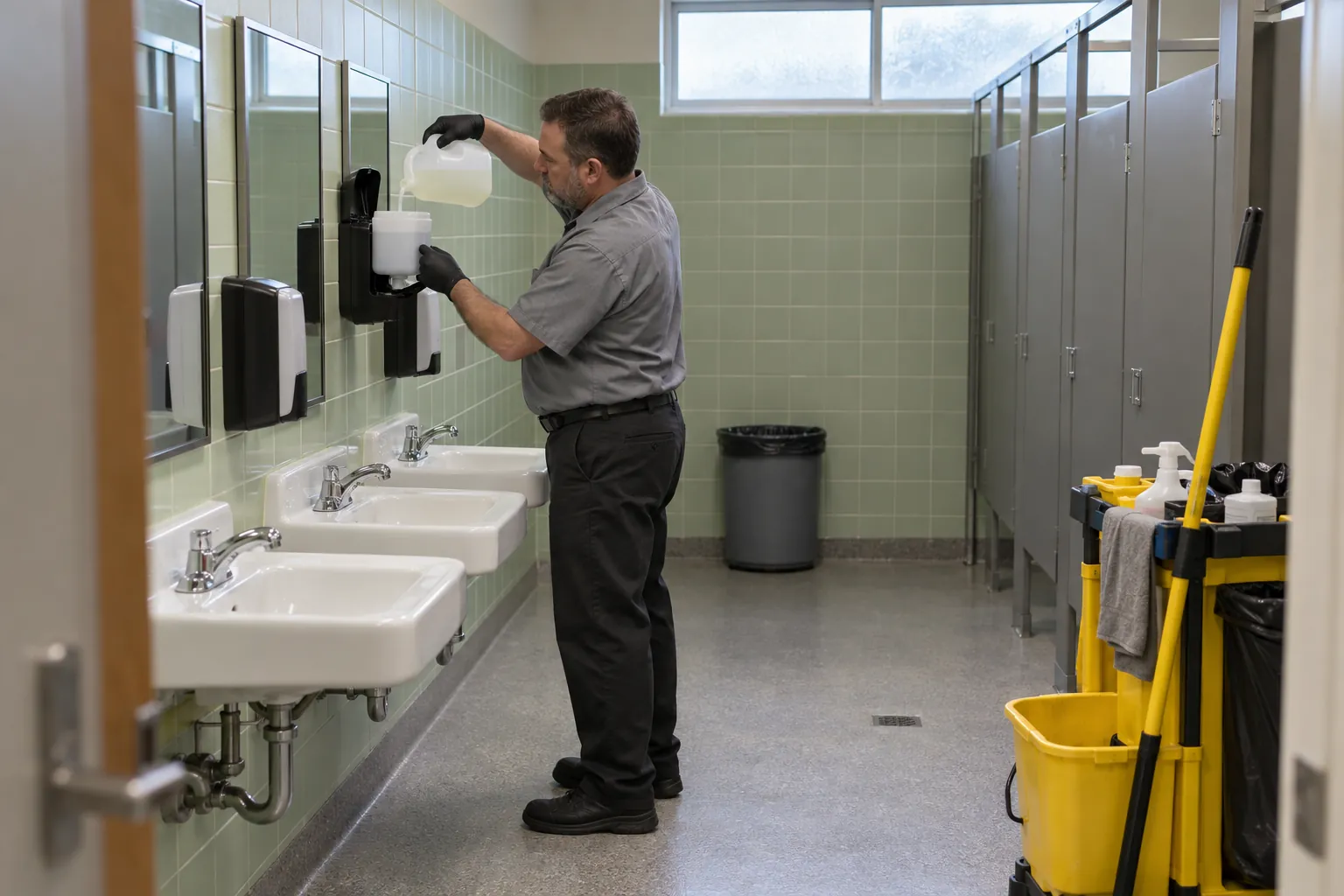
- Measuring only inputs. Tasks completed, with no check on the result, reward visiting a room rather than cleaning it.
- Measuring only outputs. An inspection score from a small, predictable sample says little about the rooms nobody inspected, or about the restroom at 2 p.m. rather than 9 a.m. Vary the time and the route, and make some inspections unannounced.
- Closing actions without fixing them. An inspection flags a deficiency, a work order is raised, someone closes it, and the same deficiency appears next month. Track repeat deficiencies, not only closed work orders.
- Too many KPIs. Among thirty indicators, the three that matter get lost.
- Self-reported data nobody checks. A contractor's own numbers, never verified, drift upward. The federal model of a surveillance plan run by the customer exists for this reason.
- Targets out of step with labor. A target appearance level the contracted hours cannot reach produces either constant failures or quiet shortcuts.
- Stale targets. KPIs set for how a building was used three years ago measure a building that no longer exists. Review them at least once a year, and whenever occupancy or use changes.
The answer is balance: quality and delivery, contractor-measured and owner-verified, monthly trend and daily detail. Together they measure cleaning performance rather than activity, and show whether the contract is really working.
06
Where the delivery data fails, and what SiteClara does about it
Of all janitorial KPIs, task completion is the one most often built on the weakest evidence. The number in the monthly report is usually assembled from log sheets on the back of restroom doors and supervisors' notes, initialed after the fact, so it cannot show when a check was done or by whom, and a missed check is rarely recorded as missed.
SiteClara records the checks at the location. A printed QR poster, with an optional NFC tag behind it, sits at each place a check is scheduled. Custodians scan or tap on their own phone, with no app to install, see the checks due there, and mark each one done or say what stopped them. The time and the named person are recorded as it happens, with a photo when one is asked for, and a problem reported there goes onto the team's list of jobs until someone closes it.
The supervisor sees what is due, done and missed, and records the reason a check was missed. Each day they review the totals and photos, add a note and approve a report that goes to nominated contacts, such as the facility manager or the client, at 8 a.m. the next morning, showing what was reported, what was completed, what is still open and how the scheduled checks went, for example 12 of 12 completed. That gives the task completion and open-job numbers a daily source recorded at the time, rather than one reconstructed for the monthly meeting.
07
Questions people ask
What are some good cleaning KPI examples?
Good examples are specific enough to count: the inspection score by area type, scheduled checks completed against those planned, response time to a reported problem by priority, and repeat deficiencies per month. The CDC gives a model of a well-defined cleaning KPI in Options for Evaluating Environmental Cleaning: the thoroughness of disinfection cleaning (TDC) score, "calculated as # of objects cleaned / total # of objects evaluated X 100," measured with objective methods such as fluorescent markers or ATP testing and fed back to the cleaning staff after each cycle.
What are the top 3 cleaning KPIs?
No official list names three, but FAR 37.601, the federal rule for performance-based service contracts, asks for "measurable performance standards (i.e., in terms of quality, timeliness, quantity, etc.)." Taking one from each gives a sound core for most buildings: an inspection score for quality, response time to reported problems for timeliness, and the task completion rate for quantity.
08
Further reading, and a list to take away
Federal OSHA publishes the walking-working surfaces standard and the sanitation standard; where cleaning involves blood or other potentially infectious materials, the bloodborne pathogens standard, 29 CFR 1910.1030, requires the employer to "determine and implement an appropriate written schedule for cleaning and method of decontamination." Check the State Plans page to see whether your state's own rules apply. For contract structure, read FAR 37.601 on performance-based service contracts and FAR 46.401 on quality assurance surveillance plans. APPA sells the Custodial Operational Guidelines, now in their fourth edition, and ISSA publishes the Cleaning Industry Management Standard (CIMS), a management standard for both in-house service providers and building service contractors. For hospitals, the CDC's Options for Evaluating Environmental Cleaning sets out objective monitoring. For how the standards fit together, see our guide to cleaning standards in the US.
Before you agree or review a set of janitorial KPIs, check that:
- there are between five and ten, and each one matters to this building;
- they measure delivery as well as quality;
- each has a written definition, data source, owner, period and target;
- targets come from a baseline, not from ambition, and match the labor hours in the contract;
- some of the data is verified by the owner, for example through joint or unannounced inspections;
- repeat deficiencies are tracked, not only closed work orders;
- results are shared with the crew as coaching, not only with the client;
- there is a daily or weekly view of delivery as well as the monthly report;
- they are reviewed at least once a year, and whenever the building's use changes.
Sources
Every document this guide quotes or links to, in the order it first cites them.
- Walking-working surfaces standard, 29 CFR 1910.22 osha.gov
- OSHA sanitation standard, 29 CFR 1910.141 osha.gov
- OSHA-approved State Plans osha.gov
- FAR 37.601 acquisition.gov
- FAR 37.603 acquisition.gov
- FAR 46.401 acquisition.gov
- Options for Evaluating Environmental Cleaning cdc.gov
- Operational Guidelines for Educational Facilities – Custodial www1.appa.org
- FAR 42.1502 acquisition.gov
- Options for Evaluating Environmental Cleaning cdc.gov
- Bloodborne pathogens standard, 29 CFR 1910.1030 osha.gov
- Custodial Operational Guidelines appa.org
- Cleaning Industry Management Standard (CIMS) cims.issa.com
Related guides
 CleaningThe janitorial service level agreement: what to include, and how to show it is metWhat a US cleaning service level agreement should contain: levels of clean, response times, inspections, deductions, escalation, and how to show the work was done.
 CleaningJanitorial quality control: how to inspect, score and fix the cleaningHow janitorial quality control works: QA versus QC, building a cleaning inspection checklist, APPA appearance levels, sampling, scoring and corrective action.
 CleaningJanitorial scope of work: what it should say, and how to show it is metWhat a janitorial scope of work should cover, how to set cleaning frequencies by room type, output versus input standards, and how to show the work is being done.
 CleaningJanitorial daily report: what goes in it, and how to make it worth readingWhat a janitorial daily report should cover, how custodians and supervisors fill it in, what facility managers read in it, and where the daily record falls short.