Premises and facilities management
Facility management SLA: setting service levels you can actually check
A facility management SLA, or service level agreement, is the part of a facility services contract that sets out, service by service, what the provider will deliver, the response times and other standards it must meet, how performance will be measured, and what happens when it falls short.
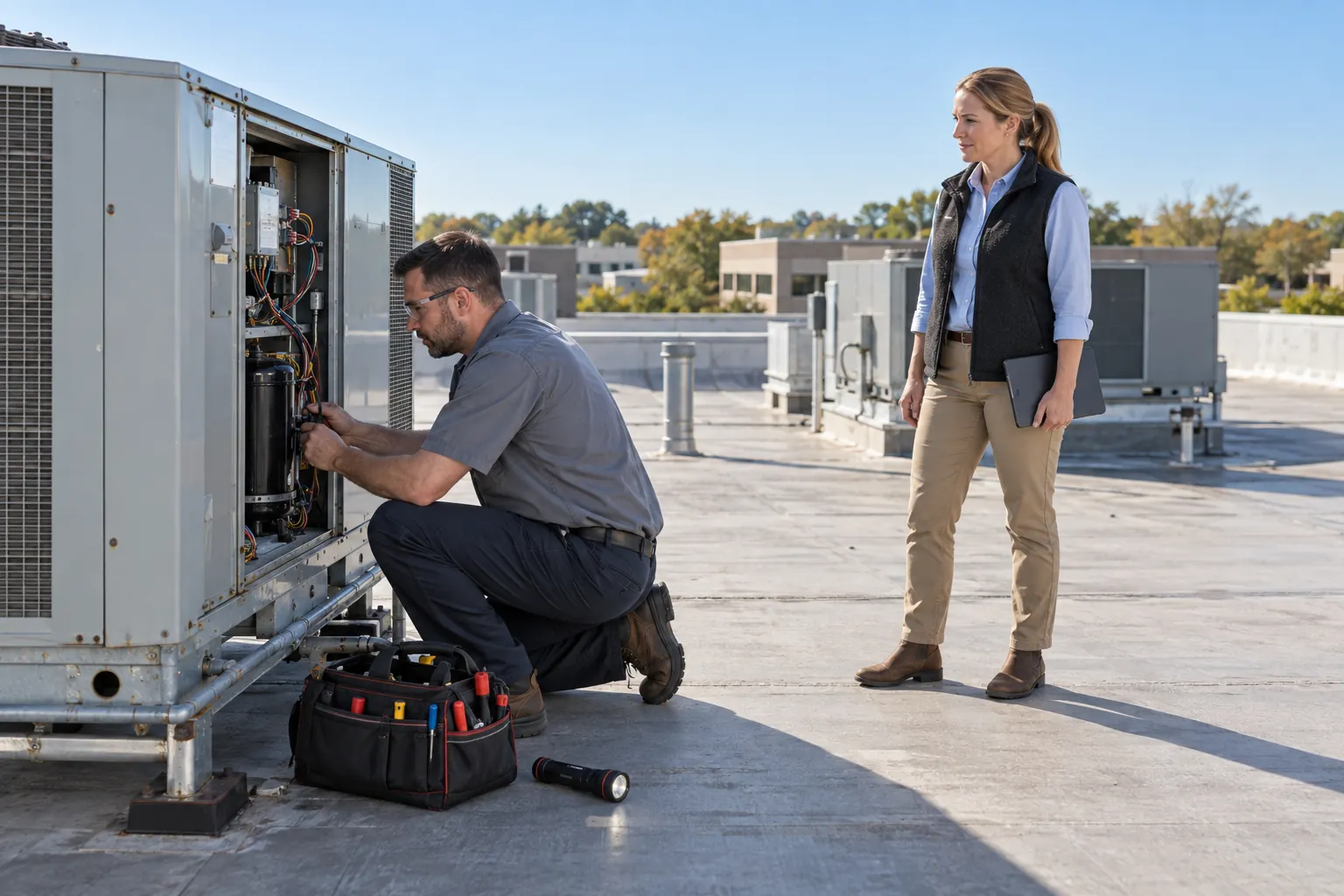
It is where facility management stops being a promise and becomes something both sides can check: how fast the help desk acknowledges a request, how soon an emergency work order is made safe, whether preventive maintenance happens in its window, and what clean and secure mean in this building. This guide covers what a facility management SLA should include, how to define service levels so they hold up, how they connect to KPIs and credits, and where the evidence usually runs thin.
01
What an SLA is in facility management
A service level agreement (SLA) in facility management sets out, service by service, what will be delivered, how performance will be measured, and what happens when it falls short. It is used wherever an organization buys facility services, from one integrated FM provider or from separate janitorial, security, mechanical and grounds contractors, and in-house facilities departments use internal SLAs too. It usually sits inside the facilities management contract, beside the scope of work and the payment terms. Some organizations call it a facilities management SLA; the content is the same.
The International Facility Management Association's definition of facility management, which IFMA notes is the ISO definition it has adopted, calls it "an organizational function which integrates people, place and process within the built environment with the purpose of improving the quality of life of people and the productivity of the core business." If none of the service levels says anything about the people using the building, the agreement measures activity, not service.
No federal or state law requires a private organization to have an SLA. It is a contract tool. The closest thing to a public rulebook is federal procurement: under FAR 37.601, a performance-based contract for services must include a performance work statement, "measurable performance standards (i.e., in terms of quality, timeliness, quantity, etc.) and the method of assessing contractor performance against performance standards," and any performance incentives must correspond to those standards. Private and institutional buyers are free to ignore the Federal Acquisition Regulation, but its three parts, what is required, how it is measured and what follows, are a good test for any SLA.
Many of the services an SLA covers carry legal duties of their own. OSHA's walking-working surfaces rule, 29 CFR 1910.22, requires that "all places of employment, passageways, storerooms, service rooms, and walking-working surfaces are kept in a clean, orderly, and sanitary condition," and that walking-working surfaces are "inspected, regularly and as necessary, and maintained in a safe condition." Fire protection systems are inspected, tested and maintained under the codes and standards the local authority having jurisdiction (AHJ) has adopted, such as NFPA 25, Standard for the Inspection, Testing, and Maintenance of Water-Based Fire Protection Systems, which is a standard until a jurisdiction adopts it. Outsourcing the work does not hand over the building owner's or employer's duties; the SLA is how the client shows it is managing them through someone else.
02
What a facility management SLA covers
A useful SLA names each service in scope, the requirement for it, and at least one measurable standard. Across a typical facility services contract that means:
- Help desk: hours of coverage, how requests reach it (phone, email, portal), time to acknowledge a request, time to assign a priority, and how the requester is kept informed until the work order closes.
- Corrective and emergency work orders: response, make-safe and completion times by priority, measured separately.
- Preventive maintenance: PM work orders completed within their scheduled window, with the tasks on each actually done and the readings or findings returned, from HVAC filters and belts to generator runs and roof drains.
- Code and regulatory inspections: fire alarm, sprinkler, fire extinguisher, elevator, backflow and boiler inspections completed before they fall due, reports on file, and deficiencies corrected within an agreed period or reported to the owner in writing.
- Janitorial: the areas cleaned, their frequencies, the standard each area must meet, inspection scores, restroom checks, and the time allowed to correct a failed item. The janitorial service level agreement guide covers this service alone.
- Security: posts staffed as the post orders require, rounds completed on schedule, incidents reported to the client within an agreed time, and alarms answered.
- Workplace and support services: reception and mailroom coverage, conference room setups, moves, waste and recycling pickups, pest control visits, grounds and snow removal.
- Reporting and review: what the vendor reports, how often, in what format, and the meetings where performance is reviewed.
Every standard should be something both the vendor and the client can check from a record. "Excellent customer service" is not a service level. "95% of priority 2 work orders attended within four business hours, measured from the CMMS" is. Other examples of wording that passes the same test:
- "Help desk requests acknowledged within 30 minutes during staffed hours, measured from the ticket timestamp."
- "PM work orders completed within the scheduled month, with each task line closed and the asset identified."
- "Restroom checks completed at the frequency in the scope of work, with a reason recorded for any missed."
- "Any incident reported to the client's designated contact within one hour of the officer becoming aware of it."
The numbers in these examples are illustrations, not recommendations. The right figure depends on the building, its hours and what its occupants need.
03
Setting service levels that hold up
Corrective work orders are where definitions matter most. Most SLAs sort requests into priorities by their effect on safety and on the operation. One common pattern, for illustration only:
- Priority 1, emergency: a danger to people or the building, or the loss of a critical system such as heating in winter, water, power or a fire protection impairment. Respond and make safe within a short, agreed time, around the clock.
- Priority 2, urgent: serious disruption, such as a failed rooftop unit over an occupied floor. Attend the same business day and complete within an agreed period.
- Priority 3, routine: a fault that can wait, such as a dripping faucet or a flickering light. Complete within a few business days.
- Priority 4, scheduled: minor work bundled into the next planned visit.
What matters more than the numbers is that each term is written down:
- When the clock starts: when the request is made, or when the help desk logs it. The gap between the two is where many disputes begin.
- What stops it: a technician on site, the hazard made safe, a temporary repair, or a permanent fix. These are different service levels and should be measured separately.
- Which hours count: business hours or calendar hours, and whether nights, weekends and holidays pause the clock.
- What pauses it: waiting for access, parts or a client decision, and who records and approves the pause.
- Who sets the priority: the requester, the help desk, or a list of agreed examples, and who can change it after the event.
Janitorial and security service levels are usually a mix of delivery measures and quality measures. Delivery measures ask whether the work was done: restroom checks at the frequency in the scope, rounds walked as the post orders say, the lobby cleaned before the building opens. Quality measures ask whether it was done well: an inspection score against the specification, a response to a complaint, a daily activity report that says something. An SLA that only measures delivery can be met by initials on a sheet; one that only measures quality can be met by one good walk-through a month.
Published frameworks help set the levels. APPA's Operational Guidelines, written for educational facilities and sold as paid books, describe five service levels for custodial work and five for grounds, with task frequencies and staffing matrices by space type. Any buyer can borrow the idea of agreeing on a level per space type, even without adopting APPA's.
04
How SLAs connect to KPIs, credits and oversight
SLA and KPI are often used interchangeably, but they do different jobs. The SLA sets the standard for each piece of work: this emergency made safe within this time. The KPI measures how often the standard is met over a period: the share of priority 1 work orders made safe within target this month. Facility management KPIs can also track what the SLA never promises job by job, such as occupant satisfaction, repeat calls or the planned to reactive ratio.
Money usually attaches through credits, performance deductions or a portion of the fee held at risk. When a KPI misses its target, the vendor's invoice is reduced by an agreed amount, normally weighted toward the service levels that matter most and capped. Federal contracts show the logic in plain terms: under the inspection clause for fixed-price service contracts, FAR 52.246-4, if services "do not conform with contract requirements, the Government may require the Contractor to perform the services again in conformity with contract requirements, at no increase in contract amount," and where that cannot fix the problem it may require corrective action or reduce the price. Private contracts often borrow the same sequence: re-perform, correct, reduce, and in the end terminate for persistent failure.
Credits are a lever, not a management system. The contract should say what happens when performance stays below the line for more than one period: a corrective action plan with dates, escalation to senior people on both sides, and termination rights. Federal buyers pair the SLA with a surveillance plan; under FAR 46.401, a quality assurance surveillance plan specifies "all work requiring surveillance" and "the method of surveillance." A private client can do the same on one page: which service levels it will check itself, how often, and from which records.
Oversight also matters for safety, not only for value. Under OSHA's Multi-Employer Citation Policy (CPL 02-00-124), an employer with general supervisory authority over a worksite, including the power to correct violations or require others to correct them, can be a controlling employer that must "exercise reasonable care to prevent and detect violations on the site." OSHA says that duty is less than what an employer owes its own workers. Check which OSHA program applies first: according to OSHA's state plans page, 22 state plans cover both private-sector and state and local government workers, and seven cover only state and local government workers.
Keep the list short: ten service levels discussed every month beat sixty that nobody reads. Review the SLA with both teams at least once a year, and whenever the building's use or operations change.
05
Measurement and reporting
An SLA is only as good as the records behind it. Before agreeing on a service level, agree on where the data for tracking it will come from and who can see it:
- Help desk and CMMS records for acknowledgment, response and completion times and PM completion, with timestamps, priority changes and pauses visible to the client, not only the vendor.
- Inspection, testing and maintenance reports for code-required work, held with the building's records and checked against a calendar of due dates. The AHJ and the insurer will ask for the report, not the KPI.
- Janitorial inspections against the specification, some carried out jointly by the client and the vendor, so that both agree what a pass looks like.
- Records of routine checks and rounds: restroom checks, lobby and common area checks, security rounds and the daily activity report, for day-to-day delivery.
- Occupant feedback on completed requests, to catch what timestamps miss.
Report SLA performance each month in a consistent format, so each month can be compared with the last, and keep the underlying records available on request. Discuss exceptions, not averages. A figure of 97% on emergencies hides the three that were not made safe in time, and the monthly meeting should talk about those three by name. Report every overdue code inspection individually. The facility management report guide covers how to present it.
06
Where SLA evidence fails, and what SiteClara does about it
Maintenance service levels usually have data behind them, because every work order passes through a help desk and a CMMS with timestamps. The janitorial and security service levels often do not. "Restrooms checked every hour", "rounds every two hours per post orders" and "lobby detailed before 7 a.m." are measured, if at all, by a sheet on the back of a door initialed for the whole shift, and a line in the monthly report that says 100%. When the client questions it, there is nothing to show, and a vendor that reports 100% every month is rarely believed.
SiteClara records that routine work where it happens. A printed QR poster at each location, such as a restroom, lobby, mechanical room or loading dock, with an optional NFC tag behind it, lets custodial, security or engineering staff scan the code or tap the tag on their own phone, with no app to install. They see the scheduled checks due there and mark each one done, or say what stopped them, with a photo when one is asked for. A problem found there goes onto the team's list of jobs until someone closes it, and a supervisor can escalate a job to the building manager, who can answer it.
The supervisor sees what is due, done and missed, and gives the reason a check was missed. Each day the supervisor approves a report that goes to the facility manager and other nominated contacts at 8 a.m. the next morning, showing what was reported, what was completed, what is still open, and how the scheduled checks went, for example 12 of 12 completed. That gives janitorial and security service levels the same kind of daily record the maintenance side already has.
07
Questions people ask
What is the difference between an SLA, an SLO and an SLI?
The terms come from IT operations and carry over to facilities. Google's Site Reliability Engineering book, chapter 4, Service Level Objectives, defines an SLI as "a carefully defined quantitative measure of some aspect of the level of service that is provided," an SLO as "a target value or range of values for a service level that is measured by an SLI," and SLAs as "an explicit or implicit contract with your users that includes consequences of meeting (or missing) the SLOs they contain." In a facility management SLA, the time from request to make-safe is the indicator, "made safe within two hours" is the objective, and the agreement adds what follows when it is missed, such as a credit or a corrective action plan.
What is an example of a good SLA?
A good SLA says what is required, how it will be measured and what follows. For performance-based federal service contracts, FAR 37.601 requires a performance work statement, measurable performance standards in terms such as quality, timeliness and quantity, a method of assessing the contractor against them, and incentives, where used, that correspond to those standards. A facility management service level that meets the same test: "95% of priority 2 work orders attended within four business hours, measured from the CMMS," with an agreed credit for a month below target.
What are some examples of service levels?
In facility management, service levels are usually set per service: response and completion times for work orders by priority, preventive maintenance completed within its window, cleaning frequencies and inspection scores by space type, and security rounds completed on schedule. Some published frameworks define levels rather than single targets: APPA's Operational Guidelines, written for educational facilities and published as separate custodial, grounds and maintenance guides, describe five service levels for custodial work and five for grounds, so a buyer can choose the level each space needs and set expectations to match.
08
Further reading, and a checklist to take away
IFMA publishes its definition of facility management; ISO 41001 sets out a management system for facility management, including performance evaluation. The Federal Acquisition Regulation, at acquisition.gov, shows how federal buyers structure performance-based service contracts and surveillance plans. APPA's Operational Guidelines describe custodial, grounds and maintenance service levels. OSHA publishes its standards, the Multi-Employer Citation Policy and the list of state plans. NFPA publishes the fire protection standards many inspection service levels depend on, but the edition that applies is the one your AHJ has adopted.
Before you agree on a facility management SLA, check that:
- every service in scope has at least one service level;
- every service level can be measured from a record both sides can see;
- work order priorities are defined with examples, and response, make-safe and completion are measured separately;
- clock starts, stops and pauses are written down, with who approves a pause;
- code-required inspections are tracked item by item against their due dates;
- janitorial and security have delivery measures as well as inspection scores;
- each service level links to a KPI and, where agreed, a proportionate credit;
- the client has written down how it will check the vendor's figures;
- the SLA says what happens when performance falls short for more than one period;
- there is a date for the SLA's next review.
Sources
Every document this guide quotes or links to, in the order it first cites them.
- International Facility Management Association's definition of facility management ifma.org
- FAR 37.601 acquisition.gov
- 29 CFR 1910.22 osha.gov
- NFPA 25, Standard for the Inspection, Testing, and Maintenance of Water-Based Fire Protection Systems nfpa.org
- APPA's Operational Guidelines appa.org
- FAR 52.246-4 acquisition.gov
- FAR 46.401 acquisition.gov
- Multi-Employer Citation Policy (CPL 02-00-124) osha.gov
- OSHA's state plans page osha.gov
- Site Reliability Engineering book, chapter 4, Service Level Objectives sre.google
Related guides
 Premises and facilities managementFacility management KPIs: how to choose them, and how to keep them honestHow to choose facility management KPIs: examples from FCI to EUI and work order metrics, input and outcome measures, data sources, definitions and gaming.
 Premises and facilities managementFacilities management contract: what to put in it, and how to make it workWhat a US facilities management contract should cover: scope, pricing, performance standards and inspection, worker transition rules, safety, and exit.
 Premises and facilities managementFacilities help desk: what it does, and how to run one wellWhat a facilities help desk does, how it logs, prioritizes and closes work orders, the people and systems behind it, and how to tell whether it is working.
 CleaningThe janitorial service level agreement: what to include, and how to show it is metWhat a US cleaning service level agreement should contain: levels of clean, response times, inspections, deductions, escalation, and how to show the work was done.