Cleaning
The janitorial service level agreement: what to include, and how to show it is met
A cleaning service level agreement (SLA) is the part of a janitorial contract that sets the standards the provider must meet: the level of clean the client is paying for, how fast a problem is fixed, how performance is inspected and reported, and what happens when it falls short.
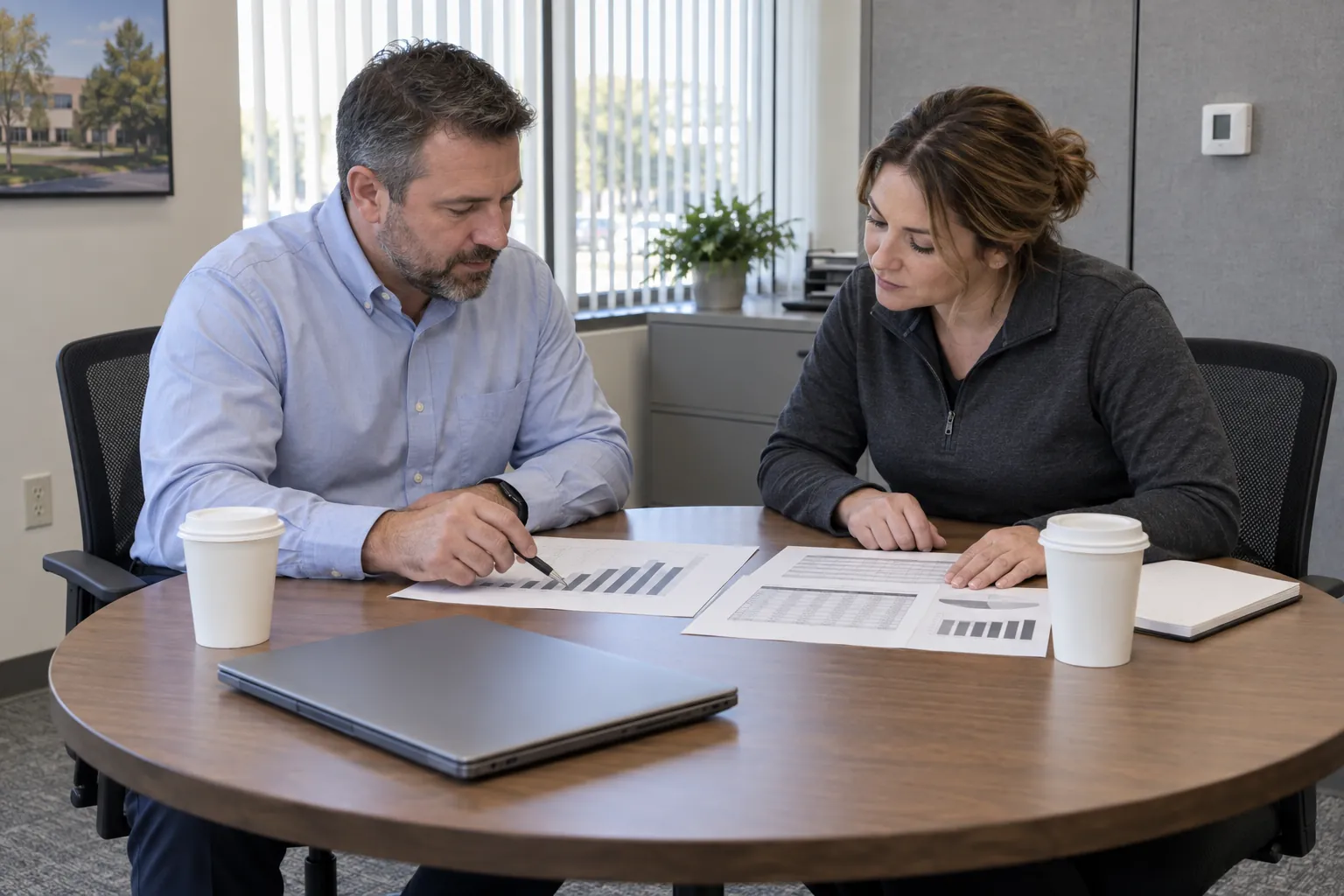
It turns a contract for cleaning services into something both parties can measure. This guide covers what a cleaning service level agreement in the United States should say, how to borrow the measurable approach federal buyers use, and how to show, day by day, that the service was delivered.
01
What a janitorial service level agreement is
A service level agreement (SLA) is the part of a service contract that says what level of service the customer will receive and how it will be measured. In commercial cleaning it usually sits beside two other documents. The janitorial contract holds the legal terms: the term, the price, payment, insurance, indemnity and termination. The scope of work says what is cleaned, where and how often. The SLA says how well, how fast, and how anyone will know.
The same structure works for a building service contractor (BSC) and for an in-house custodial department serving a campus or a school district, where the SLA tells occupants what to expect and gives the custodial manager a fair basis for being judged.
No federal or state law requires a private building to have a cleaning SLA. It is a commercial document, enforceable as part of the contract it is attached to. What the law does require is the outcome the SLA protects. Under OSHA's walking-working surfaces standard, 29 CFR 1910.22, all places of employment, passageways, storerooms, service rooms and walking-working surfaces must be "kept in a clean, orderly, and sanitary condition," and walking-working surfaces kept free of hazards including "leaks, spills, snow, and ice." OSHA's sanitation standard, 29 CFR 1910.141, says "All places of employment shall be kept clean to the extent that the nature of the work allows" and requires lavatories with running water, "Hand soap or similar cleansing agents," and towels or air dryers.
Those duties belong to the employer, and hiring a janitorial company does not hand them over. An SLA is how a building owner, tenant or property manager shows it is managing them, and how the contractor shows it has done its part.
02
What a cleaning SLA should include
Templates vary, and an office tower, a school district and a hospital's environmental services (EVS) department will each need different detail. But a janitorial SLA that works in practice usually covers:
- Parties, buildings and areas: who the contractor and customer are, the address of each building, the floors and square footage covered, and what is included and excluded. Exclusions cause as many disputes as inclusions: floor stripping and refinishing, carpet extraction, high dusting, exterior windows and day porter coverage are common arguments.
- The service in outline: a reference to the current scope of work rather than a copy of it, so the two cannot drift apart.
- Service hours: when the night crew works, when a day porter is on site, and when the contractor must answer a call.
- The level of clean for each area type: lobbies, restrooms, break rooms, offices, conference rooms, stairwells, written so two inspectors would agree.
- Response and resolution times for work orders and reported problems, by priority.
- Key performance indicators: what is measured, the target, the period and the source of the evidence.
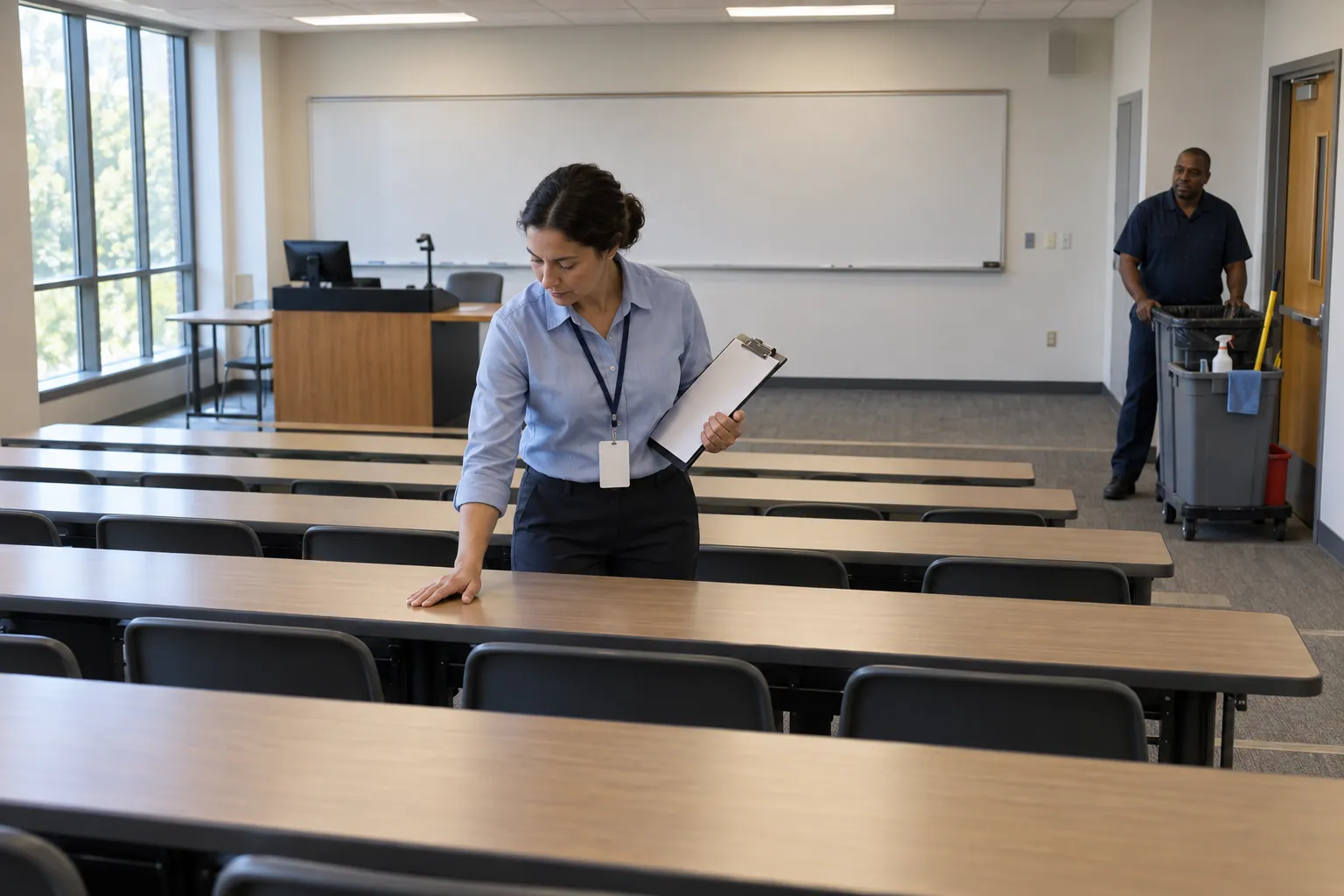
- Inspection: the contractor's own quality control, the customer's right to inspect, and joint inspections.
- Reporting: what the contractor reports, how often and to whom.
- Escalation: the path from the site supervisor to the account manager to a named executive, with a time at each step.
- Remedies: re-performance, a corrective action plan, deductions or service credits if agreed, and the point at which the customer may terminate for cause.
- Customer responsibilities: access, keys and cards, storage for equipment and chemicals, who buys paper and soap, and notice of changes to the building's use.
- Safety and health: the contractor's safety program, chemical information, and how incidents are reported.
- Staffing and supervision: supervision on each shift, background checks where the building needs them, training, and cover for absence.
- Review: how often the SLA is reviewed and how changes are agreed in writing.
Insurance, confidentiality and termination normally belong in the main contract. Keep the SLA to what is measured and managed week to week, so the people running the account actually use it.
03
Setting service levels that can be measured
The most common weakness in a janitorial SLA is a service level nobody can measure: "a high standard of cleanliness," "prompt response." Federal buyers have a useful rule for this. The Federal Acquisition Regulation's Subpart 37.6, Performance-Based Acquisition, asks for work to be described "in terms of the required results rather than either 'how' the work is to be accomplished," and says "The standards shall be measurable and structured to permit an assessment of the contractor's performance." A private SLA can apply the same test to every line.
Levels of clean. Some US contracts borrow APPA's appearance levels to say what is being bought, area by area. APPA's Operational Guidelines for Educational Facilities – Custodial (fourth edition, 2023) describe five: Level 1, Orderly Spotlessness; Level 2, Ordinary Tidiness; Level 3, Casual Inattention; Level 4, Moderate Dinginess; and Level 5, Unkempt Neglect. They were written for campuses, but the vocabulary travels well. An SLA might set Level 2 for the lobby and restrooms and Level 3 for back offices. Naming the level keeps the price honest, because a higher level needs more labor hours.
Response and resolution times. These work best in a few priorities. As an illustration of the shape, not an industry standard:
- Emergency: a spill creating a slip hazard, an overflowing toilet, a restroom out of soap or paper during business hours. Attend within minutes where a day porter is on site, make safe at once, and fix it the same shift.
- Urgent: a visibly missed clean in a public area, such as a lobby, an elevator or a conference room booked for a client meeting. Fixed the same day.
- Routine: a missed item in a low-traffic area or a request for extra work. Fixed on the next scheduled clean or by agreement.
Set numbers the contractor can meet with the crew actually on site. A 15-minute response in a building with no day porter and one night custodian is a promise the SLA has already broken.
Quality and delivery. Quality is usually set as an inspection score against the agreed level: the percentage of inspected items or rooms that pass. Delivery is set as completion: the scheduled cleans, restroom checks and periodic tasks done against those planned. An SLA needs both. One that measures only quality can be met by a crew that cleans half the rooms well; one that measures only delivery can be met by a crew that visits every room and cleans none of them properly.
04
Inspection, surveillance and reporting
Every janitorial SLA rests on evidence, and a good one names its sources. Federal contracts again give a model. The standard clause FAR 52.246-4, Inspection of Services – Fixed-Price, says "The Contractor shall provide and maintain an inspection system acceptable to the Government covering the services under this contract" and that "The Government has the right to inspect and test all services called for by the contract, to the extent practicable at all times and places during the term of the contract." The customer's side is written as a quality assurance surveillance plan (QASP); FAR 46.401 says such plans "should be prepared in conjunction with the preparation of the statement of work" and should identify the work needing surveillance and the method. Most private SLAs can use the same three sources:
- Inspections: the contractor's supervisors inspect a sample of rooms against the agreed level and score them, and the customer inspects too, as part of janitorial quality control. Joint inspections, walked by the property manager and the account manager together, take much of the heat out of disputes.
- Records of work done: check sheets, restroom logs or digital records showing each scheduled task was done, by whom and when.
- Work orders and complaints: every reported problem, with the time it was reported, the time it was fixed, and whether it keeps coming back.
In hospitals the evidence goes further. The CDC's Options for Evaluating Environmental Cleaning encourages hospitals to build programs that optimize high-touch surface cleaning at terminal cleaning, with a checklist and worksheet for objective monitoring.
Some customers also ask how the contractor manages quality across its business. ISSA's Cleaning Industry Management Standard (CIMS) certifies both contractors and in-house departments. It tells you about the contractor's systems, not about your building on a given night, so the SLA still needs its own measures.
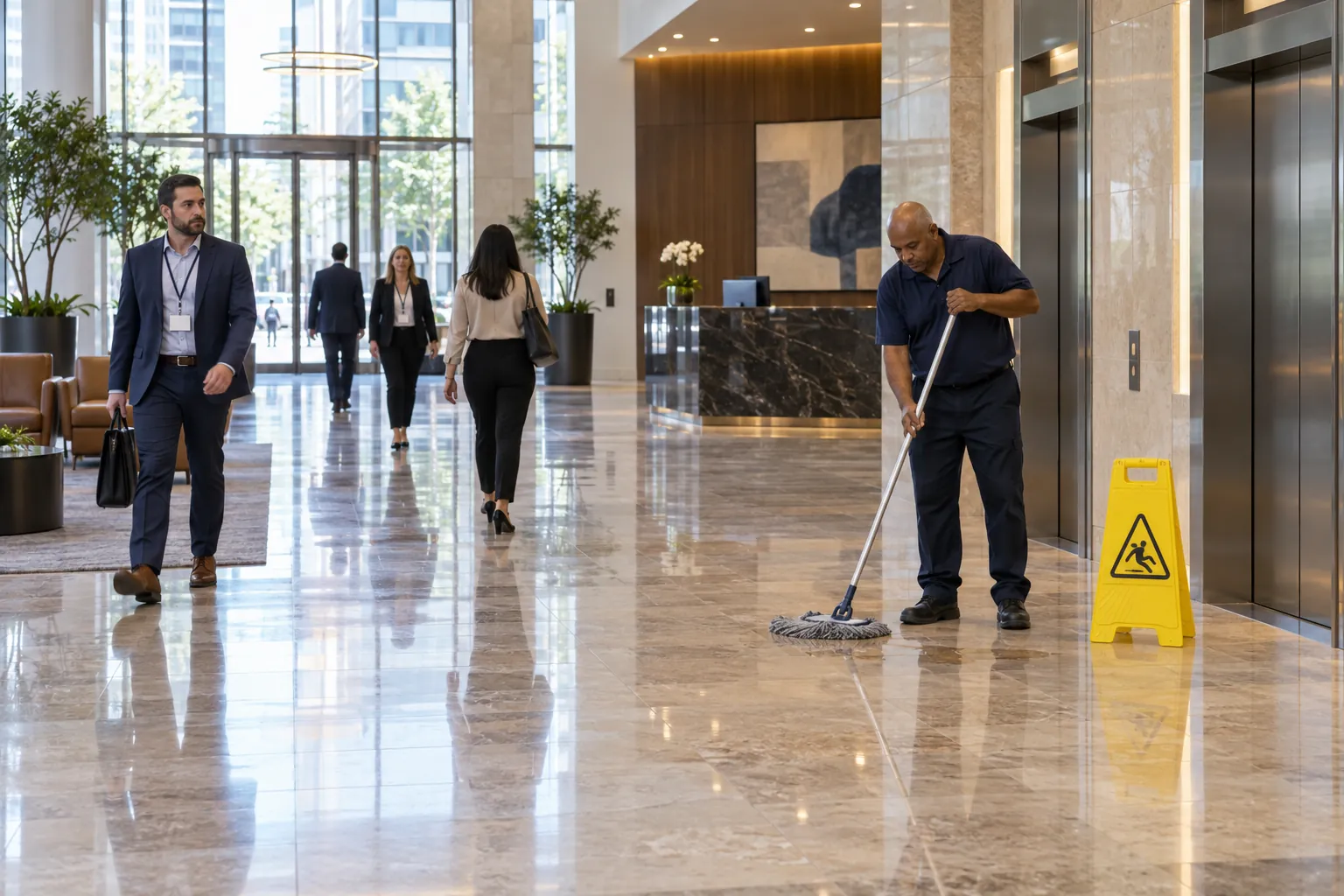
Match reporting to the pace of the account. A monthly report with KPI data, trends and corrective actions, reviewed at a meeting between the property or facility manager and the account manager, is common. Many customers also want something shorter and more often, such as a daily or weekly summary of what was done, what was missed and what is still open, so a problem surfaces before the monthly figures.
Review the SLA itself at least once a year and whenever the building changes, such as a floor going vacant or a tenant building out a fitness center.
05
Deductions, escalation and termination
A useful SLA says plainly what happens when the service falls short. The usual remedies, from mildest to strongest, are:
- Re-performance: the failure is corrected within the agreed time at no extra cost. FAR 52.246-4 takes the same line: where services do not conform, the contractor may be required "to perform the services again in conformity with contract requirements, at no increase in contract amount."
- Escalation: if it is not corrected, or keeps happening, it goes from the site supervisor to the account manager and then to a named executive, each with a time to respond.
- A corrective action plan: agreed actions and dates, reviewed until the KPI recovers.
- Deductions or service credits: a reduction in the monthly invoice when a KPI is missed, usually capped as a percentage of the fee.
- Termination for cause: after written notice and a chance to cure, where KPIs are missed repeatedly over a defined period.
Keep deductions proportionate. Federal policy on liquidated damages is a sensible test even for a private contract: FAR 11.501 says "Liquidated damages are not punitive and are not negative performance incentives," and the rate must be a reasonable forecast of the harm caused. Whether a private deduction clause is enforceable is a question of state contract law, so have an attorney licensed where the building is review it. In practice, credits work best as a signal: a small, certain deduction focuses attention, while a large one mostly produces arguments about whether the KPI was really missed.
Remedies run both ways. If the customer does not provide access, storage or the paper and soap it agreed to buy, the SLA should say that failures caused by it do not count against the contractor.
06
Where SLA evidence fails, and what SiteClara does about it
Most janitorial SLAs are strong on quality evidence and weak on delivery evidence. Inspections happen monthly and are written up; the day-to-day record of what was done is a restroom log taped to the back of the door, initialed for the whole shift in advance, if it exists at all. When a tenant says the fourth-floor restroom had no paper at 10 a.m. on Tuesday, the contractor can describe the schedule but cannot show it, and the first sign of a missed clean is a complaint to the property manager.
The same gap hurts a good contractor. A crew that cleaned every night on schedule has nothing to show for it at the monthly review, and on a rebid the incumbent has only its word.
SiteClara gives each location a printed QR code poster, with an optional NFC tag behind it. Custodians scan or tap it with their own phone, with no app to install, and see the scheduled checks due there. They mark each one done, or say what stopped them, such as a locked room. The time and the named person are recorded as it happens, with a photo when one helps. A problem found on the round, like a leak or an empty dispenser, is reported there and goes on the team's list of jobs until someone closes it.
The supervisor sees what is due, done and missed, and can record why a check was missed. At the end of the day they review it, add a note and approve a daily report that goes to nominated managers or customer contacts the next morning: what was reported, what was completed, what is still open, and how the scheduled checks went, for example 12 of 12 completed. That is the delivery half of the SLA, recorded as it happened rather than assembled for the monthly meeting.
07
Questions people ask
What's included in a service level agreement?
There is no single legal list for a private cleaning SLA, but the federal model is a good checklist. Under FAR Subpart 37.6, Performance-Based Acquisition, a performance-based service contract includes a performance work statement, "Measurable performance standards (i.e., in terms of quality, timeliness, quantity, etc.) and the method of assessing contractor performance against performance standards," and performance incentives where appropriate, which must correspond to those standards. In a janitorial SLA that means the scope, the level of clean and response times, how they are inspected, and the remedies.
How do you write a service level agreement?
Write each service level as a result that can be measured, not as a method. FAR 37.602, Performance work statement, tells federal buyers to "Describe the work in terms of the required results rather than either 'how' the work is to be accomplished or the number of hours to be provided" and to "Enable assessment of work performance against measurable performance standards." For a cleaning SLA, that means stating the level of clean for each area, the response time for each priority, and the evidence that will show whether each was met.
What is the standard format for a service level agreement?
No law sets a format for a private cleaning SLA; the nearest thing to a standard in the United States is the federal pairing of a statement of work with a quality assurance surveillance plan. FAR 46.401, General, says quality assurance surveillance plans "should be prepared in conjunction with the preparation of the statement of work" and should specify all work requiring surveillance and the method of surveillance. A private SLA can follow the same shape: what is to be done and to what standard, then how it will be checked.
08
Further reading, and a checklist to take away
For the levels of clean, read APPA's custodial operational guidelines. For writing measurable standards and an inspection system, the federal model is short and free: FAR Subpart 37.6, FAR 46.401 and FAR 52.246-4. For the underlying duties, read OSHA's walking-working surfaces and sanitation standards, or your state plan's versions. In a hospital, add the CDC's Options for Evaluating Environmental Cleaning. For the contract terms, take advice from an attorney licensed in the state; an SLA is only as enforceable as the contract it sits in.
Before you sign or renew a janitorial service level agreement, check that:
- it refers to the current scope of work and names what is excluded;
- each area type has a stated level of clean, such as an APPA level;
- every service level says what is measured, the target, the period and the evidence;
- it measures delivery as well as quality;
- response and resolution times are set by priority and can be met with the crew on site;
- both the contractor's inspections and the customer's right to inspect are written in;
- the escalation path names people and times;
- deductions, if any, are proportionate, capped and reviewed by an attorney;
- the customer's own responsibilities are written down;
- reporting is frequent enough to catch a problem before the monthly review;
- there is a date for the next review.
Sources
Every document this guide quotes or links to, in the order it first cites them.
- 29 CFR 1910.22 osha.gov
- Sanitation standard, 29 CFR 1910.141 osha.gov
- 22 approved State Plans osha.gov
- Subpart 37.6, Performance-Based Acquisition acquisition.gov
- Operational Guidelines for Educational Facilities – Custodial appa.org
- FAR 52.246-4, Inspection of Services – Fixed-Price acquisition.gov
- FAR 46.401 acquisition.gov
- Options for Evaluating Environmental Cleaning cdc.gov
- Cleaning Industry Management Standard (CIMS) cims.issa.com
- FAR 11.501 acquisition.gov
Related guides
 CleaningThe janitorial contract: what a commercial cleaning agreement should sayWhat a US commercial cleaning contract should cover, the state laws that reach into it, and how to write scope, inspection, renewal and exit terms that hold up.
 CleaningJanitorial scope of work: what it should say, and how to show it is metWhat a janitorial scope of work should cover, how to set cleaning frequencies by room type, output versus input standards, and how to show the work is being done.
 CleaningJanitorial KPIs: what to measure, and how to know the numbers are trueThe janitorial KPIs worth tracking, how to define and target them, how federal contracts measure cleaning, and how KPIs look green while the building is not clean.
 CleaningJanitorial quality control: how to inspect, score and fix the cleaningHow janitorial quality control works: QA versus QC, building a cleaning inspection checklist, APPA appearance levels, sampling, scoring and corrective action.