Fire and water checks
Fire drill requirements: frequency, running the drill, and the fire drill log
A fire drill log is the written record of every emergency evacuation drill and every unplanned evacuation in a building, and under Section 405.5 of the International Fire Code it must show who conducted the drill, the date and time, how occupants were notified, which staff took part, how many occupants were evacuated, the conditions simulated, the problems encountered, the weather and the time needed to evacuate completely.

A fire drill is the one time a building finds out whether its evacuation plan works with real people in it: whether the alarm is heard, whether the stairs are clear, whether anyone checks the restrooms, and whether everyone is counted at the assembly point. In the United States the drill is usually required by the locally adopted fire code rather than by OSHA, and the fire code also sets how often it must happen. This guide covers who requires drills, how often, how to run one that tests something, and how to keep a fire drill log that stands up to the fire marshal.
01
Who requires fire drills: the fire code, not OSHA
Most people assume fire drills are an OSHA rule. They are not, or not directly. 29 CFR 1910.38, Emergency action plans requires a written plan when another OSHA standard calls for one, with procedures for reporting emergencies, evacuating, and accounting for employees afterward, an employee alarm system, and trained people to help with evacuation. It does not mention drills. OSHA's Evacuation Plans and Procedures eTool recommends them: "Drills should be conducted as often as necessary to keep employees prepared," and "After each drill, gather management and employees to evaluate the effectiveness of the drill."
The binding drill requirements come from the fire code your state or city has adopted, enforced by the fire marshal or fire code official, the authority having jurisdiction (AHJ). Two model codes supply most of the text:
- The International Fire Code (IFC), Section 405, Emergency Evacuation Drills, adopted in many states, often under a state name such as the Virginia Statewide Fire Prevention Code or the Minnesota State Fire Code, and often with local amendments.
- NFPA 101, Life Safety Code, whose general drill rules sit in section 4.7 and whose occupancy chapters (11 through 42) say which buildings must drill and how often. NFPA 1, Fire Code, carries the same drill rules in its Chapter 10 for jurisdictions that adopt NFPA 1 instead of the IFC.
Neither model code applies until a jurisdiction adopts it. Maryland, for example, adopts NFPA 101 (2024 edition) with amendments under COMAR 29.06.01.07, including its own drill counts for schools. So ask the fire prevention bureau which code, edition and local amendments apply to your building.
NFPA's own summary of the purpose is the best short answer to why the drill matters: "The purpose of emergency egress and relocation drills is to educate the participants in the fire safety features of the building, the egress facilities available, and the procedures to be followed. Speed in emptying buildings or relocating occupants, while desirable, is not the only objective." That is from NFPA's article Emergency Egress and Relocation Drills, which explains the NFPA 1 requirements.
02
How often: fire drill frequency by occupancy
Frequency is set by occupancy group, which is how the building code classifies what a building is used for. The IFC's Table 405.2 is the usual starting point. The New Jersey edition of the 2006 IFC, Section 405 and Table 405.2, published by the New Jersey Department of Community Affairs, shows the shape of it:
- Group A (assembly, such as theaters, restaurants and churches): quarterly, employees.
- Group B (business, such as offices): annually, employees, but only in buildings with an occupant load of 500 or more, or more than 100 people above or below the lowest level of exit discharge.
- Group E (schools): monthly, all occupants.
- Group I (institutional, such as hospitals, nursing homes and day care): monthly, so that each shift drills at least quarterly.
- Group R-1 (hotels and motels): quarterly on each shift, employees.
- Group R-2 college and university buildings: four a year, all occupants.
- High-rise buildings: annually, all occupants.
Section 405.2 adds that drills must be held at those intervals "or more frequently where necessary to familiarize all occupants with the drill procedure." The table is a floor, not a target.
Later editions and state versions change the details. Fairfax County's fire marshal, enforcing the Virginia Statewide Fire Prevention Code, Section 405, as set out on its Emergency Planning and Preparedness page, lists quarterly drills for assembly occupancies, monthly for schools, quarterly on each shift for hospitals (Group I-2) and for hotels (R-1), and four a year for R-2 buildings.
Big cities often write their own. Chapter 4 of the New York City Fire Code, as posted by the FDNY, sets drills in Table 401.7.6, including semiannual drills for all occupants of Group B office buildings that must have a comprehensive fire safety and emergency action plan, and quarterly drills "in the 2 years following acceptance" of that plan. The posted chapter predates the 2022 New York City Fire Code, which the FDNY says "took effect on April 15, 2022", so check the current chapter before relying on a figure.
High-rise buildings are the case facility managers ask about most. The Seattle Fire Department's Client Assistance Memo 5963, High Rise Emergency Evacuation Drills (updated October 2014) says drills are required annually under Section 405 of the Seattle Fire Code, and that "as long as all occupants of the building experience an emergency evacuation drill annually, the conducting of drills on selected floors in the building can occur on a staggered schedule." It is candid about why: "Total evacuation of a high rise building is not practical, and could even be dangerous."
03
Planning and running a fire drill that tests something
The IFC's operating rules for drills are short, and each one closes a common gap. From Section 405 in the New Jersey edition:
- Leadership (405.3): "Responsibility for the planning and conduct of drills shall be assigned to competent persons designated to exercise leadership." Name the person, and a deputy for the shifts they do not work.
- Time (405.4): "Drills shall be held at unexpected times and under varying conditions to simulate the unusual conditions that occur in case of fire."
- Notification (405.6): where the fire code official requires it, they must be told in advance. Fairfax County does: "Prior notification of the emergency evacuation drill is required."
- Initiation (405.7): "Where a fire alarm system is provided, emergency evacuation drills shall be initiated by activating the fire alarm system."
- Accountability (405.8): at the assembly point, "efforts shall be made to determine if all occupants have been successfully evacuated or have been accounted for."
- Recall and reentry (405.9): the recall signal must be distinct from the evacuation signal, manually operated by the person in charge, and "No one shall reenter the premises until authorized to do so by the official in charge."
Varying conditions means more than a different day of the week. The Minnesota Department of Health's guidance for health care facilities, Fire Drills (revised June 2024), recommends drawing up the year's drill schedule in advance and checking the previous year's times, so that no pattern is detectable in the same month or shift. Change the simulated fire location, block a stairwell with a sign, and hold one on the night shift.
Before the alarm sounds:
- Tell the fire alarm monitoring company that a drill is starting, so the fire department is not dispatched. Seattle's memo says to call them "immediately prior to the drill" and again when the building is back to normal. Minnesota's guidance adds that the monitoring company's receipt of the signal should be written on the drill report.
- Notify the fire code official where your jurisdiction requires it.
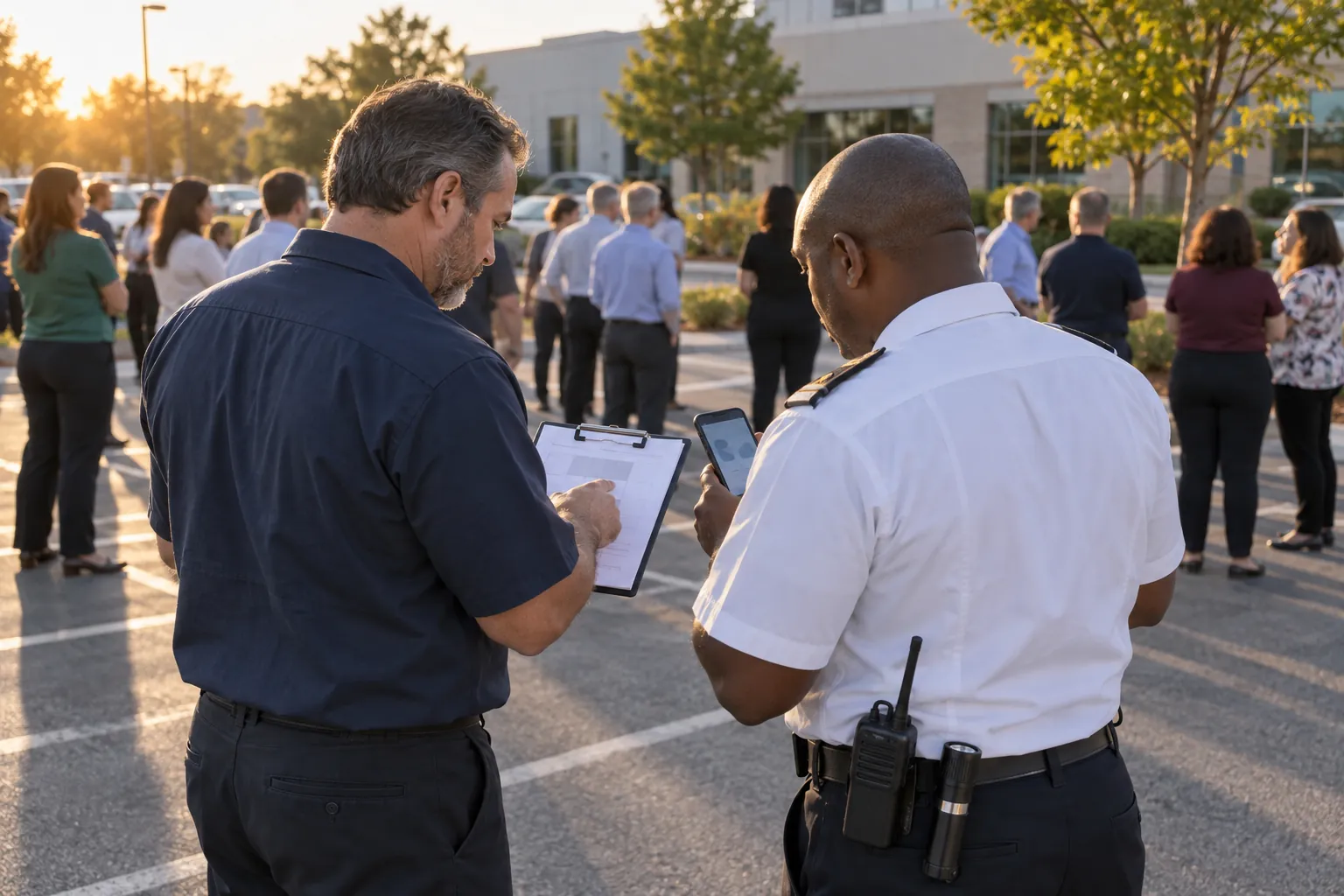
- Brief the observers: who stands at which stairwell, who times the evacuation, and who watches the assembly point.
- Decide in advance how people who need help to evacuate will be assisted, and practice it rather than excusing them.
- Agree how the all clear is given, and by whom.
During the drill, the people doing the building's routine work are often the ones who find the problems. A custodian sweeping the restrooms, a security officer keeping people away from the elevators and a building engineer at the fire alarm panel all see things the floor wardens miss. Ask for their observations afterward.
The emphasis is order, not a record time. NFPA's article puts it plainly: "Emphasis should be placed on drills being orderly rather than focusing on the speed of the evacuation."
04
The fire drill log: what the record must show
The fire code does not just require drills; it requires proof of them. IFC Section 405.5, Record keeping, in the New Jersey edition, says records "shall be maintained of required emergency evacuation drills and unplanned evacuation" and lists what they must include:
- Identity of the person conducting the drill.
- Date and time of the drill.
- Notification method used.
- Staff members on duty and participating.
- Number of occupants evacuated.
- Special conditions simulated.
- Problems encountered.
- Weather conditions when occupants were evacuated.
- Time required to accomplish complete evacuation.
A fire drill log sheet or template, printed or electronic, works best with a field for each of those nine items plus the corrective actions, and one entry per drill, so that the monthly drills a school holds sit in the same format as a high-rise building's annual one.
Note the words "and unplanned evacuation": a false alarm or a real evacuation belongs in the same log. Seattle's memo recommends a nine-point record in almost the same words, including two useful additions: "Problems encountered and corrective actions taken," and the time to complete "evacuation, lockdown, or shelter-in-place."
NFPA's summary of the drill rules says the same in general terms: "A written record of each drill is to be completed by the person responsible for conducting the drill and maintained in an approved manner," including "date, time, participants, location and results of the drill." "Approved" means approved by the AHJ, which is why the format matters in some cities. New York City's Chapter 4 requires drills to be "documented by entries in the logbook" and says the log may be "a bound log book with consecutive numbered pages, an approved electronic format, or other approved form of recordkeeping."
Retention is often not stated in the code. Minnesota's health care guidance recommends that "these records be maintained for at least three years" and that "at least two people in your facility know where your drill records are kept." Ask your fire marshal what they expect to see at an inspection, and keep the log for at least as long.
05
After the drill: the critique, the fixes, and the checks in between
A drill that is logged and forgotten has done half its job. Seattle's memo says: "After each drill evaluate the fire and life safety systems, staff performance, tenant participation and make changes as necessary to improve future events." Its suggested evaluation questions work for most buildings:
- Could building occupants clearly hear and understand the alarm and any additional instructions?
- Was the evacuation completed in an orderly and expedient manner?
- Did floor wardens guide occupants to safety, complete floor checks and report to building staff or the fire safety director?
- Did individuals requiring assistance to exit receive the assistance they need?
- Were elevators avoided by occupants during evacuation?
Turn each problem into a job with an owner and a date: the horn nobody heard in the back office goes to the fire alarm contractor, the stuck stairwell door to the building engineer. Then record when each was closed. The next drill should show whether the fixes worked.
Training sits alongside drills. The same IFC chapter, Section 406.2 in the New Jersey edition, says employees "shall receive training in the contents of fire safety and evacuation plans and their duties as part of new employee orientation and at least annually thereafter," with records "kept and made available to the fire code official upon request." Include contract custodial and security staff who work nights or weekends.
Between drills, the conditions the drill depends on have to stay true:
- exit routes, corridors and stairwells clear of storage, carts and deliveries;
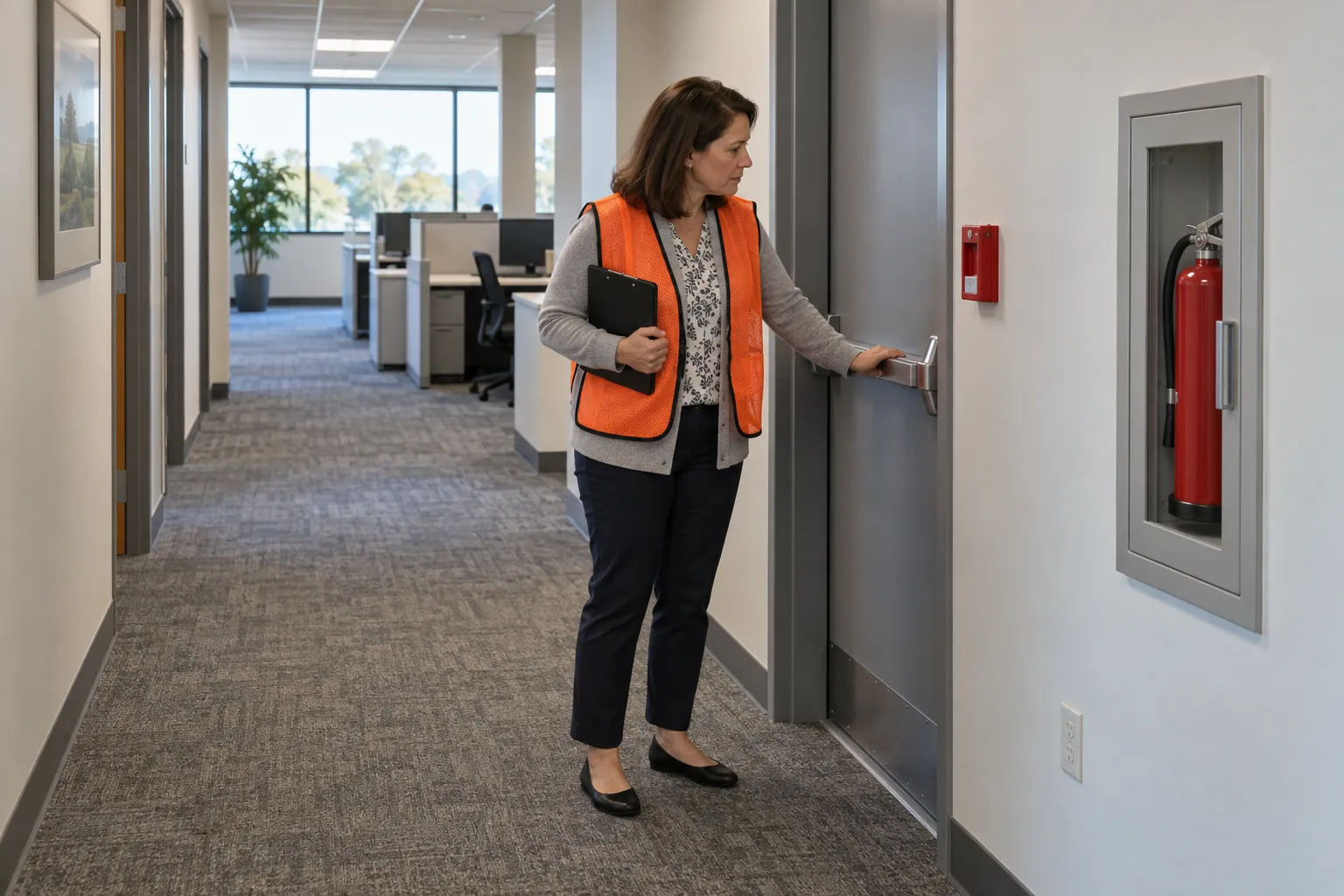
- exit doors opening freely, with no chains or wedges, and exit signs lit;
- manual pull stations unobstructed and fire extinguishers in place;
- evacuation diagrams posted and matching the floor as it is now;
- the assembly area usable and not fenced off, parked over or under construction;
- the warden list current for every floor and shift.
06
Where the record fails, and what SiteClara does about it
Fire drill logs rarely fail on the day of the drill. They fail in the gaps around it: the drill that is written up a week later from memory, with the evacuation time rounded and the problems left blank; the stuck stairwell door noted on a scrap of paper and never reported to anyone who could fix it; the night-shift drill that was planned, missed and never rescheduled; the routine exit checks between drills signed off in advance on a sheet on the back of the door. Asked what happened after the last drill, the building has a date and a signature.
SiteClara puts a printed QR poster at each place a check is due, such as an exit door, a stairwell landing, the fire alarm panel or the assembly area, with an optional NFC tag behind it. Staff scan the code or tap the tag on their own phone, with no app to install, and sign in with a link. They see the checks due there, such as a weekly exit route walk, and mark each one done or say what stopped them. A problem found in a drill or on a round, such as a door that sticks, a blocked stairwell or a missing evacuation diagram, is reported there with a photo and goes onto the team's list of jobs until someone closes it.
The supervisor sees what is due, done and missed at each location, and can record why a check was missed; a job that needs the building manager can be escalated to them to answer. Each day the supervisor reviews and approves a report that goes to nominated management or client contacts at 8 a.m. the next morning, showing what was reported, completed and still open, and how the scheduled checks went.
07
Questions people ask
What is a fire drill log?
A fire drill log is the record the fire code requires of each emergency evacuation drill. Section 405.5 of the International Fire Code, New Jersey edition, says records "shall be maintained of required emergency evacuation drills and unplanned evacuation," so a false alarm or a real evacuation goes in the same log as a planned drill.
What must be included on a fire drill log?
IFC Section 405.5 in the New Jersey edition lists nine items: the identity of the person conducting the drill, the date and time, the notification method used, the staff members on duty and participating, the number of occupants evacuated, the special conditions simulated, the problems encountered, the weather conditions when occupants were evacuated, and the time required to accomplish complete evacuation. The same items apply whether the building drills monthly, as schools do under Table 405.2, or annually.
What are the key steps in a fire drill checklist?
The steps come from IFC Section 405 in the New Jersey edition: assign a competent person to plan and conduct the drill (405.3), hold it "at unexpected times and under varying conditions" (405.4), notify the fire code official in advance where required (405.6), start it by activating the fire alarm system where there is one (405.7), account for occupants at the assembly point (405.8), and let no one reenter "until authorized to do so by the official in charge" (405.9). Then log it under 405.5.
What does OSHA say about fire drills?
29 CFR 1910.38, Emergency action plans does not mention drills. It requires procedures for emergency evacuation and "to account for all employees after evacuation," and employees designated and trained "to assist in a safe and orderly evacuation of other employees." OSHA's Evacuation Plans and Procedures eTool recommends that "Drills should be conducted as often as necessary to keep employees prepared," and that management and employees evaluate the drill afterward. The required frequency comes from the fire code your jurisdiction has adopted.
How do you write a fire drill report?
Record the nine points the fire code lists, then the critique. The Seattle Fire Department's Client Assistance Memo 5963, High Rise Emergency Evacuation Drills lists "Problems encountered and corrective actions taken" in its own nine-point record and says: "After each drill evaluate the fire and life safety systems, staff performance, tenant participation and make changes as necessary to improve future events." It also suggests asking building staff and tenants for their input on the evacuation process and drill coordination.
08
Where to read more, and a list to take away
Start with the fire code your jurisdiction has adopted, and the fire marshal's own guidance: many publish plain-language pages like Fairfax County's Emergency Planning and Preparedness page or Seattle's CAM 5963. For the OSHA side, read 29 CFR 1910.38 and OSHA's Evacuation Plans and Procedures eTool. In New York City, read the current New York City Fire Code, Chapter 4.
Before you sign off the drill program for a building, check that:
- you know which fire code and edition apply, and the drill frequency for the building's occupancy group;
- a competent person is named to plan and conduct drills, with cover for every shift;
- drills are scheduled at unexpected times and varied conditions, including night and weekend shifts where people work them;
- the monitoring company, and the fire code official where required, are notified before each drill;
- each drill is started with the fire alarm, where there is one;
- occupants are accounted for at the assembly point, and reentry waits for the person in charge;
- every drill and every unplanned evacuation is logged with the nine items the IFC lists, plus corrective actions;
- problems found are assigned, fixed and closed, with dates;
- employees, including contract staff, are trained at orientation and at least annually;
- exits, pull stations, diagrams and the assembly area are checked between drills, with the checks recorded as they are done.
Sources
Every document this guide quotes or links to, in the order it first cites them.
- 29 CFR 1910.38, Emergency action plans osha.gov
- Evacuation Plans and Procedures eTool osha.gov
- NFPA 101 (2024 edition) with amendments under COMAR 29.06.01.07 regs.maryland.gov
- Emergency Egress and Relocation Drills nfpa.org
- New Jersey edition of the 2006 IFC, Section 405 and Table 405.2 nj.gov
- Virginia Statewide Fire Prevention Code, Section 405, as set out on its Emergency Planning and Preparedness page fairfaxcounty.gov
- Chapter 4 of the New York City Fire Code, as posted by the FDNY nyc.gov
- 2022 New York City Fire Code nyc.gov
- Client Assistance Memo 5963, High Rise Emergency Evacuation Drills seattle.gov
- Fire Drills (revised June 2024) health.mn.gov
Related guides
 Fire and water checksEmergency action plan: what OSHA requires, and how to keep the plan workingWhat an emergency action plan must contain under OSHA 1910.38, who needs one, how alarms, wardens, drills and reviews fit in, and what the record should show.
 Fire and water checksFire warden duties: the floor checks, the evacuation, and the recordWhat a fire warden does in a US workplace: the OSHA rule behind the role, daily floor checks, the job in an evacuation, training, drills and a record that holds up.
 Fire and water checksFire alarm testing: who does what, and what the record should showFire alarm testing in the US: what NFPA 72 and OSHA ask of the owner, what gets tested, how to run a test day, and what the building's own record should show.
 Fire and water checksHospital fire drills: every shift, every quarter, and a record that shows itWhat CMS and the Life Safety Code require of hospital fire drills, quarterly on each shift with the alarm and night drills, and how to critique and record each one.