Fire and water checks
Fire alarm testing: who does what, and what the record should show
Fire alarm testing is the regular inspection and operation of each part of a building's fire alarm system, from every smoke detector and pull station to the horns, strobes, control panel and backup battery, to prove it will give early warning of a fire; in most American commercial buildings a fire alarm contractor does it, device by device, on a schedule set by NFPA 72 and the local fire code.
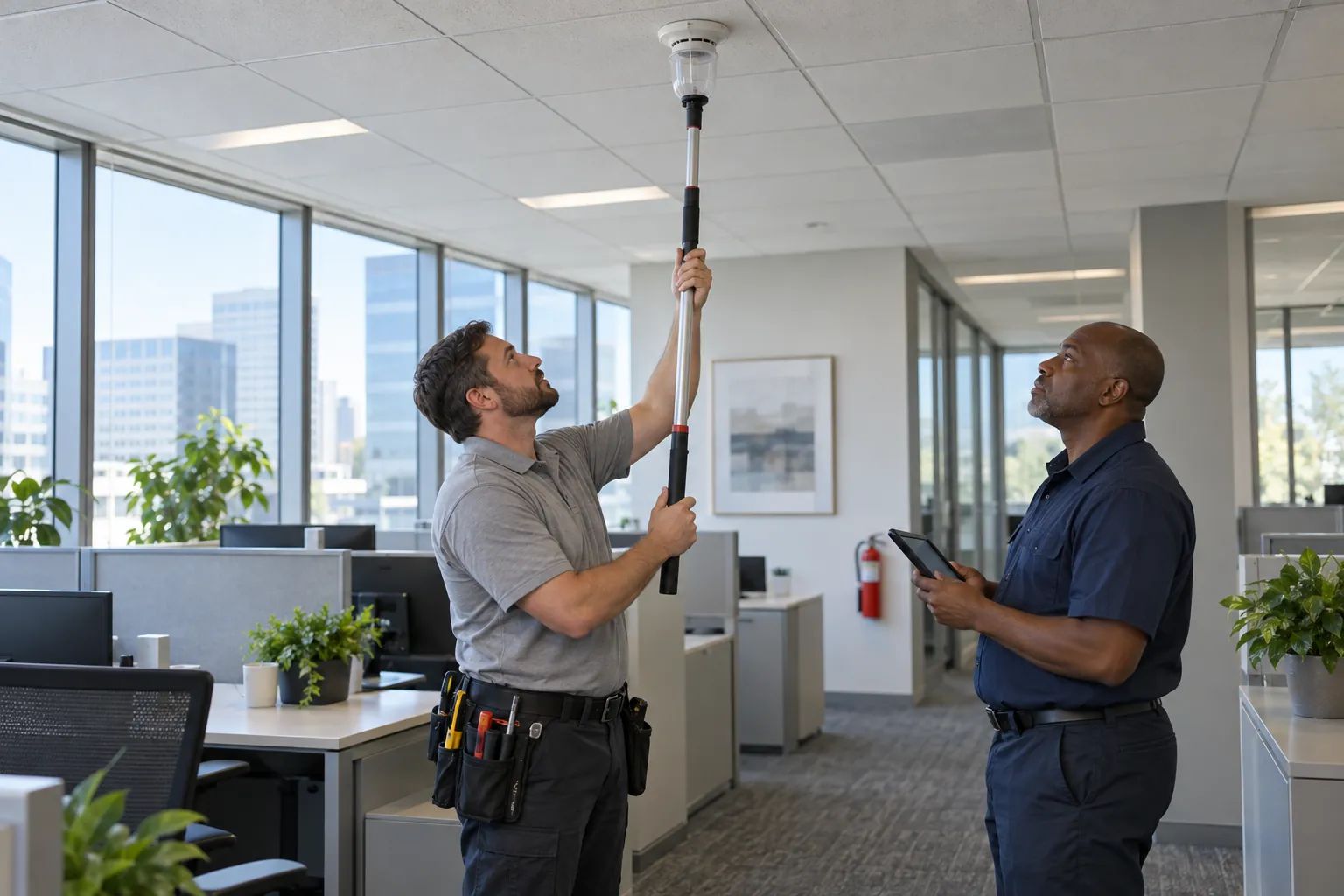
What happens between those visits is the building's job: noticing a trouble signal at the panel, keeping pull stations clear, telling the monitoring company before anyone touches a device, and getting deficiencies fixed. This guide covers where the duty comes from, what gets tested and how often, how to run a test day, and what the building's own record should show.
01
The rules: NFPA 72, your fire code and OSHA
The technical rulebook for fire alarm testing in the United States is NFPA 72, National Fire Alarm and Signaling Code, published by the National Fire Protection Association; the 2025 edition is the latest. NFPA describes it as a design standard: it does not decide whether your building needs a fire alarm system, which is the job of the building and fire codes, but it says how the system must work and, in the words of NFPA's article Which Codes and Standards Cover Fire Alarms?, it "also covers the required inspection, testing, and maintenance of a fire alarm system throughout its lifespan." Inspection, testing and maintenance, usually shortened to ITM, is Chapter 14.
NFPA 72 is a standard, not a law, until a jurisdiction adopts it. The same article explains the usual route: the International Fire Code and the International Building Code both cover fire alarms in Section 907 and reference NFPA 72, and NFPA 1, Fire Code, does the same in Section 13.7. It also warns that jurisdictions reference different editions and often amend them. The fire marshal or fire code official who enforces your code is the authority having jurisdiction (AHJ), and the edition of NFPA 72 that applies to your building is the one your AHJ enforces.
The duty itself sits with the owner. An NFPA Journal column, Fire alarm system roles and responsibilities, quotes Chapter 14 of the 2019 edition: the "property or building or system owner or the owner's designated representative shall be responsible for inspection, testing, and maintenance of the system and for alterations or additions to this system." It adds that the code allows the work to be delegated to qualified service personnel, "but it remains the owner's responsibility to ensure the system is maintained in a reliable condition."
02
What a fire alarm test covers
A fire alarm test is not one test. NFPA's A Guide to Fire Alarm Basics breaks a system into parts, and a full test exercises each of them:
- The fire alarm control unit, the panel, which NFPA calls "the brain of the fire alarm system." It shows three conditions: alarm (an immediate threat), supervisory (a problem with a monitored system, such as a closed sprinkler valve) and trouble (a fault in the fire alarm system itself, such as a broken circuit).
- Initiating devices: smoke detectors, heat detectors, manual pull stations, waterflow switches and pressure switches.
- Supervisory devices: valve tamper switches on the sprinkler system, low-temperature switches in valve rooms, and the fire pump controller. NFPA's guide to supervision notes that water-filled sprinkler piping must be kept above 40 °F (4 °C), which is why a low-temperature signal matters.
- Notification appliances: horns, speakers and strobes, which must be heard and seen where people are.
- Power: the primary supply and the secondary supply, usually batteries. NFPA's guide to power supplies says batteries must run the whole system for 24 hours in standby and then 5 minutes in alarm, or 15 minutes for an emergency voice alarm communication system.
- Emergency control functions: elevator recall, door releases, smoke control and anything else the panel operates.
- Off-premises signaling: the signal to the supervising station, which should arrive as the right kind of signal from the right place.
Waterflow switches deserve a word, because they sit on the sprinkler system but report to the fire alarm. The Texas State Fire Marshal's Office, in its SFMO frequently asked questions, says that removing the cover of a flow switch and manipulating the contacts "is not an acceptable way to test the waterflow switch"; NFPA requires water to flow through the inspector's test valve. In Texas a fire alarm technician who is not with a registered sprinkler firm cannot operate that valve, so the owner operates it or the two contractors test together. The sprinkler side is covered in the fire sprinkler inspection guide.
03
How often, and how much of the system
NFPA 72 sets inspection and test frequencies and methods component by component, in tables in Chapter 14. They can differ between editions, which is one more reason the edition your AHJ enforces matters. The Report of Inspection, Testing & Maintenance used by Portland Fire & Rescue in Oregon gives a sense of the range: its Fire Alarm System – Testing and Maintenance Report asks the contractor to record the service type as weekly, monthly, quarterly, semiannual or annual.
The practical answer is to ask your fire alarm contractor for the inspection and testing program for your system, by component, under the edition your AHJ enforces, and keep it with the records. Then check each visit against it. Two points trip buildings up:
- An annual test means every device. The Texas SFMO FAQ answers the question directly: "An annual inspection would include 100% of the devices." The 10% figure people sometimes quote applies to reacceptance testing after additions or modifications, not to the annual test. (The FAQ cites the 2007 edition's section numbers; the principle is the same in later editions, but check yours.)
- Smoke detector sensitivity is a separate test on its own schedule. The Portland form asks whether sensitivity testing records "are available and maintained using a proper testing schedule", and whether testing was done during the visit where the records were incomplete.
04
Who does which part: the owner, the contractor, the monitoring company and the building staff
The owner, or a designated representative such as a property management company or a facility manager named in a lease or management contract, carries the duty and the records.
The fire alarm contractor does the testing. OSHA's 1910.165(d)(5) requires that servicing, maintenance and testing "are done by persons trained in the designed operation and functions necessary for reliable and safe operation of the system." Licensing is set by the state. In Texas, for example, the State Fire Marshal's Office registers fire alarm firms and licenses their technicians under Texas Insurance Code Chapter 6002, and its FAQ says an out-of-state fire alarm contractor needs a valid Texas Alarm Certificate of Registration, with limited exceptions under Texas Insurance Code 6002.155. Check your own state's rules before hiring.
The monitoring company may or may not be part of testing. NFPA's article on off-premises signaling and supervising stations distinguishes central station service, which is listed to UL 827 and "provides several other services including record keeping and reporting, testing services, and runner service," from a remote supervising station, whose contracts "are typically limited to the monitoring and recording of signals." With remote service, inspection, testing and maintenance remain the owner's to arrange. Know which you have.
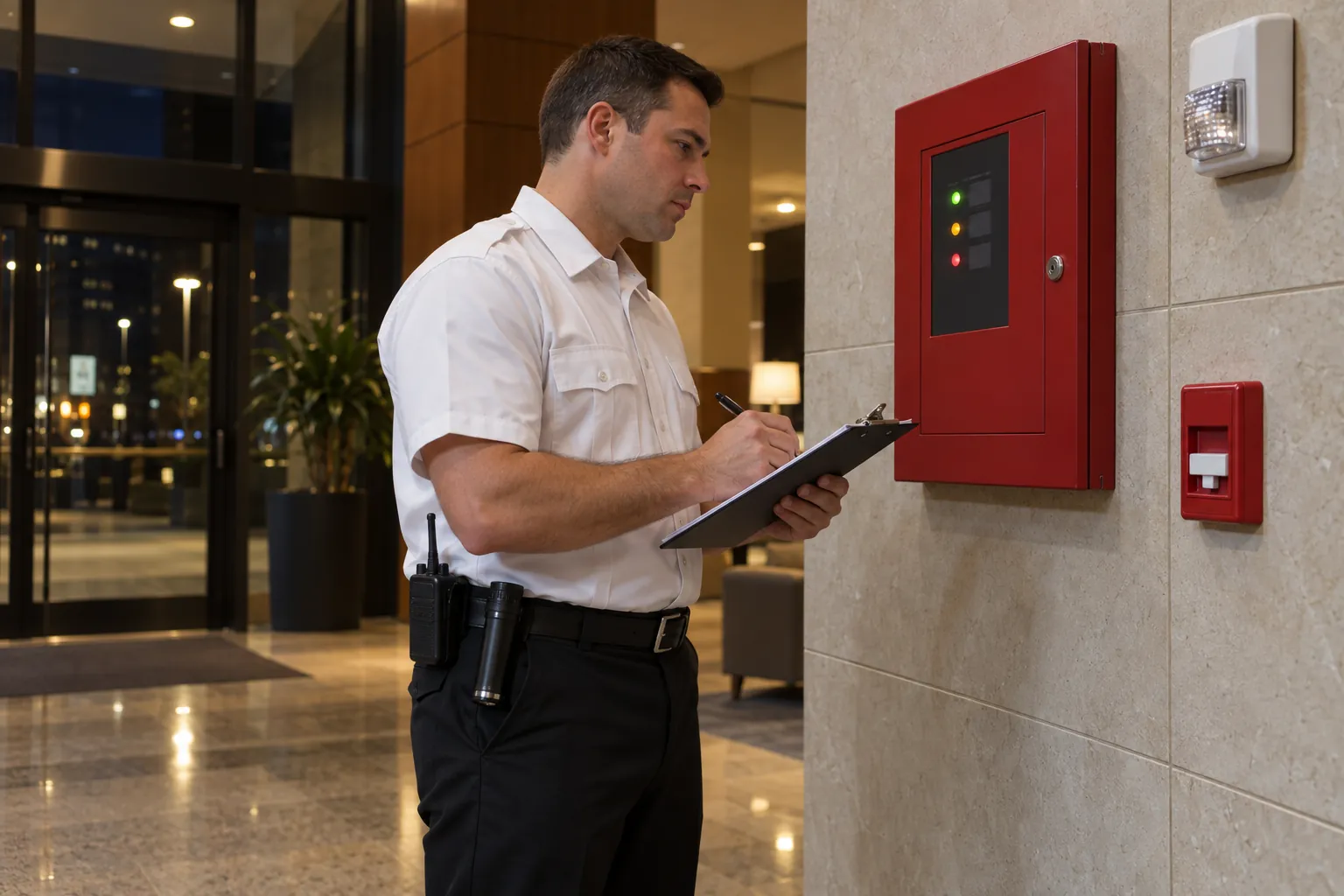
The building staff, often the chief engineer, a building engineer or the security officers at the lobby desk, see the panel every day. A sensible in-house routine:
- Look at the panel at the start of each shift and record whether it shows normal, or what trouble or supervisory signal it shows.
- Report every trouble and supervisory signal to the contractor, with the time and the panel's description, and record who was called. The trouble signals guide goes into what each one means.
- Keep devices clear: pull stations unobstructed, detectors not covered or painted during a renovation, strobes not hidden behind new signs or partitions.
- Record false alarms and their causes, so the contractor can spot a detector or an area that keeps setting the system off.
05
Running a test day, and what the record should show
Portland's form is a good model for what a well-run test looks like from the owner's side, because it asks the owner to answer for it. A test day that would satisfy it:
- Give the contractor what they need first. The form says "It is the owner's responsibility to provide all required information to the service provider prior to the service/testing": contacts, tenants, and anything that has changed.
- Tell people before testing. The form records the time and the name of whoever was notified at the monitoring agency and building management, and also covers the building occupants.
- Report changes to the building. It asks whether tenants, occupancy types and hazards are the same as last time, and whether walls or partitions were added or removed. A new wall can put a room out of reach of a strobe.
- Have someone there throughout. It asks whether the owner's representative was on site "during the entirety of the alarm test", which also means someone can open every locked room.
- Test the interconnections. It asks whether the report covers all interconnected devices, "duct detectors, elevator recall functions, door interlocks, smoke control systems, etc."
- Put the system back. Confirm with the monitoring company that the building is back online and that the test signals arrived as they should.
- Review the deficiencies. The owner's representative "is also required to review all deficiencies found by the service provider upon completion of the service or testing," and the next report asks whether they were all corrected.
Keep the reports. The Portland form states that "Reports of fire alarm testing and maintenance must be kept on site for a minimum of three years"; your jurisdiction may say more or less, so ask. Keep the record drawings, the certificate of completion and the manuals where the next contractor can find them. In Texas, the contractor's service label on the panel must stay in place for at least two years, and a yellow label marks a system with a noncompliant issue, which the SFMO FAQ says can include a "lack of required testing or maintenance of the system."
Between visits, the building's own record should show each day's panel status, every trouble or supervisory signal with the time it was reported and the time it cleared, each time the system was placed on test with the monitoring company, false alarms and their causes, and each deficiency with the date it was fixed.
06
Where the record fails, and what SiteClara does about it
The contractor's annual report is usually thorough. The weak part is everything around it. The trouble light that glowed for three weeks because each shift assumed the last one had called it in. The pull station behind a stack of chairs in the multipurpose room. The deficiency list from March still open in November because nobody owned it. And in a portfolio of buildings, a regional facility manager has no way of knowing which sites looked at their panel this week without calling around.
SiteClara records the in-house checks where they happen. A printed QR poster, with an optional NFC tag behind it, sits at each place a check is scheduled, such as the fire alarm control panel, the riser room or a floor's pull stations. Building staff scan the code or tap the tag on their own phone, with no app to install, see the checks due there, such as the start-of-shift panel check, and mark each one done or say what stopped them, such as a locked panel room. The time and the named person are recorded as it happens, with a photo when one is asked for, for example of the panel display. A problem, such as a trouble signal, a blocked pull station or a strobe covered by a new sign, is reported there with a photo and goes onto the team's list of jobs until someone closes it.
The supervisor sees what is due, done and missed across the building or portfolio, and can record the reason a check was missed. A job that needs the building manager can be escalated to them to answer. Each day the supervisor reviews and approves a report that goes to nominated management or client contacts at 8 a.m. the next morning, showing what was reported, completed and still open, and how the scheduled checks went, for example 12 of 12 completed.
07
Questions people ask
How do you test a fire alarm?
A fire alarm is tested device by device, by trained people, and the annual test covers every device. The Texas State Fire Marshal's Office, in its SFMO frequently asked questions, says that "An annual inspection would include 100% of the devices," and that a waterflow switch is tested by flowing water through the inspector's test valve, not by removing its cover and manipulating the contacts. Where OSHA's 29 CFR 1910.165, Employee alarm systems applies, a non-supervised system is tested every two months with "a different actuation device" each time, a supervised system is tested "at least annually for reliability and adequacy," and the work must be done by "persons trained in the designed operation and functions necessary for reliable and safe operation of the system."
What are the NFPA 72 fire alarm testing requirements?
NFPA 72 sets the inspection, testing and maintenance requirements for fire alarm systems in Chapter 14, and the edition that applies is the one your AHJ enforces. NFPA's article Which Codes and Standards Cover Fire Alarms? says that in addition to design, NFPA 72 "also covers the required inspection, testing, and maintenance of a fire alarm system throughout its lifespan." The NFPA Journal column Fire alarm system roles and responsibilities quotes Chapter 14 placing that duty on the "property or building or system owner or the owner's designated representative," who may delegate the work to qualified service personnel but remains responsible for keeping the system in a reliable condition.
How do I stop a smoke detector from chirping?
A chirp is usually a smoke alarm warning that its battery is low. NFPA's Installing and maintaining smoke alarms says that if an alarm with a non-replaceable 10-year battery chirps, you should "replace the entire smoke alarm right away," and if an alarm with any other type of battery chirps, "replace the battery right away." A detector on a building's fire alarm system is different: a fault shows at the control panel as a trouble signal, which the trouble signals guide covers.
08
Where to read more, and a checklist for the next test
The standard's own page, NFPA 72 on nfpa.org, has a Free Access view for reading it online, though not every edition is offered; read Chapter 14 in the edition your AHJ enforces. NFPA's A Guide to Fire Alarm Basics series is a plain-language way in. Read 29 CFR 1910.165 if your alarm was installed to meet an OSHA standard. Your fire marshal's office can tell you which edition of NFPA 72 applies, what report it expects and how long to keep it.
Before the next test, check that:
- you know which edition of NFPA 72 your AHJ enforces, and have the contractor's schedule for your system, by component;
- the annual test covers every device, not a sample, and smoke detector sensitivity testing is on its own schedule;
- the panel is looked at every shift, and every trouble and supervisory signal is reported and recorded;
- the monitoring company and occupants are told before testing, and the system is confirmed back online after;
- someone with keys is on site for the whole test, and building changes are reported to the contractor;
- every deficiency has an owner and a date, and the reports are kept on site for as long as your jurisdiction requires;
- everyone knows what happens if the system is out of service: who coordinates, who patrols, and who tells the fire marshal.
Sources
Every document this guide quotes or links to, in the order it first cites them.
- NFPA 72, National Fire Alarm and Signaling Code nfpa.org
- Which Codes and Standards Cover Fire Alarms? nfpa.org
- Fire alarm system roles and responsibilities nfpa.org
- 29 CFR 1910.165, Employee alarm systems osha.gov
- 29 CFR 1910.38, Emergency action plans osha.gov
- 29 CFR 1910.164, Fire detection systems osha.gov
- State Plans osha.gov
- A Guide to Fire Alarm Basics nfpa.org
- Guide to supervision nfpa.org
- Guide to power supplies nfpa.org
- SFMO frequently asked questions tdi.texas.gov
- Fire Alarm System – Testing and Maintenance Report portland.gov
- Off-premises signaling and supervising stations nfpa.org
- Installing and maintaining smoke alarms nfpa.org
Related guides
 Fire and water checksFire alarm trouble signals: what they mean and what to doWhat a fire alarm trouble signal means, what usually causes one, what to do at the panel, when it becomes an impairment, and what the trouble log should show.
 Fire and water checksFire watch logs: patrolling a building while its fire protection is out of serviceWhen a fire watch is required under IFC 901.7 and NFPA 25, who can stand it, how often to patrol, and what a fire watch log should show the fire marshal.
 Fire and water checksEmergency lighting testing: the codes, the two tests, and the recordEmergency lighting testing in the US: what OSHA, NFPA 101, CMS and HUD ask, how to run the short and full-duration tests, and what the record should show.
 Fire and water checksFire drill requirements: frequency, running the drill, and the fire drill logWho requires fire drills in US buildings, how often the fire code sets them by occupancy, how to run one, and what the fire drill log must record.