Fire and water checks
Fire warden duties: the floor checks, the evacuation, and the record
A fire warden is an employee designated and trained to help get other employees out safely in the event of a fire or other emergency, and to keep the exit routes clear so that they can.
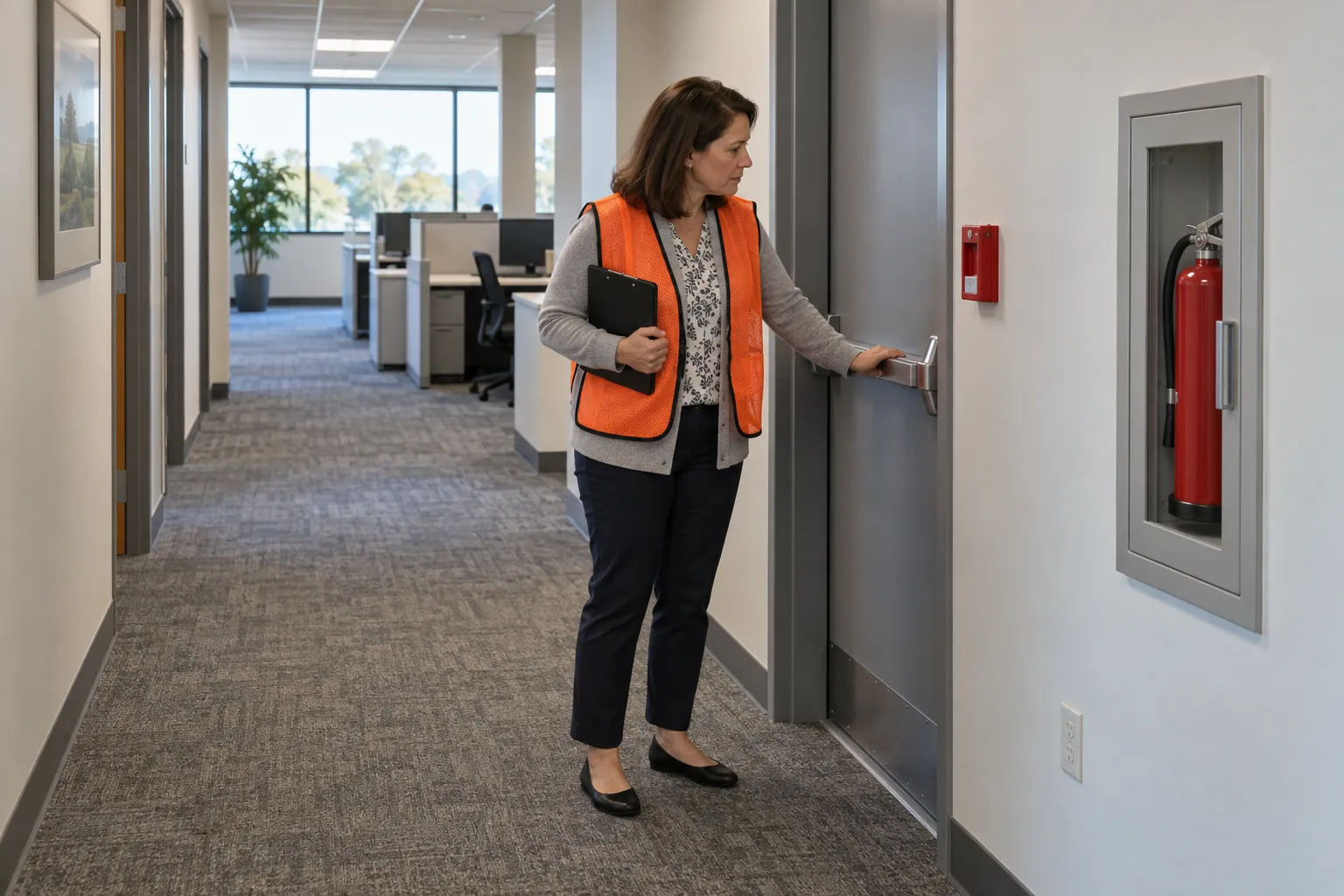
In most workplaces the fire warden, floor warden or evacuation warden is an ordinary employee with a vest or a hard hat in a desk drawer and a floor they know well. Most of the job is quiet: a look along the exit routes each morning, so the floor could be emptied if it had to be. This guide covers the OSHA rule behind the role, the checks a warden makes, what they do when the alarm sounds, the training and drills, and how the record of all of it is kept.
01
The fire warden role, and the rules behind it
For private employers under federal OSHA, the fire warden comes from the emergency action plan standard, 29 CFR 1910.38, Emergency action plans. Where a plan is required, paragraph (e) says: "An employer must designate and train employees to assist in a safe and orderly evacuation of other employees." The standard never uses the word warden. Those designated and trained employees are what most workplaces call fire wardens, floor wardens or evacuation wardens, and the titles mean the same thing in practice.
OSHA's booklet How to Plan for Workplace Emergencies and Evacuations (OSHA 3088) describes a coordinator with "the authority to make decisions during emergencies" and evacuation wardens "to help move employees from danger to safe areas during an emergency," and gives a rule of thumb: "Generally, one warden for every 20 employees should be adequate, and the appropriate number of wardens should be available at all times during working hours."
Whether a plan, and so wardens, is required depends on other OSHA standards; our guide to the emergency action plan covers the triggers. Most employers name wardens either way.
Check whose rule applies. According to OSHA's State Plans page, there are "22 State Plans covering both private sector and state and local government workers" and "seven State Plans covering only state and local government workers." In California, for example, Title 8, California Code of Regulations, section 3220, Emergency Action Plan sets the same duty in its own wording.
The local fire code can go further. Fire codes are adopted by the state or city, often the International Fire Code or NFPA 1 with local amendments, and the authority having jurisdiction (AHJ) decides what applies. In New York City, under Chapter 4 of the New York City Fire Code, Emergency Planning and Preparedness, FC 404.2.2 requires the plan for large and high-rise office buildings to designate fire and life safety (FLS) staff, including "FLS wardens, deputy FLS wardens," with "initial and refresher FLS staff training."
02
The fire warden checklist: what to look at on the floor
A warden's routine check is short and visual. It is not a fire inspection and does not replace the contractors who test the alarm, sprinklers and extinguishers. It catches the everyday problems that would slow an evacuation, most of them straight from OSHA's rules. A typical fire warden checklist for a floor covers:
- Exit routes: corridors, aisles and stair landings clear. 29 CFR 1910.37, Maintenance, safeguards, and operational features for exit routes says: "Exit routes must be free and unobstructed. No materials or equipment may be placed, either permanently or temporarily, within the exit route." Deliveries, furniture waiting for pickup and janitorial carts are the usual culprits.
- Exit doors: under 29 CFR 1910.36, Design and construction requirements for exit routes, employees must be able to open them "from the inside at all times without keys, tools, or special knowledge"; clear on both sides, including the sidewalk or alley outside.
- Exit signs and lighting: under 1910.37(b), each exit must be "clearly visible and marked by a sign reading 'Exit'," routes adequately lighted, and a doorway that could be mistaken for an exit marked "Not an Exit" or similar.
- Fire doors and stair doors: closed and latching, not wedged or propped open, unless they are held on a device that releases them when the alarm sounds.
- Portable fire extinguishers: on their hangers and not blocked. Under 29 CFR 1910.157, Portable fire extinguishers, they "shall be visually inspected monthly"; see the monthly fire extinguisher inspection.
- Manual pull stations: under 29 CFR 1910.165, Employee alarm systems, they must be "unobstructed, conspicuous and readily accessible."
- The fire alarm control panel, only where the warden is asked to look: showing normal, with no trouble or supervisory signal. Anything else is reported at once.
- Evacuation diagrams: posted and current. OSHA 3088 says they should be posted "prominently for all employees to see."
- Housekeeping and ignition sources: trash and cardboard building up, space heaters near paper, overloaded power strips, storage in stairwells. A fire prevention plan under 29 CFR 1910.39, Fire prevention plans must set procedures to control flammable and combustible waste.
- Areas of refuge, where the building has them: clear, signed, and with the two-way communication system working.
- The assembly area: reachable, and not taken over by parked cars, a dumpster or a contractor's trailer.
Keep the check to what a warden can see on a ten-minute walk. A long checklist does not make a floor safer; it makes the walk slower, and a slow walk is the one that stops happening.
03
How often, how many wardens, and who does the rest
No federal rule sets how often a warden walks the floor; the plan should. A common pattern is:
- Daily, at the start of the working day: exit routes, exit doors, stair doors and obvious hazards, because these change with every delivery and every move.
- Weekly: a fuller walk including extinguishers, pull stations, exit signs, evacuation diagrams and the assembly area.
- After any change: a renovation, a new tenant layout or a closed stair. Under 1910.37(d)(2), during repairs or alterations employees "must not occupy a workplace unless the exit routes required by this subpart are available and existing fire protections are maintained, or until alternate fire protection is furnished that provides an equivalent level of safety."
OSHA's one warden for every 20 employees is guidance, not a rule. NFPA's Guidelines to Developing Emergency Action Plans for All-Hazard Emergencies in High-Rise Office Buildings (2013) suggests each floor be "under the direction of a designated Life Safety Floor Warden," with a deputy for each tenancy and, above 7,500 square feet, a deputy "for each 7500 square feet or part thereof." A roster drawn up for the day shift says nothing about the second shift, the weekend or a warden's vacation, so name wardens by shift, with deputies arranged in advance.
Nights need their own answer. The custodial crew and the overnight security officer are often a contractor's staff, working when the tenants' wardens have gone. NFPA's guidelines say instruction should cover the plan "at times when Life Safety Floor Wardens and other EAP staff may be absent from the building." Settle in writing who acts as warden then.
A warden is one part of the building's fire safety management, not the whole of it. Other work belongs to contractors and the building engineer: the annual maintenance check of extinguishers under 1910.157(e)(3), testing supervised alarm systems "at least annually" under 1910.165(d)(4), and the alarm and sprinkler inspections the adopted fire code requires, usually by reference to NFPA 72 and NFPA 25. The warden notices what goes wrong between those visits and reports it.
04
The fire warden's job in an evacuation
When the alarm sounds, the warden gets their area out quickly and calmly and tells the person in charge what they found. The detail belongs in the emergency action plan, but it usually runs like this:
- Put on the vest or hat so people can see who is leading, and tell everyone nearby to leave by the nearest safe exit.
- Direct people to the stairs, not the elevators. NFPA's Emergency Evacuation Planning Guide for People with Disabilities notes that occupants "typically cannot use elevators during an emergency unless specifically designed for such use."
- Sweep the area on the way out: restrooms, conference rooms, break rooms, copy rooms and storage, without delaying your own escape and without opening a door with signs of fire behind it.
- Close doors behind you to slow the spread of fire and smoke.
- Help people who need assistance, following arrangements agreed with them in advance, such as a buddy or a wait at an area of refuge, and tell the person in charge where they are. NFPA's guide says employers "should provide ways for people to self-identify and communicate their particular needs during evacuation."
- Report at the assembly area. NFPA's high-rise guidelines have the floor warden verify "that the floor has been evacuated by all occupants," with missing persons reported to the authorities. OSHA 3088 asks you to identify "the names and last known locations of anyone not accounted for and pass them to the official in charge."
- Keep people out until the fire department or the person in charge gives the all clear. NFPA's guidelines tie reoccupation to clearance from the AHJ and the building's fire and life safety director.
A warden is not expected to fight the fire. Under 1910.157(b)(2), an emergency action plan may designate "certain employees to be the only employees authorized to use the available portable fire extinguishers"; under 1910.157(g)(3) and (g)(4) those employees are trained in the equipment "upon initial assignment to the designated group of employees and at least annually thereafter." On rescue, OSHA 3088 says it is "generally wise to leave rescue work to those who are trained, equipped, and certified to conduct rescues."

05
Training, drills, and what a good record shows
Under 1910.38(f), the employer must review the plan with each employee when it is developed or the employee is first assigned, when their responsibilities under it change, and when the plan changes. OSHA 3088 says people designated to assist "should be trained in the complete workplace layout and various alternative escape routes," and suggests you "consider requiring annual training in the plan."
Good fire warden training covers the building's own plan and alarm signals, every exit and stair and the alternatives, how to sweep an area and report at the assembly area, and who the coordinator is. Refresh it when the layout, the tenants or the plan change.
Drills. The OSHA standard sets no drill frequency; OSHA 3088 suggests drills "as often as necessary to keep employees prepared," with a debrief after each. The adopted fire code usually sets the frequency. For high-rise offices, NFPA's guidelines suggest two drills a year for the first two years after the plan is accepted, then a drill on each floor at least once a year. See fire drill requirements.
Some jurisdictions set the record, too. In New York City, most buildings required to have an emergency preparedness plan must keep "a log book or other approved system of recordkeeping" (FC 401.8.1), with entries documenting "drills, education, staff training, plan review and amendment, plan implementation" (FC 401.8.3).
Wherever you are, a good record lets the building manager, a client, an insurer or a fire inspector answer three questions: were the checks done, by whom, and what happened to the problems found? Each entry carries:
- the date and time the check was done, recorded at the time;
- the floor or area and the name of the warden;
- what was found, including the propped stair door and the boxes in the corridor, not only check marks;
- who each problem was reported to, and when it was fixed;
- checks that were missed, and why, such as a warden on vacation with no deputy;
- drills, with the time taken, what went wrong and what changed afterward.
Exceptions are what make the record believable. A year of warden checks with nothing ever found does not suggest a perfect floor; it suggests the sheet is being signed rather than walked.
06
Where the record fails, and what SiteClara does about it
On paper, the warden's morning check is a line on a clipboard at reception. It is easy to initial without walking the floor, easy to miss when the warden is out, and hard to follow up: the stair door propped open on Tuesday is still propped open on Friday, because the sheet records the problem but sends it to nobody.
SiteClara puts a printed QR poster at the points on the warden's route, such as a stair door, an exit, the fire alarm panel or the assembly area, with an optional NFC tag behind it. The warden scans the code or taps the tag with their own phone, with no app to install, sees the checks due at that point and marks each one done, or says what stopped them. The name and the time are recorded as it happens, with a photo when one is asked for.
A problem found on the walk, such as a blocked corridor, a dark exit sign or a stair door that will not latch, is reported there with a photo and goes onto the team's list of jobs until someone closes it. The supervisor sees which checks are due, done and missed, can record why one was missed, and can escalate a job to the building manager. Each day the supervisor approves a report that goes to nominated management or client contacts the next morning, showing how the scheduled checks went and what is still open.
07
Questions people ask
What does a fire warden do?
A fire warden helps move people from danger to a safe place in an emergency and keeps the floor ready for that between emergencies. The federal rule is 29 CFR 1910.38, Emergency action plans, which says: "An employer must designate and train employees to assist in a safe and orderly evacuation of other employees." OSHA's booklet How to Plan for Workplace Emergencies and Evacuations describes evacuation wardens "to help move employees from danger to safe areas during an emergency" and suggests you may want an evacuation warden "to assist others in an evacuation and to account for personnel." The checklist and evacuation steps above are how that usually works day to day.
How long is fire warden training?
Federal OSHA sets no length. Under 29 CFR 1910.38, the plan must be reviewed with each employee when it is developed or they are first assigned, when their responsibilities change and when the plan changes; OSHA 3088 adds that employees designated to assist in an evacuation "should be trained in the complete workplace layout and various alternative escape routes." Some fire codes do set hours. In New York City, FC Table 401.4.5.2.3 in Chapter 4 of the New York City Fire Code, Emergency Planning and Preparedness gives FLS staff other than the director, deputy directors and building evacuation supervisors, which includes FLS wardens, 1 hour of initial fire safety training and 2 hours of initial non-fire emergency training, then 1 hour of each as a refresher every year.
Is there a difference between a fire warden and a fire marshal?
Yes, in the United States. Fire wardens are the employer's own staff, designated and trained under 29 CFR 1910.38 to help with an evacuation. A fire marshal is usually a public official. In New York City, for example, the FDNY says its fire marshals, in the Bureau of Fire Investigation, "are responsible for investigating the cause and origin of more than 7,000 fires each year" (FDNY, Fire Commissioner Daniel A. Nigro Appoints Daniel E. Flynn As Chief Fire Marshal). Some workplaces call their own wardens fire marshals; check which is meant.
Do fire marshals have police powers?
Some do, depending on the jurisdiction. In New York City, the FDNY states: "FDNY Fire Marshals are law enforcement officers with the power to arrest those who commit arson and other crimes within New York City" (FDNY, Fire Commissioner Daniel A. Nigro Appoints Daniel E. Flynn As Chief Fire Marshal). A workplace fire warden has no such powers; their authority comes from the employer's emergency action plan.
08
Further reading, and a list to take away
Start with 29 CFR 1910.38, OSHA's Evacuation Plans and Procedures eTool page on developing and implementing an EAP and the booklet How to Plan for Workplace Emergencies and Evacuations. NFPA's free guides on high-rise emergency action plans and on evacuation planning for people with disabilities add detail, and NFPA 101, Life Safety Code can be read free online; it has no legal force until your jurisdiction adopts it. In a state plan state, read your state's version, and ask your local fire marshal's office which fire code edition applies. See also exit route requirements and the workplace fire safety checklist.
For your fire wardens, make sure that:
- the emergency action plan names a coordinator and enough wardens, with deputies, for every shift, night and weekend;
- each warden knows their floor, every exit and stair, the alternatives, and their part in the plan;
- the daily and weekly checklist fits a short walk, and is walked, not initialed;
- problems found go to someone who will fix them, and the record shows when they were fixed;
- missed checks are recorded with a reason;
- people who need help to evacuate have arrangements agreed with them, kept confidential;
- wardens are trained when appointed, when their duties or the plan change, and at a regular refresher;
- drills are held at the frequency your fire code sets, debriefed and followed by changes;
- the training, drill and check records are kept where your fire code and your plan say they must be.
Sources
Every document this guide quotes or links to, in the order it first cites them.
- 29 CFR 1910.38, Emergency action plans osha.gov
- How to Plan for Workplace Emergencies and Evacuations osha.gov
- OSHA's State Plans page osha.gov
- Title 8, California Code of Regulations, section 3220, Emergency Action Plan dir.ca.gov
- Chapter 4 of the New York City Fire Code, Emergency Planning and Preparedness nyc.gov
- 29 CFR 1910.37, Maintenance, safeguards, and operational features for exit routes osha.gov
- 29 CFR 1910.36, Design and construction requirements for exit routes osha.gov
- 29 CFR 1910.157, Portable fire extinguishers osha.gov
- 29 CFR 1910.165, Employee alarm systems osha.gov
- 29 CFR 1910.39, Fire prevention plans osha.gov
- Guidelines to Developing Emergency Action Plans for All-Hazard Emergencies in High-Rise Office Buildings nfpa.org
- Emergency Evacuation Planning Guide for People with Disabilities nfpa.org
- FDNY, Fire Commissioner Daniel A. Nigro Appoints Daniel E. Flynn As Chief Fire Marshal nyc.gov
- Evacuation Plans and Procedures eTool page on developing and implementing an EAP osha.gov
- NFPA 101, Life Safety Code nfpa.org
Related guides
 Fire and water checksEmergency action plan: what OSHA requires, and how to keep the plan workingWhat an emergency action plan must contain under OSHA 1910.38, who needs one, how alarms, wardens, drills and reviews fit in, and what the record should show.
 Fire and water checksFire drill requirements: frequency, running the drill, and the fire drill logWho requires fire drills in US buildings, how often the fire code sets them by occupancy, how to run one, and what the fire drill log must record.
 Fire and water checksOSHA exit sign and exit route requirements, and how to keep every route clearWhat OSHA 1910.36 and 1910.37 require of exit routes, exit doors and exit signs, how the fire code fits in, and how to check and record that routes stay clear.
 Fire and water checksWorkplace fire safety checklist: what to check, how often, and who does itA fire safety checklist for a US workplace: the daily, monthly and annual checks behind OSHA Subparts E and L and the local fire code, who does each, and the record.