Fire and water checks
Hospital fire drills: every shift, every quarter, and a record that shows it
Hospital fire drills are required at least quarterly on each shift in every hospital building that is a health care occupancy, and each drill must transmit a fire alarm signal and simulate emergency fire conditions.
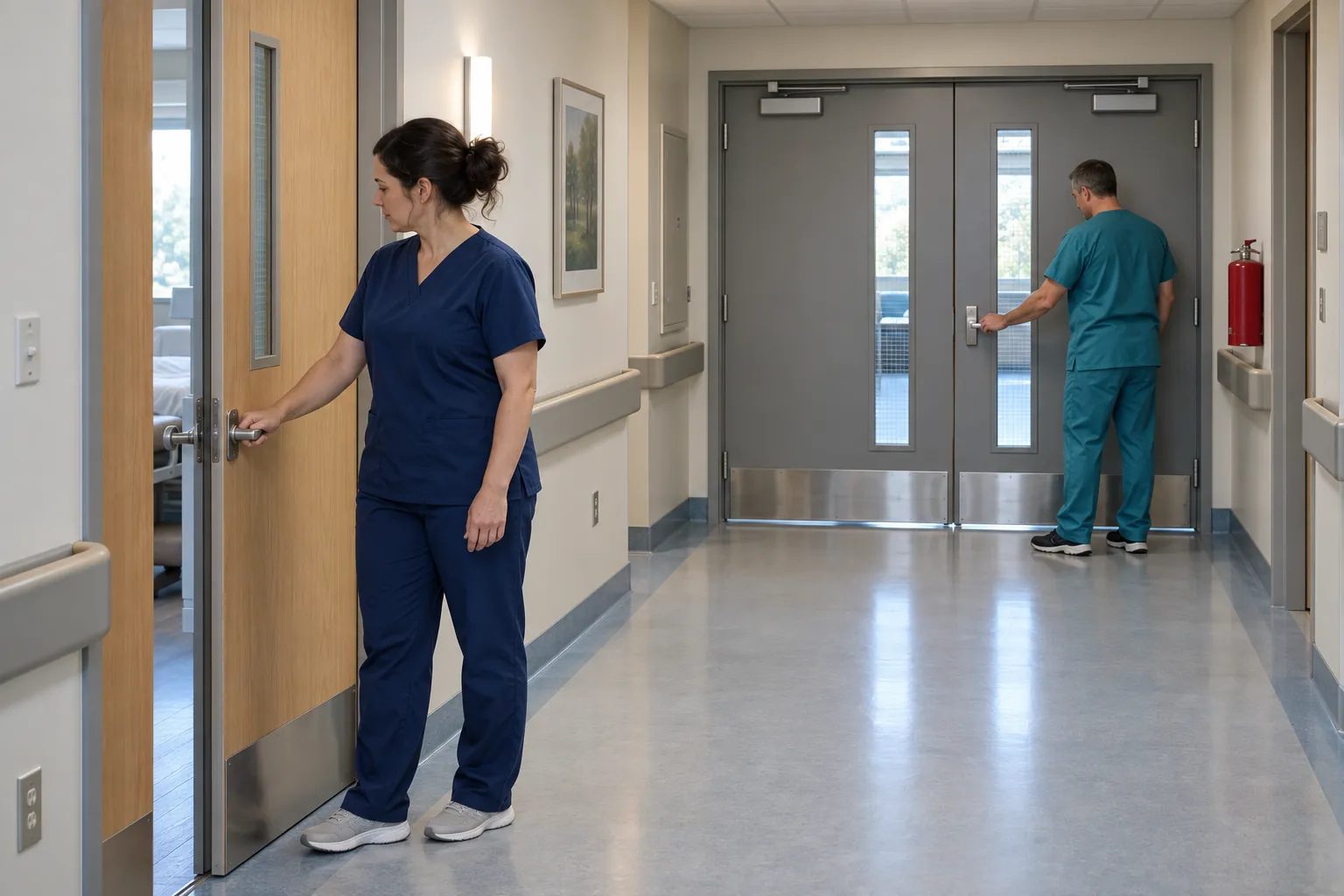
A hospital cannot empty its building every time the alarm sounds, so its fire drills test something harder than an evacuation: whether the staff on each unit, on each shift, know their part in the emergency response and how to protect patients where they are. For a hospital that takes Medicare or Medicaid, the rules come from the CMS Conditions of Participation, which adopt the 2012 edition of NFPA 101, the Life Safety Code. This guide covers who requires hospital fire drills, how often, how to plan and run them across three shifts, and what the drill record needs to show a surveyor.
01
Who requires hospital fire drills: CMS, the Life Safety Code and The Joint Commission
The federal starting point is the hospital Condition of Participation for the physical environment, 42 CFR 482.41. Paragraph (b), Life safety from fire, says the hospital "must meet the applicable provisions and must proceed in accordance with the Life Safety Code (NFPA 101 and Tentative Interim Amendments TIA 12-1, TIA 12-2, TIA 12-3, and TIA 12-4.)" Paragraph (e) names the edition: NFPA 101, Life Safety Code, 2012 edition. The same section requires written fire control plans covering "prompt reporting of fires; extinguishing fires; protection of patients, personnel and guests; evacuation; and cooperation with fire fighting authorities."
That edition matters: your state or city may enforce a newer Life Safety Code or fire code for its own inspections, but for Medicare and Medicaid certification the reference is the 2012 edition. CMS says so on its Life Safety Code and Health Care Facilities Code Requirements page, which describes provider compliance "with the 2012 edition of the National Fire Protection Association (NFPA) Life Safety Code (LSC) and Health Care Facilities Code (HCFC)." Nursing homes are under the same code through 42 CFR 483.90.
In the 2012 Life Safety Code, the drill rules for health care occupancies are in section 18.7.1 for new buildings and 19.7.1 for existing ones. Surveyors check them under K-tag K712, Fire Drills, on Form CMS-2786R, the Fire Safety Survey Report for the 2012 Life Safety Code, which cites "18.7.1.4 through 18.7.1.7, 19.7.1.4 through 19.7.1.7." CMS partners with state survey agencies, which may contract the work to the state fire marshal, and with approved accrediting organizations to carry out these surveys.
Most hospitals will know the drill rules from The Joint Commission's old standard EC.02.03.03, in its Environment of Care chapter. Under Accreditation 360, the revised hospital standards effective January 1, 2026, that standard is gone. The Joint Commission's Disposition Report for the Hospital Program lists EC.02.03.03's drill elements of performance as deleted and "replaced with more direct EP(s) or moved to guidance," mostly pointing to PE.03.01.01, EP 3: "The hospital meets the applicable provisions of the Life Safety Code (NFPA 101-2012 and Tentative Interim Amendments [TIA] 12-1, 12-2, 12-3, and 12-4)." The requirement is unchanged; it now points straight at the code CMS enforces, so policies and drill forms that still quote EC.02.03.03 need updating.
02
How often, and what counts as a hospital fire drill
The K712 wording on Form CMS-2786R sums up the 2012 code's drill requirement in four sentences: "Fire drills include the transmission of a fire alarm signal and simulation of emergency fire conditions. Fire drills are held at expected and unexpected times under varying conditions, at least quarterly on each shift. The staff is familiar with procedures and is aware that drills are part of established routine. Where drills are conducted between 9:00 PM and 6:00 AM, a coded announcement may be used instead of audible alarms." A hospital running three shifts therefore holds at least twelve drills a year in each building that is a health care occupancy, and each shift sees one every quarter.
Patients do not have to be evacuated. The Joint Commission's former EC.02.03.03, EP 1, noted that "Evacuation of patients during drills is not required," and that in leased or rented facilities drills "need be conducted only in areas of the building that the hospital occupies." Its former EPs added quarterly drills in ambulatory health care occupancies, a drill every 12 months in freestanding business occupancies where patients are seen or treated, and an annual fire exit drill for operating rooms and surgical suites, citing NFPA 99-2012, section 15.13.3.10.3. An announced OR drill "cannot be used to meet one of the unannounced quarterly fire drills."
Two other requirements are easily confused with the fire drill. The emergency preparedness condition, 42 CFR 482.15, requires exercises "to test the emergency plan at least twice per year," such as a full-scale or functional exercise and a tabletop exercise. They test the all-hazards plan, not the fire response on each shift. And state licensure may add its own fire code on top. The Minnesota Department of Health's guidance, Fire Drills (July 2016, revised June 2024), notes that the Minnesota State Fire Code, section 405.2 and Table 405.2, "also require that fire drills be conducted quarterly on each shift," with records kept under section 405.5. Ask your state health department and fire marshal which code and edition they enforce.
03
Planning the year: shifts, times, places and people
Twelve or more drills a year per building do not happen by accident. Plan the year before it starts and track it every month. The Minnesota guidance recommends "that a fire drill schedule be developed in advance of each calendar year" and that the previous year's drill times be reviewed first, so that "no pattern is detectable in either the same month or shift." It adds a practical test: "only 2 of the 4 drill times in the same shift are within 1 to 1½ hours of each other." The Joint Commission's former note set a similar rule: drills "vary by at least one hour for each shift from quarter to quarter, through four consecutive quarters."
A workable plan sets out, for each building:
- The shifts the hospital actually runs, including weekend patterns, so every shift is covered each quarter.
- A date and time window for each drill, away from last year's times.
- A location for the simulated fire, rotating through inpatient units, the emergency department, imaging, the kitchen, laboratories and support areas.
- A scenario, such as a fire in a patient room, a soiled linen room or a storage closet.
- Who conducts and who observes, with cover for nights and weekends.
- How the fire alarm monitoring company will be told.
The safety officer or life safety manager usually plans the drills; everyone at work in the area takes part. The Joint Commission's former EP 4 said staff "who work in buildings where patients are housed or treated participate in drills according to the hospital's fire response plan." That includes contract staff: environmental services (EVS) technicians, security officers, food service workers, transport and the building engineers on the night shift. The Minnesota guidance warns that "if some staff members are allowed to be excused from drills, there is a danger that, in an actual emergency, the evacuation and relocation process will be compromised."
Keep a tracker beside the plan, building by quarter by shift, so a gap shows in the third month of a quarter, while it can still be filled, and not at the survey.
04
Running a drill on the unit
Hospitals rely on a defend-in-place strategy: the building is divided into smoke compartments, and patients are protected where they are or moved away from the fire into the next compartment rather than out of the building. The drill tests that. The Minnesota guidance, written for health care facilities, says the drill should include "complete evacuation of the smoke compartment containing the area of simulated fire origin," with occupants, actual or simulated, moved to a safe location ("an adjacent smoke compartment is preferred"), and that "the emphasis when conducting drills needs to be on safe and orderly evacuation rather than speed."
It suggests starting the scenario so staff must discover it: a sign, flashing light or red cloth at the point of origin, a note handed to a staff member, a manual pull station, or a nurse call light.
Before and after:
- Call the monitoring company before the drill, so the fire department is not dispatched, and again afterward "to verify the time that an alarm signal was received." The Minnesota guidance says that verification "should be documented on the fire drill report."
- Sound the alarm. If a night drill uses a coded announcement, the Minnesota guidance says the fire alarm "should be sounded first thing in the morning the following day," so that each drill still includes transmission of an alarm signal.
- Account for people in the compartment, including visitors, once relocation is complete.
- Give the all clear from the person in charge of the drill, and no one returns until then.
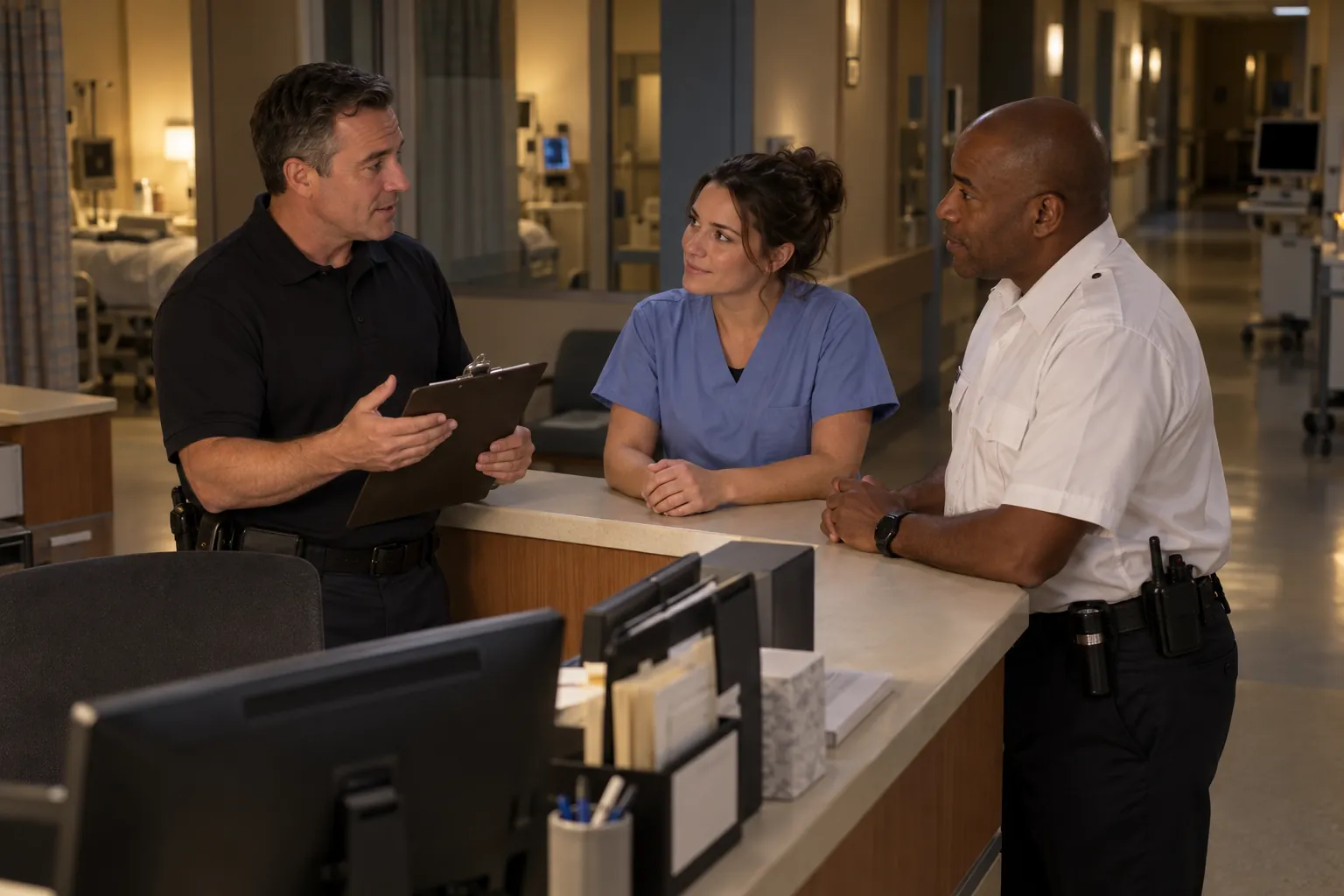
Observers watch what the drill is for. Did the first person to find the fire alert others and pull the alarm? Were patient room and corridor doors closed? Did smoke and fire doors release and latch? Were corridors clear of carts and equipment, so beds could move? Did staff know where the fire extinguishers and medical gas zone valves are, and who has authority to shut the valves? Did anyone take an elevator?
05
The drill record, the critique, and what surveyors look for
A drill that is not documented did not happen, as far as a surveyor is concerned. The CMS State Operations Manual, Appendix I, Survey Procedures for Life Safety Code Surveys (Rev. 209, 12-09-22) tells surveyors to request fire safety documentation at the start, including fire drills, and to "review the facility fire plan including fire drill records and staff interviews to determine staff actions and responsibilities during a fire or emergency." Where the records or interviews raise doubts, "the surveyor may request an actual fire drill demonstration."
The 2012 Life Safety Code does not list the fields of a drill record for health care. State fire codes based on the International Fire Code often do. The Minnesota guidance lists what section 405.5 of its state fire code requires:
- Identity of the person conducting the drill.
- Date and time of the drill.
- Notification method used.
- Staff members on duty and participating.
- Number of occupants evacuated.
- Special conditions simulated.
- Problems encountered.
- Weather conditions when occupants were evacuated.
- Time required to accomplish complete evacuation.
Add the building, unit, shift, scenario, the monitoring company's confirmation and the observers' findings. For accredited hospitals, PE.03.01.01, EP 3 carries a note on documenting inspection activities: "All inspecting activities are documented with the name of the activity; date of the activity; inventory of devices, equipment, or other items; required frequency; name and contact information of person who performed the activity; NFPA standard(s) referenced for the activity; and results of the activity."
Then critique it. The Joint Commission's former EP 5 said the hospital "critiques fire drills to evaluate fire safety equipment, fire safety building features, and staff response to fire. The evaluation is documented." The Minnesota guidance puts it more plainly: "Not all fire drills run smoothly. That's okay, so long as staff and management learn from them and correct mistakes made." Give each problem an owner and a date, such as a work order for a door that did not latch or training for a unit that did not know the code, and record when it was closed.
Keep the records where they can be found. Minnesota recommends keeping them "for at least three years" and that "at least two people in your facility know where your drill records are kept." The records have to show every shift in every quarter, and a binder only one person can find does not help.
06
Where the record fails, and what SiteClara does about it
Hospital fire drill records rarely fail on the form. They fail in the spaces around it: the night-shift drill for the third quarter that was planned, moved twice and never held; the drill report written up days later with the times rounded and "no problems" in the problems box; the fire door that did not latch, mentioned to the charge nurse and never reported to the engineers; the corridor that is clear on drill day and lined with carts and linen the rest of the week.
SiteClara puts a printed QR poster at each place a check is due, such as a smoke compartment door, a stairwell, a fire alarm panel, a corridor or a soiled utility room, with an optional NFC tag behind it. Staff scan the code or tap the tag on their own phone, with no app to install, and sign in with a link. They see the checks due there, such as a daily corridor and exit walk, and mark each one done or say what stopped them. A problem found in a drill or on a round, such as a door that does not latch, equipment stored in a corridor or a blocked pull station, is reported there with a photo and goes onto the team's list of jobs until someone closes it.
The supervisor sees what is due, done and missed at each location, and can record why a check was missed; a job that needs the building manager can be escalated to them to answer. Each day the supervisor reviews and approves a report that goes to nominated management or client contacts at 8 a.m. the next morning, showing what was reported, completed and still open, and how the scheduled checks went.
07
Questions people ask
How often are fire drills required in a hospital?
At least quarterly on each shift, in each building that is a health care occupancy. K712 on Form CMS-2786R, the Fire Safety Survey Report for the 2012 Life Safety Code says fire drills "are held at expected and unexpected times under varying conditions, at least quarterly on each shift." A hospital that runs three shifts therefore holds at least twelve drills a year in each such building, and a drill between 9:00 PM and 6:00 AM may use a coded announcement instead of audible alarms.
What are the NFPA requirements for hospital fire drills?
For Medicare and Medicaid certification, the requirements are those of NFPA 101, the Life Safety Code, 2012 edition, sections 18.7.1.4 through 18.7.1.7 for new health care occupancies and 19.7.1.4 through 19.7.1.7 for existing ones. K712 on Form CMS-2786R, the Fire Safety Survey Report for the 2012 Life Safety Code sums them up: "Fire drills include the transmission of a fire alarm signal and simulation of emergency fire conditions," and "The staff is familiar with procedures and is aware that drills are part of established routine."
Are fire drills legally required in a hospital?
Yes, for a hospital that takes Medicare or Medicaid. Under 42 CFR 482.41, the Condition of Participation for the physical environment, paragraph (b)(1)(i), "The hospital must meet the applicable provisions and must proceed in accordance with the Life Safety Code," and the drill rules are part of that code. State licensure and the state or local fire code may require drills as well.
What are the Joint Commission fire drill requirements?
From January 1, 2026, The Joint Commission's hospital standards point straight at the Life Safety Code. Its Disposition Report for the Hospital Program shows the old EC.02.03.03, EP 1, which said "The hospital conducts fire drills once per shift per quarter in each building defined as a health care occupancy by the Life Safety Code," deleted and replaced by PE.03.01.01, EP 3: "The hospital meets the applicable provisions of the Life Safety Code (NFPA 101-2012 and Tentative Interim Amendments [TIA] 12-1, 12-2, 12-3, and 12-4)." The frequency itself is unchanged.
What are the OSHA requirements for fire drills?
29 CFR 1910.38, Emergency action plans does not require fire drills. It requires an emergency action plan "whenever an OSHA standard in this part requires one," with procedures for reporting a fire, for evacuation and for accounting for all employees afterward, and it says "An employer must designate and train employees to assist in a safe and orderly evacuation of other employees." In a hospital, the quarterly drill on each shift comes from CMS and the Life Safety Code, not from OSHA.
08
Where to read more, and a list to take away
Start with the regulation, 42 CFR 482.41, and CMS's Life Safety Code and Health Care Facilities Code Requirements page. Read K712 on Form CMS-2786R and Appendix I of the State Operations Manual. The code itself is NFPA 101, sections 18.7 and 19.7 of the 2012 edition. Accredited hospitals should read The Joint Commission's Disposition Report for the Hospital Program to map old EC.02.03.03 references to the 2026 standards. The Minnesota Department of Health's Fire Drills guidance is short and practical. For drills in other kinds of building, see our guide to fire drill requirements.
Before you sign off the year's hospital fire drill program, check that:
- you know which buildings are health care, ambulatory health care and business occupancies, and the drill frequency for each;
- you know the state fire code and edition your state health department and fire marshal enforce, alongside the 2012 Life Safety Code;
- a drill is planned for every shift in every quarter, at times that vary by shift and from last year;
- the simulated fire location rotates through every department, including support areas and the operating rooms' own annual drill;
- every drill transmits an alarm signal, or uses a coded announcement at night with the alarm sounded the next morning;
- contract EVS, security, food service and engineering staff take part, not only clinical staff;
- each drill record has the person, date, time, shift, scenario, participants, problems and time taken;
- every drill is critiqued, and each problem found has an owner, a date and a closed date;
- the conditions a drill depends on, such as clear corridors and latching doors, are checked between drills, and those checks are recorded as they are done.
Sources
Every document this guide quotes or links to, in the order it first cites them.
- 42 CFR 482.41 ecfr.gov
- Life Safety Code and Health Care Facilities Code Requirements cms.gov
- 42 CFR 483.90 ecfr.gov
- Form CMS-2786R, the Fire Safety Survey Report for the 2012 Life Safety Code cms.gov
- Disposition Report for the Hospital Program digitalassets.jointcommission.org
- 42 CFR 482.15 ecfr.gov
- Fire Drills (July 2016, revised June 2024) health.mn.gov
- State Operations Manual, Appendix I, Survey Procedures for Life Safety Code Surveys cms.gov
- 29 CFR 1910.38, Emergency action plans osha.gov
- NFPA 101 nfpa.org
Related guides
 Fire and water checksFire drill requirements: frequency, running the drill, and the fire drill logWho requires fire drills in US buildings, how often the fire code sets them by occupancy, how to run one, and what the fire drill log must record.
 Fire and water checksInterim life safety measures: keeping a healthcare building safe while its fire protection is compromisedWhat The Joint Commission's LS.01.02.01 asks of an ILSM policy, when a fire watch is required, and how to run and record the daily rounds behind the measures.
 Premises and facilities managementEnvironment of care rounds: walking the building, and proving the findings were fixedHow to run environment of care (EOC) rounds in a hospital in 2026: the CMS and Joint Commission basis, what a round covers, who goes and how findings get closed.
 Fire and water checksFire alarm testing: who does what, and what the record should showFire alarm testing in the US: what NFPA 72 and OSHA ask of the owner, what gets tested, how to run a test day, and what the building's own record should show.