Cleaning
Common area cleaning: what it covers, how often, and how to show it was done
Common area cleaning is the routine cleaning of the shared spaces in apartment buildings, condos and commercial buildings that no single resident or tenant is responsible for, such as the lobbies, hallways, stairwells, elevators, mailroom and trash room.
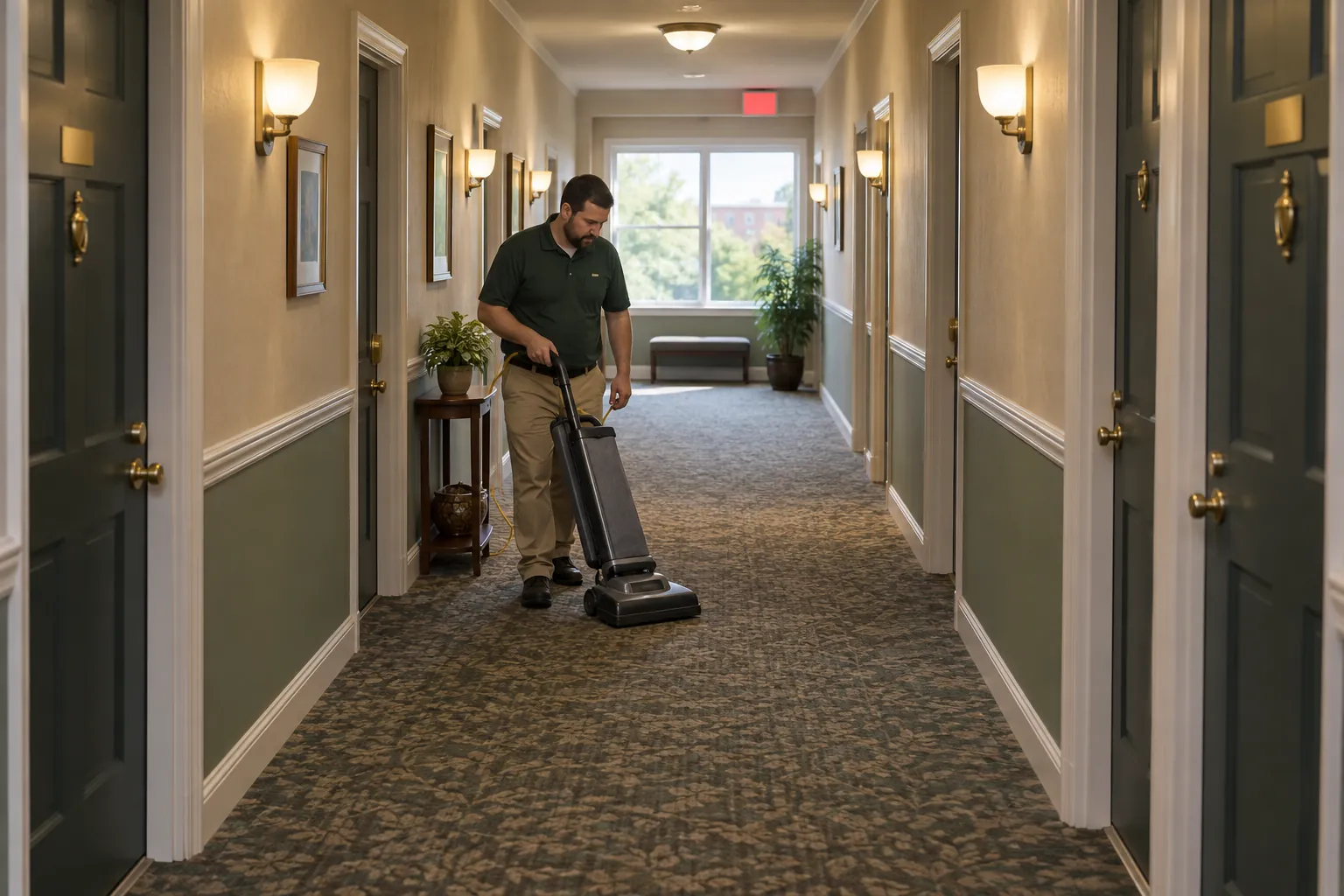
Those spaces are used by everyone and owned by no one tenant, which is why they are the first place residents and tenants notice when cleaning slips. This guide covers who is responsible for common area cleaning in apartment, condo and commercial buildings, what a cleaning schedule should include, the federal rules that apply to the work, and how to keep a record a property manager or HOA board can believe.
01
Who is responsible for cleaning common areas
Common areas are the shared parts of a building that no single resident or tenant leases or owns: the lobby and entrances, hallways, stairwells, elevators, mailrooms, trash rooms, laundry rooms, amenity spaces, parking garages and the grounds. In a rental apartment building or apartment complex they belong to the owner and are looked after by the property manager. In a condominium or HOA community they are usually common elements maintained by the association under its governing documents. In an office or mixed-use building they are the landlord's, with the cost typically passed to tenants as common area maintenance (CAM) charges.
No single federal law sets a standard for how clean a hallway must be. The duty comes from several places at once, and which ones apply depends on the building:
- The lease or the governing documents. A commercial lease, or an association's declaration (the CC&Rs) and bylaws, normally say who maintains the common areas and how the cost is shared. That is where the obligation to clean usually starts.
- The local property maintenance or housing code. Many cities and counties base their property maintenance code on the International Property Maintenance Code (IPMC), a model code published by the International Code Council, and adopt it with local amendments; others have their own housing code. A model code is not law until a jurisdiction adopts it, so check which code and edition your city or county enforces, and ask its code official if in doubt.
- OSHA, for the people doing the work. Janitors, custodians and porters are employees, so the federal walking-working surfaces standard applies to the places they work. 29 CFR 1910.22(a)(1) requires that "all places of employment, passageways, storerooms, service rooms, and walking-working surfaces are kept in a clean, orderly, and sanitary condition", and the sanitation standard, 29 CFR 1910.141(a)(3)(i), says "all places of employment shall be kept clean to the extent that the nature of the work allows."
- HUD's inspection standards, for assisted housing. HUD's list of NSPIRE standards includes a Litter standard for the inside and outside inspectable areas, alongside standards for trash chutes, infestation, handrails, lighting, egress, and flammable and combustible items. A cleaning crew is often the first to see all of them.
- The ADA, where the space is open to the public. Under the Department of Justice's ADA Title III regulations, 28 CFR 36.211, a public accommodation "shall maintain in operable working condition those features of facilities and equipment that are required to be readily accessible to and usable by persons with disabilities." An accessible route blocked by furniture is not being maintained in operable working condition.
02
What common area cleaning covers
A common area cleaning scope of work usually lists each space and the tasks done there. The same list works for apartment communities, condo buildings, office buildings and mixed-use properties, with the amenities changing from one to the next:
- Lobby, entrances and mailroom: floors and walk-off mats, entry glass and door hardware, the entry panel, mailbox fronts and the package room. It is the first impression of the building for residents, tenants, visitors and prospective renters.
- Hallways and corridors: vacuuming carpet or dust mopping and damp mopping hard floors, baseboards, light switches, door handles and push plates, and spot cleaning walls.
- Stairwells: each tread and landing swept and mopped, handrails wiped, and corners, windowsills and railings dusted.
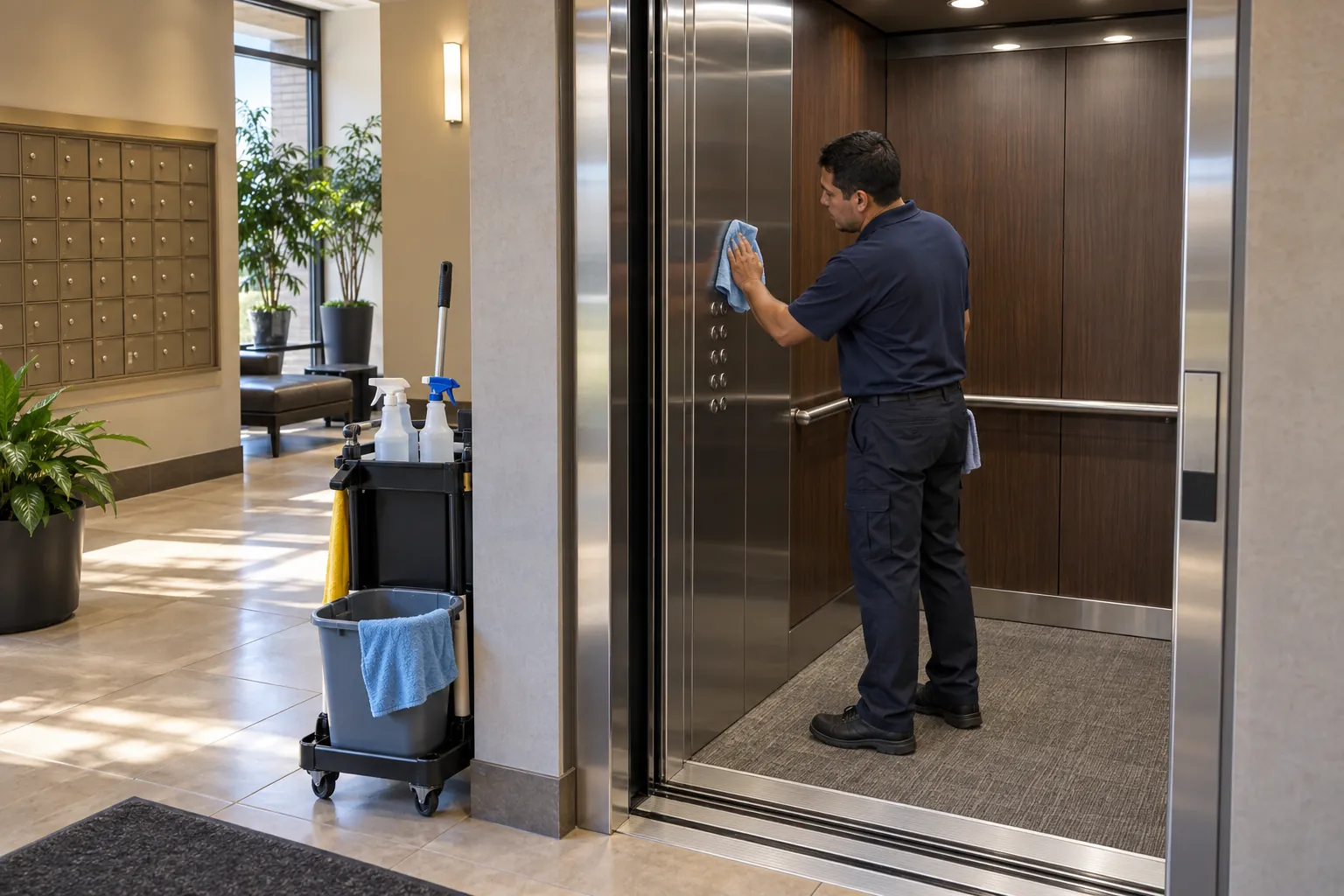
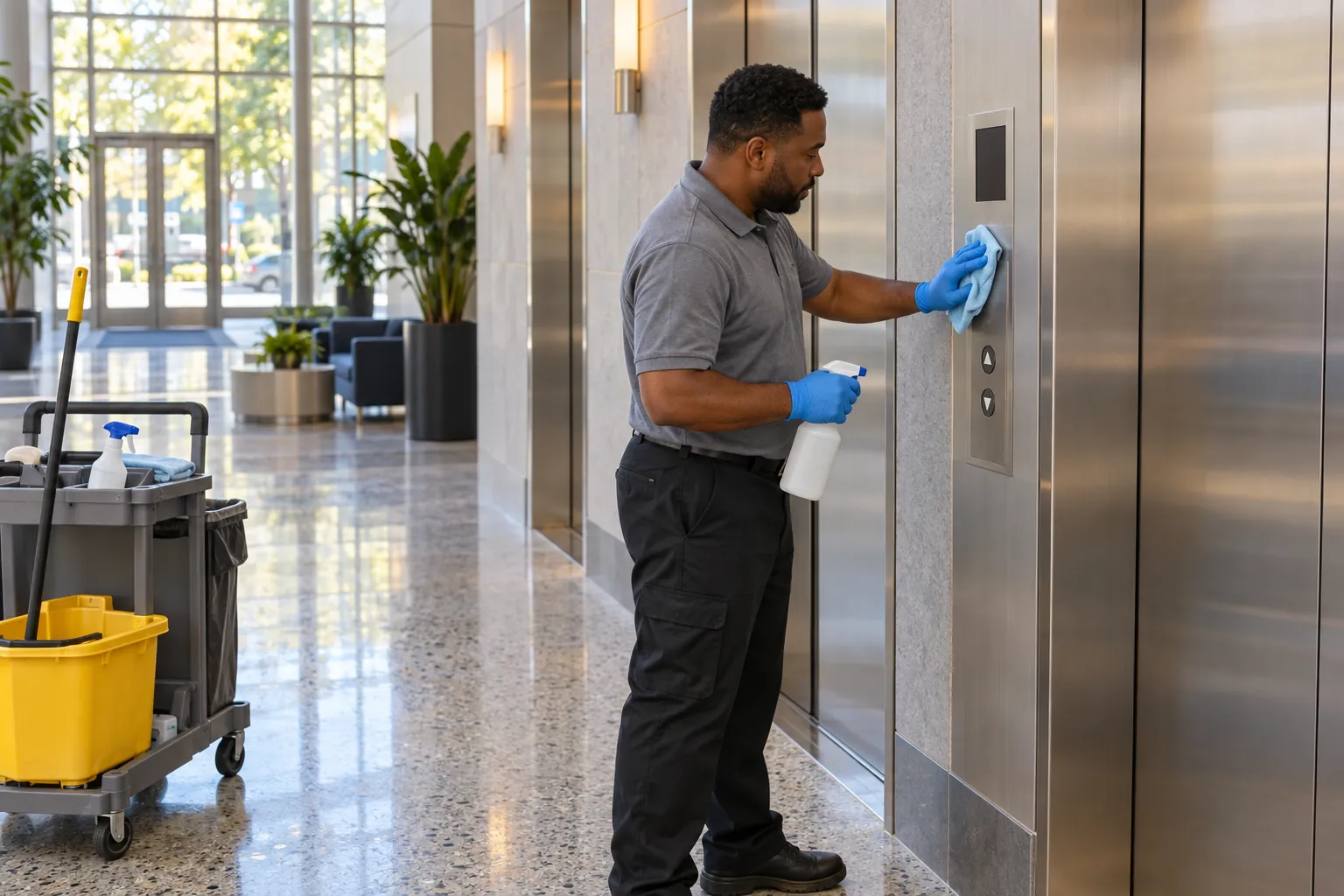
- Elevators: floor, walls, mirrors and stainless steel, call buttons and car operating panels, and the door tracks and sills vacuumed.
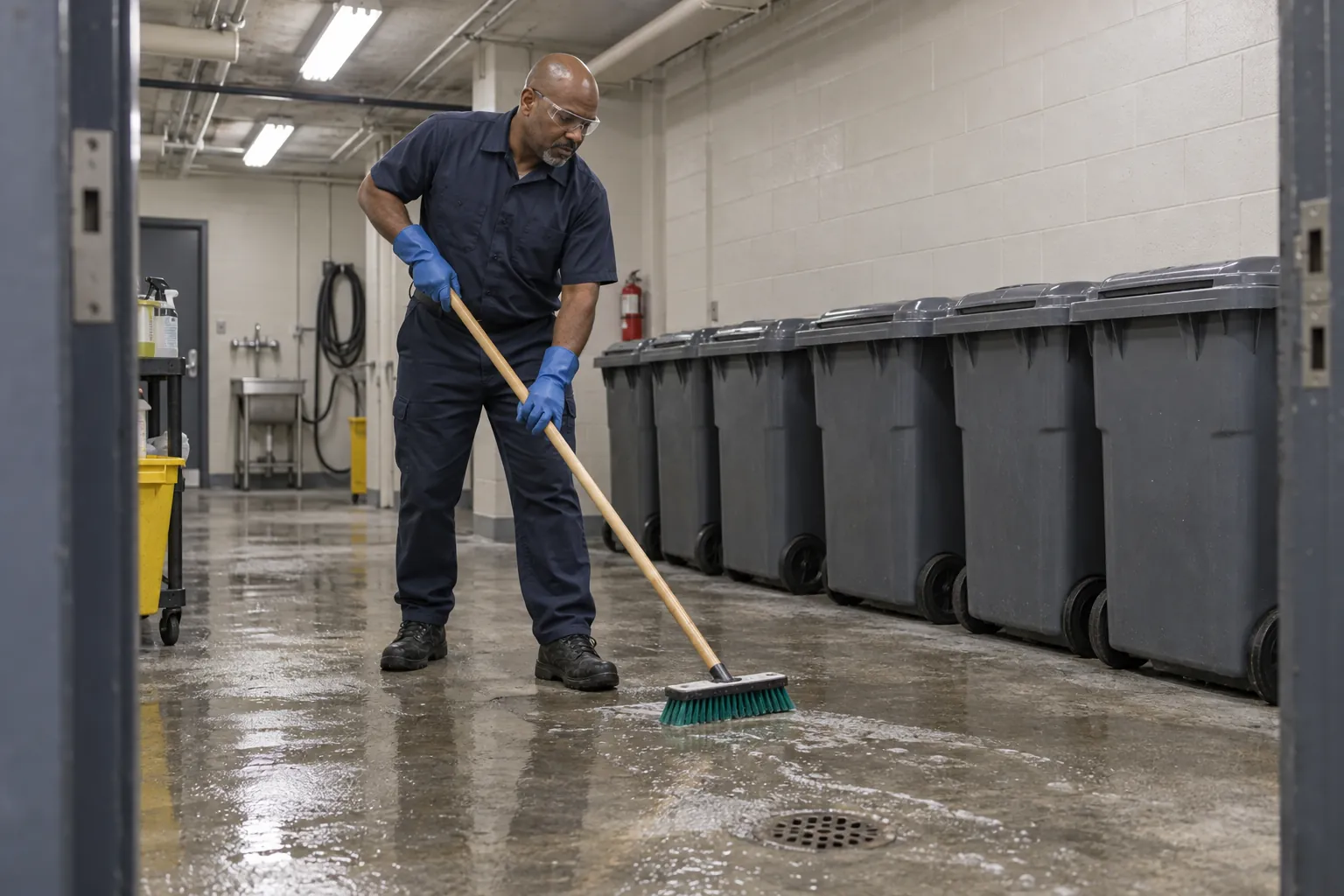
- Trash rooms and chute rooms: floors swept and mopped, bins emptied or rotated, spills and loose trash picked up, chute doors wiped, and odors and pests reported. See the trash room guide.
- Laundry rooms and amenity spaces: a laundry room, fitness center, clubhouse or pool deck, each with its own list.
- Parking garages and exterior areas: litter picked up, entries swept, stairwells and elevator lobbies in the garage cleaned, and leaves, snow and ice handled under the grounds contract.
- Touch points: the CDC's guidance on when and how to clean and disinfect a facility advises cleaning high-touch surfaces regularly and names, among others, "door handles, stair rails, elevator buttons, touchpads, restroom fixtures". See the guide to high-touch surface cleaning.
Write down what is not included as well. Window washing above ground level, carpet extraction, floor refinishing and pressure washing are usually separate periodic services, and residents and tenants should know what they are expected to deal with themselves.
03
How often common areas should be cleaned
No federal rule sets a frequency for cleaning a lobby or a stairwell. The schedule follows how many people use each space, what happens if it is left, and what the lease, governing documents or management agreement promise. A small walk-up may need a weekly visit; a busy high-rise may need a day porter all day and a night crew after hours. A common pattern:
- Daily, or several times a day in busy buildings: the lobby and entrance, elevators, the mailroom and package room, trash rooms, common area restrooms, and a walk-through to pick up litter and deal with spills.
- Several times a week: hallways and corridors on each floor, laundry rooms and amenity spaces, depending on use.
- Weekly: stairwells top to bottom, baseboards, light fixtures within reach, garage stairwells and elevator lobbies.
- Monthly: high dusting to remove dust from ledges, vents and diffusers, detailed elevator work, and walls and doors spot cleaned throughout.
- Quarterly to annually: carpet extraction, hard floor scrubbing or refinishing to remove the buildup of grit and old finish, exterior and high-level windows, and pressure washing of entrances, walkways and trash areas.
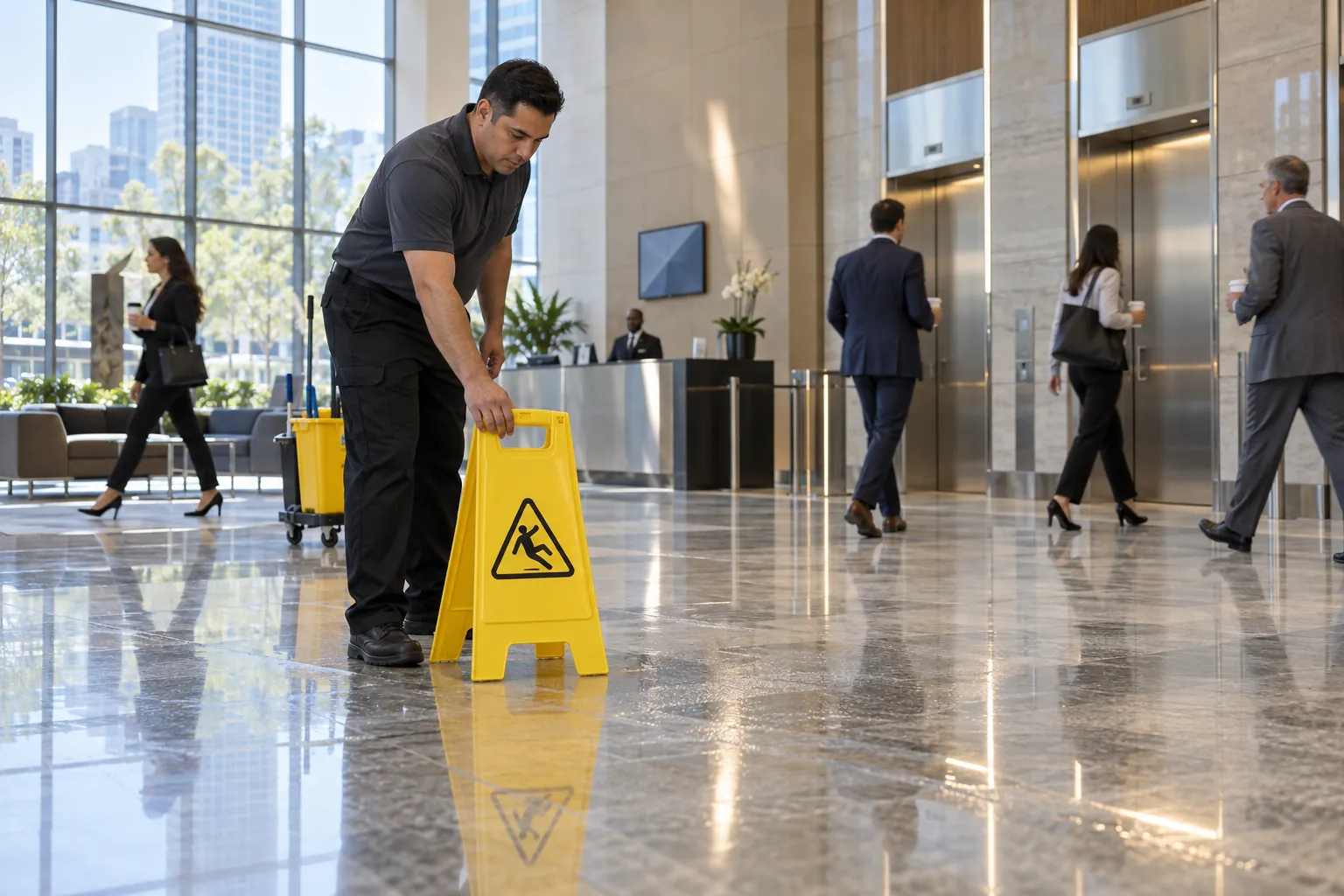
Schedule the wet work for when fewer people are in the building: mopping a lobby at the morning rush puts people on a wet floor, and the day's traffic undoes it. Commercial buildings do most of the work after hours, with a day porter keeping the lobby, restrooms and elevators presentable during the day.
For campuses and larger portfolios, APPA describes the custodial volume of its Operational Guidelines as "the industry benchmark for custodial staffing", organized around five service levels. Its approach is useful anywhere: agree on the level of cleanliness each space needs, then set frequencies and staffing to match. See the guide to cleaning standards.
04
Safety, chemicals and what the crew should report
Common area cleaning is done around people who are not part of the job: residents with strollers, tenants carrying coffee, delivery drivers and children. The rules that protect the crew protect them too.
- Wet floors and spills. Under 29 CFR 1910.22, walking-working surfaces are to be maintained "free of hazards such as sharp or protruding objects, loose boards, corrosion, leaks, spills, snow, and ice", and a hazard that cannot be corrected at once must be guarded until it is. OSHA's walking-working surfaces page says: "Falls from heights and on the same level (a working surface) are among the leading causes of serious work-related injuries and deaths." Use wet floor signs, clean in sections so a dry route stays open, and pick the signs up afterward.
- Chemicals. Employers whose staff use hazardous cleaning chemicals need a written hazard communication program under 29 CFR 1910.1200 (a household-type product is exempt only where the employer can show it is used as the manufacturer intended, with exposure no longer or more frequent than a consumer's would be), with safety data sheets "readily accessible during each work shift" and training "at the time of their initial assignment".
- Disinfectants. Disinfectants are registered pesticides, and EPA's introduction to pesticide labels quotes the statement that "it is a violation of Federal law to use this product in a manner inconsistent with its labeling." EPA's page on selected EPA-registered disinfectants explains that "the contact time is the time the product must remain on the surface for it to be effective", so a quick wipe of elevator buttons may not disinfect them. The CDC adds: "Do not mix products or chemicals with each other as this could be hazardous and change the chemical properties."
- Blood and bodily fluids. Where cleaning staff have occupational exposure, OSHA's bloodborne pathogens standard applies: contaminated surfaces must be "cleaned and decontaminated after contact with blood or other potentially infectious materials", and possibly contaminated broken glass "shall not be picked up directly with the hands."
Because the crew walks every common area more often than anyone else, a good schedule asks them to look as well as clean, and to report what they find the same day:
- Blocked exits and stored items: bikes, strollers, furniture and trash bags in hallways and stairwells. In workplaces, 29 CFR 1910.37(a)(3) says "exit routes must be free and unobstructed"; in residential common areas, the local fire code applies as adopted by the authority having jurisdiction. The crew reports; management decides.
- Fire doors and stair doors propped or wedged open, closers that do not latch, and exit signs out.
- Lighting: burned-out fixtures in corridors, stairwells and garages. OSHA's exit route standard requires each exit route to be "adequately lighted so that an employee with normal vision can see along the exit route."
- Damage and access: loose carpet or stair nosings, leaks, damaged handrails, an elevator out of service or a blocked ramp.
- Pests: droppings, roaches or signs of rodents, especially in trash rooms and laundry rooms. The sanitation standard expects workplaces to be maintained "so far as reasonably practicable" to prevent "the entrance or harborage of rodents, insects, and other vermin."
Each of these needs somewhere to go and someone to close it. A note in a binder records that it was seen; it does not get the light fixed.
05
Contracting for common area cleaning, and checking the work
Property managers, HOA and condo boards and commercial landlords ask much the same questions of a janitorial contractor, whether the building is a 20-unit walk-up or a portfolio of office towers:
- Is there a written scope of work? Every common area listed, with tasks, frequencies and the standard expected, so the board, the manager and the crew read the same thing.
- Are the staff trained, supervised and covered? Ask for proof of general liability and workers' compensation insurance, a janitorial bond where the crew holds keys, and how new staff are trained on chemicals and wet floors.
- Who supplies the equipment, chemicals and consumables? Usually the contractor, but settle it in writing.
- How is key and fob control handled? Who holds keys to trash rooms, amenity spaces and mechanical rooms, and how they are signed out and returned.
- How are visits recorded? A sign-off sheet in the stairwell, a report to the manager, or something the manager and the board can see without walking the building.
- How are problems reported and closed? Damage, leaks, pests and blocked exits found on a visit should reach the property manager the same day, and someone should close each one.
Checking the work is harder in a residential building than in an office, because nobody from the owner is there when the crew is. Most property managers rely on site visits and resident complaints: a visit shows the building on one morning, and a complaint arrives after the problem. In a condo or HOA community the owners pay through their assessments, and the board is entitled to evidence that the schedule it approved is followed. A short weekly walk of a sample of spaces, scored against the scope of work, gives the board a picture it can trust.
06
Where the common area cleaning record fails, and what SiteClara does about it
The usual record is a sign-off sheet taped inside the trash room door or the janitor's closet, initialed by the crew and read by nobody. It is as easy to fill in ahead of time as at the time. When a resident emails the board to say the fourth-floor hallway has not been vacuumed in two weeks, nobody can tell from the sheet whether they are right, and the property manager finds out through a chain of emails rather than a record.
SiteClara records the visit at the location. A printed QR code poster, with an optional NFC tag behind it, sits at each point on the round: the lobby, each floor's hallway, the stairwells, the elevator lobby, the trash room, the laundry room. The custodian or porter scans the code or taps the tag on their own phone, with no app to install, sees the checks due there, and marks each one done or says what stopped them, with a photo when one is asked for or helps. The time and the named person are recorded as it happens. A blocked exit, a propped stair door, a burned-out light or a leak can be reported on the spot; it goes onto the team's list of open jobs, grouped by building and floor, until someone closes it, and a supervisor can escalate it to the building manager.
The supervisor sees what is due, done and missed across the building, and gives the reason a check was missed. At the end of the day they review it, add a note and approve a report that goes to the property manager or other nominated contacts at 8 a.m. the next morning, showing what was reported, what was completed, what is still open and how the scheduled checks went.
07
Questions people ask
Who is responsible for cleaning communal areas?
In a rental building, the owner, usually through the property manager; in a condo or HOA community, normally the association under its governing documents. Local housing codes put the duty in writing. The New York City Housing Maintenance Code, for example, says at § 27-2011 that "the owner of a dwelling shall maintain the public parts in a clean and sanitary condition", while § 27-2012 makes the occupant responsible for keeping their own dwelling unit clean. Check the code your city or county enforces.
How often should communal areas be cleaned?
No federal rule sets a frequency; it depends on how busy each space is. The CDC's guidance on when and how to clean and disinfect a facility says to "clean high-touch surfaces regularly", including door handles, stair rails and elevator buttons, to "clean other surfaces when they are visibly dirty", and that in a high-traffic area "you may choose to clean more frequently or disinfect in addition to cleaning." In practice that means the lobby, elevators and trash rooms daily or more, and hallways and stairwells several times a week to weekly.
How much should I pay a cleaner an hour?
As a benchmark for wages, the Bureau of Labor Statistics' Occupational Outlook Handbook entry for janitors and building cleaners reports that "the median hourly wage for janitors and building cleaners was $17.71 in May 2025", with the lowest 10 percent earning less than $13.77 and the highest 10 percent more than $24.17. Local minimum wage laws and local pay rates vary, and a janitorial contractor's hourly rate is higher than the wage because it also covers supervision, insurance, equipment and supplies.
08
Further reading, and a list to take away
Read OSHA's walking-working surfaces standard, 29 CFR 1910.22, the sanitation standard, 29 CFR 1910.141 and the hazard communication standard, and check OSHA's State Plans page for your state. The CDC's facility cleaning guidance covers routine cleaning outside healthcare. For HUD-assisted housing, read the NSPIRE standards; for the property maintenance code, ask your city or county which code and edition it enforces.
Before you sign or renew a common area cleaning contract, check that:
- every common area is listed, inside and out, including trash rooms, laundry rooms, amenity spaces and the garage;
- each space has tasks, a frequency and a standard someone could inspect;
- periodic work such as carpet extraction, floor refinishing and windows has dates;
- the lease or governing documents cover the cost, and the board or tenants know what they are paying for;
- the crew is trained on chemicals, wet floors and bloodborne pathogens, with safety data sheets on site;
- the crew knows to report blocked exits, propped doors, burned-out lights, pests and damage, and to whom;
- insurance, bonding and key control are settled in writing;
- each visit is recorded in a way the property manager and the board can rely on.
Sources
Every document this guide quotes or links to, in the order it first cites them.
- 29 CFR 1910.22(a)(1) osha.gov
- 29 CFR 1910.141(a)(3)(i) osha.gov
- NSPIRE standards hud.gov
- ADA Title III regulations ada.gov
- OSHA's State Plans page osha.gov
- CDC's guidance on when and how to clean and disinfect a facility cdc.gov
- Operational Guidelines appa.org
- Walking-working surfaces page osha.gov
- 29 CFR 1910.1200 osha.gov
- Introduction to pesticide labels epa.gov
- Selected EPA-registered disinfectants epa.gov
- Bloodborne pathogens standard osha.gov
- 29 CFR 1910.37(a)(3) osha.gov
- New York City Housing Maintenance Code nyc.gov
- Occupational Outlook Handbook entry for janitors and building cleaners bls.gov
Related guides
 CleaningDay porter duties: what the job covers, and how to prove the roundsWhat a day porter does in an occupied building, a sample daily route, the OSHA rules behind the work, and how to show a client the rounds really happened.
 CleaningTrash room cleaning: the codes, the schedule and the recordHow to keep a trash room clean, safe and pest-free: the property maintenance, fire and OSHA rules behind it, a cleaning schedule, and what to record.
 CleaningHigh-touch surfaces: a cleaning routine you can show was doneHigh-touch surfaces as the CDC describes them: which ones to list area by area, how often to clean and disinfect them, the right method, and a record that holds up.
 CleaningCleaning standards in the US: a map, and how to chooseA map of US cleaning standards: OSHA, CDC and CMS rules for healthcare, the FDA Food Code, EPA disinfectant labels, APPA levels, CIMS and GS-42, and how to choose.