Cleaning
Restroom cleaning log: what to record, and how to make it believable
A restroom cleaning log is a sheet, usually posted inside the restroom or bathroom door, on which custodians record the date and time of each visit, who made it, what they checked, cleaned or refilled, and any problem they reported.
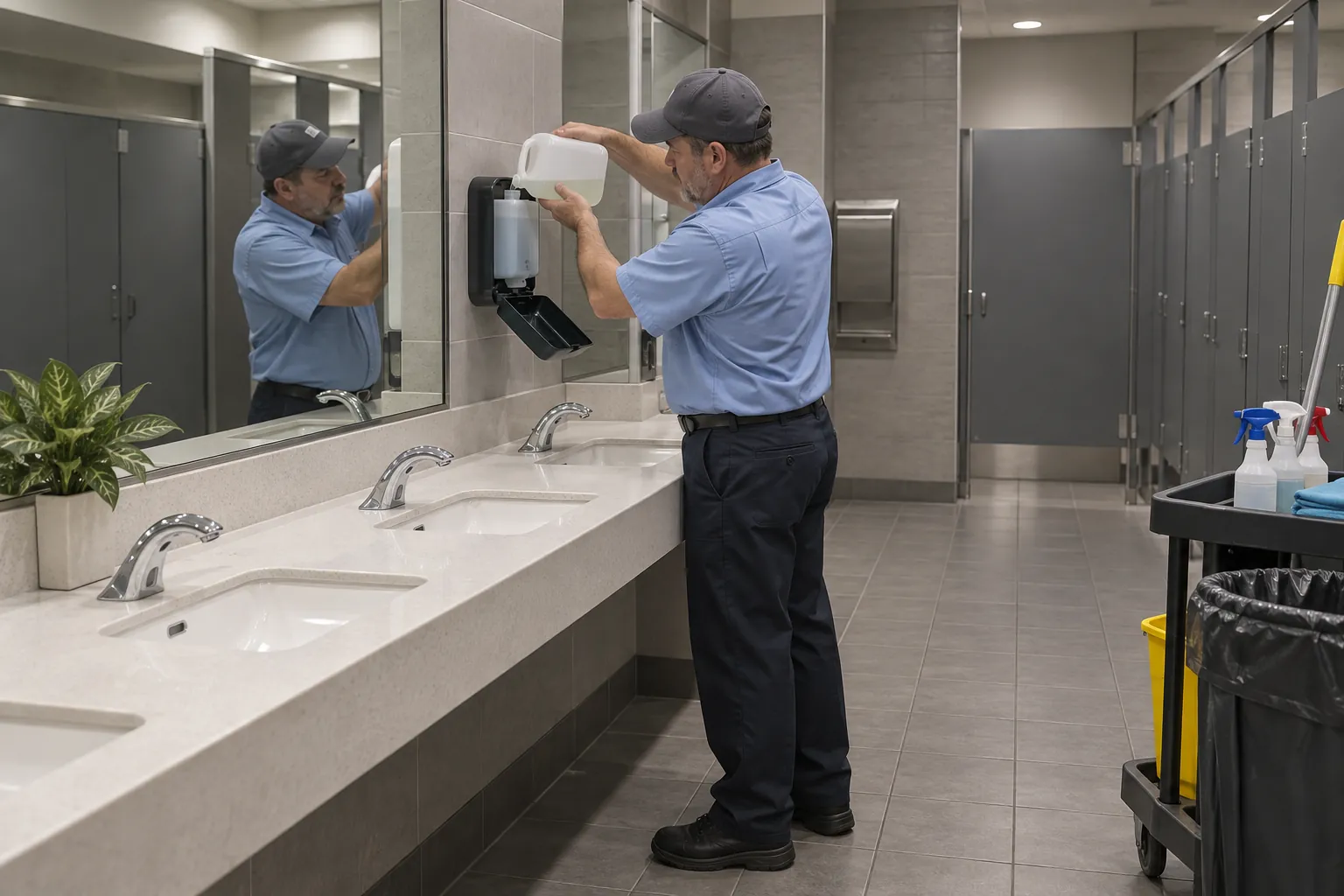
The log sheet on the back of the restroom door is the most visible janitorial record in most buildings, and often the least trusted. This guide covers the federal rules behind it, what each entry should record, how often a restroom should be checked, and what makes the log hold up when a client, a tenant or an inspector questions it.
01
The rules behind the log
No federal regulation says you must hang a cleaning log in a restroom. What the rules require is the outcome the log is meant to show: restrooms that are clean, stocked and usable. For most private employers that duty comes from OSHA's sanitation standard, 29 CFR 1910.141, Sanitation, which applies to permanent places of employment.
- Housekeeping, 1910.141(a)(3): "All places of employment shall be kept clean to the extent that the nature of the work allows," and the floor of every workroom is to be kept, so far as practicable, in a dry condition.
- Waste, 1910.141(a)(4): receptacles for waste must not leak and must be able to be thoroughly cleaned, and sweepings, wastes, refuse and garbage must be removed in a way that avoids creating a menace to health, as often as necessary to keep the workplace sanitary.
- Toilet facilities, 1910.141(c)(1)(i) and (c)(2)(i): the number of toilets follows the number of employees (Table J-1), and each water closet must occupy a separate compartment with a door and partitions high enough to assure privacy.
- Washing facilities, 1910.141(d): washing facilities "shall be maintained in a sanitary condition," and each lavatory must have hot and cold running water, or tepid running water, hand soap or a similar cleansing agent, and individual hand towels or air dryers close by.
OSHA has also said, in its April 6, 1998 interpretation of the toilet facilities requirement, that the standard is meant to ensure employees have "sanitary and available toilet facilities." A restroom that is locked for hours, out of order or out of supplies does not meet that purpose, which is why the log matters as much for what it shows was fixed as for what it shows was wiped. OSHA gathers this material on its Restrooms and Sanitation Requirements page.
Restaurants, cafeterias and other food establishments have a second layer. The FDA Food Code 2026, the current edition of the model most states and counties adopt, at their own pace and in some cases with their own amendments, says plumbing fixtures such as handwashing sinks, toilets and urinals "shall be cleaned as often as necessary to keep them clean" (6-501.18), that toilet tissue must be available at each toilet (6-302.11), that all toilet rooms are provided with a covered receptacle (5-501.17; earlier editions required it only in a toilet room used by females), and that toilet room doors are kept closed except during cleaning and maintenance (6-501.19). The local health department enforces the version your jurisdiction has adopted, which may still be an earlier edition such as 2022.
The duty sits with the employer, or with whoever controls the premises. When janitorial work is contracted out, the contract and its scope of work are how the building owner or tenant shows the duty is being met, and the restroom log is usually the only day-to-day evidence that it was.
02
What a restroom cleaning log should record
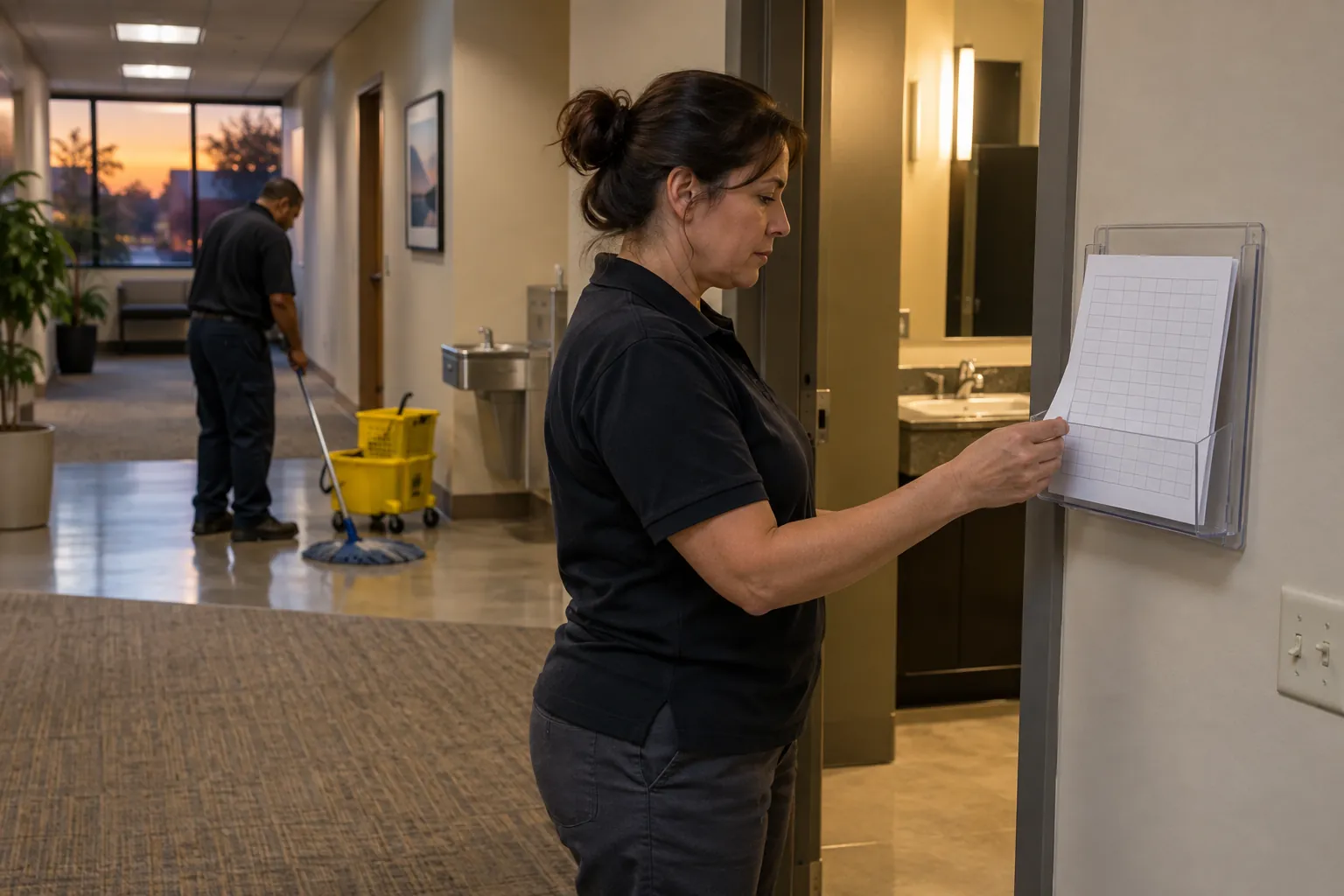
A restroom cleaning log is a short checklist, one row per visit. A useful one records two things: that someone looked, and what they found. A column of initials records only the first. Each entry should carry:
- The date and the actual time of the check, written when it happened, not the time it was due.
- Who checked: a name or initials that identify one person, not "night crew" or the company name.
- Floors: dry, free of paper and litter, no standing water around fixtures.
- Toilets and urinals: clean, flushing, seats, partitions and stall locks intact.
- Sinks, faucets, counters and mirrors: clean, water running, hot and cold or tepid.
- Supplies: toilet paper, hand soap, paper towels or a working hand dryer, seat covers and hand sanitizer where provided, refilled if low. Nobody can wash their hands properly once the soap runs out.
- Trash and sanitary napkin receptacles: emptied or within capacity, liners replaced.
- Odor and ventilation: exhaust fan running, no lingering smell.
- Problems found: a leak, a clogged toilet, a broken dispenser, a light out, and who it was reported to.
- Supervisor check: a separate column, filled in less often, by someone who did not do the cleaning.
Keep the list short enough to be completed honestly in the time the custodian has. A log with twenty boxes an hour gets initialed in one pass at the end of the shift.
Post it where the person checking will see it and fill it in on the spot: inside the restroom door at eye level, in a clear holder, with a pen on a string. A log book kept in the janitor's closet records the same visits, but nobody who uses the room ever sees it. Customers and visitors read it too. In a store, a restaurant or a hotel lobby, a current, honest log says something about cleanliness that the rest of the building has to live up to, and a log with the last entry three days ago says the opposite.
03
How often a restroom should be checked
There is no federal frequency. The Food Code's own words, "as often as necessary to keep them clean," are the honest answer: the right interval follows how many people use the room and what the building is for. It should be written into the janitorial scope of work or the building's cleaning program, not left to whoever is on shift that day. Typical intervals in practice, rather than any standard, are:
- Every 30 to 60 minutes: airports, transit stations, malls, stadiums, arenas, events and highway rest areas at peak times.
- Every one to two hours: busy offices, schools during the day, clinic and hospital waiting areas, gyms, big-box stores.
- Two or three times a day: lightly used offices and staff-only restrooms.
- At least once a day: every restroom in use, with a full cleaning.
Checks should follow the pattern of use, not only the clock: straight after the morning arrival, after lunch, after a passing period or recess, at halftime and after the final whistle. An hourly check through a quiet afternoon and none during the lunch rush produces a tidy log and a dirty restroom.
In a building with a day porter, the restroom rounds are usually the backbone of the porter's day, with the full cleaning left to the night crew. Say so on the log, so a reader knows which entries are a porter's check and which are the night crew's cleaning.
04
A check is not a cleaning
Most arguments about restroom logs come from recording two different jobs in the same box.
- A check is a short visit: look, pick up paper, wipe what needs wiping, refill dispensers, report problems. It takes a few minutes and happens many times a day.
- A cleaning is the scheduled full job in the scope of work: toilets, urinals, sinks, counters, partitions, floors, dispensers and trash, with the right color-coded cloths and the right chemicals. It happens once or twice a day, often after hours.
- Periodic or project work is weekly or monthly: descaling, grout and floor drains, high dusting, vents, behind fixtures, machine scrubbing. It belongs on a periodic schedule, not on the door log.
Record them separately, or at least mark which was done. A client reading "10:00, 11:00, 12:00" assumes three cleanings; the custodian meant three checks. When the restroom is found dirty at 12:15, that difference turns into a dispute about the contract instead of a conversation about the restroom.
Cleaning and disinfecting are different steps too. The CDC's guidance, When and How to Clean and Disinfect a Facility, explains that cleaning alone removes most types of harmful germs from surfaces, and that a disinfectant has to stay wet on the surface for its full contact time, which is given in the product's directions and Safety Data Sheet, to work. It also says to disinfect areas where people have obviously been ill, such as after vomiting. A log that says "disinfected" should mean the product was left wet for the contact time in its directions, not sprayed and wiped straight off.
A problem found on a check should go somewhere that gets it fixed. Writing "sink leaking" on the log records that it was seen; it does not tell maintenance. The log should say who the problem was reported to, when, and, if your building uses them, the work order number.
05
What makes a restroom log believable
Anyone who has managed a janitorial contract has seen a log filled in ahead of time, or every hour of the day initialed in the same pen at the same angle. Clients and tenants know it too, so an unconvincing log can do more harm than no log. What makes a record believable is simple:
- It is written at the time. The time on the log is when the check happened, not when it was scheduled.
- It names a person. Initials that identify one custodian carry weight; a crew name does not.
- It shows exceptions. A log where nothing ever ran out and nothing ever broke is not believed. Entries such as "soap refilled" or "clogged toilet, called maintenance 2:20 p.m." show that someone looked.
- Someone else checks it. A janitorial supervisor or building manager who walks the restroom and initials the log a few times a week, unannounced, gives it independence.
- It is kept. Old logs thrown out every Monday cannot answer a complaint about last Thursday. Keep them for as long as your contract, your insurer or your own policy requires, and know what that period is.
- Gaps are explained. A missed check with a reason, such as "restroom closed for plumber" or "pulled to a spill in the lobby," is more credible than a log with no gaps at all.
Quality control inspections sit on top of the log. A supervisor's scored walk of a sample of restrooms each week checks the quality of the cleaning, which the log cannot, and the two together answer a client far better than either alone.
When a client, a tenant or a health inspector asks, the questions are always the same: when was this restroom last checked, by whom, and what was done about the problem I saw? A good log answers all three.
06
Where the paper log fails, and what SiteClara does about it
Paper works well enough in one building with a steady crew. It struggles when a janitorial contractor looks after many buildings, when crews turn over often, or when a client wants the record instead of an assurance. The log stays on the door, so the client sees it only when they visit. Nobody notices a missed check until the next complaint, nobody can tell from a set of initials whether they were written at 10 a.m. or at 5 p.m., and the clogged toilet written on the log at noon is still clogged at closing because nobody in maintenance read it.
SiteClara replaces the sheet with a tag at the restroom door: a printed QR code poster, with an NFC tag behind it if you want staff to tap instead of scan. A custodian scans the code or taps the tag on their own phone, with no app to install, and completes the check. The time and the person are recorded as it happens. If something is wrong, such as a leak, a broken dispenser or a stall that will not lock, they record it there, with a photo if it helps, and it goes onto the team's list of jobs until someone closes it.
Scheduled checks are set per location. The crew see what is due and mark it done, or say what stopped them, and the janitorial supervisor sees what was done and what was missed and can record why. At the end of the day the supervisor reviews it, adds a note, and the approved report goes to the facility manager or the client at 8 a.m. the next morning, showing how many checks were completed and what is still open.
07
Questions people ask
What are the OSHA requirements for bathroom cleaning?
OSHA's 29 CFR 1910.141, Sanitation sets no cleaning frequency and does not require a written cleaning log; it requires the result. All places of employment must be kept clean to the extent that the nature of the work allows (1910.141(a)(3)(i)), waste must be removed "as often as necessary or appropriate" (1910.141(a)(4)(ii)), and washing facilities "shall be maintained in a sanitary condition" (1910.141(d)(1)), with hot and cold or tepid running water, hand soap or a similar cleansing agent, and individual hand towels or air blowers (1910.141(d)(2)). Toilet facilities must be provided in the numbers set by Table J-1 (1910.141(c)(1)(i)).
How do custodians clean toilets?
The CDC's When and How to Clean and Disinfect a Facility counts restroom fixtures among the high-touch surfaces to clean regularly, with soap and water or a cleaning product appropriate for the surface. Where disinfecting is needed, the surface is cleaned first, then an EPA-registered disinfecting product is applied and left on long enough to kill the germs, with the surface staying wet for the entire contact time. The CDC also advises increasing air circulation in the area while disinfecting and, immediately afterward, washing hands with soap and water for 20 seconds.
08
Further reading, and a list to take away
OSHA's Restrooms and Sanitation Requirements page gathers the sanitation standards and the letters that interpret them, and its Cleaning Industry page covers the hazards janitorial and custodial workers face, including cleaning chemicals and equipment. For food establishments, read the current FDA Food Code (2026) together with the version your state or county health department has adopted, which may be an earlier edition. The CDC's When and How to Clean and Disinfect a Facility explains when cleaning is enough and when to disinfect.
Before you print the next batch of logs, check that:
- the check frequency for each restroom is written in the scope of work and follows how the room is used;
- the log separates checks from full cleanings;
- each entry has the actual time and a name or initials that identify one person;
- there is room to record problems, who they were reported to and the work order number;
- a supervisor initials it on unannounced visits;
- completed logs are kept, and you know for how long;
- evenings, weekends and events are covered on the log if the building is used then;
- your state's OSHA plan and your local health code have been checked for anything that goes further than the federal rules.
Sources
Every document this guide quotes or links to, in the order it first cites them.
- 29 CFR 1910.141, Sanitation osha.gov
- April 6, 1998 interpretation of the toilet facilities requirement osha.gov
- Restrooms and Sanitation Requirements osha.gov
- OSHA-approved State Plans osha.gov
- FDA Food Code 2026 fda.gov
- When and How to Clean and Disinfect a Facility cdc.gov
- Bloodborne Pathogens standard, 29 CFR 1910.1030 osha.gov
- Cleaning Industry osha.gov
Related guides
 CleaningPublic restroom cleaning: frequency, safety and ADA upkeepCleaning public restrooms in parks, transit, venues and public buildings: how often at peak, sharps and bodily fluids under OSHA, and keeping ADA features usable.
 CleaningCleaning log sheet: what to record, who initials it, and what it provesWhat a cleaning log sheet should record in offices, break rooms, kitchens and clinics, the OSHA and Food Code rules behind it, and what each set of initials proves.
 CleaningJanitorial quality control: how to inspect, score and fix the cleaningHow janitorial quality control works: QA versus QC, building a cleaning inspection checklist, APPA appearance levels, sampling, scoring and corrective action.
 CleaningJanitorial scope of work: what it should say, and how to show it is metWhat a janitorial scope of work should cover, how to set cleaning frequencies by room type, output versus input standards, and how to show the work is being done.