Cleaning
Hospital environmental services: what EVS does, and how to show it was done
In a hospital, EVS stands for environmental services, the department that cleans and disinfects patient rooms, operating rooms, public areas and everything in between.
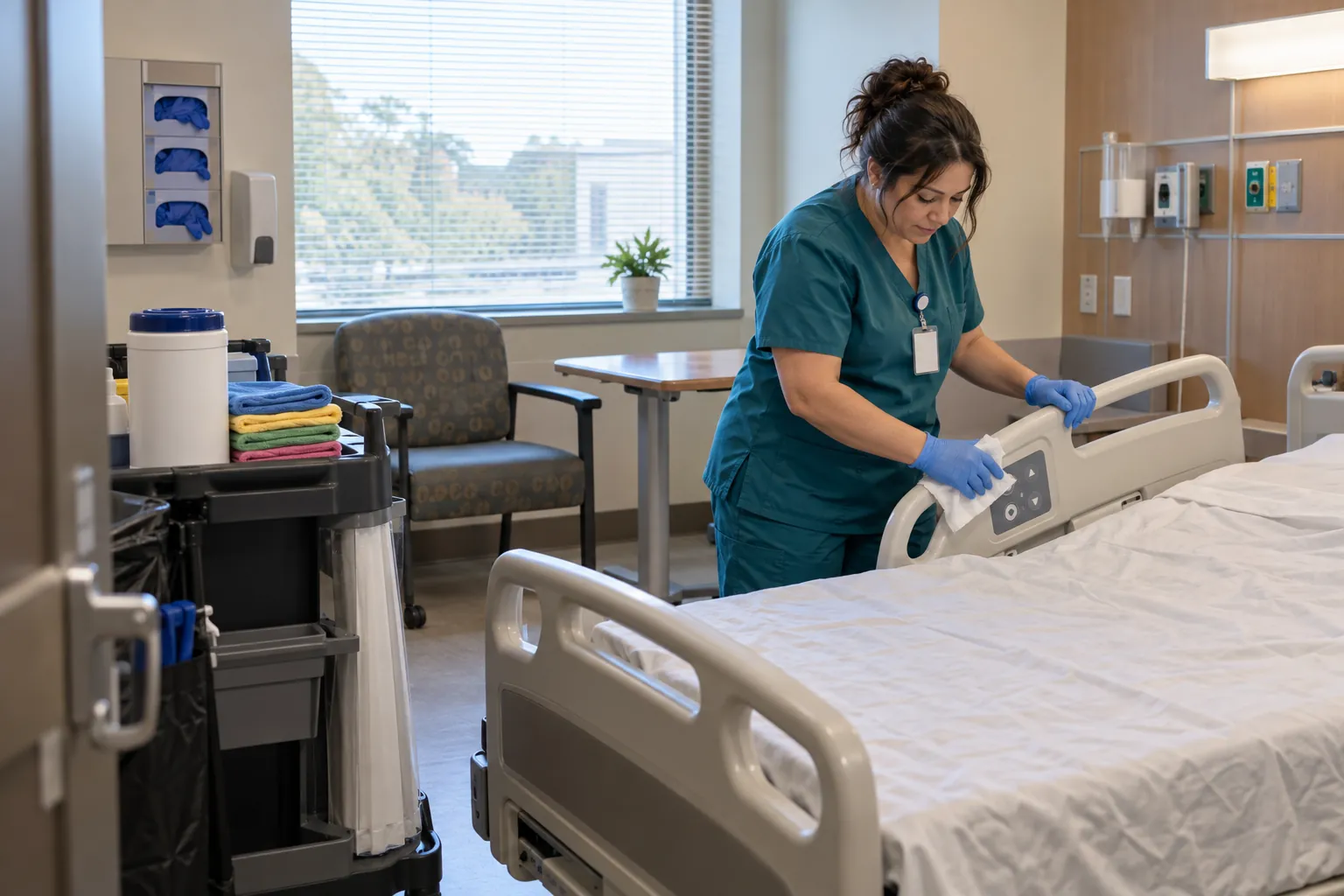
Its work is part of infection prevention and patient safety, not an add-on to it. This guide covers the federal rules and CDC recommendations behind hospital EVS, what the department covers, how often surfaces are cleaned, who is responsible for what, and how a hospital checks that the cleaning actually happened.
01
What hospital EVS is, and the rules behind it
Environmental services (EVS, sometimes still called housekeeping) is the team in a hospital or other healthcare facility that cleans and disinfects the physical environment, from patient rooms and operating rooms to corridors, public restrooms and offices, and usually moves trash, regulated medical waste and soiled linen out of care areas. Some hospitals run EVS in-house; others contract it out. The duty stays with the hospital either way.
For a hospital that takes Medicare or Medicaid, the starting point is the Centers for Medicare & Medicaid Services (CMS) Conditions of Participation. 42 CFR 482.42, Infection prevention and control and antibiotic stewardship programs, requires active hospital-wide programs that "demonstrate adherence to nationally recognized infection prevention and control guidelines." Under 482.42(a)(3), the infection prevention and control program must include surveillance, prevention and control of healthcare-associated infections (HAIs), "including maintaining a clean and sanitary environment to avoid sources and transmission of infection." The neighboring condition, 42 CFR 482.41, Physical environment, adds at 482.41(b)(4) that "the hospital must have procedures for the proper routine storage and prompt disposal of trash."
The nationally recognized guideline most EVS programs are built on is the CDC and HICPAC Guidelines for Environmental Infection Control in Health-Care Facilities (2003, last updated July 2019). Each recommendation carries a category: IA and IB are strongly recommended, IC is required by regulation or an established association standard, and II is suggested. The recommendations on how often surfaces are cleaned, and on mops and solutions, are Category II, so read them as the floor of a written program rather than a finished one; others, such as using EPA-registered disinfectants to the label (IB, IC) and not fogging patient-care areas (IB), are strongly recommended.
Worker protection is the third layer. OSHA's Bloodborne Pathogens standard, 29 CFR 1910.1030, applies to any employee with occupational exposure to blood or other potentially infectious materials, which includes most EVS staff. Paragraph (d)(4)(i) says: "Employers shall ensure that the worksite is maintained in a clean and sanitary condition. The employer shall determine and implement an appropriate written schedule for cleaning and method of decontamination based upon the location within the facility, type of surface to be cleaned, type of soil present, and tasks or procedures being performed in the area." That written schedule is the backbone of an EVS program, and it is a legal requirement.
Most hospitals are also surveyed by an accrediting organization such as The Joint Commission, whose Environment of Care and Infection Prevention and Control chapters are paid documents; work from your own current copy.
02
What EVS covers in practice
The scope of an EVS department varies with the hospital, but the core work is the same almost everywhere:
- Daily cleaning of occupied patient rooms: high-touch surfaces, the patient bathroom, floors and trash, done around care.
- Discharge and transfer cleaning, usually called terminal cleaning: the full clean and disinfection of a room before the next admission, closely watched by bed management.
- Isolation rooms: cleaning with the personal protective equipment (PPE) and the disinfectant the precautions call for.
- Operating and procedure rooms: cleaning between cases and terminal cleaning at the end of the day. The CDC guideline recommends that after the last surgical procedure of the day or night, operating room floors are wet vacuumed or mopped "with a single-use mop and an EPA-registered hospital disinfectant."
- Public and non-patient areas: lobbies, elevators, waiting areas, public restrooms, stairwells and offices. The CDC notes that detergent and water are adequate for surfaces in nonpatient-care areas such as administrative offices; restrooms and other high-touch areas usually need more.
- Spills of blood and body fluids, wherever they happen, cleaned up promptly under the OSHA standard.
- Trash, regulated medical waste and soiled linen: trash under 482.41(b)(4), regulated medical waste under your state's rules, and contaminated laundry under paragraph (d)(4)(iv) of the OSHA standard.
- Floors and carpets: routine care and periodic deep cleaning, planned around patients at higher risk from dust.
What EVS does not own matters just as much. Bedside equipment such as infusion pumps and monitors is often cleaned by nursing, and the split varies between hospitals and units. The CDC's evaluation toolkit, discussed below, says the responsibilities of EVS staff and other hospital personnel for cleaning high-touch surfaces, "e.g., equipment in ICU rooms," should be clearly defined. A surface that belongs to everyone tends to be cleaned by no one.
03
How often, and with what
The CDC guideline does not give a single cleaning frequency for every surface. It sets principles, and the hospital turns them into the written schedule OSHA requires. The principles that shape most schedules are these:
- Housekeeping surfaces visibly clean. Keep housekeeping surfaces such as floors, walls and tabletops "visibly clean on a regular basis and clean up spills promptly" (Category II).
- High-touch surfaces more often. "Clean and disinfect high-touch surfaces (e.g., doorknobs, bed rails, light switches, and surfaces in and around toilets in patients' rooms) on a more frequent schedule than minimal touch housekeeping surfaces" (Category II).
- Low-touch surfaces on a routine. Horizontal surfaces with infrequent hand contact in routine patient-care areas, such as window sills and hard floors, "require cleaning on a regular basis, when soiling or spills occur, and when a patient is discharged from the facility."
- Immediately, for blood. Under 29 CFR 1910.1030(d)(4)(ii)(A), contaminated work surfaces are decontaminated with an appropriate disinfectant after completion of procedures, "immediately or as soon as feasible when surfaces are overtly contaminated or after any spill of blood or other potentially infectious materials," and at the end of the work shift if the surface may have become contaminated since the last cleaning.
The product matters as much as the frequency. The guideline recommends selecting EPA-registered disinfectants and using them "in accordance with the manufacturer's instructions" (Category IB, IC). For rooms where C. difficile patients are treated, the April 2019 update recommends an EPA-registered product effective against C. difficile spores, which is what EPA's List K lists. EPA's advice is to follow the label directions for C. diff "carefully including the contact time," and its page on selected EPA-registered disinfectants adds that the surface should be visibly wet for the entire contact time, which may mean reapplying the product.
The guideline also asks that cleaning solutions be prepared daily or as needed; that mop heads be changed at the beginning of the day and after large spills of blood or body substances; that mops and cloths be cleaned and dried before reuse, or be single-use; and that disinfectant fogging not be performed in patient-care areas. In areas for immunocompromised patients, horizontal surfaces are wet-dusted daily and vacuums carry HEPA filters.
04
Who does what
EVS works inside the hospital's infection prevention program rather than beside it. Under 42 CFR 482.42(a)(1), the governing body appoints a qualified infection preventionist or infection control professional to run that program, and the program sets the standards EVS cleans to. In practice the responsibilities usually divide like this:
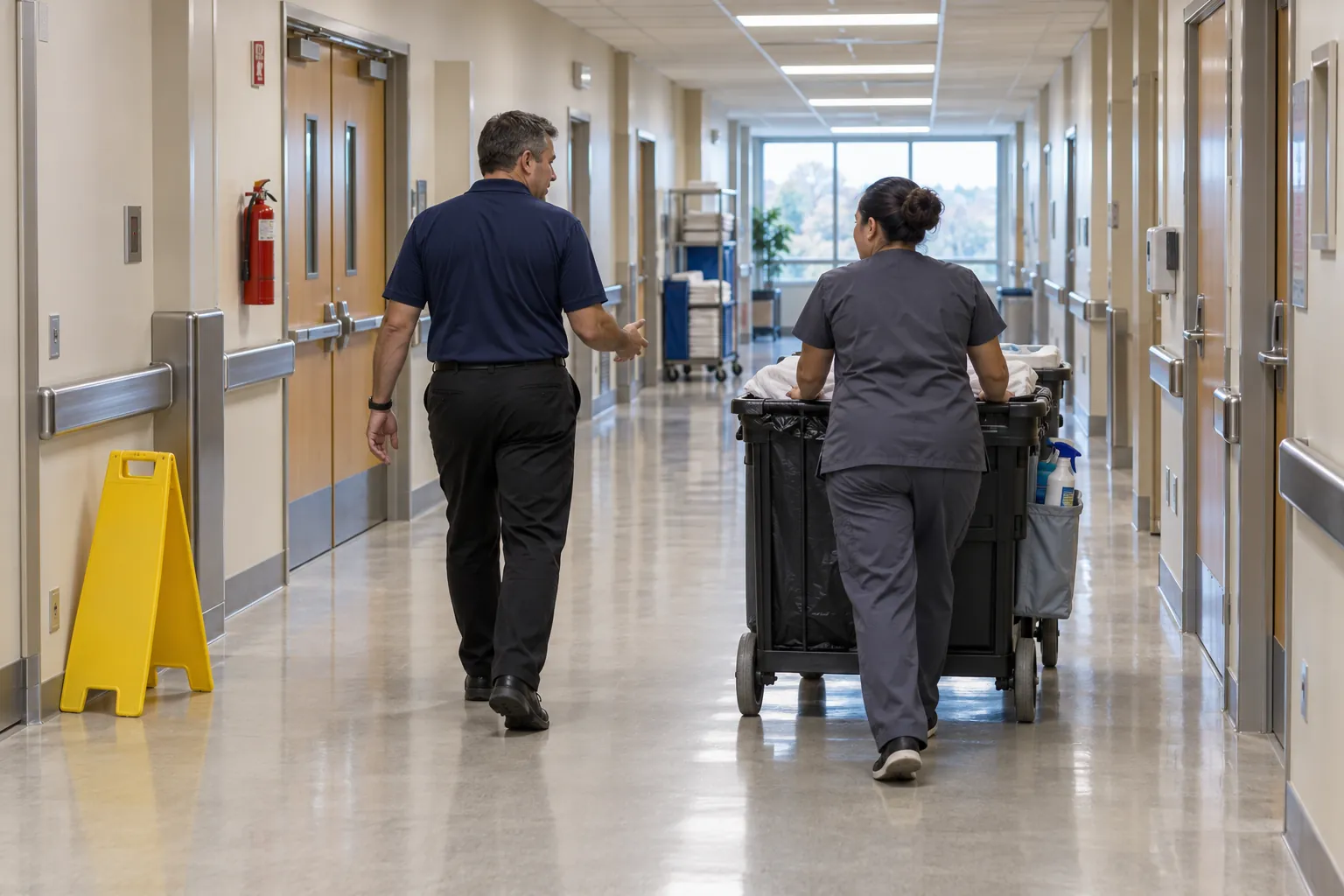
- EVS technicians (also called housekeepers, EVS associates or environmental service aides) clean assigned rooms and areas to the written procedure, report hazards and damage, and follow isolation signage and PPE requirements.
- EVS leads and supervisors assign rooms, respond to urgent cleans and spills, inspect finished rooms and keep the daily record.
- The EVS manager or director owns the written schedule, the products, staffing, training and quality measures.
- The infection preventionist sets and reviews cleaning standards with EVS, investigates clusters and outbreaks, and, in the CDC model below, runs the independent checks on cleaning thoroughness.
- Nursing and clinical staff clean the equipment agreed as theirs, tell EVS when a room is vacated or precautions change, and flag spills.
- Facilities and building engineering fix what cleaning cannot, such as a leaking fixture or a damaged surface that cannot be disinfected.
Training runs through all of it. The OSHA standard requires bloodborne pathogens training for each employee with occupational exposure at the time of initial assignment and at least annually thereafter, during working hours and at no cost to the employee. The CDC guideline adds that workers in patient-care areas "should receive periodic training in environmental-surface infection-control strategies and procedures."
When EVS is contracted out, write the division of work into the scope of work: what the vendor cleans, with which products, how fast it responds to a discharge or a spill, how its work is inspected and what records it hands over. A hospital cannot contract away the Condition of Participation.
05
How hospital cleaning is checked
Visual inspection, a supervisor walking a finished room with a checklist, catches dust and trash but cannot see whether a bed rail was disinfected. The CDC's Options for Evaluating Environmental Cleaning (2010) toolkit was written for that gap. It encourages all hospitals "to develop programs to optimize the thoroughness of high touch surface cleaning as part of terminal room cleaning at the time of discharge or transfer of patients," in two levels.
- Level I: a joint program of infection prevention and EVS, with hospital-specific expectations, structured education of EVS staff, monitoring that may include competency evaluation of EVS staff and patient satisfaction survey results, and results reported to the infection control committee and facility leadership.
- Level II: the same joint program, hospital-specific expectations and structured education, plus an objective assessment of how thoroughly high-touch surfaces are cleaned at terminal cleaning. The result is the thoroughness of disinfection cleaning (TDC) score: the number of objects cleaned divided by the number evaluated, times 100. Monitoring is done at least three times a year, with a sample size set to detect a meaningful change.
The toolkit compares the objective methods: covert direct observation of practice; swab cultures; agar slide cultures; fluorescent gel markers, which dry clear, placed on high-touch objects before cleaning and checked afterward to see whether they were removed; and ATP bioluminescence, which measures organic material on a surface with a handheld luminometer. It is candid about their limits: cultures need pre-cleaning levels to mean much, and ATP measures organic debris as well as live bacteria. Whatever method is used, the toolkit says the monitoring should be done by infection preventionists or their designees "who are not part of the actual ES cleaning program."
Its checklist names the objects that matter most, among them bed rails, the tray table, the call box, the bedside table drawer pull, the IV pole, the sink, light switches, door levers and the toilet area hand holds.
Objective monitoring checks the quality of a sample of rooms. It does not tell a supervisor, day to day, whether every scheduled clean happened, when, and by whom. That needs a different record.
06
Where the EVS record fails, and what SiteClara does about it
Terminal cleaning is usually tracked closely, because bed management depends on it. The record thins out in the routine work elsewhere: the public restroom checked hourly, the waiting area wiped down each shift, the soiled utility room, the trash holding area. The evidence is often a log sheet on a door, initialed in a column, sometimes for a whole shift at once. Nobody can tell when a check was done, a missed round is rarely written down as missed, and a leak noted on the sheet waits until someone reads it.
SiteClara records those checks at the location. A printed QR code poster, with an optional NFC tag behind it, goes at each place a check is scheduled. An EVS technician scans the code or taps the tag on their own phone, with no app to install, sees the checks due there, and marks each one done or says what stopped them, for example a room they could not enter. The time and the named person are recorded as it happens, with a photo when one is asked for. A problem found on the round, such as a leaking fixture or an overflowing sharps container awaiting pickup, goes onto the team's list of jobs until someone closes it.
The EVS supervisor sees what is due, done and missed, and records the reason when a check was missed. Each day they review the totals and photos, add a note and approve a report that goes the next morning to nominated managers, such as the EVS director or, for a contracted service, the hospital's contract manager. It shows what was reported, completed and still open, and how the scheduled checks went, for example 14 of 16 completed, with the reasons for the two that were not.
07
Questions people ask
What does EVS stand for in a hospital?
Environmental services: the department, in-house or contracted, that cleans and disinfects the hospital's rooms, surfaces and public areas. The Environmental Services section of the CDC's Guidelines for Environmental Infection Control in Health-Care Facilities gives the reason the work matters: "Cleaning and disinfecting environmental surfaces as appropriate is fundamental in reducing their potential contribution to the incidence of healthcare-associated infections."
Is EVS the same as housekeeping?
Largely, yes. The Department of Labor classifies them together: its O*NET summary for Maids and Housekeeping Cleaners lists environmental services aide and environmental services worker among the reported job titles, beside housekeeper, and describes light cleaning duties in commercial establishments "such as hotels and hospitals." The CDC guideline itself still speaks of housekeeping surfaces, and says infection-control practitioners typically coordinate a cleaning and disinfecting strategy and schedule "with the housekeeping staff."
Do you need a degree for EVS?
No. In the O*NET summary for Maids and Housekeeping Cleaners, the occupation that includes environmental services aides, 45% of respondents said a new hire needs less than a high school diploma, 36% a high school diploma or equivalent and 7% a post-secondary certificate, with on-the-job training ranging from a few days to one year. The hospital adds its own training, including the bloodborne pathogens training that OSHA's Bloodborne Pathogens standard, 29 CFR 1910.1030, requires at assignment and at least annually.
Is EVS a hard job?
It is physically demanding, and in a hospital it involves exposure to blood and body fluids. The Bureau of Labor Statistics has no separate entry for EVS, but its Occupational Outlook Handbook entry for janitors and building cleaners says cleaners spend most of the day walking, standing or bending, often move or lift heavy supplies and equipment, and sometimes suffer sprains or strains from heavy lifting; where a building such as a hospital needs 24-hour maintenance, shifts may include nights, weekends or holidays. Because of the exposure to blood, the OSHA standard's protections, from PPE to training, apply to most EVS workers.
08
Where to read more, and a list to take away
The CDC publishes the Guidelines for Environmental Infection Control in Health-Care Facilities, with its Environmental Services background section online and the Part II recommendations in the full PDF, and the Options for Evaluating Environmental Cleaning toolkit with its terminal cleaning checklist. The Conditions of Participation, the OSHA standard and EPA's lists are linked above. Your accreditor's manual and your state's hospital licensing rules complete the picture.
Before your next survey, or your next contract review, check that:
- there is a written cleaning schedule and method for each area, as 29 CFR 1910.1030(d)(4)(i) requires, with high-touch surfaces cleaned more often;
- every product is EPA-registered, used to its label, and left wet for its contact time, with a List K product where C. difficile is involved;
- the split between EVS, nursing and clinical engineering for bedside equipment is written down, unit by unit;
- bloodborne pathogens training is given at assignment and at least annually, and the spill procedure is known on every shift;
- terminal cleaning thoroughness is checked objectively, by someone outside EVS, and the results go back to the staff as feedback;
- routine rounds outside patient rooms leave a record of when they were done and by whom, and missed ones are recorded as missed;
- problems found while cleaning reach the people who can fix them, and stay open until they are fixed.
Sources
Every document this guide quotes or links to, in the order it first cites them.
- 42 CFR 482.42, Infection prevention and control and antibiotic stewardship programs ecfr.gov
- 42 CFR 482.41, Physical environment ecfr.gov
- Guidelines for Environmental Infection Control in Health-Care Facilities cdc.gov
- Bloodborne Pathogens standard, 29 CFR 1910.1030 osha.gov
- OSHA-approved State Plans osha.gov
- EPA's List K epa.gov
- Selected EPA-registered disinfectants epa.gov
- Options for Evaluating Environmental Cleaning cdc.gov
- Environmental Services section of the CDC's Guidelines for Environmental Infection Control in Health-Care Facilities cdc.gov
- O*NET summary for Maids and Housekeeping Cleaners onetonline.org
- Occupational Outlook Handbook entry for janitors and building cleaners bls.gov
Related guides
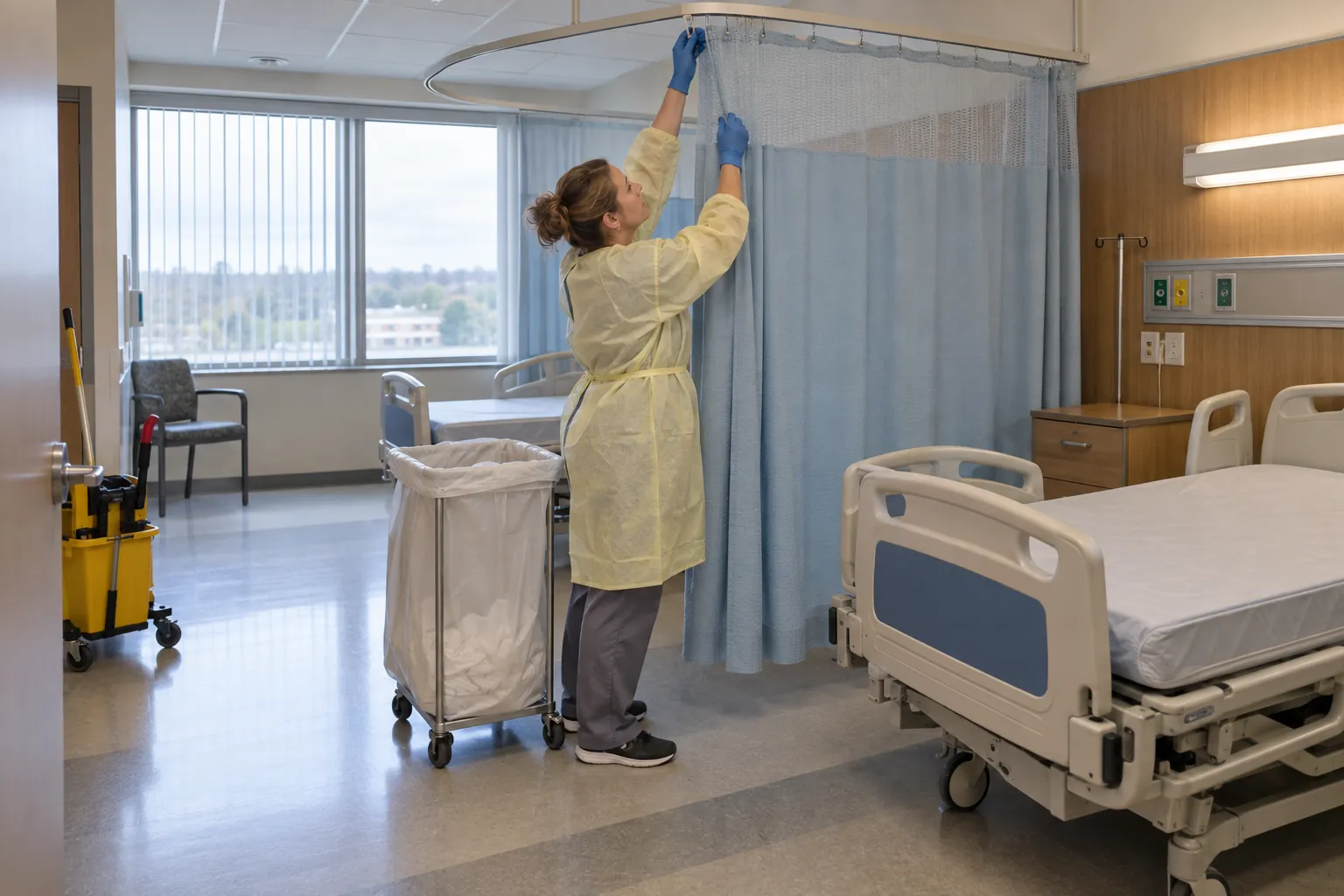 CleaningTerminal cleaning: how to do it, and how to show it was doneWhat terminal cleaning is, when it is done, the CDC steps in order, the products for C. diff and C. auris rooms, and how a hospital checks the clean was thorough.
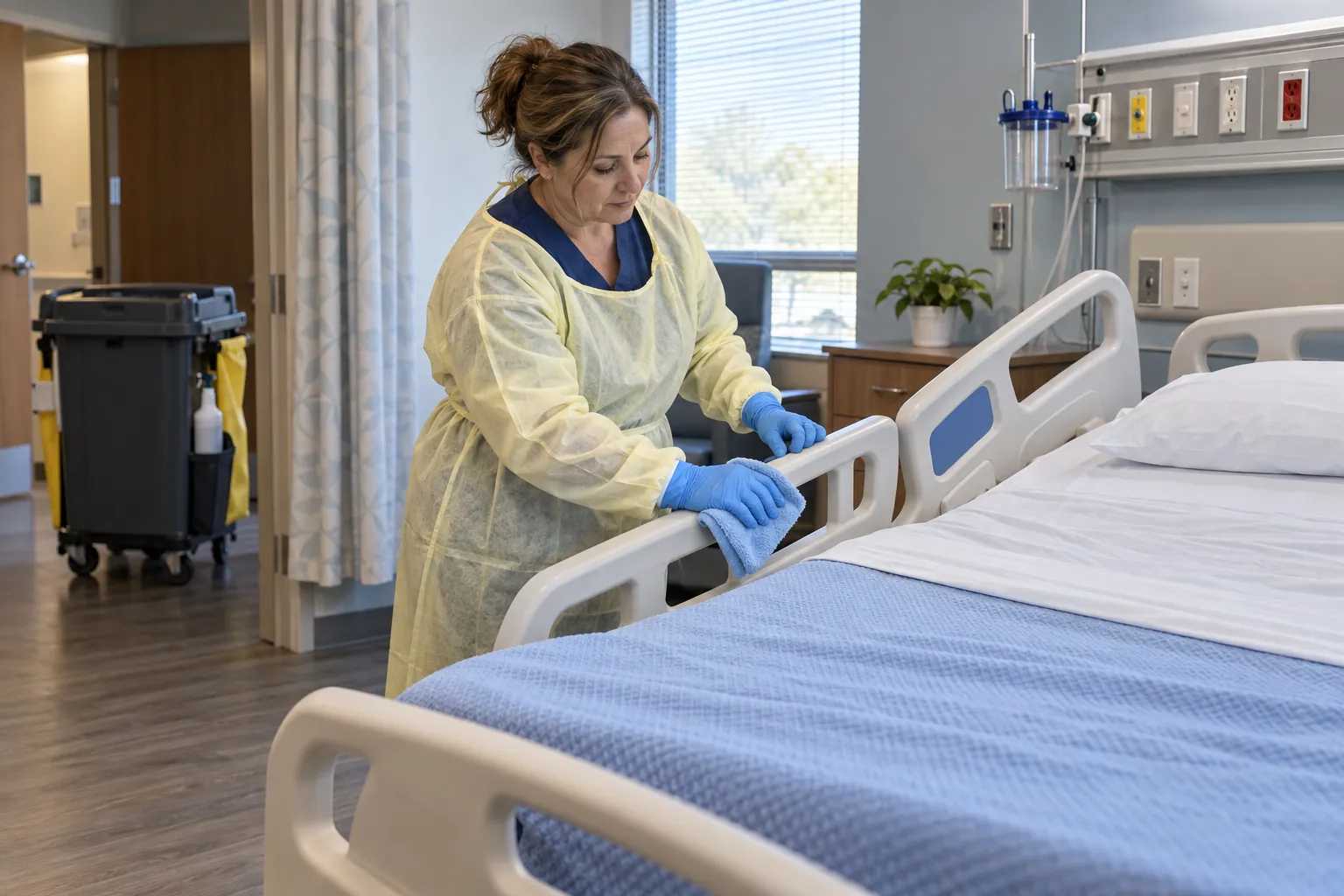 CleaningPatient room cleaning: the daily clean, and how to show it was doneHow to clean an occupied patient room each day: what the CDC and CMS expect, the order of work, products for precautions rooms, who does what, and how it is checked.
 CleaningHigh-touch surfaces: a cleaning routine you can show was doneHigh-touch surfaces as the CDC describes them: which ones to list area by area, how often to clean and disinfect them, the right method, and a record that holds up.
 CleaningC. diff cleaning: killing the spores, and showing it was doneHow to clean for C. diff: why ordinary disinfectants miss the spores, choosing a List K product, daily and discharge cleans, and how to show each clean was done.