Cleaning
C. diff cleaning: killing the spores, and showing it was done
C. diff cleaning means removing soil from a surface and then applying a sporicidal disinfectant from EPA's List K, such as a registered bleach product, and keeping the surface wet for its full labeled contact time, because the spores of Clostridioides difficile survive ordinary cleaning products and hand sanitizer.
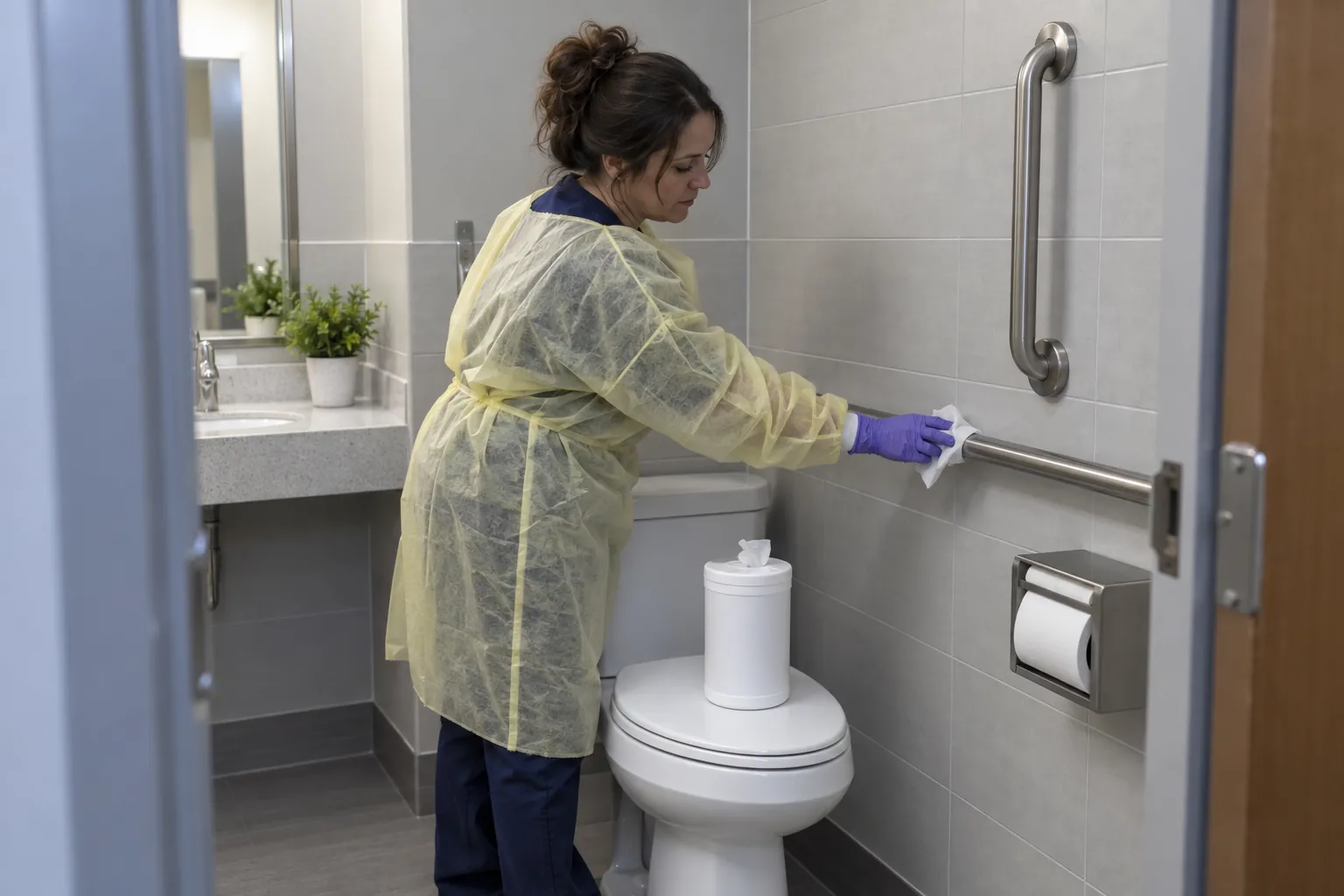
Cleaning for it means a stricter routine than the usual clean and a clear handoff between nursing and environmental services. This guide covers what the CDC recommends, the federal rules behind it, how to choose and use a sporicidal product from List K, where C. diff cleaning is needed, and how a facility checks the work was done.
01
Why C. diff cleaning is different, and the rules behind it
C. diff, the bacterium formerly named Clostridium difficile, causes diarrhea and colitis, most often in people taking an antibiotic or who have just finished one. What makes it a cleaning problem is the spore, which is how it spreads from one person to the next. The CDC's C. diff: Facts for Clinicians explains: "C. diff sheds in feces. Any surface, device or material that becomes contaminated with feces could serve as a reservoir for the C. diff spores," which "can transfer to patients by the hands of healthcare personnel who have touched a contaminated surface or item."
Spores shrug off the products most custodial and EVS carts carry. The CDC's Guideline for Disinfection and Sterilization in Healthcare Facilities (2008) says of quaternary ammonium compounds, the everyday "quat" disinfectants: "The quaternaries sold as hospital disinfectants are generally fungicidal, bactericidal, and virucidal against lipophilic (enveloped) viruses; they are not sporicidal." Hands are the same story. The CDC's clinical facts page says: "Gloves are important because hand sanitizer doesn't kill C. diff. In addition, handwashing alone may not be sufficient to eliminate all C. diff spores."
So C. diff cleaning is not a more thorough version of the usual clean. It is the usual clean, followed by a sporicidal product left wet for its full contact time, on a schedule set by the patient's precautions.
No federal rule sets out a C. diff cleaning procedure. The duty sits in broader requirements, and the CDC's recommendations are how facilities meet them:
- Hospitals. Under 42 CFR 482.42, the Condition of Participation for infection prevention and control, a Medicare or Medicaid hospital's program must "demonstrate adherence to nationally recognized infection prevention and control guidelines," and under 482.42(a)(3) it includes "maintaining a clean and sanitary environment to avoid sources and transmission of infection."
- Nursing homes. 42 CFR 483.80, Infection control, requires a long-term care facility to "establish and maintain an infection prevention and control program designed to provide a safe, sanitary, and comfortable environment," with written standard and transmission-based precautions and "a system for recording incidents identified under the facility's IPCP and the corrective actions taken."
- The people doing the work. OSHA's Hazard Communication standard, 29 CFR 1910.1200, requires "effective information and training on hazardous chemicals in their work area at the time of their initial assignment," and a safety data sheet for each hazardous chemical, readily accessible on every shift. In a State Plan state, the state's equivalent applies.
Most programs follow the CDC's Clinical Guidance for C. diff Infection Prevention in Acute Care Facilities. It is written for hospitals, but other healthcare settings can borrow from it.
02
Where and when C. diff cleaning is needed
The CDC's clinical guidance sets out the environmental cleaning a hospital should do around a patient with C. diff infection (CDI). In its own words:
- "Perform daily cleaning of CDI patient rooms using a C. difficile sporicidal agent."
- "Clean and disinfect the patient-care environment (including the immediate vicinity around a CDI patient and high-touch surfaces) at least once a day."
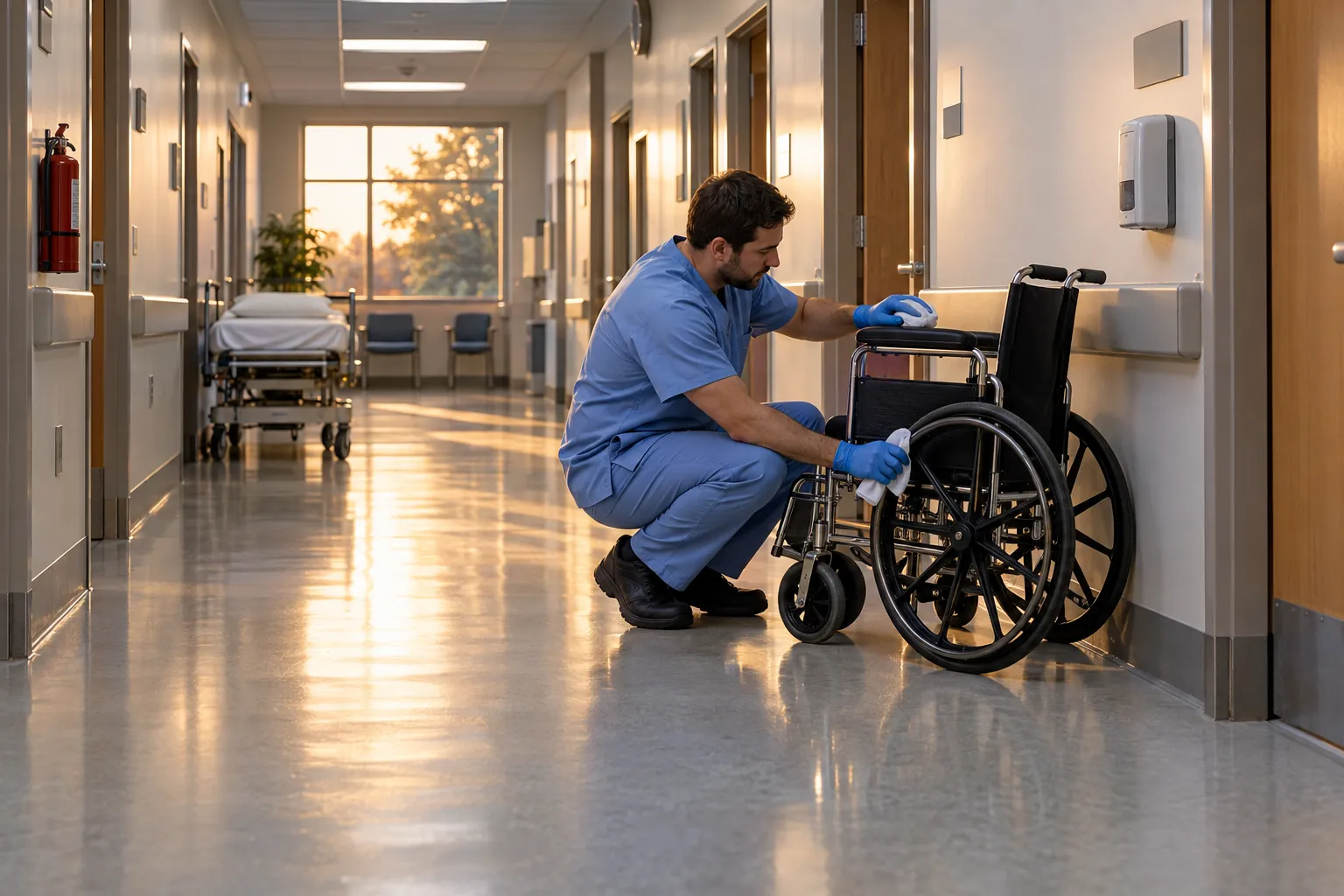
- "Clean and disinfect all shared equipment prior to use with another patient, including toilets, wheelchairs and gurneys."
- "Perform terminal cleaning after CDI patient transfer/discharge with a C. difficile sporicidal agent."
- "Clean other areas that are contaminated during transient visits by patients with suspected or confirmed CDI like radiology, emergency departments and physical therapy with a C. difficile sporicidal agent."
That gives four kinds of C. diff clean, and each needs its own trigger:
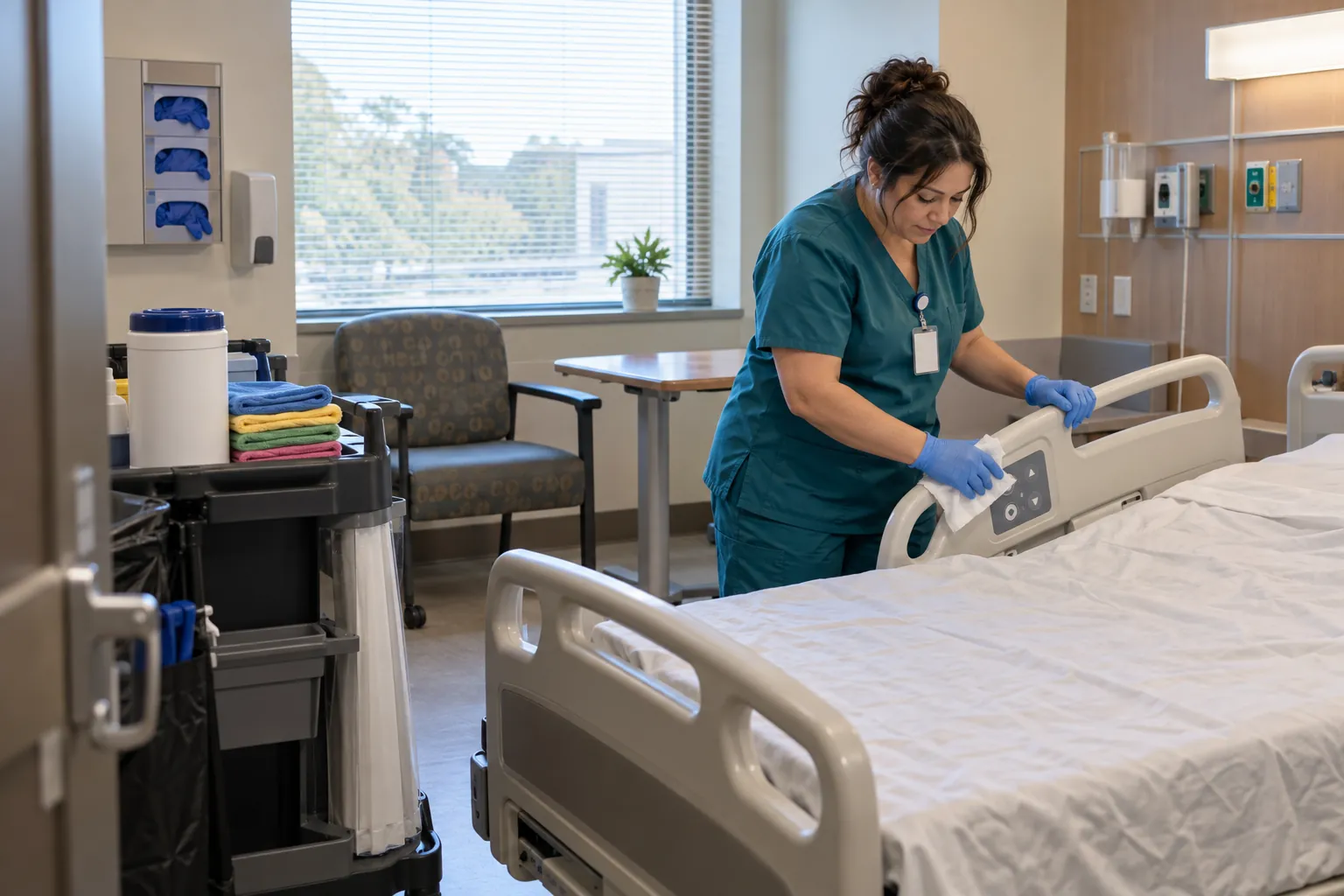
- The daily clean of an occupied CDI room and its bathroom, every day the patient is on precautions. The trigger is the precautions sign on the door and the unit's isolation list, not a request.
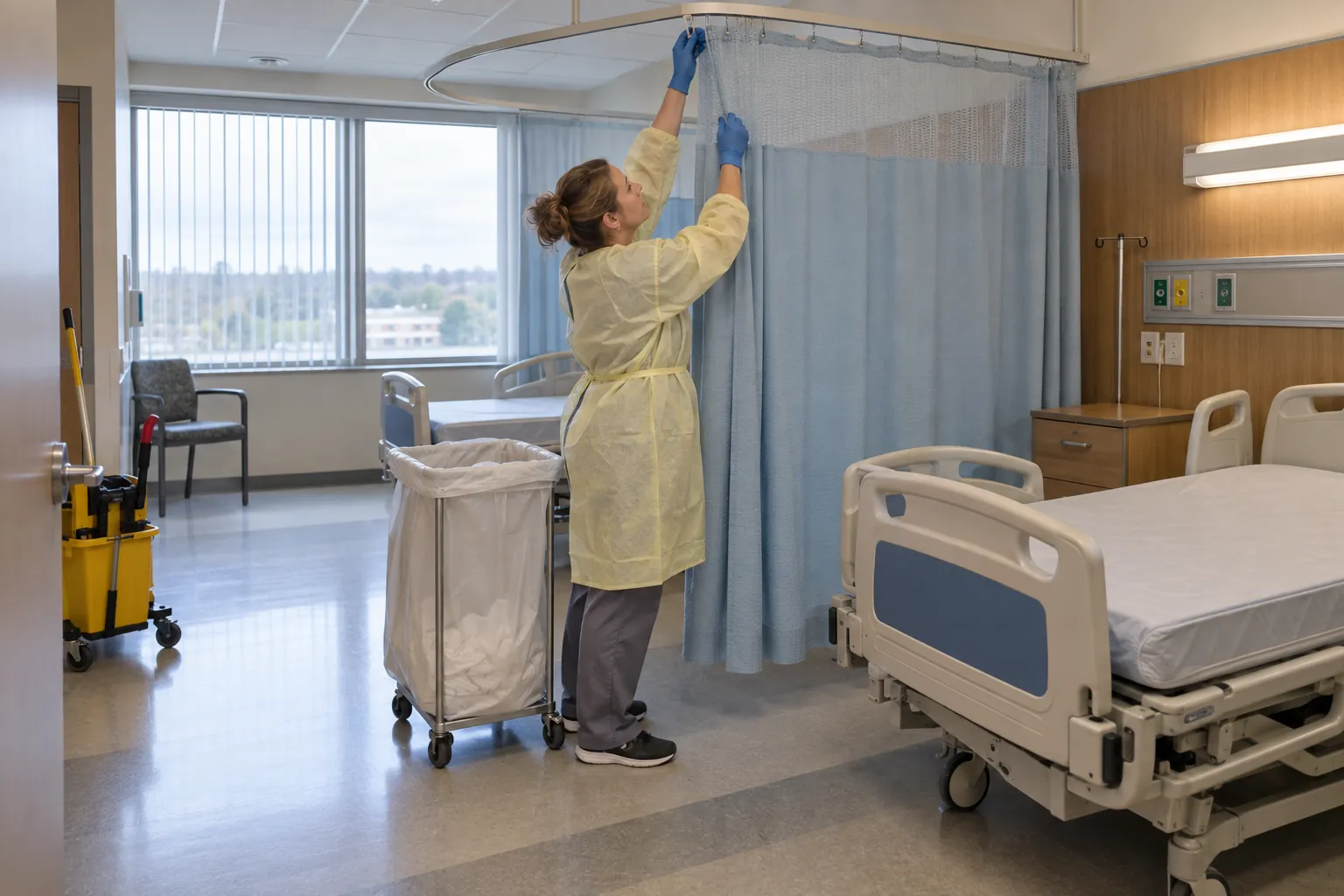
- The discharge or transfer clean, a full terminal clean with a sporicidal product before the bed is released. The detail of the steps is in the guide on terminal cleaning.
- The shared equipment clean, every time a wheelchair, gurney, commode or lift leaves the patient, before anyone else uses it.
- The transient area clean, after a CDI patient passes through imaging, the emergency department or therapy. These are the cleans most often missed, because the patient has already gone.
How long does it go on? The CDC's guidance says: "For patients with confirmed CDI, maintain contact precautions for at least 48 hours after diarrhea has resolved, or longer, up to the duration of hospitalization." The daily sporicidal clean follows the precautions, so EVS needs to know the day they are lifted as well as the day they start.
03
Choosing a C. diff disinfectant: List K, bleach and contact time
The CDC's Guidelines for Environmental Infection Control in Health-Care Facilities put the approach in one sentence: "The recommended approach to environmental infection control with respect to C. difficile is meticulous cleaning followed by disinfection using EPA-registered products specific for inactivating C. difficile spores as appropriate." Both halves matter. Soil left on a surface protects spores from the disinfectant, so the clean comes first and the sporicide goes onto a clean surface.
EPA keeps the list of products. EPA's Registered Antimicrobial Products Effective Against Clostridioides difficile (C. diff) Spores [List K] contains products for which "EPA has reviewed required laboratory testing data demonstrating that these products kill Clostridioides difficile (C. diff) spores." The active ingredients on the list include sodium hypochlorite, hydrogen peroxide, peroxyacetic acid and hypochlorous acid. Listed contact times run from about a minute and a half to ten minutes.
To check a product against List K:
- Find the EPA registration number on the label, printed as "EPA Reg. No." followed by two numbers joined by a hyphen, and search List K for it. A distributor's product carries a third number and is not on the list itself; EPA says it is an equivalent product when its first two numbers are listed.
- Confirm the label "includes directions for use as a disinfectant product against Clostridioides difficile"; the C. diff dilution, contact time or surfaces can differ from those for other organisms.
- Write the C. diff contact time and dilution into the procedure and onto the cart.
EPA's warning on the list applies every day: "A product's effectiveness can change depending on how you use it," so "follow the label directions for Clostridioides difficile (C. diff) carefully including the contact time." Contact time is how long the surface must stay wet with the product. A wipe that dries in one minute on a product with a four-minute contact time has not done the job, and the surface needs another application.
Check equipment makers' instructions before a sporicide goes on a monitor or pump, and treat any UV or vapor system as an extra step after the manual clean, never a replacement for it.
04
Doing the work: routine, equipment and the people involved
A C. diff clean follows the order of any good patient room clean, with a few additions:
- Put on the right PPE before entering. The room is on contact precautions, so gloves and a gown go on at the door, following the facility's precautions sign.
- Work clean to dirty and high to low. Finish with the bathroom and the floor; the toilet, the commode and anything near them are the most contaminated surfaces.
- Clean first, then apply the sporicide. Remove visible soil with a detergent or with a product labeled as a one-step cleaner and C. diff disinfectant, then apply the sporicide and keep the surface wet for the full contact time.
- Use a fresh cloth for each surface area, and never dip a used one back into the solution. A separate color of cloth and mop for C. diff rooms helps keep them apart.
- Treat the equipment as part of the room. The CDC guidance says: "Use dedicated patient-care equipment such as blood pressure cuffs and stethoscopes." In practice, those items stay in the room and are cleaned or discarded at the discharge clean.
- Wash hands with soap and water when leaving, after the gloves come off. Hand sanitizer at the doorway does not remove spores.
Chemical safety sits beside infection control: training on each sporicide before first use, the safety data sheet to hand, and a rule never to mix products, because chlorine bleach mixed with ammonia or acidic cleaners gives off toxic gas.
Most misses happen at a handoff, not in the room. A workable split:
- Nursing or the unit puts the room on precautions, tells EVS the same shift, and tells them again when precautions end or the patient moves, including trips to imaging or therapy.
- The EVS technician does the daily and discharge cleans with the sporicide, and reports damage that stops a surface being cleaned, such as a torn mattress cover or a cracked toilet seat.
- The EVS supervisor or lead keeps the list of rooms needing the sporicidal clean, checks it against the unit's isolation list each shift, and inspects a share of the finished rooms.
- The infection preventionist picks or approves the products with EVS, sets the procedure and runs the independent checks.
- Imaging, the emergency department and therapy know who cleans their rooms after a CDI patient, and with what.
05
Checking C. diff cleaning, and what good evidence looks like
The CDC's clinical guidance asks hospitals to "create daily and terminal cleaning protocols and checklists for patient-care areas and equipment" and to routinely audit "adequacy of room cleaning using methods described in 'Options for Evaluating Environmental Cleaning.'" The CDC's Options for Evaluating Environmental Cleaning toolkit encourages hospitals "to develop programs to optimize the thoroughness of high touch surface cleaning as part of terminal room cleaning at the time of discharge or transfer of patients."
Two different questions need answering, and they need different evidence:
- Was the room cleaned well? This is a sample question, answered by audits: direct observation, or fluorescent marks placed before the clean and checked under UV light afterward. An ATP reading shows organic residue left on a surface, which says something about the cleaning; it does not show whether spores were killed. The guide on ATP testing covers what the readings mean.
- Was every room that needed a sporicidal clean given one? A sample cannot answer this. It needs a record of every daily clean, discharge, shared item and transient area, with the time, the person and the product.
Good evidence for the second question shows, for each C. diff clean:
- the room or area, and the kind of clean (daily, discharge, shared equipment or transient area);
- when it was done and who did it, recorded at the time;
- which sporicidal product was used;
- anything that stopped it, and damage found and reported.
Missed cleans should be visible as missed. A list of rooms on precautions set beside a list of cleans done shows the gaps; a sheet that only records what was done shows none. Feed audit results back to the people doing the work; results used only to discipline teach people to clean for the auditor.
06
Where the C. diff cleaning record fails, and what SiteClara does about it
The C. diff clean is often recorded nowhere in particular. The room goes onto a whiteboard list, the daily clean is ticked on a sheet initialed for the whole shift, and the discharge clean shows up as a bed turning from dirty to clean on the bed board, which records that the bed was released, not that a sporicide was used. The wheelchair that went to radiology, and the radiology room, are recorded by nobody. When infection prevention asks which rooms had the sporicidal clean last Tuesday, the answer is a reconstruction.
SiteClara records checks at the place they happen. A printed QR code poster, with an optional NFC tag behind it, goes in each room or area where a check is scheduled. An EVS technician scans the code or taps the tag on their own phone, with no app to install, sees the checks set for that place, and marks each one done, or says what stopped them. The facility writes the checks, so a daily C. diff clean can ask which sporicide was used and whether the bathroom and commode were done, with a photo when one is asked for. The time and the named person are recorded as it happens. A problem found on the way, such as a torn mattress cover or a cracked toilet seat, goes onto the team's list of jobs until someone closes it.
The EVS supervisor sees what is due, done and missed, and records the reason when a check was missed. Each day they review the totals and photos and approve a report that goes the next morning to nominated managers, such as the EVS director or the infection preventionist, showing what was reported, completed and still open, and how the scheduled checks went.
07
Questions people ask
How do I clean my house after having C. diff?
With bleach products, paying most attention to what hands touch. The CDC's leaflet Preventing the Spread of C. diff at Home says: "Use bleach products to clean. If you're mixing your own bleach cleaner, follow the instructions on the bottle for use." It points to "items that are touched by hands like doorknobs, electronics, refrigerator handles, and any shared items," and in a shared bathroom to "toilet flushers, lids and seats, sink handles, and doorknobs." The CDC's Preventing C. diff page adds that the EPA-registered products on List K can be used at home, following the manufacturer's instructions. The leaflet also suggests showering rather than bathing: "Wash your skin in a circular motion and use a fresh washcloth."
Do disinfecting wipes work on C. diff?
Only if the wipe is on List K and its label gives C. diff directions; the brand name alone does not tell you. EPA's Registered Antimicrobial Products Effective Against Clostridioides difficile (C. diff) Spores [List K] includes ready-to-use wipes, and asks you to find the "EPA Reg. No." on the label and "make sure to check that the product's label includes directions for use as a disinfectant product against Clostridioides difficile." A wipe whose active ingredient is a quaternary ammonium compound will not do: the CDC's Guideline for Disinfection and Sterilization in Healthcare Facilities says those disinfectants "are not sporicidal." A listed wipe still has to keep the surface wet for its full contact time, which can take more than one wipe.
Can C. diff be killed by hand sanitizer?
No. The CDC's C. diff: Facts for Clinicians says: "Gloves are important because hand sanitizer doesn't kill C. diff. In addition, handwashing alone may not be sufficient to eliminate all C. diff spores." For everyone else, the CDC's Preventing the Spread of C. diff at Home says: "Washing hands with soap and water for at least 15 seconds is the best way to prevent the spread from person to person."
How should you wash clothes if someone has C. diff?
Hot, and with bleach where the fabric allows. The CDC's Preventing C. diff lists bed linens, towels, household linens and "clothing, especially underwear," asks for items with visible feces to be rinsed well before washing, and says: "Use the hottest water that is safe for items. Use chlorine bleach if you can safely do so without damaging items. Consider wearing gloves while handling items. Always wash hands with soap and water after handling laundry, even if you wore gloves." In a healthcare setting, soiled linen follows the facility's own laundry procedure.
08
Where to read more, and a C. diff cleaning checklist to take away
Start with the CDC's clinical guidance for what to clean and when, and EPA's List K for the products; the CDC's environmental infection control and disinfection guidelines give the reasoning, and its Options for Evaluating Environmental Cleaning toolkit covers the audit. All are linked above. Accreditors such as The Joint Commission survey against their own standards; work from your current copy.
Before your next survey, contract review or outbreak meeting, check that:
- the sporicidal products on the carts are on List K, and the label carries C. diff directions;
- the C. diff dilution and contact time are written into the procedure and shown on the cart;
- every CDI room gets a daily sporicidal clean for as long as it is on contact precautions, and a sporicidal terminal clean at discharge or transfer;
- shared equipment is cleaned with the sporicide before its next use, and blood pressure cuffs and stethoscopes stay in the room;
- nursing tells EVS the same shift when precautions start, end or move;
- staff are trained on each product, the safety data sheets are to hand, and nobody mixes chemicals;
- thoroughness is audited on a sample, and completeness is recorded for every clean, with missed cleans recorded as missed.
Sources
Every document this guide quotes or links to, in the order it first cites them.
- C. diff: Facts for Clinicians cdc.gov
- Guideline for Disinfection and Sterilization in Healthcare Facilities cdc.gov
- 42 CFR 482.42, the Condition of Participation for infection prevention and control ecfr.gov
- 42 CFR 483.80, Infection control ecfr.gov
- Hazard Communication standard, 29 CFR 1910.1200 osha.gov
- Clinical Guidance for C. diff Infection Prevention in Acute Care Facilities cdc.gov
- Preventing C. diff cdc.gov
- Guidelines for Environmental Infection Control in Health-Care Facilities cdc.gov
- EPA's Registered Antimicrobial Products Effective Against Clostridioides difficile (C. diff) Spores [List K] epa.gov
- Options for Evaluating Environmental Cleaning cdc.gov
- Preventing the Spread of C. diff at Home cdc.gov
Related guides
 CleaningTerminal cleaning: how to do it, and how to show it was doneWhat terminal cleaning is, when it is done, the CDC steps in order, the products for C. diff and C. auris rooms, and how a hospital checks the clean was thorough.
 CleaningHospital environmental services: what EVS does, and how to show it was doneWhat hospital environmental services (EVS) does, the CDC, CMS and OSHA rules behind it, cleaning frequencies, who cleans what, and how cleaning is checked.
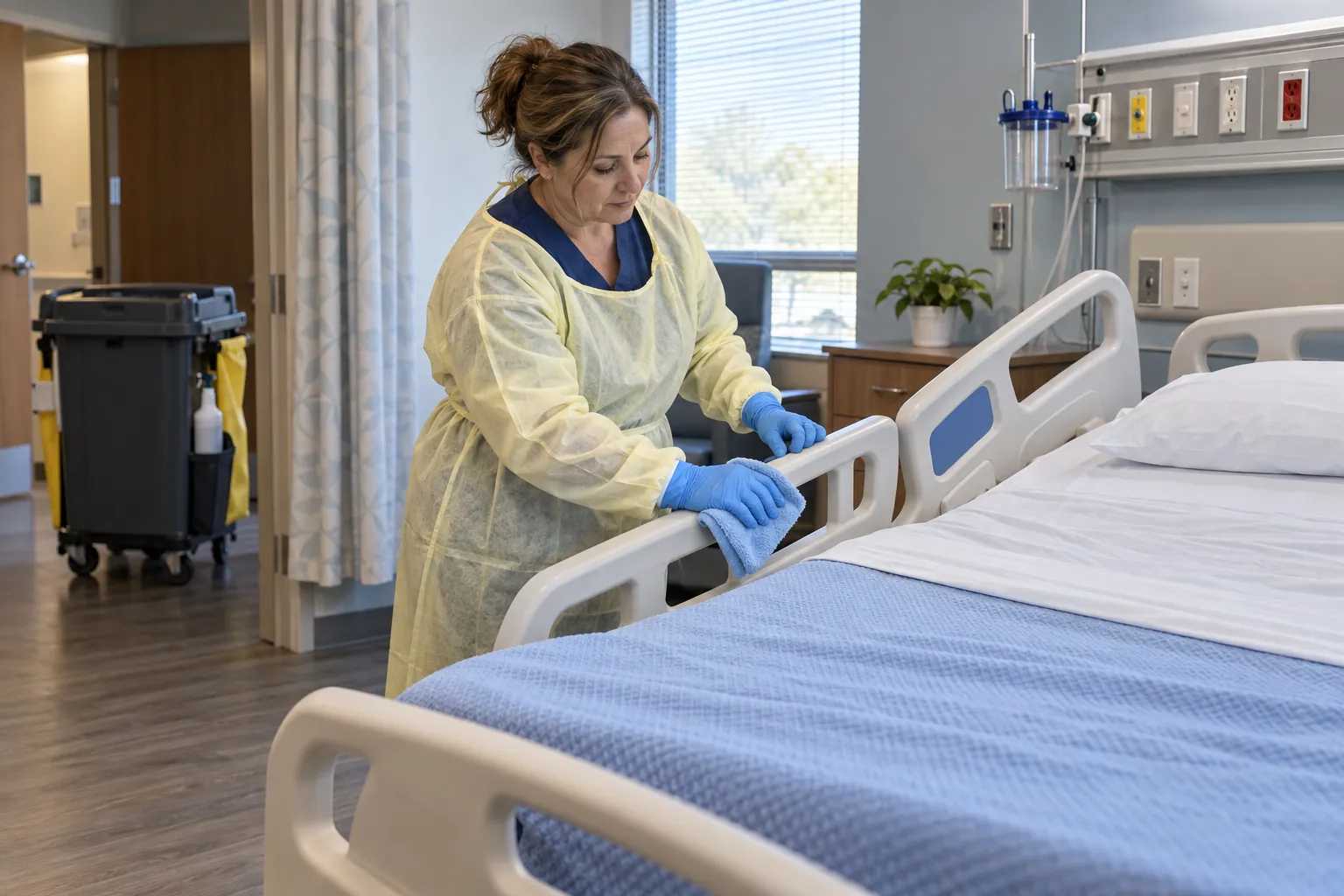 CleaningPatient room cleaning: the daily clean, and how to show it was doneHow to clean an occupied patient room each day: what the CDC and CMS expect, the order of work, products for precautions rooms, who does what, and how it is checked.
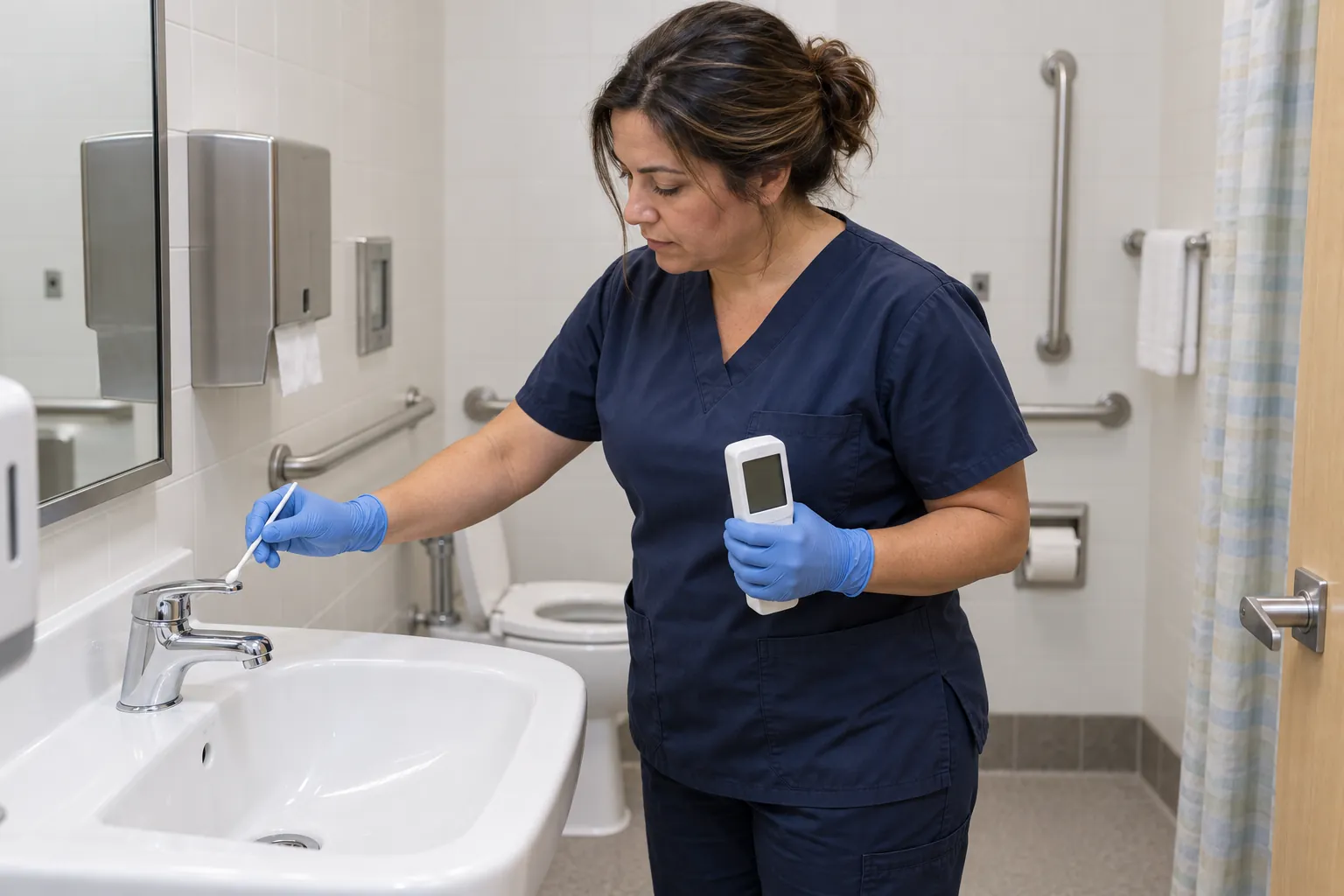 CleaningATP testing: what the reading tells you, and how to run a program that means somethingHow ATP testing works, what a reading in RLU does and does not tell you, what the CDC says about using it, and how to run and record an ATP program that holds up.