Cleaning
Janitorial pricing per square foot: how the number is built, and how to check it
Janitorial pricing per square foot is a cleaning contract's monthly or annual price divided by the cleanable square feet, built up from the labor hours the work takes, the loaded cost of each hour, supplies, overhead and profit.
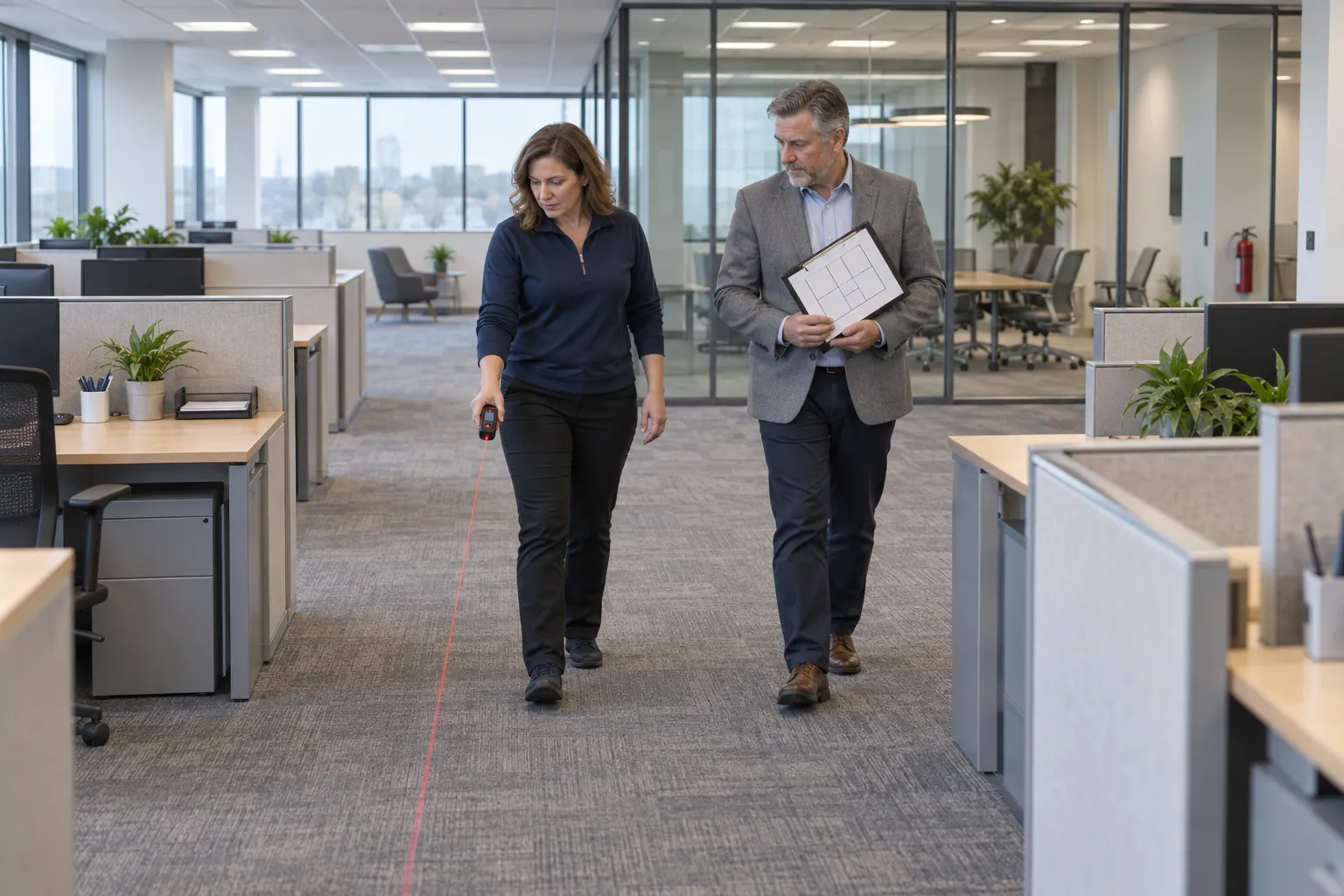
It is the figure buyers of janitorial services ask for first and understand least, because it is not a market rate you look up but the end of a calculation that starts with the tasks, the time each one takes and what a custodian costs per hour in that state. This guide shows how the number is built, which payroll costs and wage rules are fixed by law, how to compare bids that look alike, and how to tell after the contract starts whether the hours you are paying for are being worked.
01
What a price per square foot is, and where it comes from
Janitorial pricing per square foot states a cleaning contract's price, per month or per year, divided by the area cleaned. A building service contractor (BSC) bidding an office account and a property manager comparing three bids are asking the same question: what should this building cost to clean, at this standard, this often?
No federal or state law sets a price for janitorial work. What the law does set is the floor under the biggest cost in it, which is labor: the minimum wage, overtime, the employer's payroll taxes and, on federal contracts, prevailing wages. For the rest, the trade relies on two benchmarks.
- ISSA's cleaning times. ISSA, the association for the cleaning industry, publishes The Official ISSA Cleaning Times & Tasks, still widely called the 612 Cleaning Times. ISSA's article How to Calculate Cleaning Times (June 2022) says that cleaning times "are the starting point for preparing bids and estimates for budgeting labor and workloading", and that they "are not a time-motion study; their purpose is to act as a guide for bidding and estimating cleaning work."
- APPA's custodial guidelines. APPA, the association for leaders in educational facilities, publishes the custodial volume of its Operational Guidelines, now in its fourth edition, which it describes as "the industry benchmark for custodial staffing", with five service levels. The level chosen decides the area one custodian can cover, and so the hours.
Both are paid publications, so this guide explains how they are used without reproducing their tables. It gives no national average price per square foot, because no public body publishes one; the ranges quoted on the web have no stated method, building type, standard or state. Agree, too, which square footage is priced: gross area includes mechanical rooms and shafts nobody cleans, cleanable square feet (CSF) do not, and two bids dividing the same price by different areas can look far apart and be identical.
02
The ways janitorial work is priced
Most janitorial contracts mix several ways of pricing:
- Per square foot, per month or per year: the routine nightly or daily cleaning of offices, corridors and common areas, stated as a rate on cleanable square feet or as a fixed monthly sum that works out to one.
- Per fixture: restrooms and locker rooms, where the time goes on toilets, urinals, sinks and dispensers rather than floor area. ISSA's article describes a fixture calculation method for exactly this.
- Per hour: day porter coverage, event cleanup and one-off work, where the client is buying presence rather than a defined result.
- Per unit of periodic work: strip and refinish, scrub and recoat, carpet extraction, window washing and high dusting, each priced per square foot of the work done or per occurrence, often as a separate schedule.
- Per visit: small accounts cleaned two or three times a week.
- An initial deep clean: a one-off first clean, priced separately when the building's condition at the start is poor, so the routine rate is not inflated to cover it.
- Cost-plus: labor and supplies at cost with an agreed markup, where the scope is still uncertain.
Whichever form the bid takes, it was built from hours. A rate that cannot be traced back to hours is a guess.
The form also shifts risk: a fixed monthly price leaves the contractor carrying extra hours when the building gets busier, and an hourly price leaves the client carrying them.
03
From tasks to labor hours: the backbone of the price
ISSA's article Workloading: Finding the Right Balance (January 2018) describes workloading as "establishing a scope of work, staffing levels, and an accurate estimate of costs to perform the work". Its worked example is the core step: vacuuming 15,000 square feet at a production rate of 10,000 square feet per hour takes 1.5 hours, and done 260 times a year, that is 390 hours. It then says: "Once you have figured the total annual time in hours needed to clean each area, you can then find out your labor cost by multiplying the total hours by the wage rate."
In order, the steps are:
- Walk the building and measure cleanable square feet by space type and floor finish, with a fixture count for each restroom.
- List the tasks and frequencies from the scope of work: empty trash nightly, vacuum traffic lanes nightly and edges weekly, restock restrooms twice a day, dust high surfaces monthly.
- Take a production rate for each task from the ISSA times, the APPA tables or your own timed studies, adjusted for your equipment. A backpack vacuum, a wide-area vacuum and an upright give different rates on the same floor.
- Work out the time per occurrence (area divided by rate, or fixtures multiplied by minutes per fixture), multiply by the annual frequency, and add up the tasks.
- Add what is not cleaning: travel between floors and buildings, setup and cleanup at the start and end of a shift, restocking the janitor closet, lockup and alarm routines.
- Price the periodic work separately, so the client can see it and the contractor cannot quietly drop it.
The federal Planning Guide for Maintaining School Facilities, Chapter 5 (National Center for Education Statistics, 2003) shows the effect of the standard: it gives one custodian over an eight-hour shift about 18,000 to 20,000 square feet at its Level 2, but about 28,000 to 31,000 at Level 3. The standard sets the hours, and the hours set the price.
Productive hours and relief for absences are covered in custodial staffing. The output of this step is one number, the annual labor hours, with every assumption written down.
04
What a labor hour costs: wages, payroll burden and the legal floors
Labor is usually the largest cost in a janitorial price, and much of what sits on top of the wage is set by law.
The wage floor. The federal minimum wage under the Fair Labor Standards Act (FLSA) is $7.25 an hour, but the Department of Labor's Consolidated Minimum Wage Table is plain that "employers must pay the highest applicable minimum wage rate (whether federal, state, or local)." Many states and cities set rates above the federal one, and they change, often on January 1 or July 1, so check the state minimum wage laws for every site in the bid. The market rate is usually above the legal floor: the BLS Occupational Outlook Handbook entry for janitors and building cleaners gives a national median hourly wage of $17.71 in May 2025, and local wage data, collective bargaining agreements and any living wage ordinance tell you more about a particular city.
Overtime. Under the FLSA, covered employees are paid overtime at "time and one-half their regular rates of pay" for "hours worked over 40 in a workweek". A price that relies on a few people working long weeks carries overtime whether or not the bid shows it. Some states have daily overtime rules as well.
Payroll taxes. The IRS page on Social Security and Medicare withholding rates gives the employer's share as 6.2% for Social Security and 1.45% for Medicare, on top of the wage. The Federal Unemployment (FUTA) tax is 6.0% on the first $7,000 paid to each employee in the year, with a credit of up to 5.4% for state unemployment tax paid, which leaves an effective 0.6% for most employers. State unemployment insurance comes on top, at the employer's own state rate and wage base.
Workers' compensation. Required almost everywhere and run by the states: the Department of Labor's workers' compensation page tells private-sector employees to contact their state workers' compensation board. The premium depends on the state, the job classification and the employer's own claims history, so a contractor with a poor safety record pays more for every hour it bids.
Benefits and paid time off. Health coverage, paid sick leave where a state or city requires it, vacation and holidays. Across all private industry, the BLS Employer Costs for Employee Compensation for June 2026 puts benefits at 30.0% of compensation costs. Janitorial accounts vary from that average, but a price built on the wage alone falls short.
Classification. A price below the cost of an employee sometimes means the cleaners are not treated as employees. The Department of Labor's misclassification page warns that "misclassified employees may not receive the minimum wage and overtime pay to which they are entitled". Ask how the cleaners are employed.
State rules for janitorial employers. Some states regulate the trade directly. California, for example, requires janitorial employers to register with the Labor Commissioner each year, keep three years of records including hours worked daily, and provide sexual harassment prevention training every two years; the Labor Commissioner's page on Janitorial Service Providers and Contractors sets it out.
05
Supplies, equipment, overhead and profit, and how to compare bids
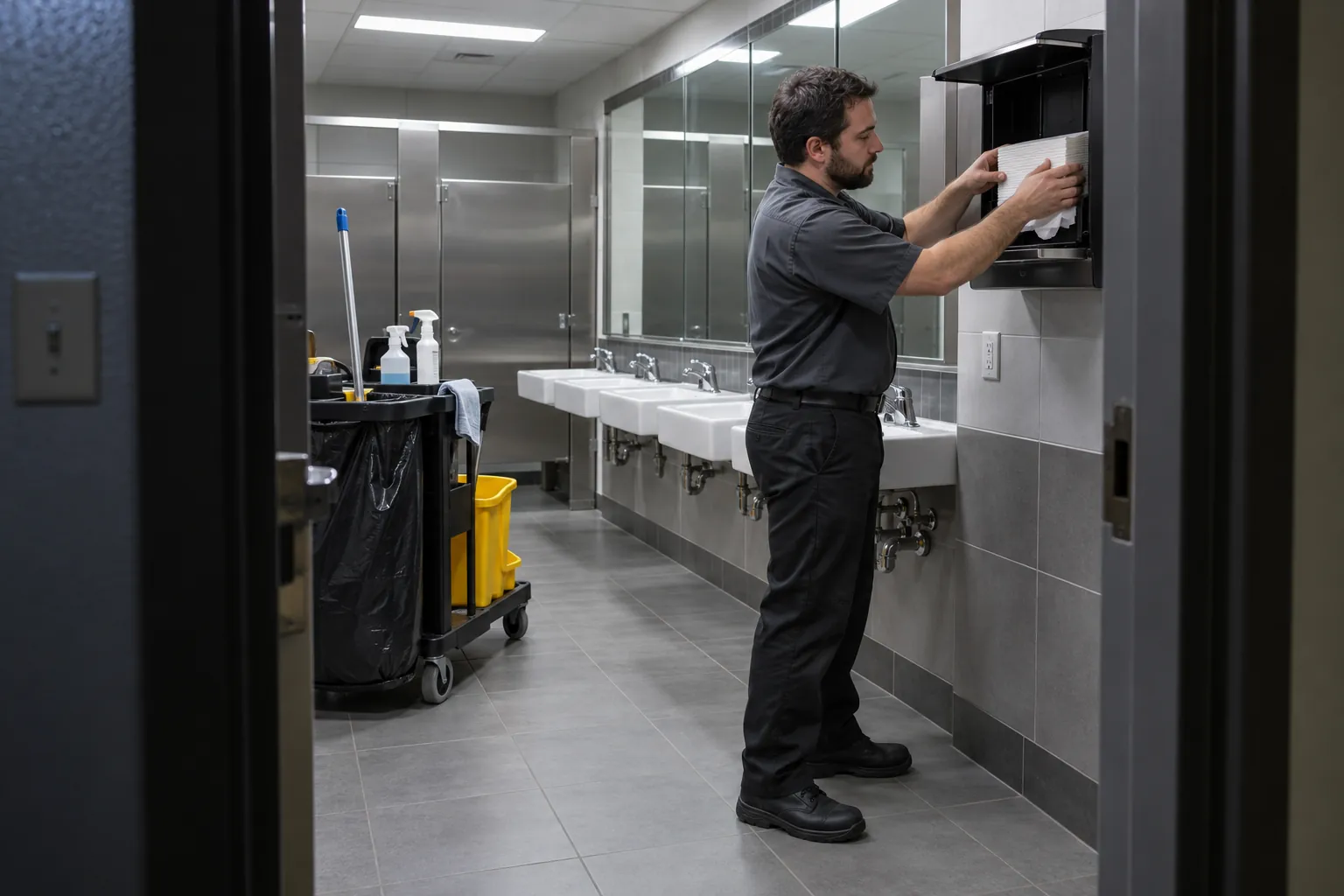
The ISSA workloading article goes on: "You may like to include an additional percentage for taxes, insurance, and benefits. Final cost also should include supply costs, equipment depreciation, miscellaneous job costs (background checks, drug testing, mobile phones, uniforms, etc.), overhead, administration, and profit." Priced honestly, each is a line the contractor can explain.
- Consumables: toilet tissue, paper towels, hand soap, can liners and seat covers. Agree who supplies them; many contracts pass them through at cost or an agreed markup, because use follows occupancy.
- Chemicals: general-purpose cleaner, restroom cleaner, EPA-registered disinfectant, floor finish and stripper. Dilution control systems make this cost more predictable.
- Equipment: vacuums, auto-scrubbers, extractors, burnishers, carts, with their depreciation and repair spread over the contract term.
- Supervision: the area manager's inspections and the account manager's time.
- Insurance and bonding: general liability, commercial auto and the janitorial bond many clients ask for, at the limits the contract sets.
- Overhead: hiring, training, uniforms, payroll, registrations and background checks.
- Profit: the contractor's margin, stated or not. A bid with no room for it is a bid where something else will give.
The price per square foot is then the total of all of this, per month or per year, divided by the cleanable square feet. Written as arithmetic: annual labor hours multiplied by the loaded hourly cost, plus supplies, equipment, overhead and profit, divided by 12 for a monthly price, divided by cleanable square feet for the rate.
Comparing bids. Whether you choose a national commercial cleaning company or a small local one, ask every bidder for the same breakdown, and read it before the bottom line:
- Hours first. Put the annual labor hours side by side. If one bid carries far fewer hours than the others for the same scope, ask which tasks or frequencies it has left out.
- The implied rate. Divide each bid's labor line by its hours. If the result is below the local minimum wage plus the employer's payroll taxes, the bid cannot be delivered as written.
- The same scope. Check that every bid priced the same frequencies, the same periodic work and the same consumables arrangement.
- Escalation. A multi-year contract should say what happens to the price when a minimum wage or a wage determination rises. Without that clause, the first increase comes out of the hours.
A contract priced below the hours it needs is delivered by leaving work out. The janitorial contract is where the hours, frequencies and escalation are made binding.
06
Where the record fails, and what SiteClara does about it
A janitorial price is a promise of hours and frequencies, and the record behind it is usually too thin to show whether the promise is kept. The restroom sheet on the back of the door is initialed for the whole day at once. The night crew leaves nothing behind but empty trash cans. When a route is short a person, the work dropped is the work nobody checks, and the client finds out through a complaint.
SiteClara records the checks at the location. A printed QR poster, with an optional NFC tag behind it, sits at each place a check is scheduled, such as a restroom, a lobby, a stairwell or a break room. Custodians scan the code or tap the tag on their own phone, with no app to install, see the checks due there, and mark each one done or say what stopped them, with a photo when one is asked for. The time and the named person are recorded as it happens, and a problem found there, such as a leak or a broken dispenser, goes onto the team's list of jobs until someone closes it.
The janitorial supervisor sees what is due, done and missed, and records why a check was missed, for example a route left uncovered or a room locked. Each day they review and approve a short report that goes to nominated contacts, such as the facility manager or the client, at 8 a.m. the next morning, showing what was reported, what was completed, what is still open and how the scheduled checks went. Over a contract year, that is a record of which frequencies in the price were delivered, and where they slipped.
07
Questions people ask
How much should I charge per square foot for janitorial services?
No public body publishes a going rate, so the charge is worked out rather than looked up. ISSA's article Workloading: Finding the Right Balance divides each area by the task's production rate to get the time, multiplies the total annual hours by the wage rate, and then adds taxes, insurance, benefits, supplies, equipment depreciation, overhead, administration and profit. Divide that total by the cleanable square feet and you have the rate.
How do you quote commercial cleaning?
Start from the tasks and the time each one takes. ISSA's article How to Calculate Cleaning Times calls cleaning times "the starting point for preparing bids and estimates" and gives three ways to turn them into time: one task over an area, several tasks bundled together, and restrooms by the fixture. Turn that time into annual hours, cost each hour with its payroll burden, and add supplies, equipment, overhead and profit.
Is $50 an hour for cleaning good?
It depends on what the hour has to cover. The BLS Occupational Outlook Handbook entry for janitors and building cleaners gives a median hourly wage of $17.71 in May 2025, and the IRS page on Social Security and Medicare withholding rates puts the employer's share at 6.2% and 1.45% on top of it. Unemployment tax, workers' compensation, benefits, supplies, supervision, overhead and profit come on top again, so judge an hourly price against that build-up in your own state.
How much can one custodian clean in 8 hours?
It depends on the standard of cleanliness. The National Center for Education Statistics' Planning Guide for Maintaining School Facilities, Chapter 5 gives one custodian about 10,000 to 11,000 square feet in an eight-hour shift at Level 1, its most thorough standard, 18,000 to 20,000 at Level 2, 28,000 to 31,000 at Level 3, 45,000 to 50,000 at Level 4 and 85,000 to 90,000 at Level 5.
08
Further reading, and a list to take away
ISSA sells The Official ISSA Cleaning Times & Tasks, and APPA the custodial volume of its Operational Guidelines. For the legal floors, keep the Department of Labor's Consolidated Minimum Wage Table and the IRS pages on payroll taxes to hand; for federal work, the wage determination in the solicitation.
Before you quote or accept a janitorial price per square foot, check that:
- the area is cleanable square feet, measured by space type and floor finish, and every bid used the same figure;
- the price traces back to annual labor hours, with the production rates and their sources written down;
- the chosen level of cleanliness is stated, because it decides the hours;
- the hourly cost starts at the highest applicable minimum wage, or the wage determination, and carries payroll taxes and workers' compensation;
- benefits, paid time off, relief, supplies and periodic work are priced, not assumed away;
- the contract says what happens to the price when wage rates rise;
- there is a record, day by day, of which checks were done and missed, so the price can be defended or corrected at rebid.
Sources
Every document this guide quotes or links to, in the order it first cites them.
- How to Calculate Cleaning Times issa.com
- Operational Guidelines appa.org
- Workloading: Finding the Right Balance issa.com
- Planning Guide for Maintaining School Facilities, Chapter 5 nces.ed.gov
- Consolidated Minimum Wage Table dol.gov
- State minimum wage laws dol.gov
- BLS Occupational Outlook Handbook entry for janitors and building cleaners bls.gov
- Overtime dol.gov
- Social Security and Medicare withholding rates irs.gov
- Federal Unemployment (FUTA) tax irs.gov
- Workers' compensation page dol.gov
- Employer Costs for Employee Compensation bls.gov
- Service contracts dol.gov
- Misclassification dol.gov
- Janitorial Service Providers and Contractors dir.ca.gov
Related guides
 CleaningCustodial staffing: how many custodians a building needs, and how to show itHow to work out custodial staffing: cleanable square feet, APPA's five levels, ISSA cleaning times, labor hours to FTEs, and checking the numbers hold up.
 CleaningThe janitorial contract: what a commercial cleaning agreement should sayWhat a US commercial cleaning contract should cover, the state laws that reach into it, and how to write scope, inspection, renewal and exit terms that hold up.
 CleaningJanitorial scope of work: what it should say, and how to show it is metWhat a janitorial scope of work should cover, how to set cleaning frequencies by room type, output versus input standards, and how to show the work is being done.
 CleaningHow to get janitorial contracts, and keep themHow commercial and government janitorial contracts are bought in the US, what buyers check, how to write a proposal that scores, how to price it and how to keep it.