Cleaning
Custodial staffing: how many custodians a building needs, and how to show it
Custodial staffing is the number of custodians and janitors a building or campus needs, and on which shifts, to keep it clean, sanitary and in good condition to an agreed standard.
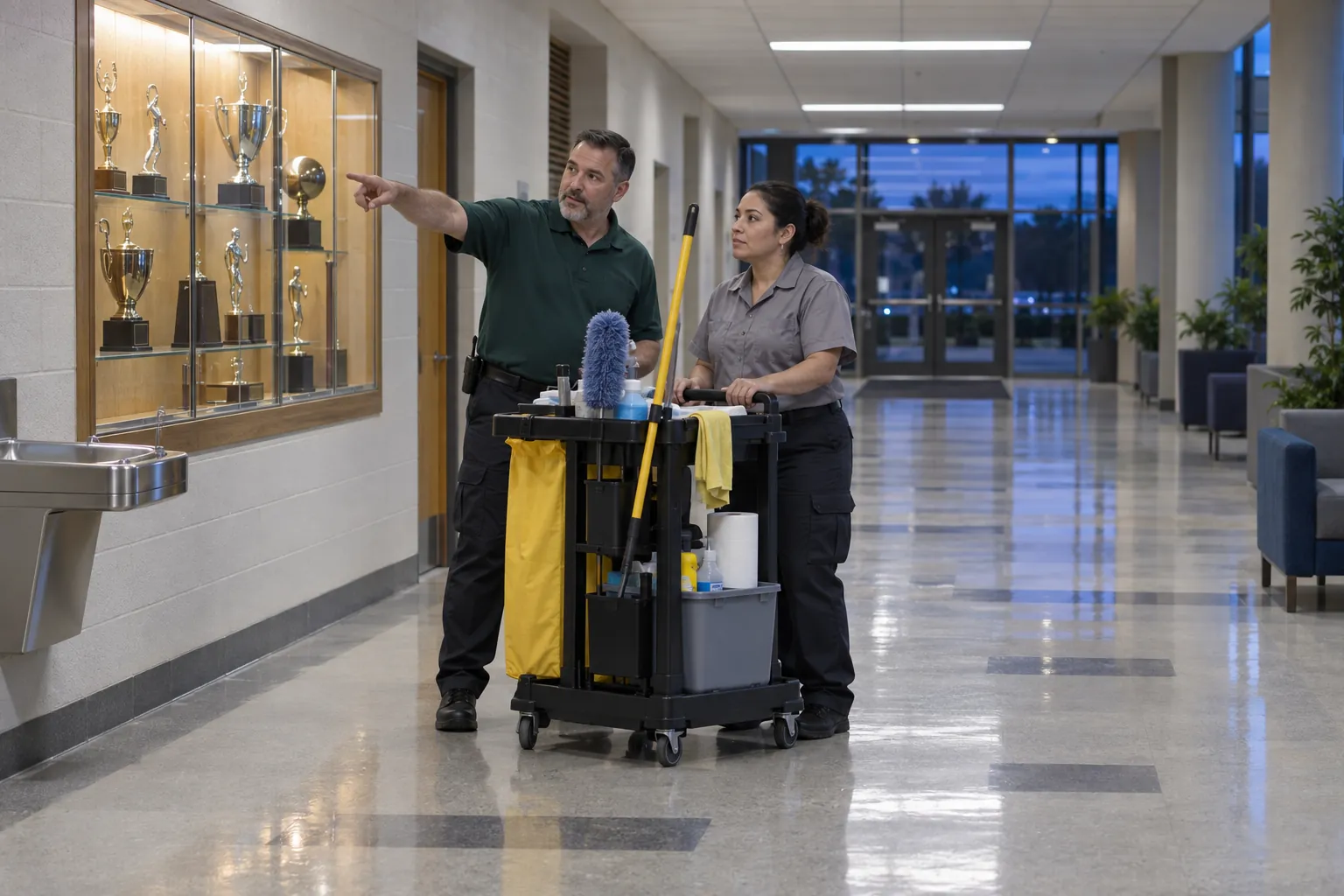
It is the question behind every cleaning budget: how many custodial staff, on which shifts, for how many square feet, at what standard. No federal rule answers it. The answer comes from the space, the tasks, the time each task takes and the level of appearance the building's owner is willing to pay for. This guide covers the APPA guidelines and the ISSA cleaning times most US staffing plans are built on, how to turn them into labor hours and full-time equivalents, and how to check the plan against what actually happens on the floor.
01
What custodial staffing means, and where the standards come from
Custodial staffing is the number of custodians, janitors and day porters a building or campus needs, and on which shifts, to keep it at an agreed standard of cleanliness. It is a school district staffing a new high school, a university defending its headcount at budget time, and a janitorial contractor working out how many people to put on a new office account before it bids. The custodial staff may be the facility's own hires, a janitorial contractor's team, or temporary cover from a janitorial staffing agency for peak seasons and absences; the number of hours the work takes is worked out the same way.
No federal law sets a ratio of custodians to square feet. The legal duty, where there is one, is the outcome. For a private employer under federal OSHA, 29 CFR 1910.22, Walking-working surfaces: general requirements requires that "all places of employment, passageways, storerooms, service rooms, and walking-working surfaces are kept in a clean, orderly, and sanitary condition", and that walking-working surfaces are kept free of hazards such as "leaks, spills, snow, and ice". A staffing plan is how that happens every day, with the people the employer can afford.
Because nothing in law says how many people that takes, the trade relies on two sets of published benchmarks:
- APPA's custodial guidelines. APPA, the association for leaders in educational facilities, first published Custodial Staffing Guidelines for Educational Facilities in 1992. As APPA's Facilities Manager magazine explains in Operational Guidelines for Educational Facilities – Custodial (January/February 2013), it was "the first work that sought to correlate the productivity of custodial operations (the amount of space cleaned) with the level of cleanliness". It was revised in 1998 and republished in 2012 as Operational Guidelines for Educational Facilities: Custodial; APPA's Operational Guidelines page now offers the fourth edition, describing it as "the industry benchmark for custodial staffing", with five service levels.
- ISSA's cleaning times. ISSA, the association for the cleaning industry, publishes The Official ISSA Cleaning Times & Tasks, still widely called the 612 Cleaning Times. ISSA's own article How to Calculate Cleaning Times says it provides "a set of average cleaning times for both individual cleaning tasks as well as bundled cleaning processes", and that the times "are not a time-motion study; their purpose is to act as a guide for bidding and estimating cleaning work".
Both are paid publications. This guide explains how they are used, with only the figures their owners have published openly.
02
What goes into a custodial staffing plan
The 2013 Facilities Manager article sets out the four elements the APPA guidelines are built on: the task to be performed, the time it takes, how often it is done, and the type of space, or room type, it is done in. Before anyone reaches for a benchmark, gather:
- Cleanable square feet, not gross square feet. Take out mechanical rooms, shafts, locked storage and anything custodians never touch. APPA's figures are in cleanable square feet (CSF), and mixing the two throws the answer out.
- Space types: classrooms, offices, restrooms, entrances and lobbies, corridors and public circulation, stairwells, cafeterias and break rooms, locker and shower rooms, labs, gyms, patient rooms. The 2012 APPA edition works with 33 room types and lets a manager add specialty rooms of their own.
- Floor and surface finishes: carpet, resilient tile, sealed concrete, terrazzo. The same room takes different time on a different floor.
- Fixture counts for restrooms and locker rooms: toilets, urinals, sinks, showers, dispensers. Restrooms are usually worked out per fixture, not per square foot.
- Use and occupancy: how many people, for how long, and when the building is empty enough to clean.
- The tasks and their frequencies, from the scope of work: daily, weekly, monthly and periodic, including floor care, carpet extraction and high dusting.
- The standard wanted in each area, which is where APPA's five levels come in.
- Everything that is not cleaning: day porter calls, event setups, opening and locking up, and snow and ice at the entrances.
03
APPA's five levels of cleanliness, and what they mean for headcount
The APPA guidelines tie staffing to an expected result, called a level of appearance or level of cleanliness. The 2013 article lists them:
- Level 1, Orderly Spotlessness
- Level 2, Ordinary Tidiness
- Level 3, Casual Inattention
- Level 4, Moderate Dinginess
- Level 5, Unkempt Neglect
The point of the levels is that the standard and the staffing are one decision. The more square feet each custodian is given, the lower the level the building can expect. The article gives an example drawn from the 2012 guidelines, in cleanable square feet per custodian: for a classroom with a hard floor, 7,200 at Level 1, 17,000 at Level 2, 18,100 at Level 3, 23,600 at Level 4 and 24,500 at Level 5; for an office with carpet, 12,300 at Level 1, 24,500 at Level 2, 45,600 at Level 3, 74,000 at Level 4 and 116,800 at Level 5. If a custodian cleans classroom space at a Level 2 workload and an inspection finds Level 5, the article calls it "a misalignment of expectations".
Those two rows show why one campus-wide ratio misleads: a staffing plan is worked out by space type, then added up.
An older federal source, which does not cite APPA, describes a similar scale. The Planning Guide for Maintaining School Facilities, Chapter 5, published in 2003 by the National Forum on Education Statistics with the National Center for Education Statistics (NCES 2003-347), describes "a five-tiered system of expectations" and gives rough figures for one custodian over an eight-hour shift: about 10,000 to 11,000 square feet at Level 1, 18,000 to 20,000 at Level 2, 28,000 to 31,000 at Level 3, which it treats as the norm for most schools, 45,000 to 50,000 at Level 4, and 85,000 to 90,000 at Level 5, which it warns "can very rapidly lead to an unhealthy situation". It adds that the real figure "will depend on additional variables, including the type of flooring, wall covers, and number of windows".
Most buildings choose different levels for different spaces: higher for restrooms, food service areas and entrances, lower for storage and back corridors. Write the chosen level beside each space type, so the standard is a decision someone owns.
04
Working the numbers: from cleaning times to labor hours and FTEs
Where APPA gives area per custodian by level, the ISSA method builds the answer up task by task, which is how janitorial contractors usually bid. ISSA's Workloading: Finding the Right Balance (2018) describes workloading as establishing "a scope of work, staffing levels, and an accurate estimate of costs to perform the work", and gives the core step: divide the area by the task's production rate to get the task time, so 15,000 square feet at 10,000 square feet per hour is 1.5 hours, then multiply by how often the task is done in a year. ISSA's How to Calculate Cleaning Times (2022) adds a fixture method for restrooms: the number of fixtures multiplied by the time per fixture, for example 10 fixtures at 3 minutes each is 30 minutes.
A worked outline, with your own figures in place of the placeholders:
- List every task by space type, with its frequency: vacuum offices daily, damp mop corridors daily, clean and restock restrooms twice a day, scrub and recoat hard floors each quarter.
- Take a production rate for each task from the ISSA times, the APPA tables or your own timed studies, adjusted for your equipment and building.
- Work out the time per occurrence: area divided by rate, or fixtures multiplied by minutes per fixture.
- Multiply by the annual frequency and add the tasks up to get annual labor hours for each area, then for the building.
- Add what is not cleaning: travel between floors and buildings, setup and cleanup, restocking the closet, day porter calls, events and supervision.
- Divide by productive hours per custodian, meaning paid hours less breaks, vacation, sick leave, holidays, training and meetings. The result is the number of full-time equivalents (FTEs) the building needs.
- Turn FTEs into shifts and routes, deciding which work is done by day and which at night, and who covers when someone is out.
Two figures move the answer most, so decide them in writing. One is productive hours: a plan that divides by paid hours rather than working hours is short-staffed from its first day. The other is the relief factor, the extra cover that keeps every route staffed through vacations and absences. Neither has a national standard.
The same arithmetic gives the cost. APPA's article notes the guidelines do not give costs, because pay differs between organizations and regions, but that a manager can compute them from the hourly rate of pay and benefits. For a contractor, the labor hours are the backbone of the price, which is covered in janitorial pricing.
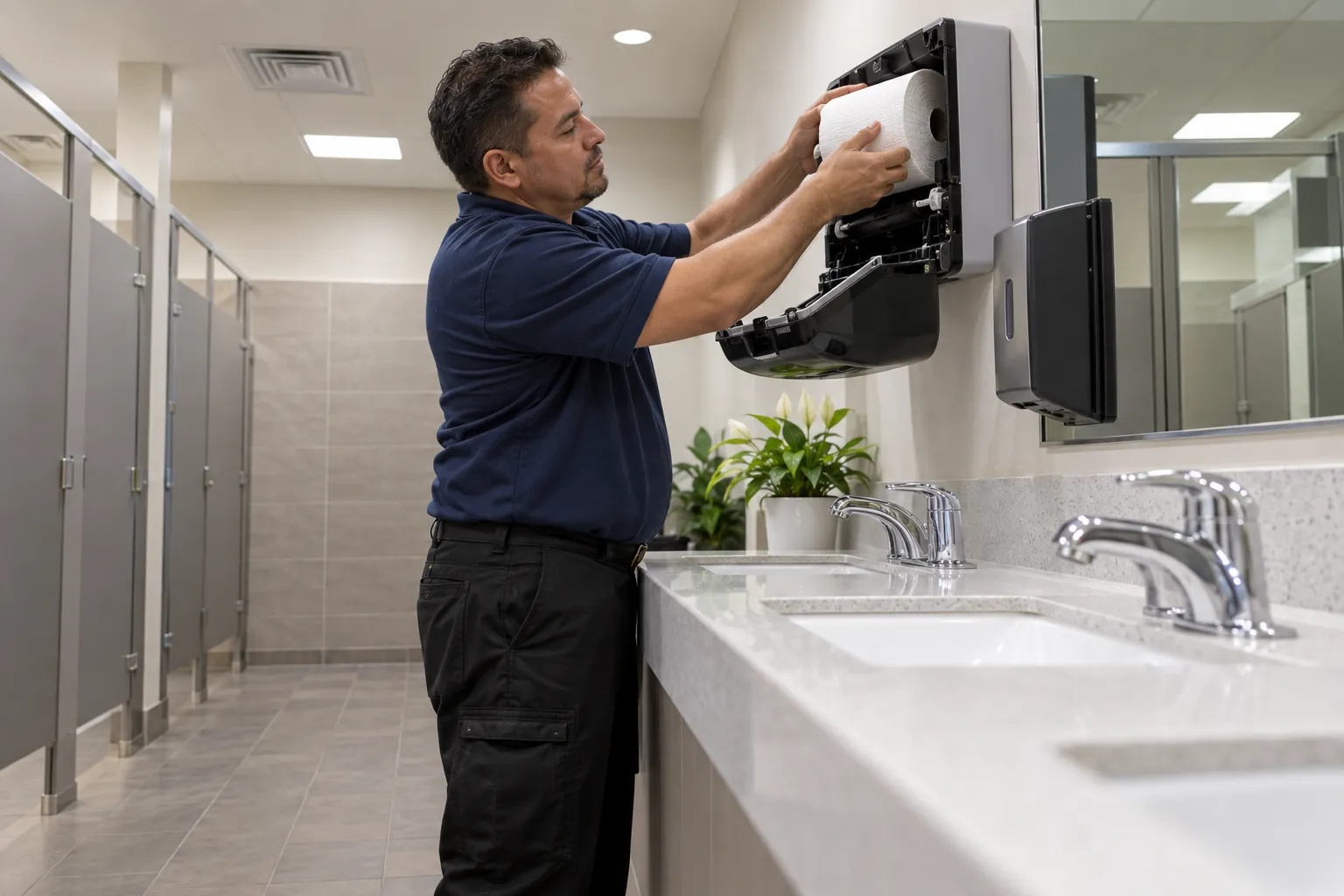
05
Checking the staffing holds up, and the rules when a contract changes
A staffing plan is a prediction. To know whether it works, inspect a sample of spaces against the chosen level on a regular schedule, record the result by area and route, and read it beside the workload each custodian carries. The method is covered in janitorial quality control.
When inspections and workloads disagree, look for what the benchmarks cannot see before cutting or adding people:
- The building: older buildings and worn finishes take longer than the tables assume.
- Use: a restroom beside a gym gets dirty faster than a quiet office floor.
- When the inspection happens: a restroom checked at 7 a.m. and one checked at 2 p.m. are different rooms.
- The season: winter brings snow, salt and water through every entrance.
- Experience: a new hire will not match a veteran's output in the first weeks.
- Unplanned work: events and callouts that eat the hours the plan gave to cleaning.
The BLS Occupational Outlook Handbook entry for janitors and building cleaners notes that "part-time work is common" and expects about 321,800 openings a year, mostly to replace people leaving the occupation. A plan that assumes every route is always filled will not match the building.
When a janitorial contract changes hands in California, staffing is not only the new contractor's choice. The Displaced Janitor Opportunity Act (California Labor Code sections 1060 to 1065) generally requires a successor contractor with 25 or more employees to retain, for a 60-day transition period, the outgoing contractor's employees who had worked at the site for the preceding four months or longer, unless there is reasonable and substantiated cause. If fewer are needed, they are kept by seniority within the job classification. California also requires janitorial employers to register with the Labor Commissioner each year and to keep records of employees' daily hours, including start and end times, for three years, under the Property Service Workers Protection Act; the Labor Commissioner's page for Janitorial Service Providers and Contractors sets out what is required. Other states and cities have their own rules, and a collective bargaining agreement may set workloads too.
06
Where the record fails, and what SiteClara does about it
Staffing arguments are usually lost for lack of evidence. The budget office says the building looks fine; the principal or the tenant says the restrooms are never checked after lunch. The restroom sheet on the back of the door was initialed for the whole day at once, the night route leaves nothing behind it, and nobody can say which checks were missed on the nights a route was short. Without a record, the plan can be neither defended nor fixed.
SiteClara records the checks at the location. A printed QR poster, with an optional NFC tag behind it, sits at each place a check is scheduled, such as a restroom, an entrance, a stairwell or a cafeteria. Custodians scan the code or tap the tag on their own phone, with no app to install, see the checks due there, and mark each one done or say what stopped them, with a photo when one is asked for. The time and the named person are recorded as it happens, and a problem found there, such as a leak or an empty dispenser, goes onto the team's list of jobs until someone closes it.
The custodial supervisor sees what is due, done and missed, and records why a check was missed, for example a route left uncovered. Each day they review and approve a short report that goes to nominated contacts, such as the facility manager or the client, at 8 a.m. the next morning, showing what was reported, what was completed, what is still open and how the scheduled checks went. Over weeks, a staffing review can see where checks slip when a route is short.
07
Questions people ask
What does custodial staff mean?
Custodial staff are the custodians, janitors and building cleaners who, in the words of the BLS Occupational Outlook Handbook entry for janitors and building cleaners, "keep many types of buildings clean, sanitary, orderly, and in good condition". The duties it lists include gathering and emptying trash, sweeping, mopping or vacuuming floors, cleaning and stocking restrooms, cleaning spills and other hazards, washing windows, walls and glass, disinfecting frequently touched surfaces, ordering supplies, making minor building repairs, notifying managers when major repairs are needed, and locking doors to secure buildings.
How many hours do custodians work?
Most work full time. The BLS Occupational Outlook Handbook, Janitors and Building Cleaners: Work Environment says "most janitors and building cleaners work full time, although part-time work is common", that many work evening hours because office buildings are often cleaned while they are empty, and that where a building needs 24-hour maintenance, such as a hospital, cleaners work in shifts that may include nights, weekends or holidays.
What custodian job pays the most?
Among the top industries employing janitors and building cleaners, government pays the most. The BLS Occupational Outlook Handbook, Janitors and Building Cleaners: Pay gives median hourly wages for May 2025 of $20.76 in government, excluding state and local education and hospitals, $18.63 in educational services, $18.35 in healthcare and social assistance, and $17.21 in services to buildings and dwellings, against a median of $17.71 an hour for the occupation as a whole.
Is being a custodian hard?
It is physical work. The BLS Occupational Outlook Handbook, Janitors and Building Cleaners: Work Environment says custodians "sometimes get injured on the job", for example with "sprains or strains from heavy lifting or pain and soreness from repetitive motion", and that workers may receive safety and ergonomics training to help minimize these risks. That is one more reason a staffing plan should not load each route beyond what the chosen level of cleanliness allows.
08
Further reading, and a list to take away
APPA publishes the fourth edition of the custodial guidelines through its Operational Guidelines page, and ISSA sells The Official ISSA Cleaning Times & Tasks. The NCES Planning Guide for Maintaining School Facilities is free and still a clear introduction for school districts. OSHA's Cleaning Industry page gathers the safety material for custodial and janitorial work.
Before you set or defend a custodial staffing level, check that:
- the plan uses cleanable square feet, measured and grouped by space type and floor finish;
- each space type has a chosen level of cleanliness, written down and agreed with whoever pays;
- every production rate names its source and edition;
- labor hours include travel, setup, day porter calls and events, not only cleaning;
- FTEs are worked out from productive hours, with a stated relief factor for absences;
- every route has cover when someone is out;
- inspections against the chosen level are scheduled, recorded and read beside workloads;
- you have a record of which checks were done and missed, to show where the plan falls short;
- you know the state rules and any bargaining agreement that apply when a contract changes hands.
Sources
Every document this guide quotes or links to, in the order it first cites them.
- 29 CFR 1910.22, Walking-working surfaces: general requirements osha.gov
- Operational Guidelines for Educational Facilities – Custodial www1.appa.org
- Operational Guidelines appa.org
- How to Calculate Cleaning Times issa.com
- State Plans osha.gov
- Planning Guide for Maintaining School Facilities, Chapter 5 nces.ed.gov
- Workloading: Finding the Right Balance issa.com
- BLS Occupational Outlook Handbook entry for janitors and building cleaners bls.gov
- Displaced Janitor Opportunity Act (California Labor Code sections 1060 to 1065) leginfo.legislature.ca.gov
- Janitorial Service Providers and Contractors dir.ca.gov
- Cleaning Industry osha.gov
Related guides
 CleaningJanitorial pricing per square foot: how the number is built, and how to check itHow janitorial pricing per square foot is built: cleaning times, labor hours, payroll burden, wage floors, supplies, overhead and profit, and how to check a bid.
 CleaningJanitorial quality control: how to inspect, score and fix the cleaningHow janitorial quality control works: QA versus QC, building a cleaning inspection checklist, APPA appearance levels, sampling, scoring and corrective action.
 CleaningJanitorial supervisor duties: what the job involves, and what good looks likeWhat a janitorial supervisor does: the core duties, a typical night shift, the OSHA rules behind the work, inspecting the cleaning and reporting to the client.
 CleaningJanitorial scope of work: what it should say, and how to show it is metWhat a janitorial scope of work should cover, how to set cleaning frequencies by room type, output versus input standards, and how to show the work is being done.