Cleaning
Janitorial scope of work: what it should say, and how to show it is met
A janitorial scope of work is the part of a commercial cleaning contract that defines the service: what is cleaned, where, how often, to what standard, and how anyone will know.
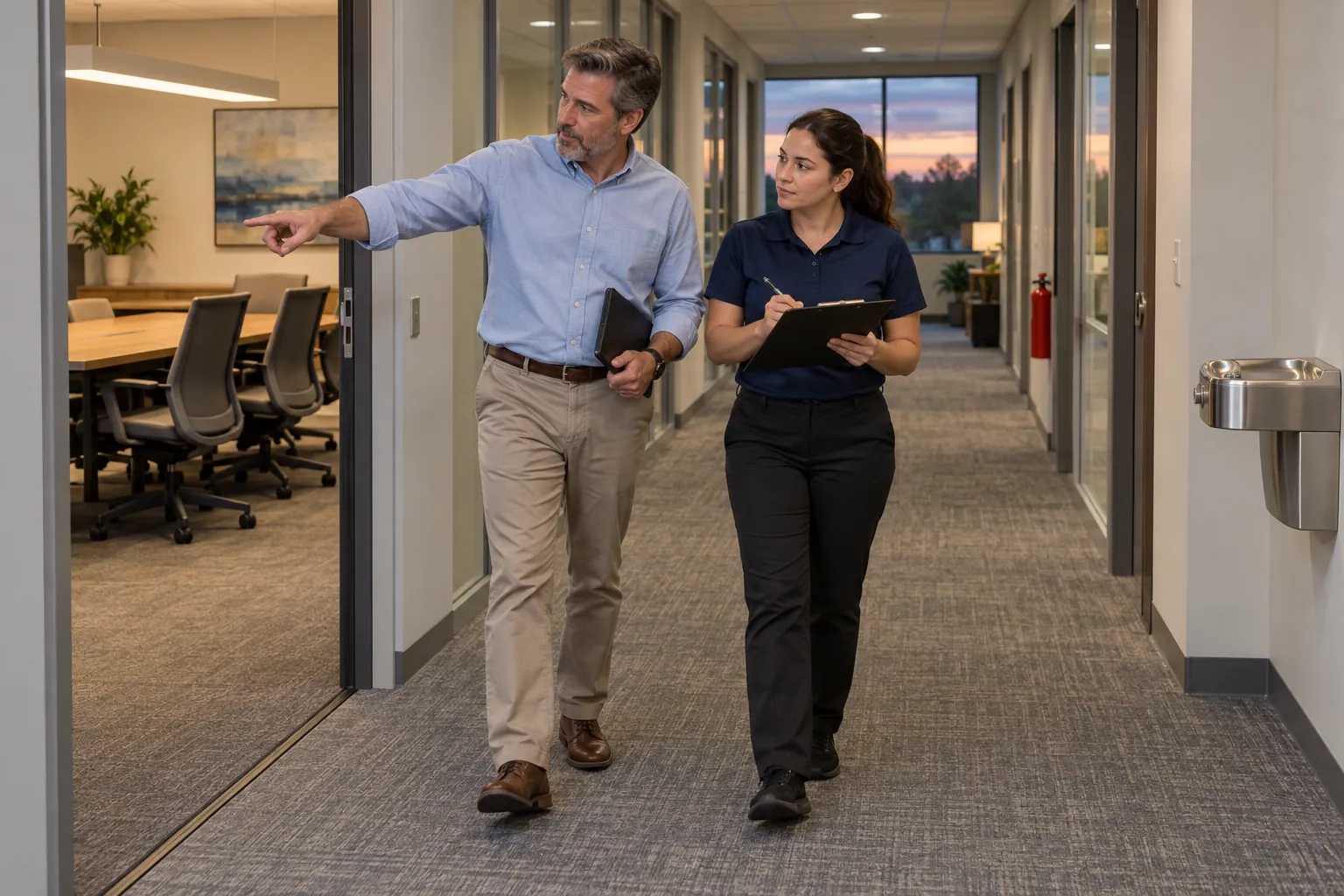
This guide covers what to put in one, how to set frequencies by room type, how federal buyers write performance work statements, and how to turn the scope into a record rather than a promise.
01
What a janitorial scope of work is
A janitorial scope of work, often shortened to SOW and sometimes called the cleaning specifications, sets out the custodial service a building needs, area by area: the tasks, how often each is done, the standard the result must meet, and how performance will be checked. It is the part of a janitorial contract that turns "keep the building clean" into detailed requirements a contractor can bid on and a facility manager can hold them to, so that the client's expectations and the contractor's are the same ones. An in-house custodial department needs the same document, even if nobody calls it a contract.
Behind it sit federal duties that apply whoever does the cleaning. OSHA's sanitation standard, 29 CFR 1910.141, says that "all places of employment shall be kept clean to the extent that the nature of the work allows", and that waste is removed "as often as necessary or appropriate to maintain the place of employment in a sanitary condition". The walking-working surfaces standard, 29 CFR 1910.22, requires passageways, storerooms, service rooms and walking-working surfaces to be kept "in a clean, orderly, and sanitary condition", and workroom floors clean and, as far as feasible, dry. Those duties sit with employers; in a leased or multi-tenant building the scope of work is often how they are met in practice.
Check which rules apply before you cite them. According to OSHA's State Plans page, there are "22 State Plans covering both private sector and state and local government workers, and seven State Plans covering only state and local government workers". In a state plan state, such as California, the state's own standards apply in place of federal OSHA's.
Some buildings carry a stricter duty. Where employees have occupational exposure to blood or other potentially infectious materials, the bloodborne pathogens standard, 29 CFR 1910.1030, requires the employer to "determine and implement an appropriate written schedule for cleaning and method of decontamination based upon the location within the facility, type of surface to be cleaned, type of soil present, and tasks or procedures being performed in the area". In a clinic, a dental office or a school nurse's room, part of the scope of work is a legal requirement, not a preference.
Federal buyers have their own term for the document. Under FAR 37.602, the performance work statement, agencies describe the work "in terms of the required results rather than either 'how' the work is to be accomplished or the number of hours to be provided". Private buyers are not bound by it, but the discipline is worth borrowing.
02
What a janitorial scope of work should include
A scope of work that a contractor can price and a facility manager can check usually covers:
- Scope: the buildings, floors and areas included, with cleanable square feet by room type, and anything excluded named, such as tenant suites cleaned by their own vendor, server rooms or labs.
- Tasks by room type: restrooms, entrances and lobbies, private and open offices, conference rooms, break rooms and kitchenettes, corridors and stairwells, elevators, locker rooms, and any specialty space.
- Frequency for each task: several times a day, daily, weekly, monthly, quarterly or annually.
- The standard: what "clean" means for each room type, in words a supervisor could check on a walkthrough.
- Service hours and access: nightly cleaning windows, day porter hours, when rooms are free, and who holds keys, access cards and alarm codes.
- Project and periodic work: hard floor stripping and refinishing, burnishing, carpet extraction, high dusting, interior glass and window washing, and deep cleaning of restrooms and break rooms.
- Supplies and equipment: who provides restroom consumables such as paper towels, toilet tissue, hand soap and can liners, which chemicals may be used, and color-coded microfiber and tools to keep restroom equipment out of food areas.
- Safety: hazard communication, safety data sheets on site, personal protective equipment, and how the contractor's chemicals are shared with the building's own staff.
- Staffing and supervision: supervision on site, training, background checks where the building requires them, and how the account is managed.
- Reactive work: spills, restroom service calls and special or one-off requests, how they are raised, and how quickly they must be dealt with.
- Quality control: how cleaning is inspected, the key performance indicators, and how deficiencies are corrected.
- Reporting and change: what the contractor reports and how often, and how the scope is changed when the building's use changes.
The safety line matters more than it looks. OSHA's Hazard Communication Standard, 29 CFR 1910.1200, requires employers at a workplace shared with other employers to give those employers access to safety data sheets, to tell them the precautions needed, and to explain the labeling system in use. A janitorial contractor working in a client's building is exactly that situation, and the scope is a sensible place to say who does what.
Leave out anything nobody will check. A scope that lists two hundred tasks but is inspected on ten is really a scope of ten tasks.
03
Setting frequencies by room type
Frequencies should follow traffic and risk, not habit. Start by grouping every space into a handful of room types and ask two questions of each: how many people use it, and what happens if it is dirty.
- Restrooms: a full clean at least daily, with checks and restocking through the day in busy buildings. See our guide to the restroom cleaning log.
- Break rooms and kitchenettes: daily, with counters, sinks, appliance fronts and tables cleaned after peak use.
- Entrances and lobbies: daily, with extra attention to walk-off mats and glass in wet or snowy weather, because soil tracked in here spreads through the building.
- Offices and conference rooms: trash and touch points often daily, with vacuuming and dusting on a set cycle.
- Corridors, stairwells and elevators: daily or on a cycle, with handrails, push plates and elevator buttons treated as touch points.
- Mechanical rooms, storage and low-use areas: weekly or monthly.
The CDC's page on when and how to clean and disinfect a facility advises cleaning high-touch surfaces regularly, naming examples such as door handles, stair rails, elevator buttons, touchpads, restroom fixtures and desks, and disinfecting as well where people have obviously been ill. Listing touch points as their own task makes them far easier to check.
Put periodic work on its own calendar. High dusting, vents and baseboards are where scopes quietly fail, because none is urgent on any given night.
04
Output, input, or both
There are two ways to write the standard, and most good scopes of work use a mix.
- An input, or frequency-based, scope says what the contractor must do and how often: "vacuum carpeted areas nightly", "clean restroom fixtures twice daily". It is easy to price and easy to check, but it rewards doing the task rather than achieving the result.
- An output, or performance-based, scope says what the result must be: "carpets free of visible soil, litter and debris", "restroom fixtures clean, with no residue, streaks or odor, whenever the building is open". It lets the contractor decide how, which suits an experienced vendor, but it means nothing without regular inspection.
- A hybrid sets the outcome and a minimum frequency. Many commercial janitorial scopes take this shape, because it protects the client against a vendor who quietly cuts visits and protects the vendor against a standard nobody can measure.
FAR 37.602 is a useful checklist even outside federal work. A statement of objectives must at a minimum include the purpose, the scope or mission, the period and place of performance, background, the performance objectives ("required results") and any operating constraints, and agencies are asked to make work assessable "against measurable performance standards". A private scope that answers those six headings is most of the way there.
Whichever you choose, write each standard so that two people inspecting the same room would reach the same answer. "Clean" fails that test; "no visible soil, spots or streaks on mirrors and fixtures, dispensers at least a quarter full" passes it.
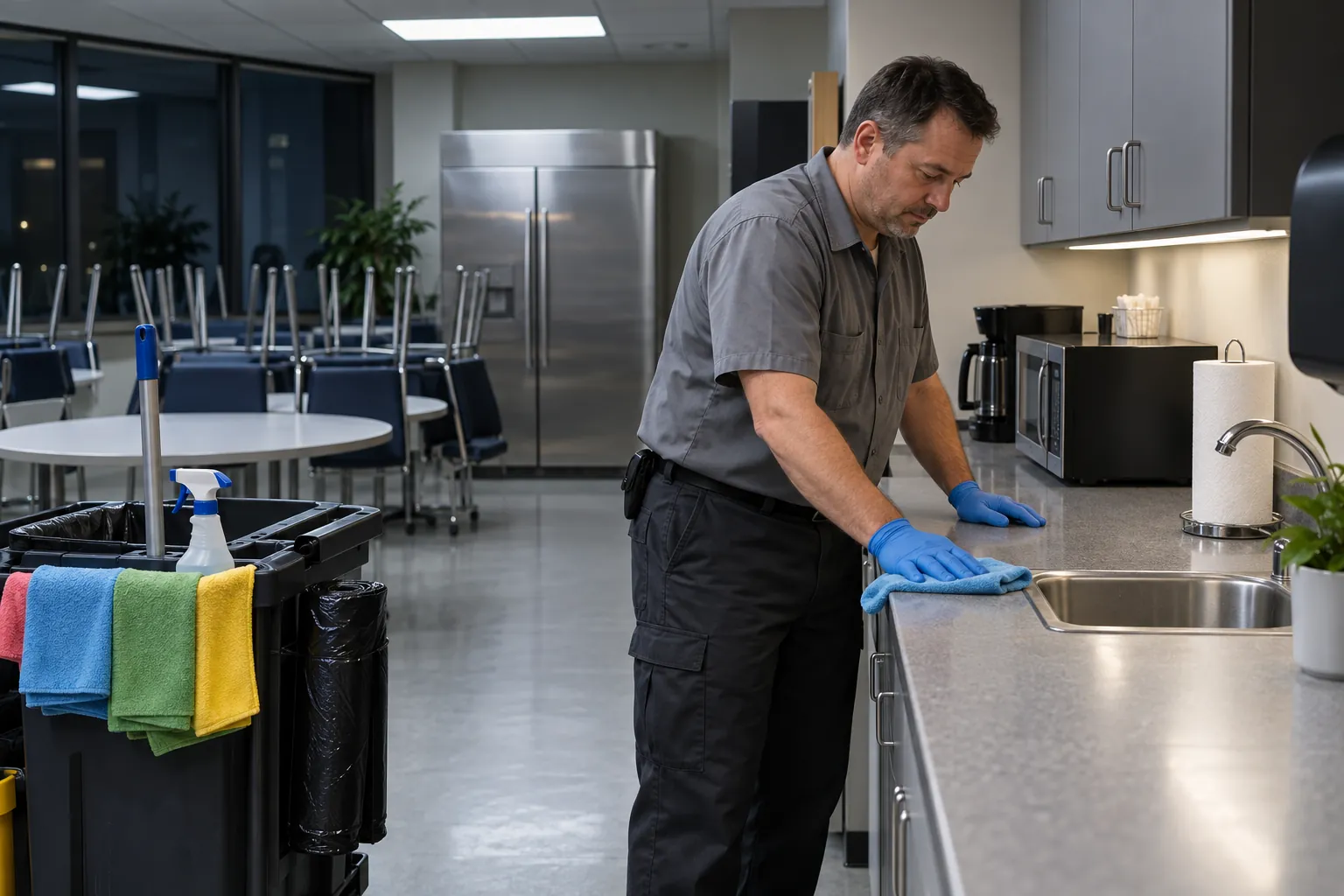
Be precise about disinfection, which is not the same as cleaning. The EPA's page on selected EPA-registered disinfectants reminds users to read the label before use and says that "the surface should be visibly wet for the entire contact time", which may mean reapplying the product. A scope that says "disinfect restroom touch points" should also say that the product is EPA-registered, used as its label directs, and left for its contact time. Otherwise the task is priced as a wipe.
05
How performance is checked
A scope of work is only as good as the way it is checked. Federal contracting builds this in. FAR 46.401 says that quality assurance surveillance plans "should be prepared in conjunction with the preparation of the statement of work" and should specify all work requiring surveillance and the method of surveillance. The standard fixed-price services clause, FAR 52.246-4, Inspection of Services, requires the contractor to "provide and maintain an inspection system acceptable to the Government", and lets the government require nonconforming services to be performed again "at no increase in contract amount". Private contracts often borrow both ideas: the vendor runs its own quality control, and the client may inspect and require rework.
The usual tools are:
- Inspections: a supervisor or client representative walks a sample of rooms against the standards in the scope and scores them. Joint walkthroughs, with the facility manager and the contractor's account manager together, settle disagreements before they become disputes. See our guide to janitorial quality control.
- Key performance indicators: inspection scores, the time taken to correct a deficiency, complaints, and scheduled tasks completed against those planned.
- Records of work done: logs and check sheets that show each scheduled task was carried out, by whom and when.
- Correction times: how quickly a reported problem must be fixed, by type. A spill in a lobby needs minutes; a stained carpet can wait for the next extraction.
- A management standard: some buyers ask for a vendor certified to ISSA's Cleaning Industry Management Standard (CIMS), which concerns the vendor's management system, not how any one room looks.
Communication belongs in the scope too. Green Seal's GS-42 standard for commercial and institutional cleaning services (edition 2.3) requires procedures for cleaning staff, building management and occupants to communicate and give feedback. Certified or not, a scope should say how a tenant reports a problem and how the answer comes back.
Inspections measure quality; records measure delivery. Clients often have plenty of the first and very little of the second, which is why a missed restroom check usually comes to light through a complaint rather than a report.
06
Where the record fails, and what SiteClara does about it
Most scopes of work promise more checks than anyone can show happened. "Restrooms checked hourly" becomes a log sheet on the back of the door, initialed for the whole shift at the end of it, and "lobby cleaned before 7 a.m." becomes an assurance on a monthly call. Asked whether the scope is being delivered, the contractor can describe it but cannot show it.
SiteClara turns each scheduled check in a scope into a check at a location. A printed QR poster, with an optional NFC tag behind it, sits at each place. Custodians scan or tap it on their own phone, with no app to install, see the checks due there, and mark each one done or say what stopped them, with a photo when one is asked for. The time and the person are recorded as it happens. A problem found or reported there goes onto the team's list of jobs until someone closes it.
The supervisor sees what is due, done and missed, and records why a check was missed. Each morning the approved daily report goes to nominated contacts, such as the facility manager or the client, showing what was reported, what is still open and how the scheduled checks went, for example 23 of 24 completed. That is the delivery half of the scope, recorded as it happens.
07
Questions people ask
What are the job duties of a janitor?
The Bureau of Labor Statistics' Occupational Outlook Handbook entry for janitors and building cleaners says they "keep many types of buildings clean, sanitary, orderly, and in good condition". The duties it lists include gathering and emptying trash, sweeping, mopping or vacuuming floors, cleaning restrooms and stocking them with supplies, cleaning spills and other hazards, washing windows, walls and glass, and cleaning and disinfecting surfaces that are touched frequently, as well as ordering supplies, making minor repairs, reporting major ones and locking up. A scope of work should specify which of these the contract covers.
What should I include on my cleaning list at work?
List the tasks for each room type, then add the touch points as tasks of their own. The CDC's page on when and how to clean and disinfect a facility advises cleaning high-touch surfaces regularly, naming door handles, stair rails, elevator buttons, touchpads, restroom fixtures and desks among its examples, and disinfecting as well where people have obviously been ill. Give each item a frequency and a standard someone could check.
What falls under janitorial services?
Usually routine cleaning done nightly or through the day, periodic project work such as floor refinishing and carpet extraction, restocking restroom supplies, and reactive work such as spills. Beneath all of it sits the employer's legal floor: OSHA's sanitation standard, 29 CFR 1910.141, requires places of employment to be kept clean "to the extent that the nature of the work allows", sweepings and refuse to be removed "as often as necessary or appropriate to maintain the place of employment in a sanitary condition", and washing facilities to be "maintained in a sanitary condition".
08
Who writes it, and a list to take away
The client, or the facility manager or property manager acting for them, owns the scope of work: it describes the service they are buying. The best ones are written with a contractor's input, because an experienced janitorial vendor knows which standards can be measured and what each frequency costs in labor hours. Review it when the building's use changes, at contract renewal, and whenever the same complaint keeps coming back. For the rest of the contract around it, see our guides to the janitorial contract and janitorial pricing.
For reference: the OSHA standards and State Plans page linked above, the Federal Acquisition Regulation on performance work statements and surveillance plans, APPA's custodial guidelines, the CDC and EPA pages on cleaning and disinfectant labels, and the CIMS and GS-42 standards.
Before a scope of work goes into a bid package or a renewal, check that it:
- lists every area, grouped by room type with cleanable square feet, and names anything excluded;
- gives each task a frequency and each room type a standard someone could inspect;
- separates nightly tasks, day porter checks through the day, and project work;
- says who supplies consumables, chemicals and equipment, and where safety data sheets are kept;
- says how disinfection is done, with EPA-registered products used to their label;
- sets correction times for reported problems;
- defines how quality is inspected, by whom, and which KPIs are reported;
- says how completed work will be evidenced, not only how it will be scored;
- has a date for its next review.
Sources
Every document this guide quotes or links to, in the order it first cites them.
- Sanitation standard, 29 CFR 1910.141 osha.gov
- Walking-working surfaces standard, 29 CFR 1910.22 osha.gov
- State Plans osha.gov
- Bloodborne pathogens standard, 29 CFR 1910.1030 osha.gov
- FAR 37.602, the performance work statement acquisition.gov
- Hazard Communication Standard, 29 CFR 1910.1200 osha.gov
- When and how to clean and disinfect a facility cdc.gov
- Operational Guidelines for Educational Facilities: Custodial appa.org
- APPA article on the guidelines (Facilities Manager, January/February 2013) www1.appa.org
- Selected EPA-registered disinfectants epa.gov
- FAR 46.401 acquisition.gov
- FAR 52.246-4, Inspection of Services acquisition.gov
- Cleaning Industry Management Standard cims.issa.com
- GS-42 standard for commercial and institutional cleaning services greenseal.org
- Occupational Outlook Handbook entry for janitors and building cleaners bls.gov
Related guides
 CleaningThe janitorial contract: what a commercial cleaning agreement should sayWhat a US commercial cleaning contract should cover, the state laws that reach into it, and how to write scope, inspection, renewal and exit terms that hold up.
 CleaningThe janitorial service level agreement: what to include, and how to show it is metWhat a US cleaning service level agreement should contain: levels of clean, response times, inspections, deductions, escalation, and how to show the work was done.
 CleaningJanitorial quality control: how to inspect, score and fix the cleaningHow janitorial quality control works: QA versus QC, building a cleaning inspection checklist, APPA appearance levels, sampling, scoring and corrective action.
 CleaningCustodial staffing: how many custodians a building needs, and how to show itHow to work out custodial staffing: cleanable square feet, APPA's five levels, ISSA cleaning times, labor hours to FTEs, and checking the numbers hold up.