Fire and water checks
Fire extinguisher inspection: the monthly check and the annual maintenance
Portable fire extinguishers in a workplace need two kinds of attention: a quick visual inspection every month by someone on site, and an annual maintenance check by a trained technician, with hydrostatic testing at longer intervals.
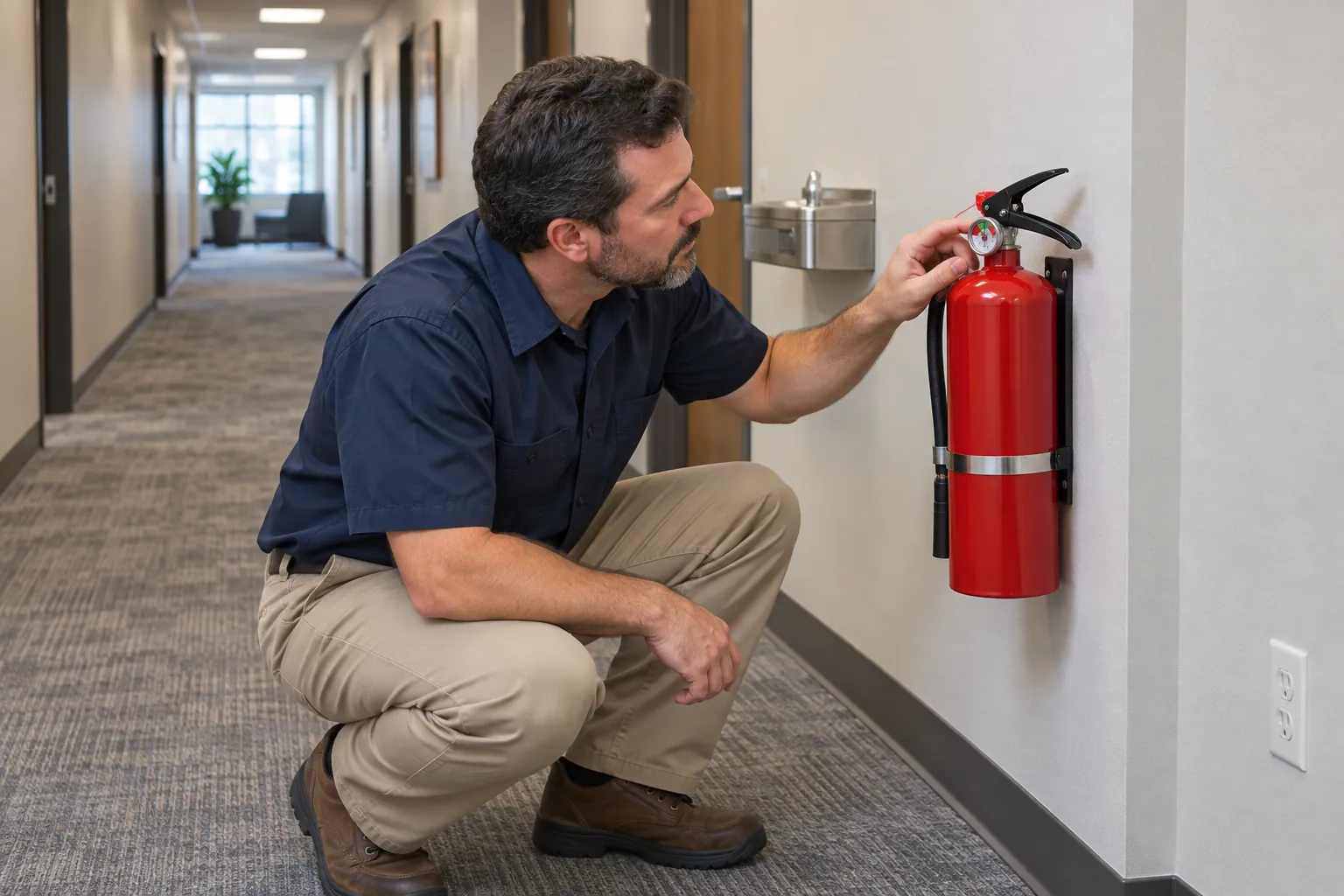
This guide covers what OSHA requires, where NFPA 10 and the local fire code come in, what the monthly walk actually looks at, and what the record should show.
01
The rule: OSHA 1910.157, NFPA 10 and the local fire code
For most private employers in the United States, the federal requirement is OSHA 29 CFR 1910.157, Portable fire extinguishers. It covers the placement, use, maintenance and testing of portable extinguishers provided for employees to use, and it is short and direct about inspection:
- 1910.157(e)(1): "The employer shall be responsible for the inspection, maintenance and testing of all portable fire extinguishers in the workplace."
- 1910.157(e)(2): "Portable extinguishers or hose used in lieu thereof under paragraph (d)(3) of this section shall be visually inspected monthly."
- 1910.157(e)(3): the employer must make sure extinguishers get "an annual maintenance check," and "shall record the annual maintenance date and retain this record for one year after the last entry or the life of the shell, whichever is less."
Two more paragraphs set the standard the monthly inspection is checking against. Under 1910.157(c)(1), extinguishers must be mounted, located and identified "so that they are readily accessible to employees without subjecting the employees to possible injury." Under 1910.157(c)(4), they must be "maintained in a fully charged and operable condition and kept in their designated places at all times except during use." The monthly fire extinguisher inspection is how an employer finds out, twelve times a year, whether that is still true.
Under 1910.157(b)(1), an employer whose written policy is immediate and total evacuation when the alarm sounds, with emergency action and fire prevention plans that meet 1910.38 and 1910.39, and with no extinguishers available in the workplace, is exempt from all of 1910.157 unless another Part 1910 standard requires an extinguisher. If extinguishers are on the walls, expect to inspect them.
The second source is the fire code. NFPA 10, Standard for Portable Fire Extinguishers, published by the National Fire Protection Association, is the technical standard most fire codes point to for selecting, installing, inspecting and maintaining extinguishers. NFPA 10 is a standard, not a law, until a jurisdiction adopts it, usually through the International Fire Code or NFPA 1, often with local amendments. The fire marshal or building official who enforces the code is the authority having jurisdiction (AHJ), and the edition of NFPA 10 that applies to your building is the one your jurisdiction has adopted. Ask the AHJ if you are not sure.
In a 2006 letter of interpretation, Whether inspections for portable fire extinguishers can be reduced from monthly to quarterly intervals, OSHA noted that the monthly requirement "is essentially consistent with" NFPA 10, quoting the 2002 edition's call for inspection "at approximately 30-day intervals." Later editions have been revised, so read the one your AHJ enforces; the practical answer is still every extinguisher, every month.
02
What the monthly fire extinguisher inspection looks at
A monthly inspection is visual. It is quick, needs no tools, and can be done by anyone who has been shown what to look for. It is not a service: nothing is opened, weighed or recharged. A typical monthly walk checks that each extinguisher:
- is in its designated place, on its hanger, bracket or in its cabinet, and has not been moved, taken or hidden;
- is visible and readily accessible, with nothing stacked in front of it: no carts, pallets, trash cans, chairs or stock, and its sign or marking still in place;
- shows a pressure gauge in the operable range, where it has a gauge, with the needle in the green;
- has its safety pin and tamper seal intact, which shows it has not been used or tampered with since it was last serviced;
- has no obvious physical damage: no dents, corrosion, leaks, or a cracked, kinked or clogged hose or nozzle;
- has its operating instructions legible and facing outward;
- feels full when lifted slightly, since a partly discharged extinguisher can be noticeably light;
- carries a current maintenance tag showing the annual maintenance was done within the last year, and has the month's inspection recorded.
The inspector also needs to notice when the wrong extinguisher is in a place. OSHA's own Extinguisher Basics eTool page sets out the classes of fire: A for ordinary combustibles, B for flammable liquids, C for energized electrical equipment, D for combustible metals and K for cooking oils and fats. A Class K unit belongs by the fryers, and a water extinguisher does not belong beside a server rack. Which type goes where is decided at installation, but a swap is a finding.
Spacing is part of the same picture. Under 1910.157(d)(2) and (d)(4), extinguishers for Class A fires must be within a travel distance of 75 feet, and for Class B hazards within 50 feet. The monthly walk is when someone notices that a renovation has moved a wall or taken an extinguisher away with the old reception desk.
03
Annual maintenance, the six-year maintenance and hydrostatic testing
The annual maintenance check is not the monthly inspection done more carefully. It is a thorough examination of each extinguisher, normally done by a trained technician from a fire protection company, who fits or updates a maintenance tag on the extinguisher when the work is done. OSHA's requirements sit in 1910.157(e) and (f):
- Annually, a maintenance check of every portable extinguisher, with the date recorded and the record kept (1910.157(e)(3)). Stored pressure extinguishers do not need an internal examination at this check.
- Every six years, stored pressure dry chemical extinguishers that need a 12-year hydrostatic test must be emptied and given the applicable maintenance procedures (1910.157(e)(4)). Disposable, non-refillable dry chemical units are exempt, and the six years restart when the extinguisher is recharged or hydrostatically tested.
- Hydrostatic testing at the intervals in the standard's Table L-1, five or twelve years depending on the type, "by trained persons with suitable testing equipment and facilities" (1910.157(f)(1)). Carbon dioxide and stored pressure water extinguishers are on five years; stored pressure dry chemical with mild steel shells is on twelve.
When an extinguisher is taken away for maintenance or recharging, 1910.157(e)(5) requires the employer to make sure "alternate equivalent protection" is provided. In practice that means loaner units in the same places, not empty brackets for a week.
Some states and cities license extinguisher service companies and technicians; your state fire marshal's office can tell you what applies. OSHA itself does not require the service vendor to certify its work to OSHA or NFPA standards: in its 1990 letter Inspecting and maintaining fire extinguishers, it left that to the employer's discretion, while making clear that "employers are responsible for inspecting and maintaining their fire extinguishers in use and for keeping, retaining, and making related records available to the Assistant Secretary upon request." Hiring a contractor does not move the duty.
04
What the record should show
OSHA's written recordkeeping requirements for extinguishers are narrower than many people expect. The federal standard requires two records:
- The annual maintenance date, kept "for one year after the last entry or the life of the shell, whichever is less," and available to OSHA on request (1910.157(e)(3)).
- Hydrostatic test certification, including "the date of the test, the signature of the person who performed the test and the serial number, or other identifier, of the fire extinguisher that was tested," kept until the next hydrostatic test or until the extinguisher is taken out of service (1910.157(f)(16)).
The monthly inspection itself is required by 1910.157(e)(2), but the federal text does not say how it is to be written down. What the record must contain is set by the fire code your AHJ enforces and the edition of NFPA 10 it has adopted, so check that. Insurers and fire inspectors commonly ask to see it, and without a record there is no way to show the inspection happened. The traditional record is the tag on each extinguisher, initialed and dated each month: hard to review across a building, easy to initial in advance, and gone when the unit is swapped.
Electronic records are acceptable if they carry what the paper did. In a 1996 letter, OSHA's position on PROTRAC, a company's computerized fire and safety bar code management system, OSHA said such a system "must comply with all relevant sections of OSHA regulations requiring such inspection and maintenance records," including the tester's signature and the extinguisher's serial number or identifier for hydrostatic tests. Whatever the format, a useful monthly record shows:
- which extinguisher, by location and an identifier, not just "all units OK";
- the date of the inspection and who did it;
- what was found, pass or fail, with a note of any defect;
- what happened about each defect: reported to whom, when the unit was replaced or serviced, and when the space was covered again;
- any unit that could not be inspected, and why, for example a locked room or an area under construction.
Keep the monthly inspections with the annual maintenance report, the hydrostatic test certifications and the building's other fire protection records, so an inspector can see the whole picture in one place.

05
Who does the inspection, training, and what goes wrong
The employer is responsible, but the monthly walk is usually delegated: in an office building to the facility manager, the building engineer or a security officer on patrol; in a school to the head custodian; in a warehouse to a shift lead. Whoever it is, name them and a backup, give them a list of every extinguisher by location, and make the inspection a fixed part of the month rather than something done when someone remembers.
Training is a separate duty. Under 1910.157(g)(1) and (g)(2), where extinguishers are provided for employee use, the employer must provide an educational program on "the general principles of fire extinguisher use and the hazards involved with incipient stage fire fighting," on hiring and at least annually after that. Employees designated to use firefighting equipment under an emergency action plan need training in the equipment itself (1910.157(g)(3)). The U.S. Fire Administration's Choosing and Using Fire Extinguishers page sets out the PASS method: pull the pin, aim low at the base of the fire, squeeze the lever slowly and evenly, and sweep from side to side. The first priority is still to raise the alarm and get out; an extinguisher is for a small fire, and only when it is safe to fight it.
Common findings on fire inspections and insurance surveys include:
- extinguishers used as door stops, or taken off the hanger and left on the floor;
- units blocked by stock, carts, furniture or event setups, or hidden behind a door that is usually open;
- a pin missing or a seal broken, with the unit still on its hanger after a small incident;
- annual maintenance tags more than a year old, or a monthly record that stops in the spring;
- the wrong type for the hazard, such as no Class K unit in a commercial kitchen;
- empty brackets while units are away for service, with no loaners in their place.
06
Where the record fails, and what SiteClara does about it
Monthly extinguisher inspections are the kind of routine that fades: skipped in a busy month, then a row of tags all initialed on the same afternoon. Nobody can say whether the unit by the loading dock was there in July, and a missing extinguisher is found at the next annual service, or not at all.
SiteClara puts a printed QR poster at each extinguisher point or group of points, with an optional NFC tag behind it. Staff scan the code or tap the tag on their own phone, with no app to install, and sign in with a link. They see the checks due at that location, such as the monthly extinguisher inspection, and mark each one done, or say what stopped them, such as a locked room. A problem, such as a missing extinguisher, a broken seal or a gauge out of the green, is reported there with a photo and goes onto the team's list of jobs until someone closes it.
The supervisor sees what is due, done and missed, and can record why a check was missed; a job that needs the building manager can be escalated to them to answer. Each day the supervisor reviews and approves a report that goes to nominated management or client contacts at 8 a.m. the next morning, showing what was reported, completed and still open, and how the scheduled checks went, for example 12 of 12 completed.
07
Where to read more, and a list to take away
Read the full text of 29 CFR 1910.157 on OSHA's site, and the eTool page Portable Fire Extinguishers: OSHA Requirements, which restates the inspection, maintenance and testing duties in plain language. In a State Plan state, read your state's version too. NFPA 10, Standard for Portable Fire Extinguishers, is published by the NFPA; read the edition your jurisdiction has adopted. Your local fire marshal can tell you which edition applies and whether local rules add to it.
Before the next annual service visit, check that:
- there is a current list of every extinguisher, by location, type and identifier;
- each one is inspected every month by a named person, and the inspection is recorded;
- defects and missing units are reported and fixed, not just noted, and loaners cover any gap;
- the annual maintenance is booked with a qualified company, and the date is recorded;
- six-year maintenance and hydrostatic tests are tracked by unit, with the certifications kept;
- recommendations from the last service visit have been acted on;
- employees have had their annual extinguisher training, and know that getting out comes first.
Sources
Every document this guide quotes or links to, in the order it first cites them.
- OSHA 29 CFR 1910.157, Portable fire extinguishers osha.gov
- OSHA-approved State Plans osha.gov
- Whether inspections for portable fire extinguishers can be reduced from monthly to quarterly intervals osha.gov
- Extinguisher Basics osha.gov
- Inspecting and maintaining fire extinguishers osha.gov
- OSHA's position on PROTRAC, a company's computerized fire and safety bar code management system osha.gov
- Choosing and Using Fire Extinguishers usfa.fema.gov
- Portable Fire Extinguishers: OSHA Requirements osha.gov
Related guides
 Fire and water checksFire extinguisher types: the classes, the labels and which one belongs whereThe fire extinguisher types used in US workplaces, the classes of fire they are for, how to read the rating label, and how to match each type to the space.
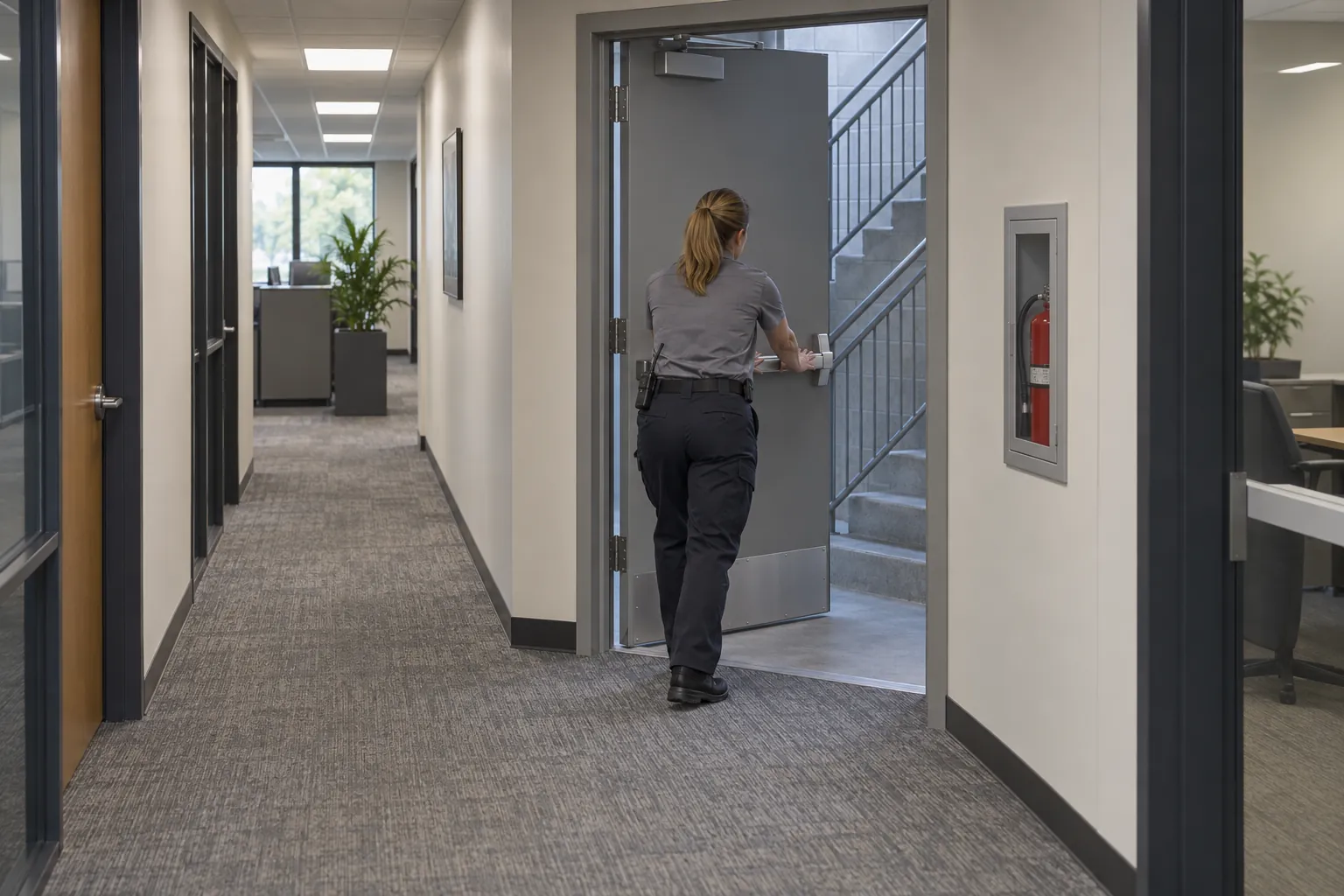 Fire and water checksWorkplace fire safety checklist: what to check, how often, and who does itA fire safety checklist for a US workplace: the daily, monthly and annual checks behind OSHA Subparts E and L and the local fire code, who does each, and the record.
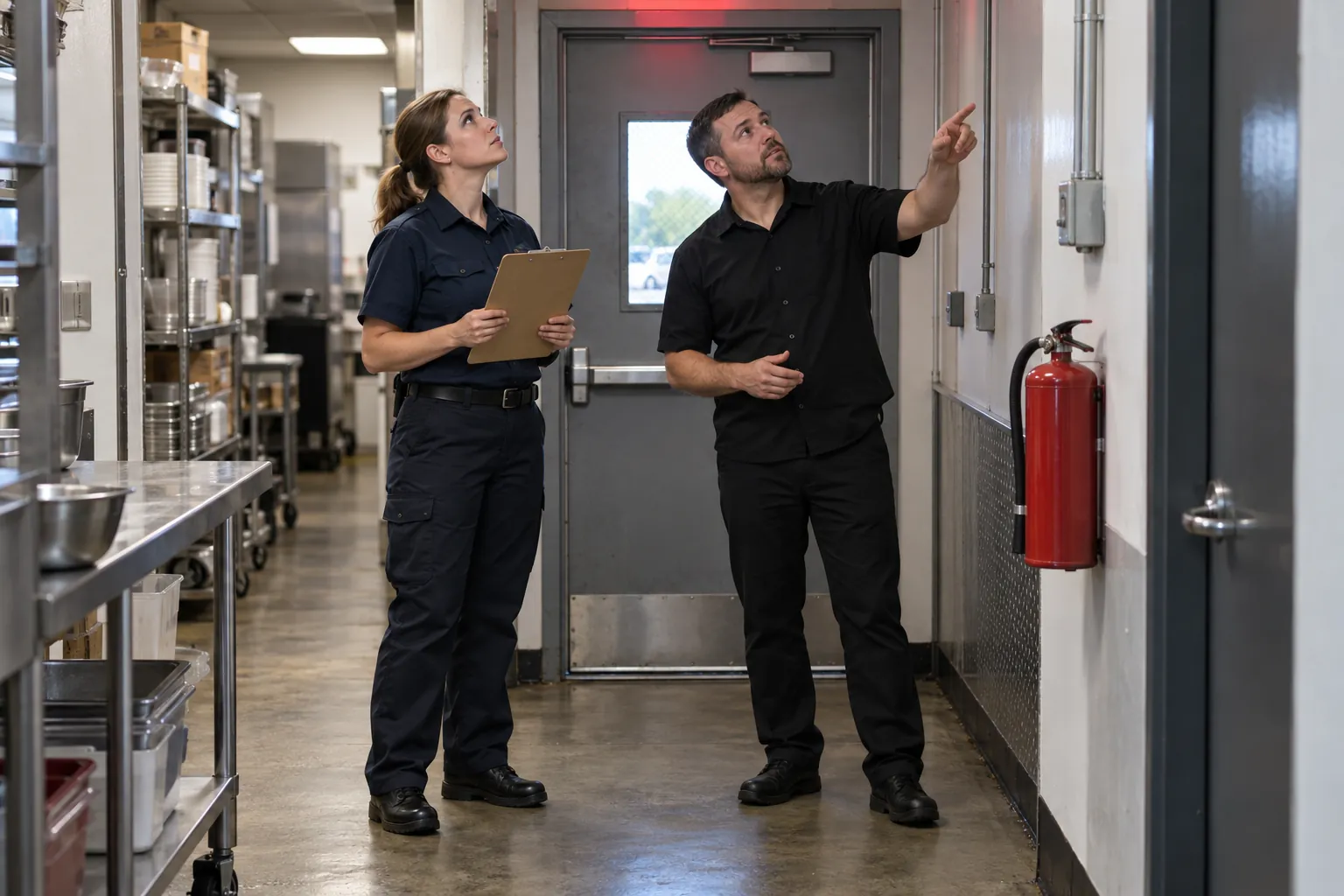 Fire and water checksFire inspection checklist: what the fire marshal looks at, and how to be readyA fire inspection checklist for US businesses: what the fire marshal checks, the records to have ready, who prepares what, and how to stay ready between visits.
 Fire and water checksEmergency action plan: what OSHA requires, and how to keep the plan workingWhat an emergency action plan must contain under OSHA 1910.38, who needs one, how alarms, wardens, drills and reviews fit in, and what the record should show.