Fire and water checks
Fire extinguisher types: the classes, the labels and which one belongs where
The main fire extinguisher types are multipurpose dry chemical (ABC), ordinary dry chemical (BC), water, carbon dioxide, wet chemical for kitchens (Class K), dry powder for metals (Class D) and clean agent, and each is listed for particular classes of fire.
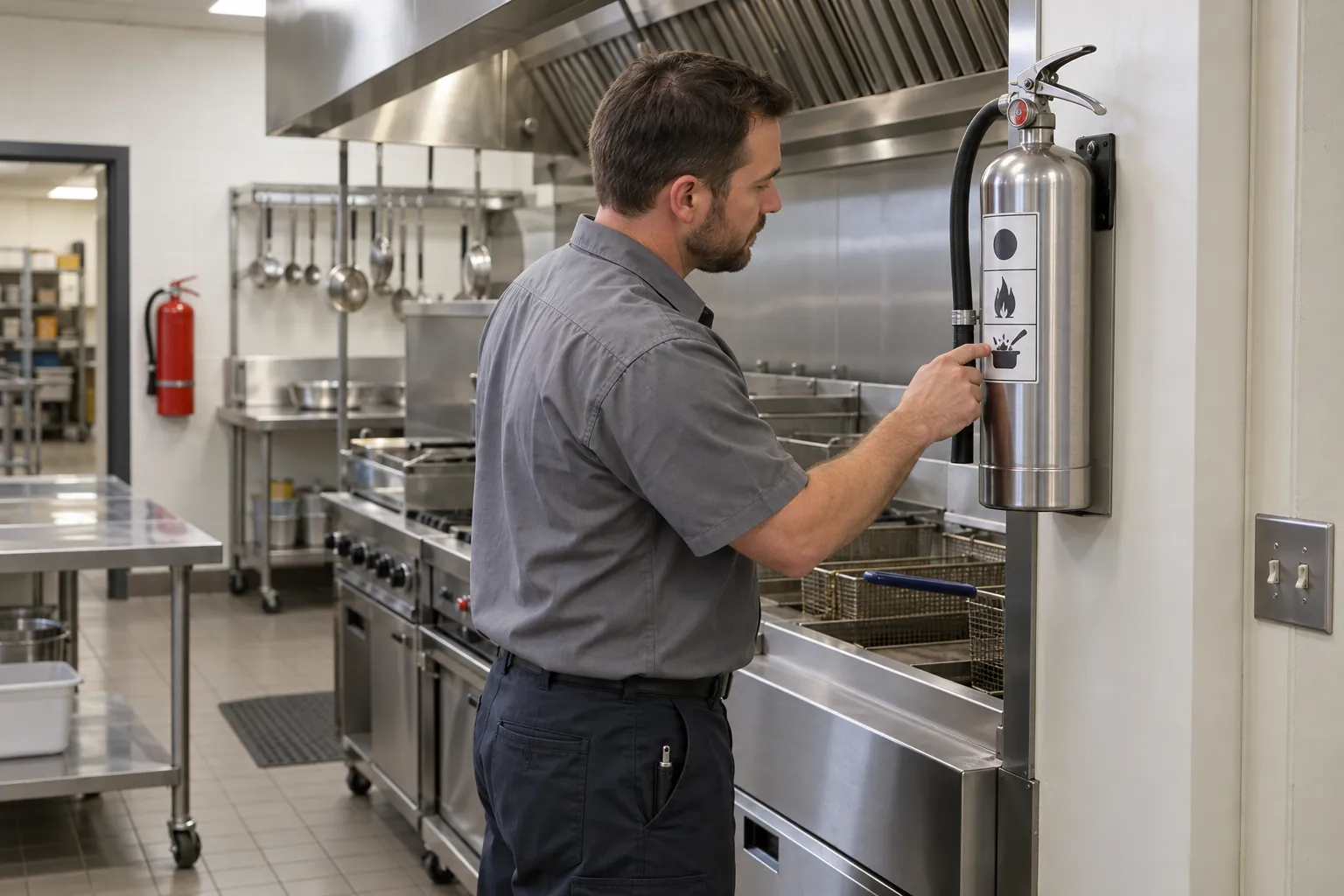
Using the wrong one can make a fire worse. In the United States the letters A, B, C, D and K describe the classes of fire, the label on the extinguisher says which classes it is listed for and how big a fire it can handle, and OSHA requires employers to choose extinguishers to suit the fires they can expect. This guide covers the main types, how to read the label, which type belongs in which part of a building, and how to keep the right one in the right place.
01
The classes of fire, and the rule that ties extinguishers to them
Fire extinguisher types in the United States are sorted by the class of fire they are meant to put out. For most private employers the federal definitions are in OSHA 29 CFR 1910.155, Scope, application and definitions, which sets out four classes:
- Class A: "a fire involving ordinary combustible materials such as paper, wood, cloth, and some rubber and plastic materials" (1910.155(c)(8)).
- Class B: "a fire involving flammable or combustible liquids, flammable gases, greases and similar materials, and some rubber and plastic materials" (1910.155(c)(9)).
- Class C: "a fire involving energized electrical equipment where safety to the employee requires the use of electrically nonconductive extinguishing media" (1910.155(c)(10)).
- Class D: "a fire involving combustible metals such as magnesium, titanium, zirconium, sodium, lithium and potassium" (1910.155(c)(11)).
A fifth class, Class K, covers fires in commercial cooking appliances that involve vegetable or animal oils and fats. It is not among the definitions in 1910.155, which predate it. OSHA's own eTool page, Portable Fire Extinguishers: Extinguisher Basics, explains that because of "the higher heating rates of vegetable oils in commercial cooking appliances," NFPA 10 "now includes a Class K rating for kitchen fires extinguishers which are now required to be installed in all applicable restaurant kitchens."
The rule that connects these classes to the extinguishers on your walls is OSHA 29 CFR 1910.157, Portable fire extinguishers. Under 1910.157(d)(1), "Portable fire extinguishers shall be provided for employee use and selected and distributed based on the classes of anticipated workplace fires and on the size and degree of hazard which would affect their use." The type follows from what can burn there.
Under 1910.157(c)(2), "Only approved portable fire extinguishers shall be used," and under 1910.155(c)(3) that includes equipment accepted by a nationally recognized testing laboratory. The U.S. Fire Administration's Choosing and Using Fire Extinguishers says to look for a "UL Listed" or "ULC Listed" label.
02
The main fire extinguisher types, and what each one is for
Most US commercial and institutional buildings use a handful of types. OSHA's Extinguisher Basics page describes the common ones:
- Multipurpose dry chemical (ABC): the workhorse of offices, schools, stores and corridors. OSHA defines multipurpose dry chemical as "a dry chemical which is approved for use on Class A, Class B and Class C fires" (1910.155(c)(32)). The eTool says dry chemical units work by "coating the fuel with a thin layer of fire retardant powder." The powder gets everywhere, which matters in some rooms.
- Ordinary dry chemical (BC): dry chemical units "are usually rated for class B and C fires and may be marked multiple purpose," according to the eTool. A BC unit is for flammable liquids and electrical fires, not a burning trash can full of paper.
- Air-pressurized water (APW): designed "for Class A (wood, paper, cloth, rubber, and certain plastics) fires only." The eTool is blunt: "Never use water to extinguish flammable liquid fires" and "Never use water to extinguish an electrical fire."
- Carbon dioxide (CO2): "a colorless, odorless, electrically nonconductive inert gas" (1910.155(c)(7)), for Class B and C fires, with no residue, a hard horn and no gauge. CO2 "is not recommended for Class A fires," and the eTool says: "Never use CO2 extinguishers in a confined space while people are present without proper respiratory protection."
- Class K (wet chemical): for commercial cooking appliances, using potassium bicarbonate or a wet mist according to the eTool. It backs up the kitchen's fixed hood suppression system; it does not replace it.
- Class D (dry powder): "a compound used to extinguish or control Class D fires" (1910.155(c)(13)), not the same as dry chemical. Fires in powders, flakes or shavings of combustible metals "require special extinguishers labeled D."
- Clean agent (halon and halocarbon): agents that leave no residue, used where powder or water would damage equipment. OSHA defines Halon 1211 and 1301 as electrically nonconductive agents that inhibit the fire's chemical chain reaction (1910.155(c)(23) and (c)(24)). The EPA's Substitutes in Fire Suppression and Explosion Protection says "the production and import of virgin halons in the United States has been phased out," and lists alternatives such as halocarbons, inert gas and carbon dioxide.
Some types are banned. Under 1910.157(c)(3), the employer "shall not provide or make available in the workplace portable fire extinguishers using carbon tetrachloride or chlorobromomethane extinguishing agents." Under 1910.157(c)(5), old soldered or riveted shell soda acid, self-generating foam and gas cartridge water units operated by turning them upside down must be removed from service.
03
How to read the label: classification, rating and the numbers
The type is on the label, not in the color. The eTool describes both ABC and CO2 units as red, so across a room one type looks much like another. Read the label.
OSHA distinguishes two things on that label. The extinguisher classification is "the letter classification given an extinguisher to designate the class or classes of fire on which an extinguisher will be effective" (1910.155(c)(16)). The extinguisher rating is "the numerical rating given to an extinguisher which indicates the extinguishing potential of the unit based on standardized tests" (1910.155(c)(17)). A typical label reads something like 2-A:10-B:C. The eTool explains the numbers:
- The number in front of the A "indicates how much water the extinguisher is equal to and represents 1.25 gallons of water for every unit of one." A 2-A unit is equivalent to 2.5 gallons of water on a Class A fire.
- The number in front of the B "represents the area in square feet of a class B fire that a non-expert user should be able to extinguish." A 10-B unit is rated for about 10 square feet of burning liquid.
- The C carries no number. It shows that the agent is safe to use on energized electrical equipment; the size of the unit is judged by its A or B rating.
- K and D appear on units listed for those hazards; a Class D unit is often listed for particular metals.
The rating matters as much as the letters, because the fire code sizes and spaces extinguishers by rating. OSHA's eTool page Extinguisher Placement and Spacing gives NFPA 10's rule of thumb for Class A: "one 2-A extinguisher for every 3,000 square feet." A 1-A:10-B:C and a 4-A:80-B:C are both ABC units, but the second is far more capable, so when a service company swaps a unit, check that the replacement has at least the same rating, not just the same letters.
04
Which type goes where in a building
Selection starts from the hazard: walk the building area by area and ask what could burn there. The fire protection company normally makes the choice at installation, but the facility manager or building engineer is the one who notices when a space changes use. Typical choices:
- Offices, classrooms, corridors, lobbies and retail floors: multipurpose ABC, for paper, furniture, trash and plugged-in equipment.
- Commercial kitchens and cafeterias: Class K by the cooking line, with ABC units for the rest of the space. The eTool warns: "Do not attempt to use a Class A extinguisher containing water or CO2 on a deep fat fryer fire. An explosive type reaction may result." A break room with a microwave is not a commercial kitchen.
- Server rooms, telecom closets and labs: CO2 or clean agent where powder would damage equipment, bearing in mind the warning about CO2 in confined spaces.
- Mechanical rooms, warehouses, loading docks and parking garages: ABC units, with higher B ratings near fuels, forklift propane cages and battery charging.
- Machine shops working combustible metals: Class D units matched to the metal, as well as the general units.
Distance matters as much as type. OSHA's travel distance limits are in 1910.157(d): 75 feet or less to an extinguisher for Class A fires (d)(2), 50 feet or less from a Class B hazard area (d)(4), Class C distributed on the pattern of the existing Class A or B hazards (d)(5), and Class D agents within 75 feet of areas where combustible metal powders, flakes or shavings are generated at least once every two weeks (d)(6). The Placement and Spacing eTool adds that where cooking oils and fats are a hazard, Class K extinguishers must be installed "at a maximum travel distance of 30 feet."
The same eTool page sets mounting heights: handles no higher than 5 feet for extinguishers of 40 pounds or less, no more than 3 1/2 feet for heavier ones, and at least 4 inches between the bottom and the floor. Local fire codes can add to all of this.
The kitchen needs one extra item. The eTool says to place a placard near the Class K extinguisher which states: "In case of appliance fire, use this extinguisher only after the fixed fire suppression system has been actuated." It also warns that the agents in many Class K extinguishers "are electrically conductive and should only be used after electrical power to the kitchen appliance has been shut off."

05
Using the right type: training, PASS and when to leave
Knowing the types is part of the training OSHA requires. Under 1910.157(g)(1), where extinguishers are provided for employee use, the employer must provide "an educational program to familiarize employees with the general principles of fire extinguisher use and the hazards involved with incipient stage fire fighting." Under (g)(2), that education is given "upon initial employment and at least annually thereafter." Employees designated to use firefighting equipment under an emergency action plan need training in the equipment itself, under (g)(3).
An incipient stage fire, in OSHA's definition, is one "in the initial or beginning stage" that can be controlled or extinguished by portable fire extinguishers without protective clothing (1910.155(c)(26)). That is the only kind of fire an extinguisher is for. OSHA's eTool page Fire Extinguisher Use says to evacuate immediately if the fire grows beyond that stage, and: "If you have the slightest doubt about your ability to fight a fire....EVACUATE IMMEDIATELY!"
The same page teaches the PASS method:
- Pull the pin, which also breaks the tamper seal.
- Aim low, pointing the nozzle, horn or hose at the base of the fire.
- Squeeze the handle to release the agent.
- Sweep from side to side at the base of the fire until it appears to be out.
The U.S. Fire Administration adds a test: others alerted and the fire department called, the fire small and contained, a clear way out. If not, alert others, leave and call 911.
The type-specific points belong in the annual training: water on grease or live equipment, CO2 in a small occupied room, Class K before the hood system has fired, and anything but Class D agent on a metal fire are where people get hurt.
Keeping the right type on the wall is part of routine maintenance too. Under 1910.157(e)(2), portable extinguishers "shall be visually inspected monthly," and under (e)(3) the employer must see that they are "subjected to an annual maintenance check" and record the date, so each monthly inspection is a chance to confirm the type and rating as well as the pressure gauge and seal.
06
Where the record fails, and what SiteClara does about it
The extinguisher list in the fire protection company's report says an ABC unit hangs by the kitchen door. On the wall there is a water extinguisher left over from a swap, the Class K unit has been moved to the other end of the cooking line, and the server room's CO2 unit went out for service and came back as dry chemical. Nobody chose this; it drifted, one service visit and one renovation at a time.
A monthly check that only asks "extinguisher present?" will never notice the wrong type. A useful one asks whether the unit on the wall is the type and rating the list says it should be.
SiteClara puts a printed QR poster at each extinguisher point or group of points, with an optional NFC tag behind it. Staff scan the code or tap the tag on their own phone, with no app to install, and sign in with a link. They see the checks due at that location, which can include confirming the extinguisher type against what that location should have, and mark each one done, or say what stopped them, such as a locked room. A problem, such as a water unit where a CO2 unit should be, a missing Class K placard or an empty bracket, is reported there with a photo and goes onto the team's list of jobs until someone closes it.
The supervisor sees what is due, done and missed, and can record why a check was missed; a job that needs the building manager can be escalated to them to answer. Each day the supervisor reviews and approves a report that goes to nominated management or client contacts at 8 a.m. the next morning, showing what was reported, completed and still open, and how the scheduled checks went.
07
Questions people ask
What are the 5 classes of fire?
The five classes are A, B, C, D and K. OSHA 29 CFR 1910.155 defines the first four: Class A is ordinary combustibles such as paper, wood and cloth; Class B is flammable or combustible liquids, flammable gases and greases; Class C is energized electrical equipment; and Class D is combustible metals such as magnesium and sodium. The U.S. Fire Administration's Choosing and Using Fire Extinguishers adds Class K, "for use with vegetable oils, animal oils and fats in cooking appliances."
What are the four types of fire extinguishers?
No federal rule fixes a set number of types. OSHA's Portable Fire Extinguishers: Extinguisher Basics says "the three most common types of fire extinguishers are: air pressurized water, CO2 (carbon dioxide), and dry chemical," and also describes multipurpose dry chemical units for Class A, B and C fires, Class K units for commercial kitchens and Class D units for combustible metals.
Which fire extinguisher is used for an electrical fire?
Use one whose label includes C, which means the agent does not conduct electricity. OSHA's Extinguisher Basics says CO2 extinguishers "are designed for Class B and C (flammable liquid and electrical) fires only," and that dry chemical units are usually rated for Class B and C and may be multipurpose ABC. It warns: "Never use water to extinguish an electrical fire. Water is a good conductor and may lead to electrocution if used to extinguish an electrical fire."
What is the safest fire extinguisher to use?
The safest one is the one listed for the fire in front of you, used by someone who can handle it. For homes, the U.S. Fire Administration's Choosing and Using Fire Extinguishers says multipurpose units labeled B-C or A-B-C suit most fires, and that "it is recommended to select the largest fire extinguisher that a user can safely and comfortably operate." Before using any type, check that the fire department has been called and that you have a clear escape route.
08
Where to read more, and a list to take away
Read 29 CFR 1910.155 and 29 CFR 1910.157 on OSHA's site, with the eTool pages Extinguisher Basics, Extinguisher Placement and Spacing and Fire Extinguisher Use. The U.S. Fire Administration's Choosing and Using Fire Extinguishers suits staff training. Ask your AHJ which edition of NFPA 10 applies, and whether a State Plan or local amendment adds to the federal rule.
Before the next fire inspection or service visit, check that:
- every extinguisher is listed by location, type, rating and identifier, and the list matches the walls;
- each area has the type its hazard needs: ABC generally, Class K by commercial cooking, CO2 or clean agent where powder would do harm, Class D where metals are worked;
- replacements have at least the rating of the unit they replace;
- travel distances and mounting heights meet 1910.157(d) and your fire code;
- the Class K placard is posted, and no banned or inverting-type units remain;
- employees have had their annual training and know that getting out comes first.
Sources
Every document this guide quotes or links to, in the order it first cites them.
- OSHA 29 CFR 1910.155, Scope, application and definitions osha.gov
- Portable Fire Extinguishers: Extinguisher Basics osha.gov
- OSHA 29 CFR 1910.157, Portable fire extinguishers osha.gov
- Choosing and Using Fire Extinguishers usfa.fema.gov
- OSHA-approved State Plans osha.gov
- NFPA 10, Standard for Portable Fire Extinguishers nfpa.org
- Substitutes in Fire Suppression and Explosion Protection epa.gov
- Extinguisher Placement and Spacing osha.gov
- Fire Extinguisher Use osha.gov
Related guides
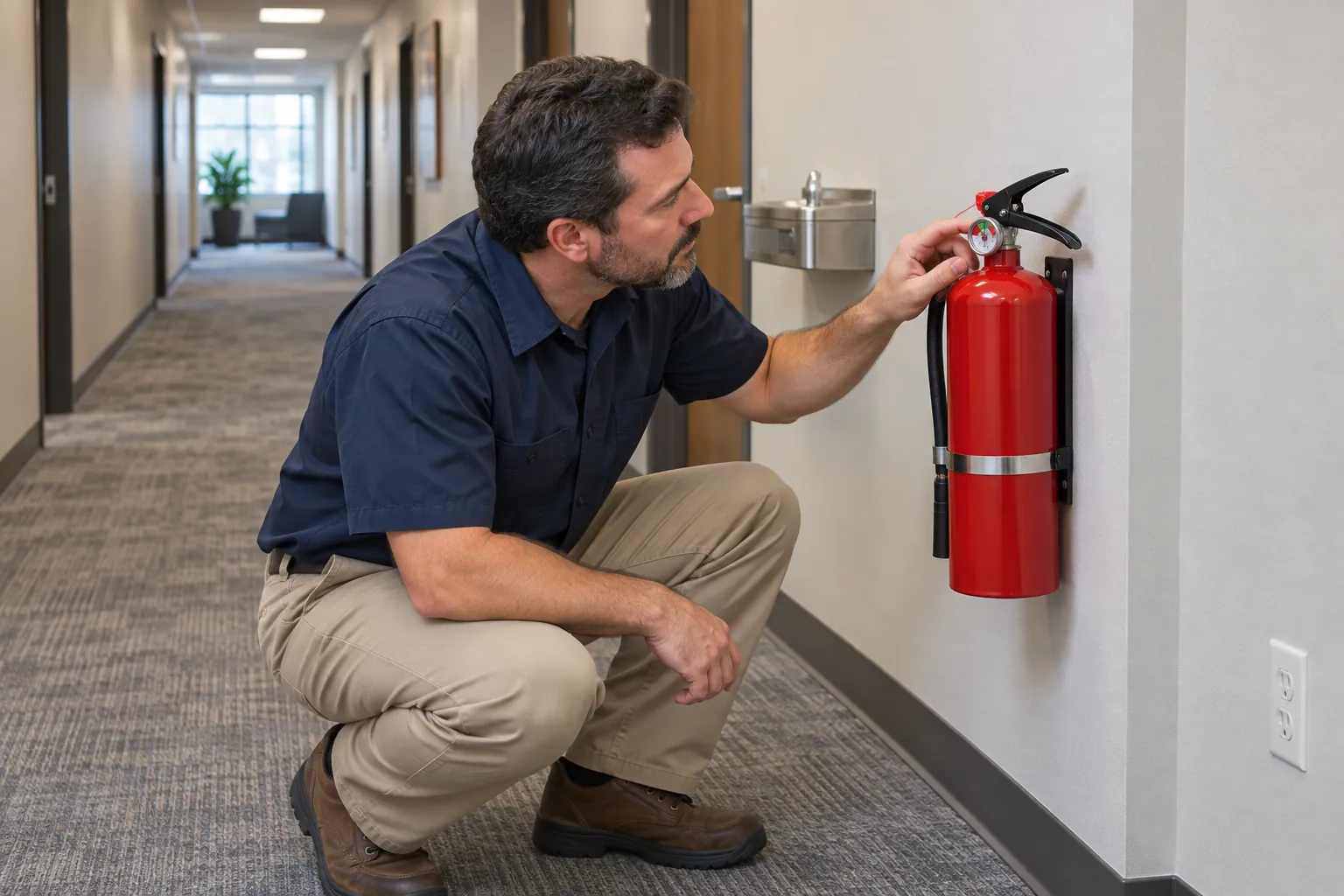 Fire and water checksFire extinguisher inspection: the monthly check and the annual maintenanceWhat a monthly fire extinguisher inspection covers under OSHA 1910.157 and NFPA 10, how it differs from annual maintenance, and what the record should show.
 Fire and water checksWorkplace fire safety checklist: what to check, how often, and who does itA fire safety checklist for a US workplace: the daily, monthly and annual checks behind OSHA Subparts E and L and the local fire code, who does each, and the record.
 Fire and water checksKitchen hood inspection: grease, cleaning and the fire suppression systemHow commercial kitchen hood inspection works under NFPA 96: grease buildup, cleaning, the six-month suppression service, daily checks and the records to keep.
 Fire and water checksFire inspection checklist: what the fire marshal looks at, and how to be readyA fire inspection checklist for US businesses: what the fire marshal checks, the records to have ready, who prepares what, and how to stay ready between visits.