Fire and water checks
Workplace fire safety checklist: what to check, how often, and who does it
A workplace fire safety checklist is the list of fire safety checks a building needs, from the daily walk of exit routes to the monthly fire extinguisher inspection and the annual testing of alarms and sprinklers, each with a frequency, a person responsible and a record.
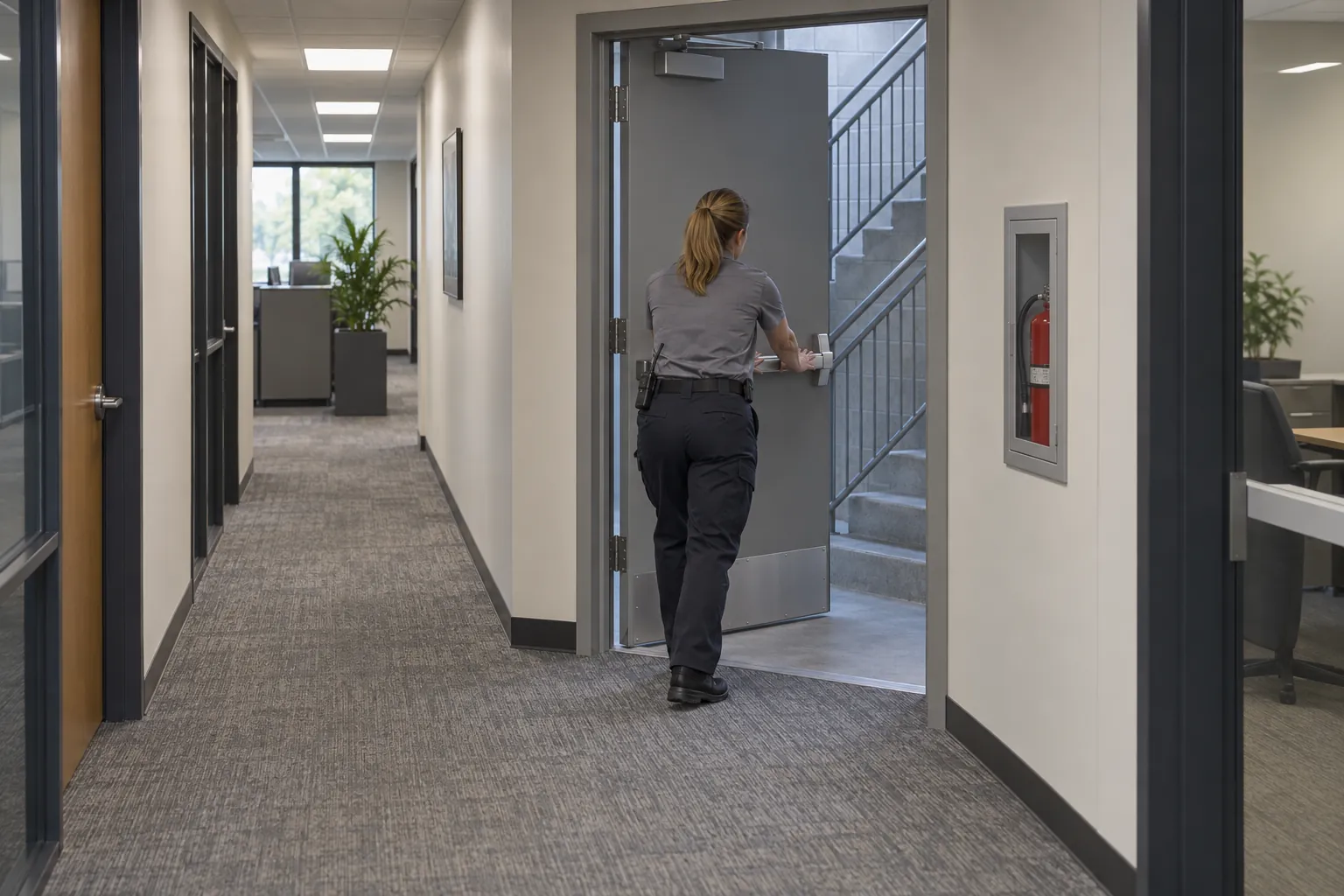
Most fire safety checklists online are written for homes: smoke alarms, candles, an escape plan for the family. A commercial building needs something different. This guide sets out a fire safety checklist for an office, school, store or warehouse in the United States, built on OSHA's exit route and fire protection rules and the fire code your jurisdiction enforces, with who does each check and what the record should show.
01
Whose rules apply: OSHA, the state and the fire code
Fire safety in a US workplace sits under two sets of rules at once, and a useful checklist has to serve both.
The first is OSHA. For most private employers, the federal requirements are in 29 CFR Part 1910, the general industry standards. Two subparts do most of the work. Subpart E, Exit Routes and Emergency Planning, covers the design and upkeep of exit routes (1910.36, Design and construction requirements for exit routes, and 1910.37, Maintenance, safeguards, and operational features for exit routes), the emergency action plan in 1910.38 and the fire prevention plan in 1910.39. Subpart L, Fire Protection, covers the equipment: portable fire extinguishers (1910.157), automatic sprinkler systems (1910.159) and employee alarm systems (1910.165), among others.
OSHA's exit route rules also point outward. Under 1910.35, Compliance with alternate exit-route codes, an employer who complies with "the exit-route provisions of NFPA 101, Life Safety Code, 2009 edition, or the exit-route provisions of the International Fire Code, 2009 edition" is deemed to comply with OSHA's corresponding exit route requirements.
The second set of rules is the fire code. Fire codes are adopted locally, usually the International Fire Code or NFPA 1 with local amendments, and enforced by the fire marshal, the authority having jurisdiction (AHJ). Most testing frequencies come from the NFPA standards the code adopts: NFPA 10 for extinguishers, NFPA 25 for sprinklers, NFPA 72 for fire alarms, NFPA 80 for fire doors and NFPA 101, the Life Safety Code. An NFPA standard binds only once adopted, in the edition your AHJ adopted; ask the fire marshal's office if unsure.
Neither gives you a single checklist. The one below is assembled from both; adjust it to your building and to what your AHJ and contractors tell you.
02
The fire safety checklist, from daily to annual
A typical commercial fire safety checklist, for a building with a fire alarm system, sprinklers, emergency lighting and portable fire extinguishers, looks like this. Your fire code, your contractors' service agreements and your own plans may add items or change the intervals.
- Daily, or each shift: exit routes and stairwells clear; exit doors unlocked from the inside while people are in the building and opening without keys, tools or special knowledge; the outside of each exit discharge clear of vehicles, dumpsters and deliveries; fire doors closed and latched, never wedged or propped; exit signs lit; the fire alarm control panel showing normal, with any trouble signal reported; pull stations and extinguishers unobstructed; no build-up of trash, cardboard or other combustible waste.
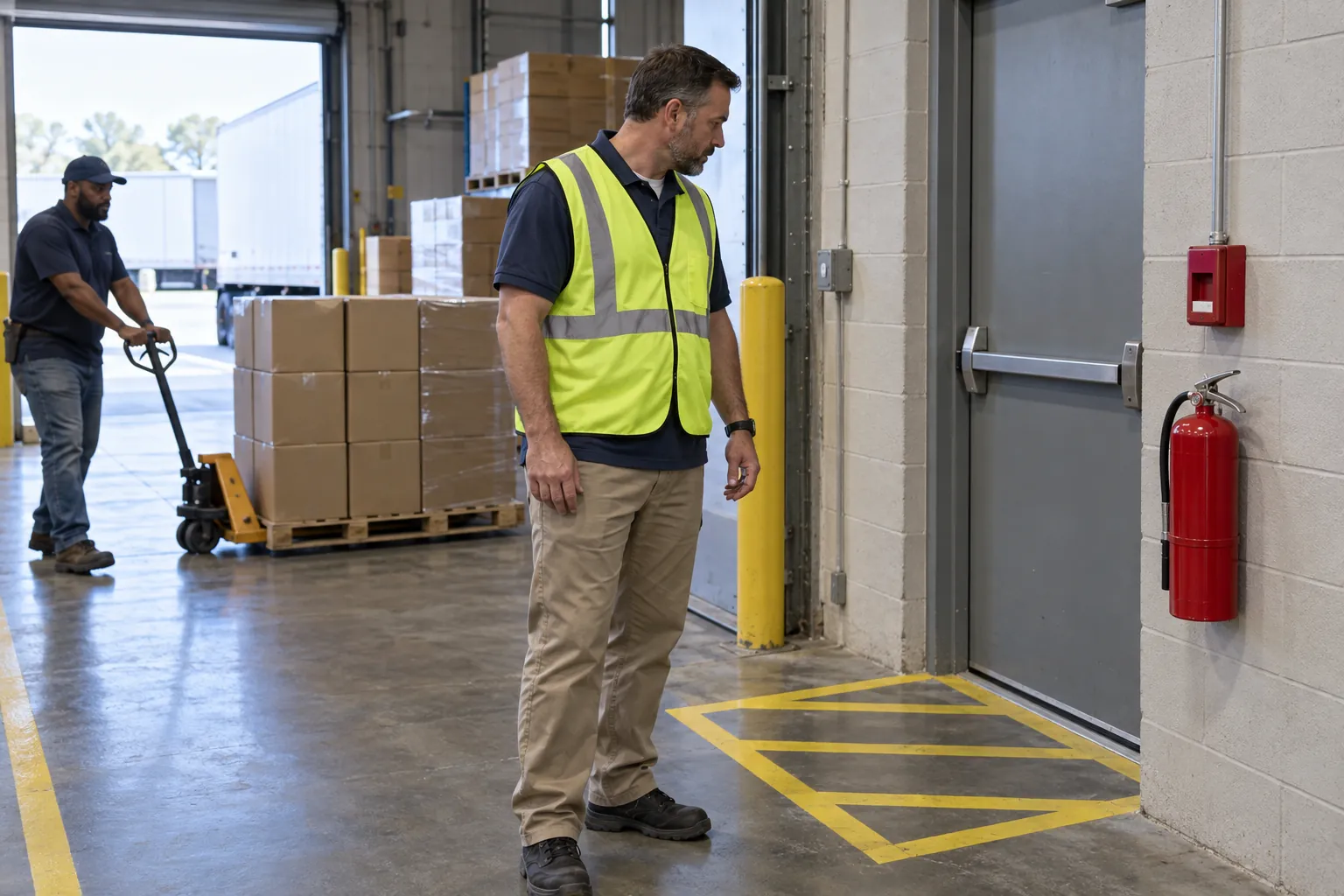
- Weekly: a walk of storage rooms, back corridors, mechanical rooms and loading docks, where exits and equipment are most often blocked; flammable and combustible materials stored away from heaters and other ignition sources; electrical panels clear, and no extension cords used in place of permanent wiring or run through doorways.
- Monthly: the visual inspection of every portable fire extinguisher, which OSHA requires; a check of emergency lighting and exit signs as your fire code sets out; a check that 18 inches of clearance is kept below sprinkler heads in storage areas; a walk of fire doors for damage, missing hardware and doors that no longer close.
- Every two months: where the employee alarm system is not supervised, OSHA's test of its reliability and adequacy.
- Annually: the maintenance check of every portable extinguisher by a qualified technician; the inspection and testing of the fire alarm system and its smoke detectors, sprinklers, fire doors and emergency lighting that the adopted NFPA standards require, by contractors your AHJ accepts; OSHA's annual main drain flow test on a sprinkler system installed to meet an OSHA standard; at least one evacuation drill; and a review of the emergency action plan and fire prevention plan.
A fire pump, standpipes, kitchen hood suppression or a generator each has its own standard and schedule. Put them on the same calendar, with an owner.
03
Exit routes, exit doors and housekeeping
The daily exit walk matters most and is most often skipped. OSHA's requirements are short:
- 1910.36(d)(1): "Employees must be able to open an exit route door from the inside at all times without keys, tools, or special knowledge."
- 1910.36(d)(2): "Exit route doors must be free of any device or alarm that could restrict emergency use of the exit route if the device or alarm fails."
- 1910.36(g)(2): "An exit access must be at least 28 inches (71.1 cm) wide at all points."
- 1910.37(a)(1): "Exit routes must be kept free of explosive or highly flammable furnishings or other decorations."
- 1910.37(a)(3): "Exit routes must be free and unobstructed. No materials or equipment may be placed, either permanently or temporarily, within the exit route."
- 1910.37(b)(1): "Each exit route must be adequately lighted so that an employee with normal vision can see along the exit route."
- 1910.37(b)(2): "Each exit must be clearly visible and marked by a sign reading 'Exit.'"
- 1910.37(b)(5): "Each doorway or passage along an exit access that could be mistaken for an exit must be marked 'Not an Exit' or similar designation."
On the walk, that means: nothing stored in the corridor, even for an hour; no exit door chained, padlocked or blocked outside; exit signs lit and visible; fire doors closed or held only on devices that release with the alarm. Housekeeping is part of it. The fire prevention plan in 1910.39 must include "Procedures to control accumulations of flammable and combustible waste materials," and the daily walk is where cardboard by the compactor or oily rags in an open bin get noticed.
Remodeling changes the picture fastest. Under 1910.37(d), during repairs or alterations employees may not occupy a workplace unless the required exit routes remain available and existing fire protections are maintained. A tenant fit-out or a contractor's hot work should prompt a fresh look at the exits and equipment around it.
04
Alarms, extinguishers and sprinklers: routine checks and contractor work
Every item is one of two kinds of work:
- Routine checks are done by people in the building: the building engineer, a custodian, a security officer on patrol or a fire warden. They are short, need no tools, and find the obvious fault early.
- Inspection, testing and maintenance is done by a fire protection contractor with the training, equipment and often the state or local license for that system.
A routine check does not replace a contractor's inspection, and an annual inspection does not replace the checks in between. OSHA's standards show both kinds of work side by side:
- Fire extinguishers: under 1910.157(e)(2), extinguishers "shall be visually inspected monthly," and under 1910.157(e)(3) they must have "an annual maintenance check," with the employer required to "record the annual maintenance date and retain this record for one year after the last entry or the life of the shell, whichever is less." Under 1910.157(c)(4), they must be "maintained in a fully charged and operable condition and kept in their designated places at all times except during use." Our guide to the monthly fire extinguisher inspection covers the monthly walk in detail.
- Employee alarm systems: under 1910.165(d)(1), employers must make sure "all employee alarm systems are maintained in operating condition except when undergoing repairs or maintenance." Under 1910.165(d)(2), "a test of the reliability and adequacy of non-supervised employee alarm systems is made every two months," and under 1910.165(d)(4) "all supervised employee alarm systems are tested at least annually for reliability and adequacy." Under 1910.165(e), "manually operated actuation devices for use in conjunction with employee alarms are unobstructed, conspicuous and readily accessible." Under 1910.165(d)(5), servicing, maintenance and testing must be done by persons trained in the system's designed operation.
- Automatic sprinklers: for a system installed to meet an OSHA standard, 1910.159(c)(2) requires the employer to "properly maintain" it, with a main drain flow test on each system annually and the inspector's test valve opened at least every two years. Under 1910.159(c)(10), "The minimum vertical clearance between sprinklers and material below shall be 18 inches (45.7 cm)." Stock stacked too high in a stockroom is a routine-check finding, not something to wait a year for.
Most commercial alarm and sprinkler systems are also maintained under NFPA 72 and NFPA 25 as your fire code adopts them. Ask your contractor which items site staff should look at between visits, put them on the checklist, and make sure the contractor's deficiencies reach someone who will get them fixed.
05
Plans, training, drills and what the record should show
Where an OSHA standard requires them, an employer must also have an emergency action plan and a fire prevention plan, in writing and kept in the workplace; an employer with 10 or fewer employees may communicate them orally.
The fire prevention plan is, in effect, the reason the checklist exists. Under 1910.39(c)(1), it lists "all major fire hazards, proper handling and storage procedures for hazardous materials, potential ignition sources and their control, and the type of fire protection equipment necessary to control each major hazard." It also names, under 1910.39(c)(4) and (c)(5), "The name or job title of employees responsible for maintaining equipment to prevent or control sources of ignition or fires" and those "responsible for the control of fuel source hazards." Under 1910.39(d), "An employer must inform employees upon initial assignment to a job of the fire hazards to which they are exposed."
The emergency action plan covers what happens when the alarm sounds. Under 1910.38(e), an employer must "designate and train employees to assist in a safe and orderly evacuation." Our guide to the emergency action plan covers its elements.
OSHA's general industry standards do not set one drill frequency for every workplace. The same Develop and Implement an Emergency Action Plan page says "Drills should be conducted as often as necessary to keep employees prepared," suggests considering "retraining employees annually," and advises updating the plan "when there is a change in the layout or design of the facility." Many fire codes set drill frequencies for particular occupancies, such as schools, hospitals and high-rise buildings, so ask your AHJ what applies to yours.
OSHA's recordkeeping requirement here is narrow; the fire code requires more, and inspectors and insurers ask to see it. A good record:
- Records each check when it is done, with the date, the time and the name of the person who did it.
- Identifies what was checked: which exit, which floor, which extinguisher, which fire door.
- Records defects and what happened next: who the fault was reported to, when it was fixed, and by whom.
- Shows the gaps honestly: a missed check with a reason, such as a locked tenant suite, is more credible than a year of identical entries.
- Keeps contractors' reports and drill records with the routine checks.
The common failure is a record nobody can believe: a month initialed in one pen, or three years of ticks with no defect found. Have someone else look through it each month.
06
Where the record fails, and what SiteClara does about it
A clipboard by the fire alarm panel works in one building with a conscientious building engineer. It struggles across a campus or portfolio, or when the contractor changes. A regional facility manager usually finds out that the exit checks stopped in the spring when the fire marshal or the insurer finds a blocked exit, months later.
SiteClara puts a printed QR poster at each place a check happens, such as an exit door, the fire alarm panel, a fire door or an extinguisher point, with an optional NFC tag behind it. Staff scan the code or tap the tag on their own phone, with no app to install, and sign in with a link. They see the checks due at that location, such as the daily exit check or the monthly extinguisher inspection, and mark each one done, or say what stopped them. A problem they find, such as a chained exit, a wedged fire door or a gauge out of the green, is reported there with a photo and goes onto the team's list of jobs until someone closes it.
The supervisor sees what is due, done and missed, and can record the reason a check was missed. A job that needs the building manager can be escalated to them to answer. Each day the supervisor reviews and approves a report, which goes to nominated management or client contacts at 8 a.m. the next morning, showing what was reported, completed and still open, and how the scheduled checks went, for example 12 of 12 completed.
07
Questions people ask
What are the OSHA guidelines for fire safety?
OSHA's Fire Safety topic page says that "Fire safety is addressed in specific OSHA standards for recordkeeping, general industry, maritime, and construction." For most workplaces the general industry standards in 29 CFR Part 1910 apply: Subpart E for exit routes, the emergency action plan and the fire prevention plan, and Subpart L for fire safety equipment such as portable fire extinguishers, automatic sprinklers and employee alarm systems. In a State Plan state, read the state's own standards as well.
What are the 5 E's of fire safety?
They are a fire department's strategy for a community rather than a workplace rule. The U.S. Fire Administration's Community Risk Reduction page calls the "5 E's" "one of the strategies used to combat local fire and preventable injury issues" and names them as education, engineering, enforcement, economic incentives and emergency response. The one a workplace meets most directly is enforcement, which, in the page's words, "identifies potential risks and noncompliance in your local properties and teaches your community how fire and building codes protect them."
08
Where to read more, and a list to take away
Read the full text of 29 CFR 1910.37 and the other Subpart E and Subpart L standards on OSHA's site, and its Fire Safety topic page, which gathers the standards and guidance in one place. The Evacuation Plans and Procedures eTool walks small, low-hazard businesses through exit routes, alarms, extinguishers and the plan. All of these resources are free to read online. The NFPA standards and the International Fire Code apply in the editions your jurisdiction has adopted.
Before the next fire inspection or insurance survey, check that:
- you know which OSHA regime applies, federal or State Plan, and which fire code and editions your AHJ enforces;
- every check on the list has a frequency, a named person and a backup;
- daily exit checks happen and are recorded, including the outside of each exit discharge;
- every extinguisher is inspected monthly and its annual maintenance date is recorded;
- contractors have visited on schedule, and their deficiencies have been fixed;
- the emergency action and fire prevention plans are current, and drills are recorded;
- in a multi-tenant building, everyone knows which checks are theirs and sees the results.
Sources
Every document this guide quotes or links to, in the order it first cites them.
- 1910.36, Design and construction requirements for exit routes osha.gov
- 1910.37, Maintenance, safeguards, and operational features for exit routes osha.gov
- Emergency action plan in 1910.38 osha.gov
- Fire prevention plan in 1910.39 osha.gov
- 1910.157 osha.gov
- 1910.159 osha.gov
- 1910.165 osha.gov
- 1910.35, Compliance with alternate exit-route codes osha.gov
- State Plans osha.gov
- Develop and Implement an Emergency Action Plan osha.gov
- Fire Safety osha.gov
- Community Risk Reduction usfa.fema.gov
- Evacuation Plans and Procedures eTool osha.gov
Related guides
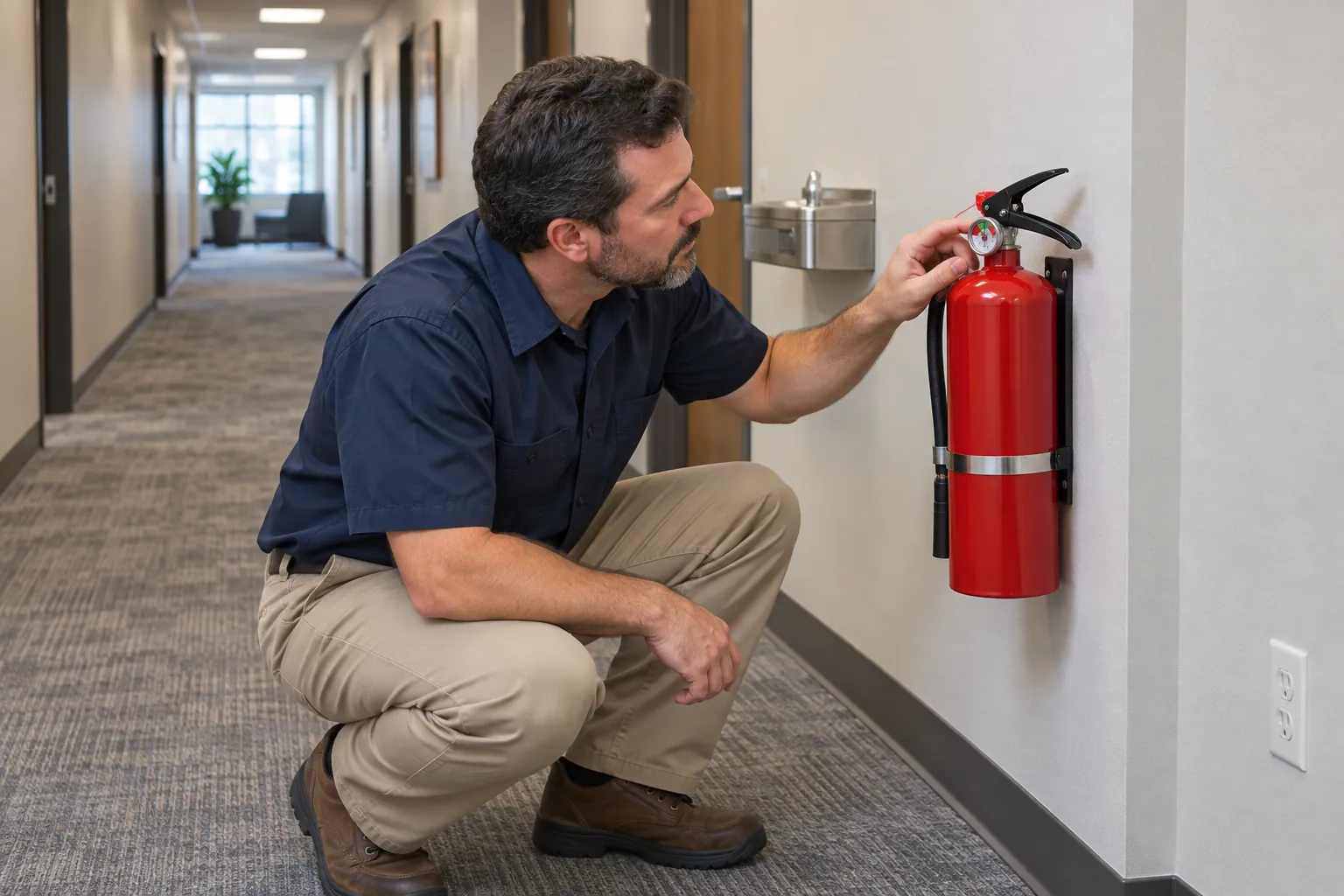 Fire and water checksFire extinguisher inspection: the monthly check and the annual maintenanceWhat a monthly fire extinguisher inspection covers under OSHA 1910.157 and NFPA 10, how it differs from annual maintenance, and what the record should show.
 Fire and water checksEmergency action plan: what OSHA requires, and how to keep the plan workingWhat an emergency action plan must contain under OSHA 1910.38, who needs one, how alarms, wardens, drills and reviews fit in, and what the record should show.
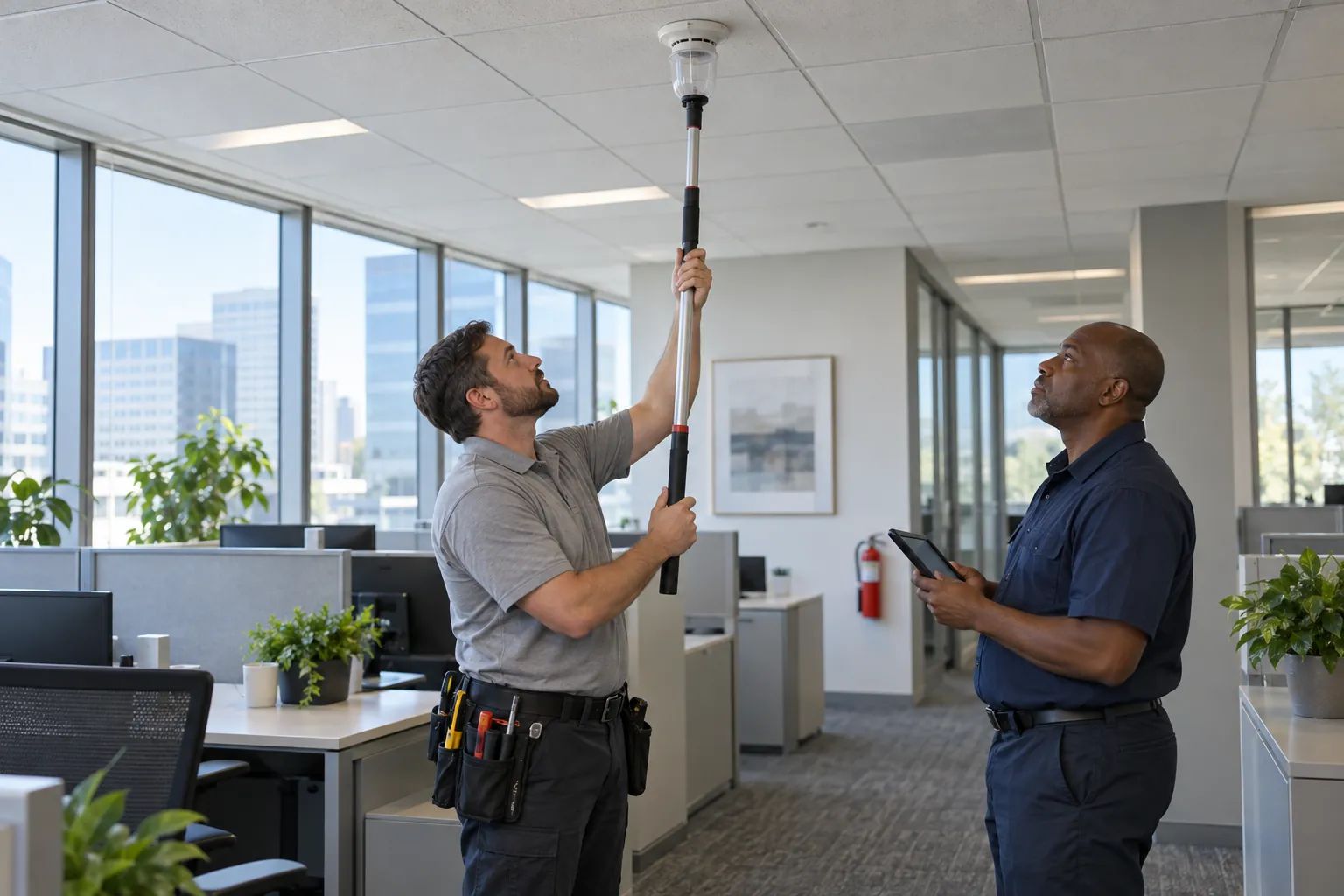 Fire and water checksFire alarm testing: who does what, and what the record should showFire alarm testing in the US: what NFPA 72 and OSHA ask of the owner, what gets tested, how to run a test day, and what the building's own record should show.
 Fire and water checksOSHA exit sign and exit route requirements, and how to keep every route clearWhat OSHA 1910.36 and 1910.37 require of exit routes, exit doors and exit signs, how the fire code fits in, and how to check and record that routes stay clear.