Fire and water checks
Fire inspection checklist: what the fire marshal looks at, and how to be ready
A fire inspection checklist lists what the local fire marshal checks on a visit to a commercial building: exits, exit signs and emergency lighting, fire alarm and sprinkler systems, portable fire extinguishers, fire doors, electrical hazards, storage and housekeeping, and the inspection, testing and maintenance records for each fire protection system.
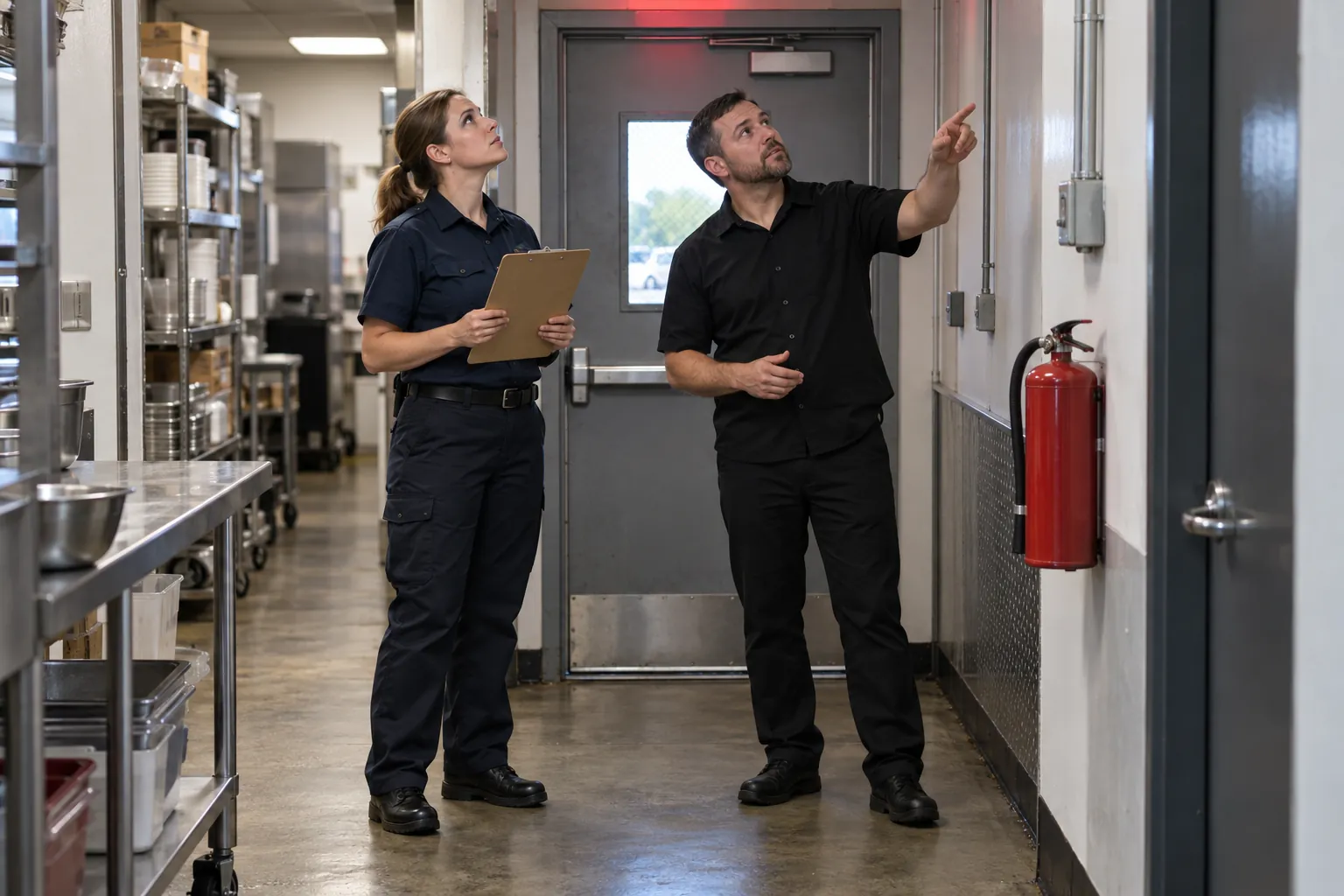
The inspection itself confirms that the building meets the fire code the jurisdiction has adopted, and many fire departments publish a self-inspection checklist so that businesses can check for compliance first. This guide gathers what those checklists have in common, the records to have ready, who in a commercial building prepares what, and how to stay ready between visits rather than for the week before.
01
What a fire inspection is, and whose code the inspector enforces
A fire inspection, also called a fire and life safety inspection or a fire prevention inspection, is carried out by the local fire marshal's office or fire prevention bureau. The fire marshal is the authority having jurisdiction (AHJ) for the fire code: the office that interprets the code for your building, decides what counts as a violation and sets the date to correct it.
There is no single national fire code in the United States. Each state, and often each county or city, adopts a model code by reference, usually the International Fire Code (IFC) from the International Code Council or NFPA 1, Fire Code, from the National Fire Protection Association, and then amends it. Two examples:
- In Washington State, WAC 51-54A-003, International Fire Code, reads: "The 2021 edition of the International Fire Code, published by the International Code Council is hereby adopted by reference with the following additions, deletions, and exceptions."
- In Florida, Florida Statutes section 633.202, Florida Fire Prevention Code, directs the State Fire Marshal to adopt "the current edition of the National Fire Protection Association's Standard 1, Fire Prevention Code" and "the current edition of the Life Safety Code, NFPA 101", with a new edition "every third year".
Both families of code rely on NFPA standards for how systems are inspected, tested and maintained, such as NFPA 10 for extinguishers, NFPA 25 for sprinklers and NFPA 72 for fire alarms. An NFPA standard binds only once your jurisdiction adopts it, and only in the edition it adopted, so the first question for any checklist is which code and editions your AHJ enforces. The fire marshal's office will tell you.
How often an inspector calls depends on the building and the department. The City of Vancouver, Washington, says on its Fire Inspections page: "The target frequency of inspection is every year. However, the actual frequency of inspection may be longer." The Colorado Springs Fire Department's Inspections by the Division of the Fire Marshal page ties the frequency and type of inspection to what the business does, naming large occupancy businesses, high-piled or rack storage and hazardous materials among the occupancies it inspects.
02
The fire inspection checklist: what the inspector looks at
Fire departments publish their own checklists so that businesses can inspect themselves first, and most share the same core. The list below draws on the Charlotte Fire Department's Self Inspection Checklist in North Carolina and the San Marcos Fire Department's Fire & Life-Safety Inspection Checklist for Businesses in California. Your own department's form, and its dimensions, win wherever they differ.
- Access and address. Street numbers visible from the street; fire lanes marked and clear; hydrants and the fire department connection (FDC) accessible, with caps in place; a key box, where required, holding current keys; fire alarm, sprinkler riser and electrical rooms labeled.
- Exits. Exit doors unlocked while the building is occupied, openable from inside without a key or special knowledge, with no added bolts or latches; corridors and enclosed stairways clear of storage; the outside of each exit door clear.
- Exit signs and emergency lighting. Exit signs lit; emergency lights and their batteries working.
- Fire alarm and sprinkler systems. Inspected and tested by a licensed contractor at the required intervals; control valves labeled and secured open; the alarm panel accessible; pull stations, horns and strobes unobstructed; sprinkler heads free of paint and corrosion, with storage clear below them.
- Portable fire extinguishers. Mounted, visible and accessible, the right type for the hazard, within the travel distance the code sets, with a current annual service tag.
- Fire doors and rated construction. Fire doors self-closing and latching, not wedged open, and undamaged; no holes in rated walls and ceilings; ceiling tiles in place.
- Electrical. Extension cords not used as permanent wiring or run through walls, floors or doors; cover plates on outlets and junction boxes; working clearance kept in front of panels.
- Housekeeping and storage. No build-up of combustible waste; nothing stored in electrical, mechanical or boiler rooms; storage kept below the ceiling by the distance the code sets, more where there are no sprinklers.
- Hazardous materials. Flammable liquids in approved containers and, above the threshold, approved cabinets; gas cylinders secured upright; safety data sheets available.
- Commercial kitchens. Hood suppression serviced, usually every six months; hoods and ducts cleaned at the required intervals; a Class K extinguisher near the cooking equipment.
- Permits and plans. Operational permits posted and current; evacuation plans and drill records where the occupancy requires them.
Several of these items are also OSHA requirements for employers. 29 CFR 1910.37 states that "Exit routes must be free and unobstructed" and that "Each exit must be clearly visible and marked by a sign reading 'Exit.'" For sprinklered buildings, 29 CFR 1910.159 sets a floor for sprinkler clearance: "The minimum vertical clearance between sprinklers and material below shall be 18 inches (45.7 cm)." Fire codes can ask for more; Charlotte's checklist asks for 36 inches below ESFR and large drop sprinklers.
03
The records the inspector will ask to see
Colorado Springs says its inspectors check "the inspections testing and maintenance records for your fire protection systems such as fire alarms and fire sprinklers." An inspector sees a blocked exit in a second; the paperwork takes longer. Before the visit, gather the records into one place, in date order:
- Fire alarm: the latest inspection and test report from the alarm contractor.
- Sprinklers, standpipes and fire pumps: the contractor's inspection, testing and maintenance reports, with any deficiencies listed and proof they were fixed.
- Kitchen hood suppression and other special systems: the service reports and hood cleaning records.
- Portable fire extinguishers: the annual service tags and the monthly inspection record. Under 29 CFR 1910.157, extinguishers "shall be visually inspected monthly", and the employer "shall record the annual maintenance date and retain this record for one year after the last entry or the life of the shell, whichever is less."
- Emergency lighting and any emergency generator: the routine checks and the annual test.
- Fire doors: inspection reports for fire door assemblies, and the drop test for rolling fire doors where required.
- Plans, drills and permits: the evacuation plan where the occupancy needs one, the drill record, and any operational permits.
Some departments now require contractors to send test reports straight to the fire marshal's office. Vancouver requires fire protection contractors to hold a City endorsement and submit annual testing and maintenance reports, and warns that "Incomplete reports or deficiencies marked on confidence reports will result in a special inspection and an additional fee." A deficiency the contractor noted may be on the fire marshal's desk before the inspector arrives, so the question on the day is whether you fixed it.
OSHA adds its own duties where a standard applies: 29 CFR 1910.159, for example, requires an annual main drain flow test and opening the inspector's test valve at least every two years.
04
Preparing for the inspection: who does what
In a commercial building, responsibility for fire code compliance usually falls on the owner and the occupant between them. In practice the preparation is spread across several people, and it goes wrong when each assumes someone else has it.
- The facility manager or property manager owns the list, the contractor schedule and the records, and follows violations to closure.
- The building engineer or chief engineer covers the systems: alarm panel, sprinkler risers and valves, fire pumps, emergency lighting, the generator, and access to mechanical and electrical rooms.
- Janitorial and custodial crews and day porters see storage creep first: boxes in corridors, supplies in electrical rooms, trash by an exit door. Their daily route passes most of the places an inspector will look.
- Security officers check exits, fire doors and fire lanes after hours, when doors get chained and cars park in the lane. Their post orders should say what to check and whom to call.
- Tenants and department heads keep their own space clear: storage heights, extension cords, space heaters, doors propped open.
- Fire protection contractors test and service the systems; their reports are the evidence the inspector reads first.
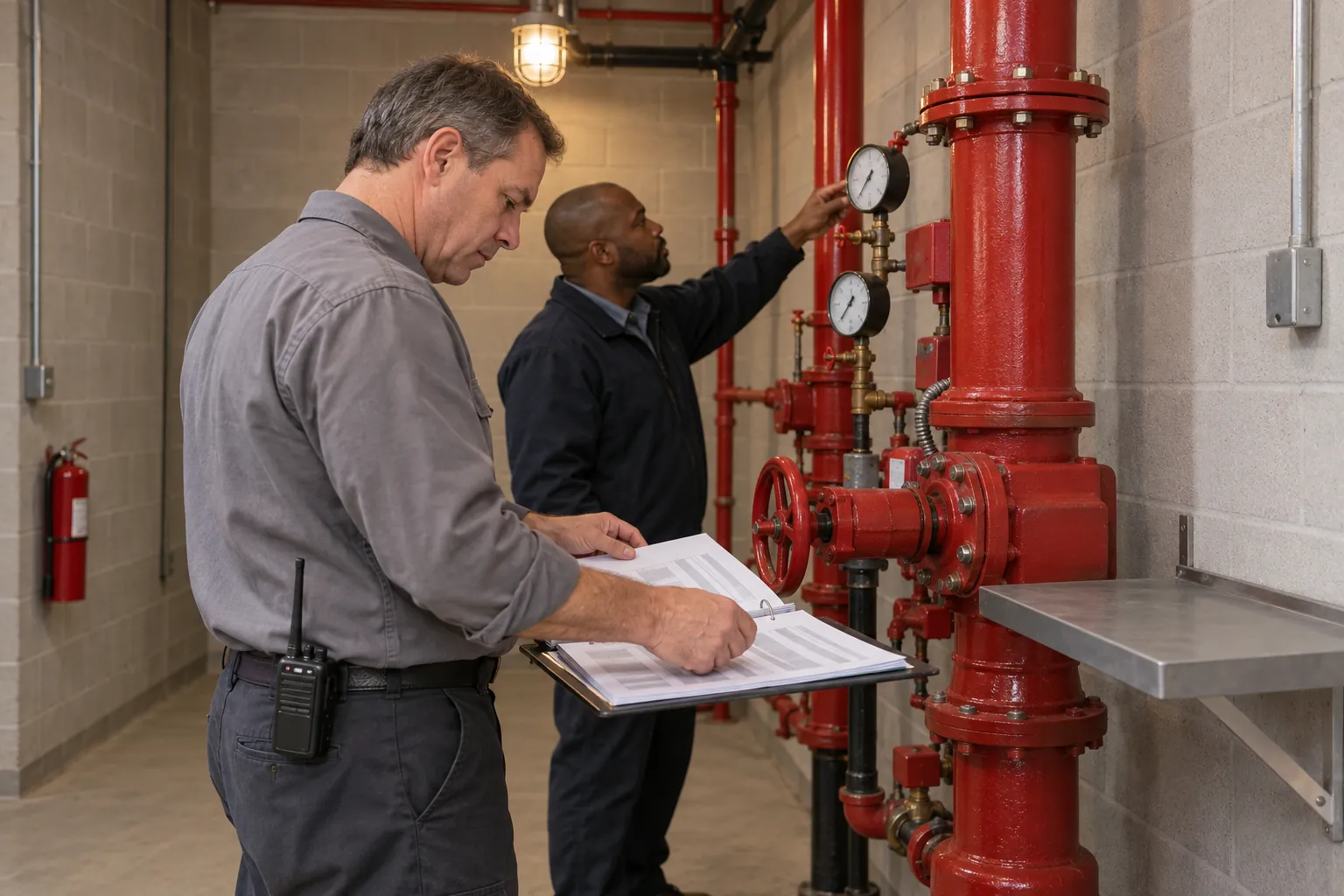
Start with the department's own form. Colorado Springs offers a "General Business Self-inspection Form", which it calls "a great tool for businesses to use to prepare for a fire inspection"; Vancouver offers a Business Pre-Inspection Checklist. Walk the building with it a few weeks before the expected visit, because some fixes need a contractor. Walk it as the inspector will: from the fire lane, along each exit route, then into the back-of-house rooms.
On the day, send someone around with the inspector who can open every door, knows where the alarm panel and risers are, and can find any record in minutes. Note each finding as it is made, with its location.
05
Violations, reinspection and staying ready between visits
Findings go on a written report with a date to correct them, and a reinspection to confirm. Vancouver's report details "all the conditions that violate the fire code", and "These deficiencies are required to be corrected immediately." Delay costs money: Colorado Springs warns that "Failure to correct violations in a timely manner could result in the assessment of reinspection fees or a summons to court", and in Vancouver violations not corrected by the second reinspection may bring civil penalties that "start at $500 per violation".
Most items on these checklists are about daily life in the building, not the systems: an exit blocked by deliveries, storage up to the sprinkler heads, a cord run under a door, an extinguisher behind a pallet, a fire door propped open, a panel room used as a storeroom. The annual contractor visit fixes none of them. Someone looking regularly does.
So the best preparation is to turn the inspector's list into routine checks, each with a frequency and a named person:
- Daily, at opening: exit doors unlocked and clear inside and out, exit signs lit, fire lanes clear, no combustible waste building up.
- On each patrol or cleaning round: fire doors closed and latching, corridors and stairwells clear, nothing stored in electrical or mechanical rooms.
- Monthly: every extinguisher inspected and recorded (see the monthly fire extinguisher inspection), emergency lights checked, storage heights and sprinkler clearance walked.
- Quarterly to annual: contractor tests of the alarm, sprinklers, hood suppression and emergency lighting as your adopted code requires (see fire alarm testing and sprinkler system inspection), with each deficiency tracked to a fix.
- After any change: a new tenant, a change of use, new racking or hazardous materials, or a renovation, which may need a permit before work starts.
The wider routine, including OSHA's exit route and fire protection rules, is in the workplace fire safety checklist. If those checks are done and recorded, the inspector's visit confirms what you already know.
06
Where the record fails, and what SiteClara does about it
Most buildings that fail a fire inspection had a checklist. What they lacked was evidence that it was used. The sheet on the back of the stairwell door is initialed for the month in one hand, or not at all; the night patrol walked past the chained exit with nothing to show for it; the wedged fire door was mentioned to whoever was passing and never reached anyone who could fix it. When the inspector asks when the exits were last checked, nobody can say.
SiteClara puts a printed QR poster at each place a check happens, such as an exit door, a fire door, the alarm panel or an extinguisher point, with an optional NFC tag behind it. Staff scan the code or tap the tag on their own phone, with no app to install, see the checks due there, and mark each one done or say what stopped them. The time and the named person are recorded as it happens, with a photo when one is asked for. A problem found there, such as a blocked exit or a missing extinguisher, goes onto the team's list of jobs until someone closes it.
The supervisor sees what is due, done and missed, and records the reason a check was missed. A job that needs the building manager can be escalated to them. Each day the supervisor reviews and approves a report, which goes to nominated management or client contacts at 8 a.m. the next morning, showing what was reported, completed and still open, and how the scheduled checks went, for example 12 of 12 completed.
07
Questions people ask
What is included in a fire inspection?
A fire inspection covers the building's exits and the records for its fire protection systems. The Colorado Springs Fire Department's Inspections by the Division of the Fire Marshal page says: "During the inspection process our inspectors will check items such as your building's exits, emergency lighting, exit signs, fire lanes, and the inspections testing and maintenance records for your fire protection systems such as fire alarms and fire sprinklers." Where a business needs an operational permit, it "must pass a fire inspection prior to the issuance of the operational permit."
What does the NFPA 25 inspection checklist include?
NFPA 25 covers the routine inspection, testing and maintenance (ITM) of water-based fire protection systems such as sprinklers. NFPA's article Responsibilities of the Building Owner for Fire Sprinkler System Inspection, Testing, and Maintenance says the activities "range from simple visual confirmation of some things such as valve position or room or water tank temperature on a more frequent basis to much more complex activities such as full flow tests and internal assessments at longer intervals." It also notes that some of these duties fall to the building owner or their designated representative, and points to Chapter 4 of NFPA 25 for the full list. The frequencies that bind you are those in the edition your jurisdiction has adopted.
What are the 5 E's of fire safety?
The 5 E's of fire safety are education, engineering, enforcement, economic incentives and emergency response, the parts of community risk reduction set out on the U.S. Fire Administration's Community Risk Reduction page. Fire inspections belong to enforcement, which the USFA says "identifies potential risks and noncompliance in your local properties and teaches your community how fire and building codes protect them."
08
Where to read more, and a list to take away
Start with your own fire department's self-inspection checklist, such as Charlotte's Self Inspection Checklist. For the employer's side, read 29 CFR 1910.37, 1910.157 and 1910.159 on OSHA's site, and check OSHA's State Plans page for your state. The International Fire Code and NFPA 1 apply in the editions, and with the amendments, your jurisdiction has adopted.
Before the next fire inspection, check that:
- you know which fire code and editions your AHJ enforces, and have its self-inspection form;
- every exit is unlocked, clear inside and out, and signed, every day the building is open;
- storage is below the ceiling limit, clear of sprinkler heads and out of electrical and mechanical rooms;
- fire doors close and latch, and nothing holds them open;
- every extinguisher has a current service tag and a recorded monthly inspection;
- the alarm, sprinkler, hood and emergency lighting reports are current, in one place, and every listed deficiency is fixed;
- permits are posted and the evacuation plan and drill records are up to date;
- each routine check has a named person, a frequency and a record of when it was done.
Sources
Every document this guide quotes or links to, in the order it first cites them.
- WAC 51-54A-003, International Fire Code app.leg.wa.gov
- Florida Statutes section 633.202, Florida Fire Prevention Code leg.state.fl.us
- Fire Inspections cityofvancouver.us
- Inspections by the Division of the Fire Marshal coloradosprings.gov
- State Plans osha.gov
- Self Inspection Checklist charlottenc.gov
- Fire & Life-Safety Inspection Checklist for Businesses sanmarcosca.gov
- 29 CFR 1910.37 osha.gov
- 29 CFR 1910.159 osha.gov
- 29 CFR 1910.157 osha.gov
- Responsibilities of the Building Owner for Fire Sprinkler System Inspection, Testing, and Maintenance nfpa.org
- Community Risk Reduction usfa.fema.gov
Related guides
 Fire and water checksWorkplace fire safety checklist: what to check, how often, and who does itA fire safety checklist for a US workplace: the daily, monthly and annual checks behind OSHA Subparts E and L and the local fire code, who does each, and the record.
 Fire and water checksFire sprinkler inspection: what NFPA 25 asks of the buildingWhat a sprinkler system inspection involves under NFPA 25, who does the weekly, monthly and annual checks, how impairments work, and what the record should show.
 Fire and water checksFire alarm testing: who does what, and what the record should showFire alarm testing in the US: what NFPA 72 and OSHA ask of the owner, what gets tested, how to run a test day, and what the building's own record should show.
 Fire and water checksFire extinguisher inspection: the monthly check and the annual maintenanceWhat a monthly fire extinguisher inspection covers under OSHA 1910.157 and NFPA 10, how it differs from annual maintenance, and what the record should show.