Fire and water checks
Lockdown drills and school safety drills: what the rules ask and what the record should show
A lockdown drill is a school safety drill in which students and staff lock the doors, turn off the lights, move out of sight and stay silent until the all clear, practicing the procedure they would follow if an intruder or active shooter threatened the building.
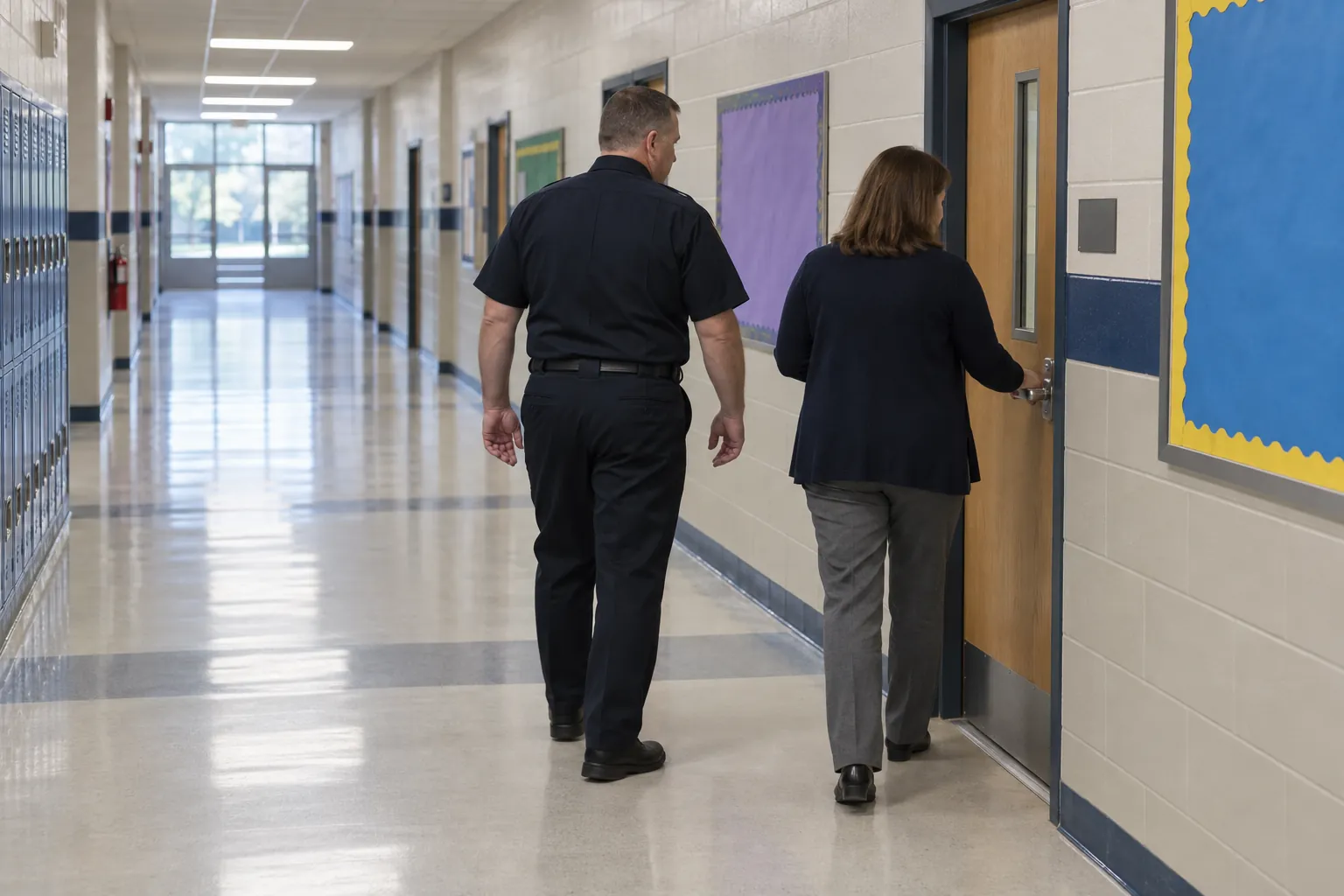
Most states now require lockdown drills alongside fire evacuation drills, and the fire code sets its own drill rules for educational buildings. This guide covers who requires which drills, how to plan a year of them, how to run a lockdown drill that actually tests something, and what the record should show afterward.
01
What a lockdown drill is, and who requires school safety drills
A lockdown drill practices the response to an immediate threat of violence in or around a school. The federal Guide for Developing High-Quality School Emergency Operations Plans (2013), published jointly by the U.S. Departments of Education, Health and Human Services, Homeland Security and Justice, with the FBI and FEMA, puts the objective plainly: "to quickly ensure all school staff, students, and visitors are secured in the rooms away from immediate danger." Doors are locked to deny access to the room, lights go off, people move out of sight of doors and windows and stay quiet until the all clear is given by someone with the authority to give it. The same guide has a part on active shooter situations, which sets out run, hide and fight as the courses of action; hiding means locking and barricading the doors, turning off the lights, staying silent and out of view from the hallway, and remaining in place until identifiable law enforcement officers give the all clear.
There is no single federal rule that sets how many lockdown drills a school must hold. School safety drills are set mainly by state law, usually the education code or the state board of education's rules, and by the fire code the state or city has adopted. The numbers differ widely, so start with your own state. Four examples show the range:
- New York: New York Education Law section 807 makes it the duty of the principal or other person in charge of every public or private school to hold drills "at least twelve times in each school year," eight of them between September 1 and December 31. Eight must be evacuation drills and "four of all such required drills shall be lock-down drills."
- California: California Education Code section 32001 requires fire drills in public, private and parochial schools "at least once every calendar month" in elementary schools, at least four times a school year in intermediate schools, and not less than twice a school year in secondary schools.
- Florida: Florida Statutes section 1006.07(4) requires district policies for emergency drills covering fires, natural disasters, active assailant and hostage situations, and bomb threats, with all types of drill held at least once a school year. Active assailant drills must be developmentally and age-appropriate, law enforcement officers designated as first responders must be physically present and directly involved, and they must be told at least 24 hours ahead.
- Texas: Texas Education Code section 37.114 has the commissioner of education set the number and type of mandatory drills, and 19 Texas Administrative Code section 103.1209, as amended in 2023, sets one secure drill, two lockdown drills (one a semester), one evacuation drill and one shelter-in-place drill a school year. For fire evacuation drills, districts must consult the local authority having jurisdiction, such as the fire marshal, and follow its requirements; a district with no local authority must hold four a school year (two a semester). The Texas School Safety Center's drill guidance notes that the requirements were enhanced again by legislation in 2025, so check the rule's current text.
The fire code adds its own layer. NFPA 101, the Life Safety Code, has emergency egress drill requirements for educational occupancies in Chapters 14 (new) and 15 (existing), and the International Fire Code has its own. Neither applies until a jurisdiction adopts it, often with local amendments, and the authority having jurisdiction (AHJ), usually the fire marshal, decides how it is enforced. Where the state statute and the adopted fire code differ, a school has to satisfy both.
02
The drills a school runs in a year
State lists vary, but most school safety drill programs are built from the same handful of responses, and many districts use standard terms so the words on the PA mean the same thing in every building:
- Fire evacuation drill: everyone leaves by the planned routes to assembly areas, and teachers account for their students. Usually the most frequent drill, and the one the fire code governs.
- Lockdown drill: an immediate threat inside or near the building. Classrooms lock, lights off, out of sight, silence. Hallways, restrooms and common areas are cleared into the nearest lockable room.
- Secure (sometimes called lockout): a threat outside. Exterior doors are locked, outside activities come in and visitors are closely watched, but teaching carries on.
- Shelter-in-place: it is safer inside, for example during severe weather or a hazardous materials release, and people move to designated rooms or a weather shelter.
- Evacuation to an off-site location, and the reunification of students with families, usually practiced as an exercise with district staff rather than a full-school drill.
- Hazard-specific drills where the risk calls for them, such as earthquake or tornado drills.
The REMS guide separates drills from other exercises. A tabletop exercise is a small-group discussion that walks through a scenario. In a drill, "school personnel and community partners ... use the actual school grounds and buildings to practice responding to a scenario." Functional and full-scale exercises bring in more partners. A school that only drills never tests the decisions behind the drill; one that only runs tabletops never finds out that the gym doors cannot be locked from inside.
Staff are employees as well as responders. Under OSHA's emergency action plan standard, 29 CFR 1910.38, where a plan is required it must set out procedures for reporting emergencies, evacuation and exit route assignments, and accounting for all employees after evacuation, and the employer must "designate and train employees to assist in a safe and orderly evacuation of other employees." Federal OSHA covers private schools; state and local government workers are not covered by federal OSHA, so public school staff are covered only in states with an approved state plan (see OSHA's State Plans page).
03
Planning the year: timing, notice and who is involved
Put the whole year's drills on the school calendar before the first day, with the statutory minimum for each type and a date for each. Front-load them: New York's rule puts eight of its twelve drills before the end of December, and in any state the first weeks are when new students, new staff and substitutes know least. Florida requires students to be told within the first 10 days of the school year where the safest areas in each classroom are.
Vary the conditions. The REMS guide advises exercising "under different and non-ideal conditions," such as different times of day, weather, points in the academic calendar, and the absence of key personnel. A lockdown drill that always happens at 10 a.m. on a Tuesday in homeroom never tests the lunch period, the passing period, the assembly in the gym or the afternoon when the principal is at the district office.
- Decide who calls it and who gives the all clear, and who deputizes when they are absent.
- Tell your first responders. Florida sets 24 hours' notice where officers are expected to attend; elsewhere, invite law enforcement and the fire department to observe and walk the building. The REMS guide lists them among the partners to include.
- Tell families and staff in advance, in plain words, that a drill is planned. The REMS guide says to "communicate information in advance to avoid confusion and concern."
- Plan for students with disabilities. The Texas School Safety Center advises that extra assistance be provided in a drill only where it is part of a student's IEP or 504 plan, so that the drill tests what would really happen.
- Keep it age-appropriate. Florida's statute requires active assailant drills to be developmentally and age-appropriate, and SchoolSafety.gov's emergency planning guidance says exercises and drills "should be tailored to account for the specific features and characteristics of the school community."
- Include everyone in the building: custodians, cafeteria staff, the front office, contracted security, after-school programs and visitors. New York requires the person running an after-school program, event or performance to tell those attending the emergency procedures at the start.
The custodial and facilities team matters more than most plans admit. They are often in the boiler room or a portable when the drill is called, and they fix the lock that failed. Put them on the drill schedule.
04
Running a lockdown drill that tests something
A lockdown drill is short, but it has several parts, and each one can fail on its own. A good drill tests all of them:
- The announcement: can it be heard in every space, including the gym, the cafeteria, the restrooms, the library stacks, the courtyard and the portables? Is it given in the district's standard words?
- The doors: can every classroom and instructional space be locked quickly from inside without stepping into the hallway? Do the locks work, and do substitutes know how?
- Out of sight: is there a corner of each room that cannot be seen from the door glass or the windows? Are window coverings where the plan says they are?
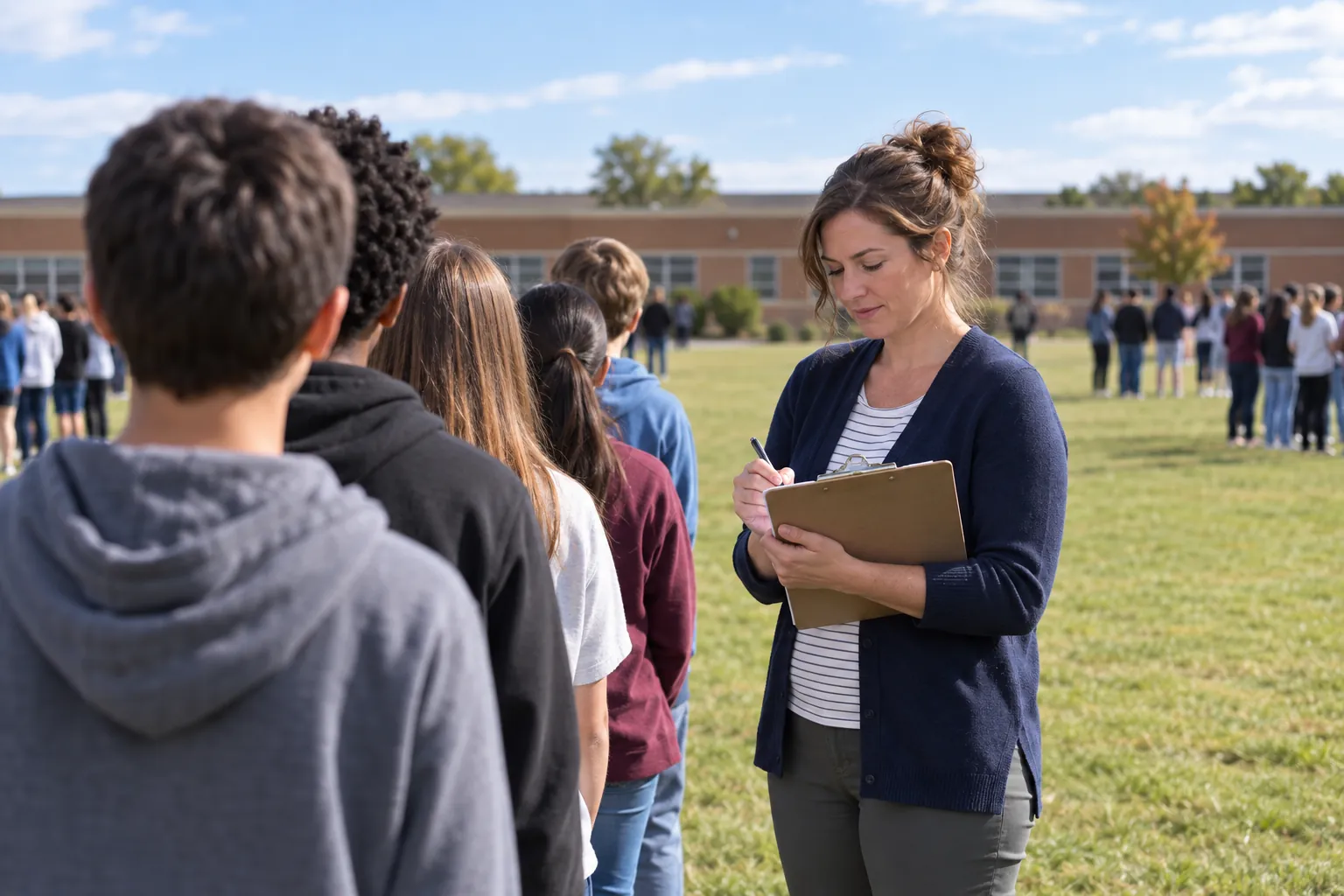
- The sweep: someone, often an administrator with law enforcement, walks the corridors, tries each door, listens for noise and looks into rooms. That walk is the drill's inspection, and it should be written down room by room.
- People out of place: students in restrooms or hallways between classes, a class outside for PE, visitors in the front office. Where did they go, and how long did it take?
- The release: the all clear comes from someone with authority, in a way people trust, and staff know not to open a door to a voice they cannot verify.
Afterward, hold a short debrief while it is fresh. The REMS guide says to "debrief and develop an after-action report that evaluates results, identifies gaps or shortfalls, and documents lessons learned," and to decide who is responsible for changing the plan. The Texas School Safety Center advises giving all staff a chance to report how the drill went, and that "any issues should be documented, and action items should be identified."
Most findings are ordinary: a door that sticks, a lock that needs a key from the hallway side, a dead PA speaker in one wing, an exterior door propped open. They slip away once the debrief ends, because the person who noticed them is not the person who fixes them.
05
What the drill record should show
Keep a record of every drill, in the form your state and your fire marshal expect. Some states prescribe a form or require reporting to the state or the district; others leave it to the school. In any case, the fire marshal inspecting the building, the district safety office and, after an incident, anyone reviewing the school's preparedness will ask for it. A useful drill record shows:
- the building, the type of drill and the scenario, if any;
- the date, the time called and the time the all clear was given, or the time the building was cleared for an evacuation;
- the conditions: time of day, what was happening in the building, who was absent;
- who observed it, including any first responders;
- the result of the sweep, room by room: locked or not, out of sight or not, noise heard or not;
- every problem found, with where it is and who owns putting it right;
- when each problem was fixed, and who confirmed it;
- the changes made to the plan or to training as a result.
A drill log that lists twelve drills and no findings is either describing a remarkable building or written only to show that the drills happened. A finding without a closing date will be found again at the next drill.
Treat the physical findings as work orders: send each one to the custodial or facilities team with a location and a photo, confirm the fix at the door, and recheck those rooms at the next drill.
06
Where the record fails, and what SiteClara does about it
The drill itself is usually recorded somewhere: a form sent to the district, a line in the principal's log. What falls through is everything around it. The sweep is done from memory, the door that would not lock is mentioned in the debrief and passed to whoever was nearest, and the routine checks that make a lockdown work on the day (exterior doors secured, classroom locks working, PA speakers audible) are either not recorded or initialed in a row at the end of the month.
SiteClara records the checks at the location. A printed QR poster, with an optional NFC tag behind it, sits at each place a check is scheduled, such as an exterior door, a corridor or a wing of classrooms. Custodial, facilities or security staff scan the code or tap the tag on their own phone, with no app to install, and sign in with a link. They see the checks due at that location, such as a daily exterior door check or a classroom lock check after a drill, and mark each one done, or say what stopped them. A problem, such as a door that will not lock or a speaker that cannot be heard, is reported there with a photo and goes onto the team's list of jobs until someone closes it.
The supervisor sees what is due, done and missed, and can record why a check was missed; a job that needs the building manager can be escalated to them to answer. Each day the supervisor reviews and approves a report that goes to nominated management or client contacts at 8 a.m. the next morning, showing what was reported, completed and still open, and how the scheduled checks went, for example 12 of 12 completed.
07
Questions people ask
Do lockdown drills actually work?
The guidance school psychologists and school resource officers use says they do, when they are done calmly. The Best Practice Guidance for School Safety and Lockdown Drills: Preparing for Active Threats (April 2026), from the National Association of School Psychologists, the National Association of School Resource Officers and Safe and Sound Schools, says lockdown drills "have been proven effective" and that "available research supports the effectiveness of nonsensorial lockdown drills conducted by calmly walking and talking through the procedures, with no simulation of a real-life event." It recommends against simulated gunfire, dramatic enactments and other sensorial drills with students, because they can cause harm.
How do you explain a lockdown drill to a child?
Tell them beforehand, in calm, plain words that suit their age. The Best Practice Guidance for School Safety and Lockdown Drills: Preparing for Active Threats says all participants "should know beforehand that the drill will take place and what to expect, including what announcement will be made or what signal will be given," recommends notifying parents before lockdown drills, and, for children with a trauma history, advises using developmentally appropriate language, avoiding alarming terms, and explaining the drill "in a calm and reassuring manner." For preschool and kindergarten children it suggests explaining that adults at school work hard to keep school safe.
What is said in a lockdown drill announcement?
Many districts use a short, standard phrase so everyone knows what to do. Under the Standard Response Protocol, the Texas School Safety Center's drill guidance says to repeat "Lockdown. Locks, Lights, Out of Sight. This is a drill." over the public address, and warns that failing to tell students and staff it is a drill "will most likely result in parents, media and maybe even law enforcement coming to the school." Whatever words your district uses, say plainly that it is a drill.
08
Further reading, and a list to take away
Start with your own state's education code and its department of education or school safety center, which usually publish the drill requirements with a form. The Guide for Developing High-Quality School Emergency Operations Plans covers the lockdown, shelter-in-place and evacuation annexes and the exercise program, and SchoolSafety.gov collects federal guidance on drills. Ask your fire marshal which edition of NFPA 101 or the International Fire Code applies.
Before the school year starts, check that:
- you know your state's required number and type of drills, and the fire code's, and meet both;
- every drill is on the calendar, front-loaded into the first months;
- the drills vary in time of day, location of students and who is absent;
- first responders, families and staff are told in advance;
- custodial, cafeteria, security and after-school staff are part of the plan;
- students with an IEP or 504 plan have their drill accommodations set out;
- every lockdown drill includes a room-by-room sweep that is written down;
- every drill has a debrief and an after-action note;
- every physical finding becomes a job with an owner, and its fix is confirmed at the door;
- the drill records are kept where the fire marshal and the district can see them.
Sources
Every document this guide quotes or links to, in the order it first cites them.
- Guide for Developing High-Quality School Emergency Operations Plans dhs.gov
- New York Education Law section 807 nysenate.gov
- California Education Code section 32001 leginfo.legislature.ca.gov
- Florida Statutes section 1006.07(4) flsenate.gov
- Texas Education Code section 37.114 statutes.capitol.texas.gov
- 19 Texas Administrative Code section 103.1209 law.cornell.edu
- Texas School Safety Center's drill guidance txssc.txstate.edu
- NFPA 101, the Life Safety Code nfpa.org
- OSHA's emergency action plan standard, 29 CFR 1910.38 osha.gov
- OSHA's State Plans page osha.gov
- SchoolSafety.gov's emergency planning guidance schoolsafety.gov
- Best Practice Guidance for School Safety and Lockdown Drills: Preparing for Active Threats nasponline.org
Related guides
 Fire and water checksFire drill requirements: frequency, running the drill, and the fire drill logWho requires fire drills in US buildings, how often the fire code sets them by occupancy, how to run one, and what the fire drill log must record.
 Fire and water checksEmergency action plan: what OSHA requires, and how to keep the plan workingWhat an emergency action plan must contain under OSHA 1910.38, who needs one, how alarms, wardens, drills and reviews fit in, and what the record should show.
 Security patrolsSchool security checklist: what to check at a K-12 school, when, and by whomA school security checklist for US K-12 campuses, built on CISA's layered approach: perimeter, grounds, building and interior, who checks what, when, and the record.
 Fire and water checksOSHA exit sign and exit route requirements, and how to keep every route clearWhat OSHA 1910.36 and 1910.37 require of exit routes, exit doors and exit signs, how the fire code fits in, and how to check and record that routes stay clear.