Security patrols
Security guard shift checklist: what to check from post-up to pass-down
A security guard checklist is a short, ordered list of the tasks an officer confirms on each shift: before taking the post, on every patrol round, and at the handover to the next officer.
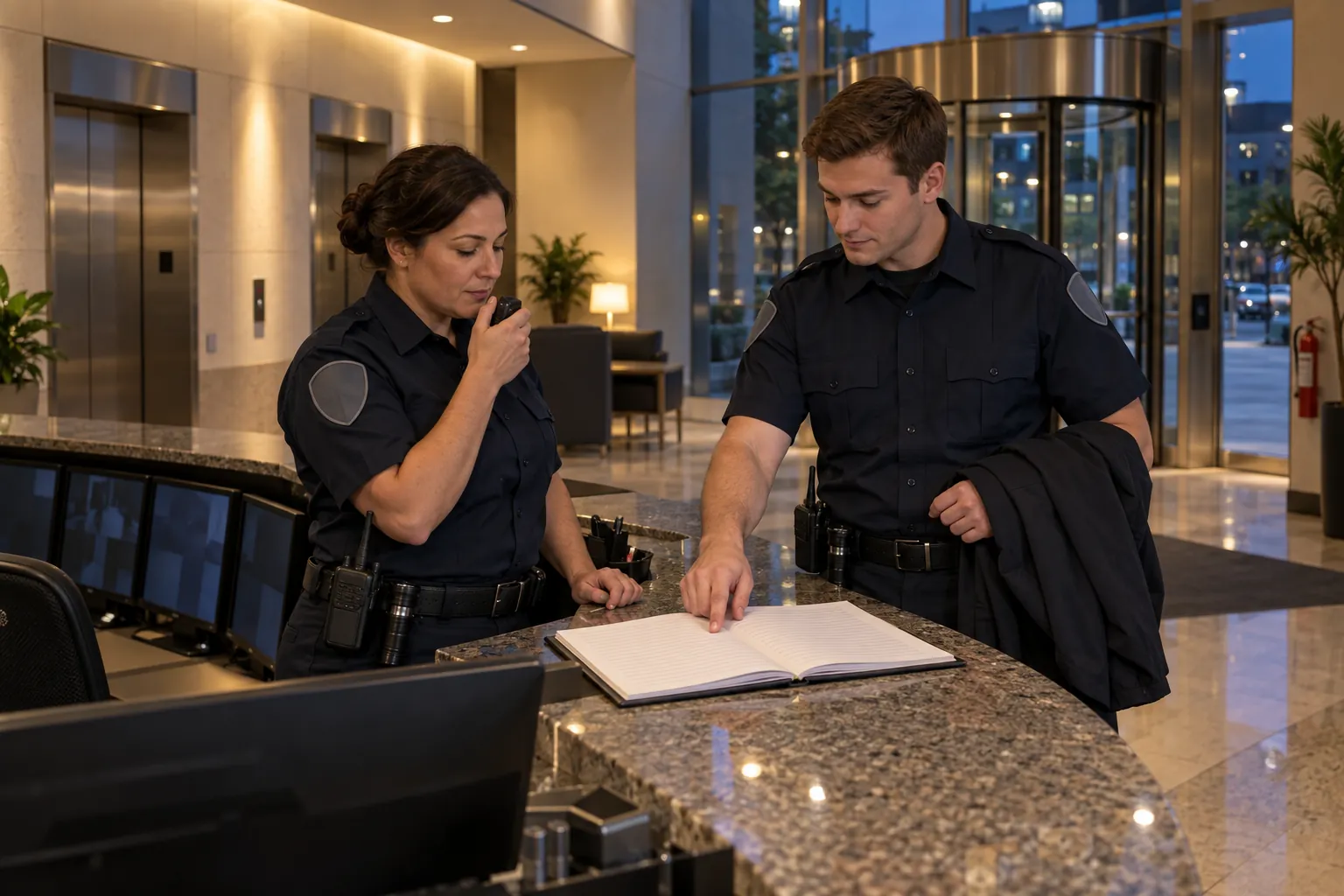
It is the post orders turned into a routine an officer can follow at 3 a.m. without rereading a binder. Done well, it means nothing is missed and the client can see that. Done badly, it is a sheet ticked at the end of the shift from memory. This guide covers what belongs on the checklist, the state and federal rules behind parts of it, and how a supervisor can tell whether it was really done.
01
What a shift checklist is, and which rules sit behind it
A security guard checklist for a shift is a short, ordered list of what the officer on a post must do and confirm: at the start of the shift, on each patrol or at set times during it, and at the end. It is not a legal document in its own right. It is drawn from the site's post orders, the written instructions that say what the post covers, and it should never say anything the post orders do not. Where the two disagree, the post orders win and the checklist is corrected.
No single federal rule requires a security officer shift checklist. Several rules, though, decide what has to be on it, and they differ by state:
- State licensing. Most states license or register security officers, and some attach duties to the officer personally. In California, Business and Professions Code section 7583.3 says a registered guard must not "fail to carry on their person, while on duty, a valid and current security guard registration card", which is why "guard card on person" is the first line of many California checklists. The same section requires a guard to report to their employer within 24 hours any incident involving the discharge of a firearm.
- Training. State training rules decide who may be put on a post at all. The California Bureau of Security and Investigative Services training requirements call for Power to Arrest and Appropriate Use of Force training, further mandatory courses within 30 days and six months, and eight hours of annual training. The New York Department of State security guard training requirements set an 8-hour pre-assignment course, 16 hours of on-the-job training within 90 days of employment, and 8 hours of in-service training each calendar year. A checklist cannot fix an untrained officer, but a supervisor should not post one.
- Exits and emergencies. Where federal OSHA applies, an employer that needs an emergency action plan must generally have one "in writing, kept in the workplace, and available to employees for review" under 29 CFR 1910.38 (emergency action plans) (an employer with 10 or fewer employees may communicate it orally instead), and exit routes must stay usable under 29 CFR 1910.36 and 29 CFR 1910.37. Officers are often the people who find a chained exit door or a pallet in a corridor at night, so those checks belong on the round.
- Workplace violence. OSHA's workplace violence page says plainly that "there are currently no specific OSHA standards for workplace violence." California has gone further: Labor Code section 6401.9, operative from July 1, 2024, requires most employers to keep a violent incident log, so a California checklist needs a line on how an officer reports an incident into it.
One trap before anything federal is cited: according to OSHA's State Plans page, "there are currently 22 State Plans covering both private sector and state and local government workers, and seven State Plans covering only state and local government workers." A site in a state plan state follows the state's own standards, which can differ from the federal ones. Check which applies before writing a regulation number into a checklist.
02
What a security guard shift checklist covers
Every site is different, but a working checklist has the same five parts. Keep each part short enough to fit on one screen or one side of a page, and write it in the order the officer will do it. A security guard checklist template for your property should follow the same order, with room for notes against each line.
- Before the post: license or guard card, uniform, equipment and communications.
- Taking over the post: the pass-down from the outgoing officer, changes to the post orders, open incidents, BOLOs and expected visitors or contractors.
- Fixed-post duties: the things done at the desk or gate, such as visitor sign-in, key issue and return, deliveries and CCTV monitoring.
- Rounds: the patrol route, the checkpoints on it, what to look at at each one, and how often.
- End of shift: the daily activity report, the handover to the next officer, keys and equipment accounted for, and anything left open named.
What does not belong on the checklist is anything the officer is not trained or authorized to do. If a line says "check the fire alarm panel", the post orders must say what checking means (read the display and report any trouble signal, for example), and the officer must know what to do with what they find. A checklist item nobody can act on is a line that will be ticked without being done.
Keep the checklist and the daily activity report separate in your mind even if they sit on the same form. The checklist says what should happen; the DAR says what did, including everything the checklist did not predict.
03
Start of shift: the checklist before and at post-up
The first fifteen minutes decide how the rest of the shift goes. An officer who takes a post without the pass-down, a working radio or the right keys spends the night catching up. A start-of-shift checklist for most commercial, residential and campus posts looks like this:
- Credentials: guard card or state license carried, where the state requires it, and any site ID badge worn.
- Uniform and appearance: as the post orders set out, including high-visibility outerwear for parking lots and loading docks.
- Communications: radio on the right channel and tested with the control room or supervisor, phone charged, and the emergency and escalation numbers for this site on hand.
- Equipment: flashlight, keys or access cards signed out against the key log (see key control), and any patrol device or checkpoint reader working.
- The pass-down: read the pass-down log and talk to the outgoing officer. What is open, what alarms are bypassed, which contractors are still on site, who is not to be admitted.
- Post orders: any change since the last shift read and acknowledged, and any temporary order (a fire watch, an event, a VIP visit) understood.
- Alerts: BOLOs and trespass notices current for the site, with photographs where the client allows them.
- Systems: the fire alarm panel and intrusion panel read for troubles or bypasses, and the camera monitors checked for dark or frozen views, reported rather than repaired unless the orders say otherwise.
- A first look: a walk of the immediate post area, the lobby, the entrance doors and the desk, before the public or staff arrive.
Record the time the officer took the post and the name of the officer relieved. That single line settles most later arguments about who was on post when something happened.
04
During the shift: rounds, checkpoints and what to look at
Most of a shift is either watching from a fixed post or walking a patrol. For the patrol, the checklist should name each checkpoint in order and say what to look at there, not just "patrol building". A useful round, at a typical office or mixed-use building, checks:
- Exit doors: closed and latched, not propped or chained, and able to open from the inside. Under 29 CFR 1910.36(d)(1), "employees must be able to open an exit route door from the inside at all times without keys, tools, or special knowledge."
- Exit routes: corridors and stairwells clear. 29 CFR 1910.37(a)(3) says "exit routes must be free and unobstructed" and that no materials or equipment may be placed in them, even temporarily.
- Exit signs and lighting: signs lit and routes lit well enough to see along them, with failed lamps reported.
- Fire equipment: extinguishers in place, not blocked and not discharged, and sprinkler control valves and fire department connections unobstructed where the round passes them. The monthly visual inspection of portable extinguishers under 29 CFR 1910.157(e)(2) is a separate task; an officer can be assigned it, but a glance on a round is not it.
- Perimeter and access points: doors, gates, roll-up doors, roof hatches and ground-floor windows secure, and access control readers working.
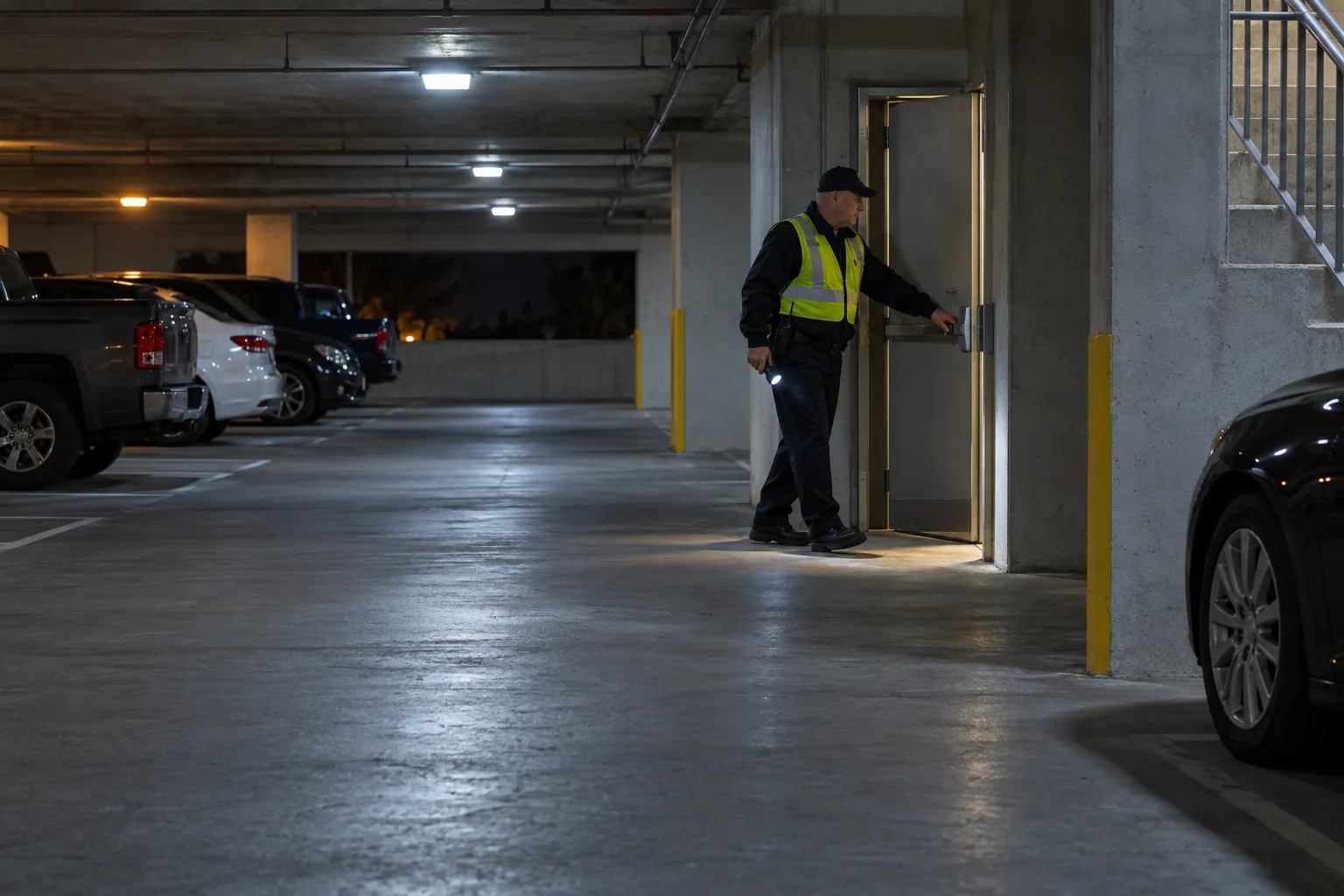
- Parking and exterior: lighting working, vehicles where they should be, nobody in areas closed at night, and anything suspicious recorded with a description and the time.
- Housekeeping and hazards: leaks, spills, trip hazards, smells of gas or burning, and anything left running that should not be.
- Restricted areas: mechanical rooms, IT rooms and storage secured, with anything found open recorded along with who was told.
Vary the timing of rounds within what the post orders allow. A round at exactly the top of every hour is easy to plan around. Record each round as it happens, with the time and anything found, not at the end of the shift.
Findings need an owner. A burned-out exit sign is a work order for the building engineer or facility manager; a propped fire door may need to be closed and reported at once; an intruder is a call to police and an incident report. The checklist should say, for each kind of finding, who is told and how, following the reporting procedures in the post orders. "Reported to" is the column most often left blank.
If a fire protection system is impaired and the authority having jurisdiction or the owner has ordered a fire watch, that watch has its own route, frequency and log, set by the order. Put it on the checklist as a separate task and never let it merge into the ordinary round.
05
End of shift, and how a supervisor checks the checklist
The end of the shift is where the record either holds together or falls apart. An end-of-shift checklist covers:
- Daily activity report completed, with every round, incident, visitor and maintenance issue, and signed by the officer.
- Open items written into the pass-down log in plain words: what, where, who was told, what the next officer should do.
- Incident reports finished, or started and flagged to the supervisor, for anything that needs one. In California, anything that falls within the workplace violence definitions in Labor Code section 6401.9 reported so the employer can enter it in the violent incident log.
- Keys and equipment returned or handed over against the key log, radios on charge.
- The handover in person where the post orders require the post to be relieved, never a post left empty before the relief arrives.
- Time off post recorded, with the name of the relieving officer.
A checklist is only worth as much as the supervision behind it. Security supervisors check it in three ways. They read the DAR and pass-down log each day and look for gaps: a round missing between 2 a.m. and 5 a.m., or the same finding reported three nights running with nobody fixing it. They make unannounced post visits, walking part of the round to see whether what the checklist says was checked has been. And they compare the record with other evidence the site already has: access control logs, CCTV footage and alarm panel history.
Good evidence that a round was done is specific. It names the officer, gives the time at each checkpoint, says what was found, and shows that anything found went to someone. A column of identical ticks at identical times is not evidence; it is a sign the sheet was filled in afterwards. The test is the same whether the records are kept on paper or on a digital form on a mobile phone, and it is the test a client is likely to apply when something goes wrong.
Even large, formal programs struggle here. In GAO-25-108085, Federal Protective Service: Actions Needed to Address Critical Guard Oversight and Information System Problems (March 2025), the Government Accountability Office found that "the paper-based system that the Post Tracking System was designed to replace remains the system of record for FPS." The lesson for a private site is modest: decide what record you will actually use to check posts, and keep it simple enough that it is used.
06
Where shift checklists fail, and where SiteClara fits
The checklist on the clipboard at the security desk says the officer walked the building at 11 p.m., 1 a.m., 3 a.m. and 5 a.m. Every box is ticked in the same pen. The rear exit door at the loading dock was found chained the next morning by the day porter. Nobody can say whether it was checked and found secure, checked and missed, or never checked at all. The checklist was sound; the record of it proves nothing.
SiteClara turns the rounds on the checklist into a record made as they happen. A printed QR poster, with an optional NFC tag behind it, goes at each checkpoint the post orders name: the loading dock, the parking garage stairwell, the roof access door. The officer scans the code or taps the tag on their own phone, with no app to install, sees the checks due at that point and marks them done, or says what stopped them, such as a locked door or a blocked corridor. The time and the named officer are recorded as it happens, with a photo when one is asked for. A problem found on the round is reported there and goes onto the team's list of jobs until someone closes it.
The security supervisor sees what was due, done and missed, with the reason where one was given, and a job that needs the building manager can be escalated to them to answer. Each day the supervisor reviews the totals and photos, adds a note and approves a report that goes to nominated management or client contacts the next morning, showing how the scheduled checks went, for example 24 of 24 completed, and what is still open.
07
Questions people ask
What are the 5 basic functions of a security guard?
There is no official list of five. The Bureau of Labor Statistics Occupational Outlook Handbook: Security Guards and Gambling Surveillance Officers says security guards typically patrol property, enforce rules and regulations of an employer's property, monitor alarms and video-surveillance systems, respond to emergencies, deter criminal activity, control building access by employees and visitors, conduct security checks over a specified area, and "write reports on what they observed while on duty." A shift checklist puts those duties in order for one post.
What items does a security guard need?
State law sets a few and the post orders set the rest. In California, Business and Professions Code section 7583.3 requires a guard to carry on their person, while on duty, "a valid and current security guard registration card", and a guard carrying a firearm to carry a valid and current firearms permit. The radio, flashlight, keys and uniform are set by the employer and the post orders, which is why they head the start-of-shift checklist.
What is the 10 code in security?
Ten codes are numbered radio shorthand, and the same code can mean different things from one agency or company to the next. The federal National Incident Management System, Third Edition (October 2017) tells incident personnel to "use plain language and clear text, not codes", and to avoid "acronyms or jargon unique to an agency, organization, or jurisdiction" when more than one organization is involved. Write the radio procedures on a checklist in words, especially anything that involves police or the fire department.
08
Further reading, and a checklist to take away
The rules that shape a shift checklist are the state's and the site's, so start with your state's security licensing regulator and your post orders. For the pieces covered here:
- California BSIS security guard training requirements and Business and Professions Code section 7583.3.
- New York Department of State security guard training requirements.
- 29 CFR 1910.38, emergency action plans, and the exit route rules in 29 CFR 1910.36 and 29 CFR 1910.37.
- OSHA's State Plans page, to check which rules apply in your state.
- OSHA on workplace violence, and in California Labor Code section 6401.9.
A shift checklist in ten lines:
- Credentials carried, uniform correct, radio tested.
- Pass-down read and discussed with the outgoing officer.
- Post order changes, BOLOs and trespass notices read.
- Keys and access cards signed out against the key log.
- Fire and intrusion panels read, camera views checked.
- Each round walked checkpoint by checkpoint, at varied times, recorded as it happens.
- Exits openable, routes clear, signs lit, fire equipment unobstructed.
- Every finding given an owner and a "reported to".
- DAR, incident reports and pass-down completed before leaving.
- Post relieved in person, keys returned, time off post recorded.
Sources
Every document this guide quotes or links to, in the order it first cites them.
- Business and Professions Code section 7583.3 leginfo.legislature.ca.gov
- California Bureau of Security and Investigative Services training requirements bsis.ca.gov
- New York Department of State security guard training requirements dos.ny.gov
- 29 CFR 1910.38 (emergency action plans) osha.gov
- 29 CFR 1910.36 osha.gov
- 29 CFR 1910.37 osha.gov
- Workplace violence page osha.gov
- Labor Code section 6401.9 leginfo.legislature.ca.gov
- State Plans page osha.gov
- 29 CFR 1910.157(e)(2) osha.gov
- GAO-25-108085, Federal Protective Service: Actions Needed to Address Critical Guard Oversight and Information System Problems gao.gov
- Occupational Outlook Handbook: Security Guards and Gambling Surveillance Officers bls.gov
- National Incident Management System, Third Edition (October 2017) fema.gov
Related guides
 Security patrolsSecurity post orders: what they should say, and how to know they are followedSecurity post orders in the US: what they are, what state rules say, what to include, how to write, sign and review them, and how to check they are followed.
 Security patrolsSecurity pass-down log: what to hand over, and how to make the shift change stickThe security pass-down log: what the outgoing officer hands over, how to run the shift change, how to write entries that stay useful, and how to review and keep it.
 Security patrolsSecurity daily activity report: what to include, and how to write one that holds upThe security daily activity report (DAR): what to record, how to write entries that hold up, how it differs from an incident report, and how to review and keep it.
 Security patrolsSecurity guard duties and responsibilities: what the job involves, and how it is checkedSecurity guard duties in the US: state licensing and training, patrols, access control, reports, the limits of the role, and how post duties are set and checked.