Security patrols
School bathroom vandalism: the checks that keep restrooms open
School bathroom vandalism is deliberate damage to a student restroom, such as graffiti, clogged toilets, pulled dispensers and broken fixtures, and frequent, short, recorded checks help a school prevent it without locking doors.
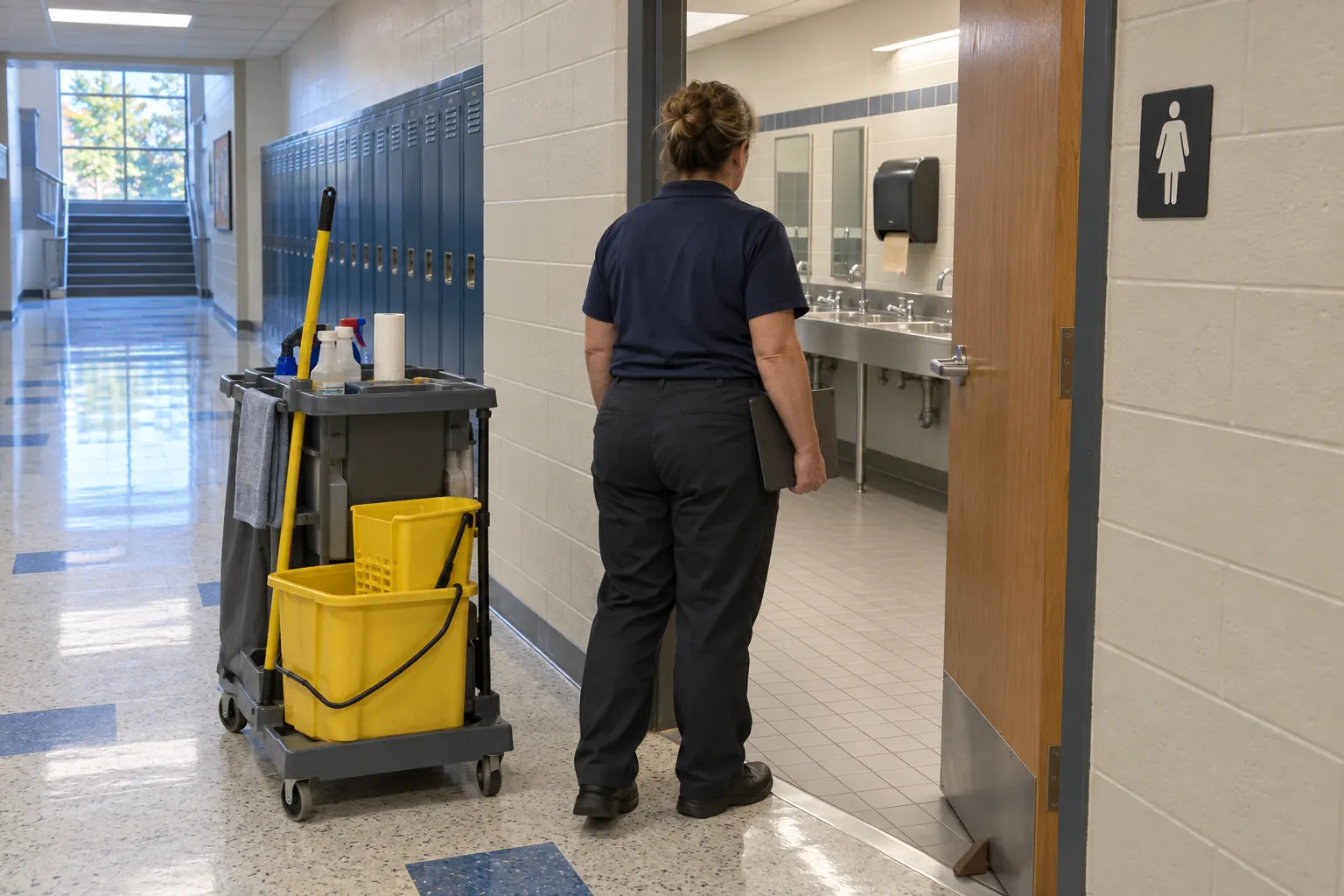
It is rarely one big incident. It is a soap dispenser pulled off the wall on Monday, a clogged toilet on Tuesday, graffiti in the end stall on Wednesday, and by Friday a principal who wants the restroom locked. This guide covers what the law says about keeping student restrooms open, how campus supervisors and custodians check them without intruding, and how to keep a record that narrows down when the damage happened.
01
What the law expects of a school bathroom
No federal rule tells a school how often to check its student bathrooms. The duties come from the state, from the district's board policy and, for staff restrooms, from workplace safety law. The detail varies a great deal from state to state, so what follows uses California as a worked example, because its Education Code spells the duty out more plainly than most. Check your own state's education code and your district's policies before you rely on any of it.
California's Education Code section 35292.5 (as amended by SB 760, effective January 1, 2024) applies to every public and private school with any classes from kindergarten to grade 12. It requires every restroom to be "maintained and cleaned regularly, fully operational, and stocked at all times with toilet paper, soap, and paper towels or functional hand dryers", and it requires schools to keep all restrooms open during school hours when pupils are not in classes, and a sufficient number open when pupils are in classes. A school may close a restroom temporarily only when that is necessary for a documented pupil safety concern, for an immediate threat to pupil safety, or to repair the facility. By July 1, 2026, the same section also requires each public school district, county office of education and charter school to provide at least one all-gender restroom for pupils at any schoolsite that has more than one female and more than one male restroom for pupil use only. This part does not apply to private schools.
That closure rule matters for vandalism. Locking a bathroom because it keeps getting damaged is the obvious response, and under this section it has to rest on a documented safety concern or on a repair. A school that cannot show why a restroom was closed, and for how long, is on weak ground when a parent complains.
The same state checks restrooms through its facilities rules. Education Code section 17002 defines "good repair" as a facility maintained so that it is clean, safe and functional as determined by a school facility inspection, and the criteria it sets include restrooms that are functional, regularly maintained and stocked, accessible to pupils during the school day, and compliant with section 35292.5, and a separate criterion expects restrooms to appear to have been cleaned each day school is in session. Broken or unstocked restroom fixtures would fail those criteria.
Staff restrooms fall under workplace law. The OSHA sanitation standard, 29 CFR 1910.141, applies to permanent places of employment and requires that washing facilities be "maintained in a sanitary condition", with hand soap and towels or air blowers provided. It protects employees, not students. And it only reaches a public school district where the state runs an OSHA-approved State Plan: OSHA's State Plans page is explicit that in states without one, state and local government workers are not covered by federal OSHA. Private and charter schools that are private employers are covered either way.
02
What bathroom vandalism looks like in practice
Most of what a campus supervisor or custodian finds on a bathroom check falls into a handful of patterns. Knowing them tells you what to look at in the thirty seconds a check takes:
- Graffiti and etching on stall partitions, mirrors, doors and tile, in marker, paint or scratched in. The earlier it is removed, the less it invites more.
- Clogged toilets and urinals from paper towels, whole rolls or foreign objects, often causing a flood that reaches the corridor.
- Dispensers pulled or broken: soap, paper towel, toilet paper and sanitary product dispensers, and hand dryers.
- Damaged fixtures: sinks pulled from the wall, faucets broken, mirrors cracked, stall doors and latches broken, ceiling tiles pushed up.
- Vaping and smoking, including covered or tampered-with smoke detectors and vape sensors. The CDC's page on e-cigarette use among youth reports that in 2024, 1.63 million students (5.9%) currently used e-cigarettes.
- Items that should not be there: food, contraband, damaged property taken from elsewhere, or anything that suggests a student needs help rather than a consequence.
- Theft of supplies, which leaves a bathroom that is technically open but out of soap or paper, and so short of what the law requires.
The pattern that does most harm is the closure spiral. A bathroom is damaged, so it is locked; the remaining bathrooms get busier and less supervised, so they are damaged in turn; and students end up with one open restroom at the far end of the building. Frequent, short checks are how a school breaks that cycle without locking doors.
03
Who checks, how often, and how to do it without intruding
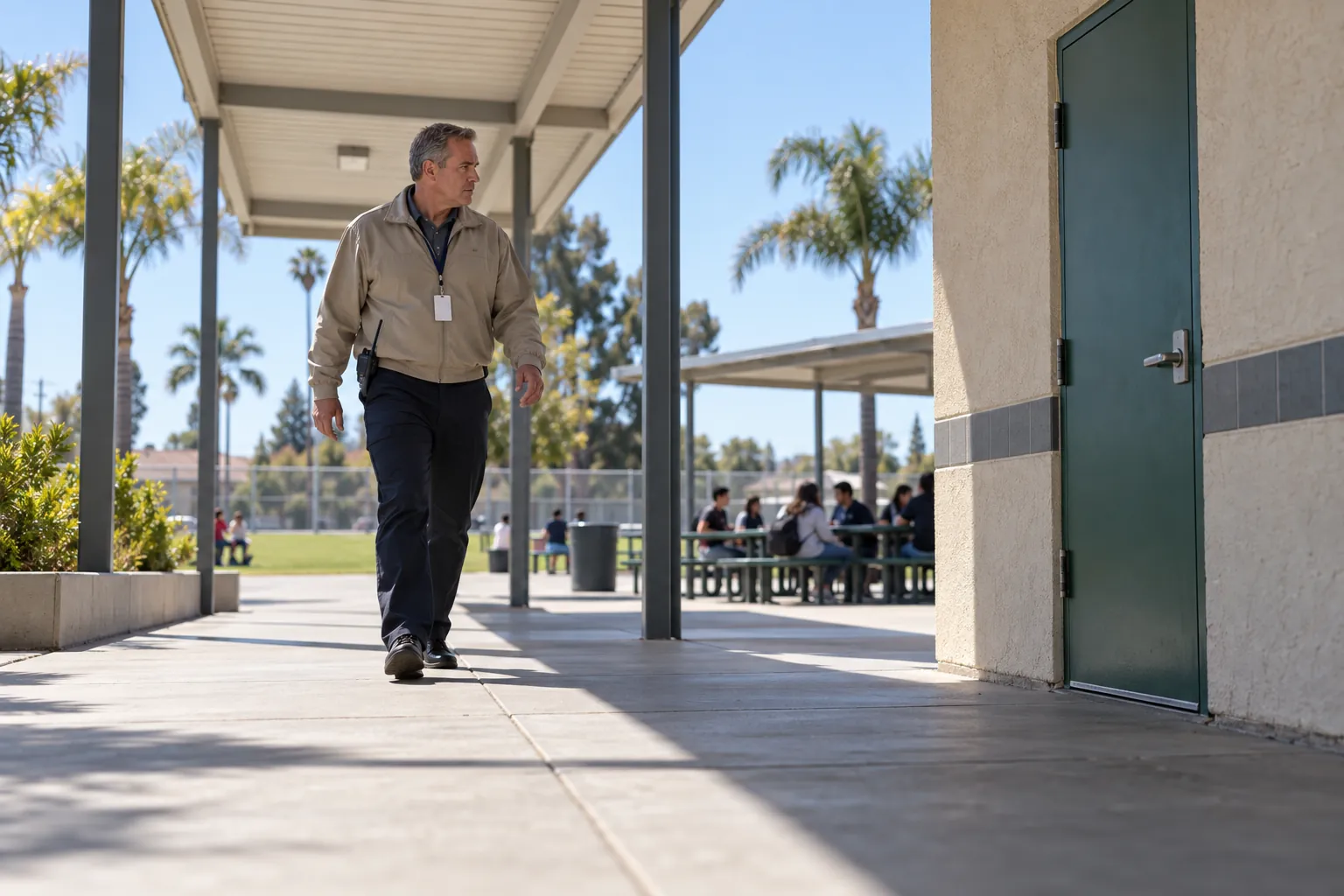
In most districts bathroom checks are shared. Day custodians check and restock on a route; campus supervisors, campus monitors or security officers look in during and after passing periods and lunch; an administrator on duty covers gaps. Where a school resource officer is assigned, their role is set by the district's agreement with the law enforcement agency, and routine bathroom checks are usually left to school staff. Whoever does it, write it down in the post orders or duty roster so it does not fall between two jobs.
A workable pattern for a secondary school looks like this:
- Before the first bell: a custodian opens every student restroom, checks it works, restocks it, and notes anything already damaged so it is not blamed on the day's students.
- During and just after each passing period: a supervisor looks in at the restrooms in their zone. Vandalism tends to happen when a bathroom is busy and unsupervised, or empty and out of sight.
- During lunch: a check every 15 to 20 minutes at the busiest restrooms, and a walk-past at the others.
- Mid-class: a short look-in at restrooms that have had repeated trouble, because a student on a hall pass has the place to themselves.
- After dismissal: a custodian checks and cleans every restroom and records its condition, so the next morning's check starts from a known state.
Elementary schools need fewer sweeps but closer attention to supplies and flooding. Adjust the frequency to your own incident history: a restroom that has been damaged three times this month gets more checks, not a padlock.
04
What a useful bathroom check record shows
A bathroom check is only as useful as what it leaves behind. The point of the record is twofold: to show the restroom was checked and kept open, and, when something is damaged, to narrow the window in which it happened. Each entry should hold:
- The restroom, named unambiguously: "Building B, second floor, boys' restroom by room 214", not "upstairs".
- The time, recorded when the check was made, not filled in at the end of the shift.
- Who checked, by name or staff ID.
- The condition: fine, or what was wrong, in a few words.
- Supplies: stocked, or what was out.
- Any damage, with a photograph of the damage itself. Photograph the fixture, the wall or the floor, never a student.
- What happened next: restocked, cleaned, work order submitted, restroom closed and why, administrator told.
With checks every period, a damaged dispenser found at 11:40 that was fine at 10:55 gives an administrator a 45-minute window, which is often enough to match to hall passes and staff observations. A check sheet initialed "all day" gives nothing.
Be careful with what the record says about students. Under FERPA, the Family Educational Rights and Privacy Act, parents have rights of access to their children's education records and some control over disclosure of personally identifiable information from them. The Department of Education's FAQs on photos and videos under FERPA explain that a photo or video is an education record when it is directly related to a student and maintained by the school, and give the example of a surveillance video of two students fighting that is used in a disciplinary action. Keep the check record about the room. Anything that names or shows a student belongs in the discipline process and your district's student records, handled under its FERPA policy.
05
Closing a restroom, repairing it, and following up
When a check finds damage, the response should be fast and proportionate. A reasonable sequence:
- Make it safe: turn off water to a flooding fixture, put out a wet floor sign, remove broken glass.
- Record it, with a photograph of the damage and the time found.
- Submit a work order for maintenance, marked with how urgent it is. A broken latch on the only accessible stall is urgent; graffiti on a partition can wait for the afternoon.
- Decide whether to close, and if so, record the reason and the expected reopening time. In California that reason must be a documented safety concern, an immediate threat, or a repair under section 35292.5. Point students to the nearest open restroom with a sign, and make sure an accessible restroom stays available.
- Reopen and record it as soon as the repair or the safety concern is dealt with.
- Tell the administrator if there is reason to think a student was responsible, and leave the investigation to them.
Discipline and restitution are the administrator's decisions, under state law and district policy. In California, damaging school property is one of the grounds for suspension listed in Education Code section 48900, subdivision (f), and possessing or using tobacco or nicotine products is another, subdivision (h). Education Code section 48904 makes the parent or guardian of a minor who willfully damages school property liable for the damages, up to $10,000, adjusted annually for inflation. A check record with times and photographs of the damage is what lets the district put a cost on it.
Look at the pattern monthly. Which restrooms, which times of day, which days of the week? The answer usually points to a supervision gap, such as a restroom next to an unstaffed corridor or a lunch period with too few monitors. The CISA K-12 School Security Guide (3rd edition, 2022) sets out a method for assessing a school's physical security in layers, and the same thinking applies here: sightlines, where supervisors stand, and how quickly damage is found and fixed, before any new hardware.
06
Where the bathroom check record fails, and what SiteClara does about it
Most schools already have some form of bathroom check sheet, usually a clipboard or a sheet taped inside the door. It fails in familiar ways. It is filled in at the end of the day from memory. Several people check the same restroom and nobody knows who saw what. The broken dispenser noted at 9 a.m. is still broken at 2 p.m. because the note never reached maintenance. And when an administrator asks when the graffiti appeared, the sheet has initials but no times anyone believes.
SiteClara replaces the sheet with a tag outside the restroom: a printed QR code poster, with an NFC tag behind it if staff prefer to tap. A custodian or campus supervisor scans it with their own phone, with no app to install, and completes the check. The person and the time are recorded as it happens. If something is wrong, they record it there with a photograph of the damage, and it goes onto the team's list of open jobs until someone closes it.
Checks are scheduled per location, so the custodial team sees which restrooms are due and marks them done, or says what stopped them, and the supervisor sees what was missed and can record why. At the end of the day the supervisor reviews the day and approves it, and the report reaches the principal or the facility manager at 8 a.m. the next morning, showing the checks completed and what is still open.
07
Questions people ask
What happens if students vandalize school property?
It depends on the state and the district's policy. In California, Education Code section 48900 lists causing or attempting to cause damage to school property or private property, subdivision (f), among the acts for which a principal or superintendent may suspend a pupil or recommend expulsion. Under Education Code section 48904, the parent or guardian of a minor who willfully damages school property is liable for the damages, up to $10,000 adjusted annually for inflation, and after due process the school may withhold the pupil's grades, diploma and transcripts until the damages are paid; where the family cannot pay, the school must offer a voluntary work program instead.
Is it legal for schools to not let you use the bathroom?
It depends on the state. In California, Education Code section 35292.5 requires a school to keep all restrooms open during school hours when pupils are not in classes, and a sufficient number open when pupils are in classes. It allows a restroom to be closed temporarily only for a documented pupil safety concern, for an immediate threat to pupil safety, or to repair the facility. Elsewhere, check your state's education code and your district's board policy.
Is it illegal to film in a school bathroom?
In California, yes, when it is done to invade privacy. California Penal Code section 647, subdivision (j), makes it disorderly conduct, a misdemeanor, to view the inside of a bathroom with a camera, mobile phone or other device with the intent to invade the privacy of the people inside, or to use a concealed camera to secretly record an identifiable person who may be undressed there, without their consent, to view their body or underclothing. Report any recording found in a school restroom to an administrator at once, and leave the device and the investigation to them and to law enforcement.
What is the punishment for filming in a bathroom?
In California, under subdivision (k) of California Penal Code section 647, a violation of subdivision (j) is punishable by up to one year in county jail, a fine of up to $2,000, or both, where the victim was a minor or where it is a second or subsequent violation. Other states set their own penalties.
08
Further reading, and a list to take away
Start with your own state's education code and your district's board policies on facilities, student supervision, discipline and student records. For the sources cited here:
- California Education Code section 35292.5: restrooms maintained, stocked and open, and when they may be closed.
- California Education Code section 17002: "good repair" and the school facility inspection.
- OSHA 29 CFR 1910.141, Sanitation, for staff restrooms, and OSHA State Plans to see whether it reaches your district.
- FAQs on photos and videos under FERPA, U.S. Department of Education.
- CISA K-12 School Security Guide Product Suite.
A list to take away:
- Name every student restroom unambiguously and put each one on a check route.
- Open, check and restock every restroom before the first bell, and record its condition.
- Check during and after passing periods, and every 15 to 20 minutes at lunch at the busiest restrooms.
- Knock and announce, never look into an occupied stall, and never put a camera inside a restroom.
- Record each check when it happens: restroom, time, who, condition, supplies, action.
- Photograph damage, never students.
- Submit a work order for every fault, and record when it is fixed.
- Close a restroom only for a documented safety reason or a repair, record why, and reopen it as soon as you can.
- Keep anything that identifies a student out of the check record and in the discipline process.
- Review the pattern monthly and fix the supervision gap it shows.
Sources
Every document this guide quotes or links to, in the order it first cites them.
- Education Code section 35292.5 leginfo.legislature.ca.gov
- Education Code section 17002 leginfo.legislature.ca.gov
- 29 CFR 1910.141 osha.gov
- OSHA's State Plans page osha.gov
- CDC's page on e-cigarette use among youth cdc.gov
- Family Educational Rights and Privacy Act studentprivacy.ed.gov
- FAQs on photos and videos under FERPA studentprivacy.ed.gov
- Education Code section 48900 leginfo.legislature.ca.gov
- Education Code section 48904 leginfo.legislature.ca.gov
- CISA K-12 School Security Guide (3rd edition, 2022) cisa.gov
- California Penal Code section 647 leginfo.legislature.ca.gov
Related guides
 Security patrolsSchool security checklist: what to check at a K-12 school, when, and by whomA school security checklist for US K-12 campuses, built on CISA's layered approach: perimeter, grounds, building and interior, who checks what, when, and the record.
 CleaningRestroom cleaning log: what to record, and how to make it believableWhat a restroom cleaning log should record, how often to check, the OSHA and Food Code rules behind it, and how to keep a log a client or inspector will believe.
 CleaningSchool cleaning checklist: what custodians clean, how often, and how to show it was doneA school cleaning checklist for classrooms, restrooms, hallways, the cafeteria, gym and nurse's office: daily, weekly and summer tasks, the rules and the record.
 Security patrolsSecurity daily activity report: what to include, and how to write one that holds upThe security daily activity report (DAR): what to record, how to write entries that hold up, how it differs from an incident report, and how to review and keep it.