Cleaning
School cleaning checklist: what custodians clean, how often, and how to show it was done
A school cleaning checklist is a written list of the cleaning tasks for each area of a school, from classrooms and restrooms to the cafeteria, gym and nurse's office, with how often each is done: during the school day, every night, every week and during breaks.
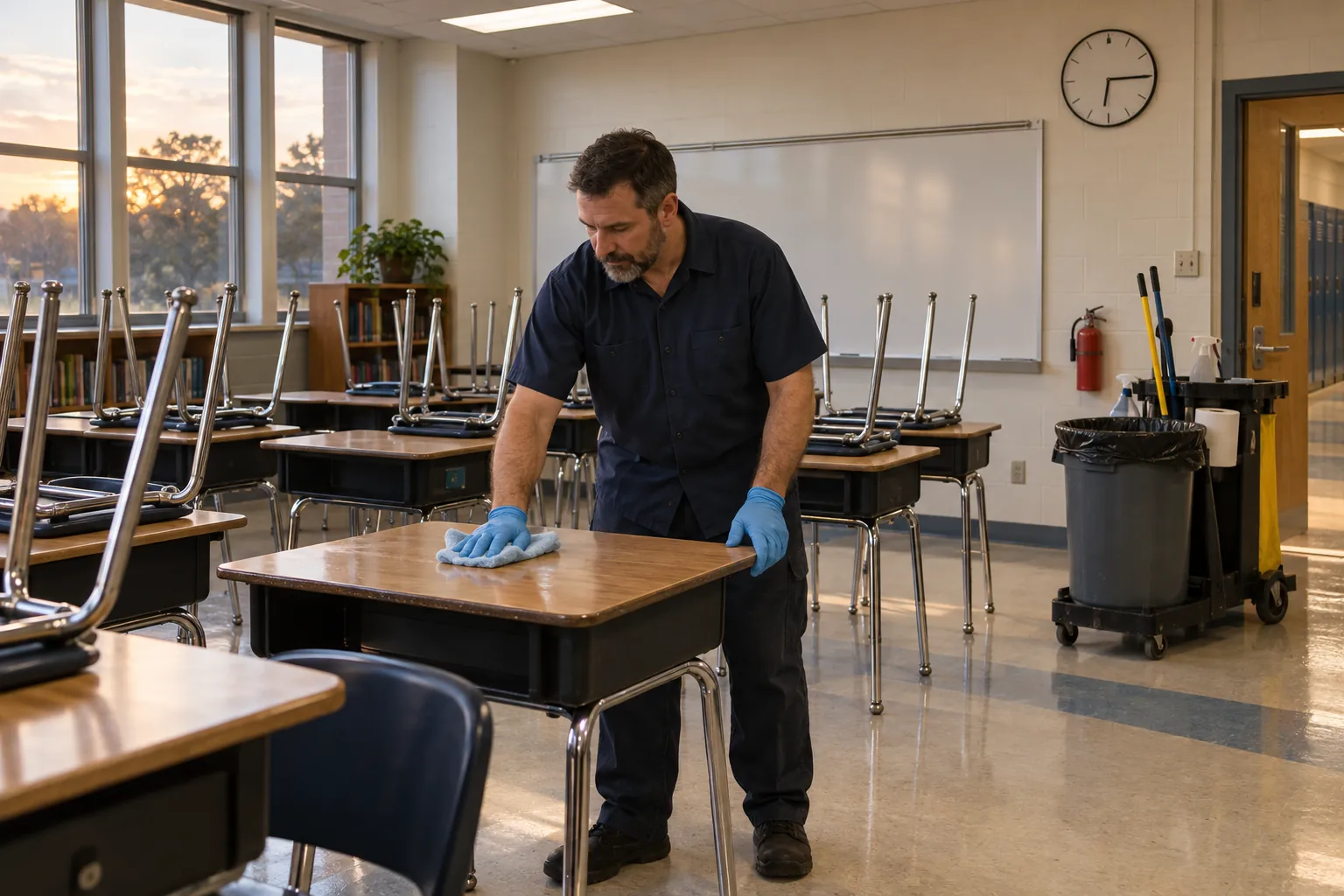
A school is cleaned in the few hours when students are not in it, and judged every minute they are. This guide sets out a school cleaning checklist area by area for K-12 buildings in the United States, what the custodial team does every day and what waits for summer, which federal and state rules sit behind it, and how to keep a record the principal and the facilities director can rely on.
01
The rules behind a school cleaning checklist
No federal regulation prescribes a school cleaning checklist. Several rules each set part of the outcome, and the checklist is how a district, charter or private school shows it meets them every night.
For the people who work in the building, the starting point is OSHA's walking-working surfaces standard. 29 CFR 1910.22 requires that "all places of employment, passageways, storerooms, service rooms, and walking-working surfaces are kept in a clean, orderly, and sanitary condition", and that walking-working surfaces are kept free of hazards such as leaks and spills. OSHA's sanitation standard, 29 CFR 1910.141 adds that washing facilities "shall be maintained in a sanitary condition", with hand soap and towels or air dryers provided.
Whether those standards reach a given school depends on who runs it. Federal OSHA covers private employers, so a private or parochial school and a private janitorial contractor are covered. It does not cover state and local government workers, so a public school district's own custodians are covered only where the state runs an OSHA-approved State Plan. OSHA lists 22 State Plans covering both private and public employers and seven covering only state and local government workers; elsewhere, public school staff fall outside OSHA.
Two more federal standards shape the custodial routine. The Bloodborne Pathogens standard, 29 CFR 1910.1030 applies where an employee's duties make contact with blood or other potentially infectious materials reasonably anticipated, which can include custodians who clean up after nosebleeds and injuries. It requires the employer to set "an appropriate written schedule for cleaning and method of decontamination" and to decontaminate surfaces after any spill of blood. The Hazard Communication standard, 29 CFR 1910.1200 requires safety data sheets for each hazardous chemical to be "readily accessible during each work shift" and training when a worker is first assigned and whenever a new chemical hazard is introduced.
Schools also carry a duty most workplaces do not. Under the Asbestos Hazard Emergency Response Act (AHERA), public and non-profit private K-12 schools, including charter schools and schools affiliated with religious institutions, must manage asbestos-containing building material, as the EPA explains in Asbestos and School Buildings. Under 40 CFR 763.92, custodial and maintenance staff who may work in a building containing that material must receive at least two hours of awareness training, and new staff within 60 days.
Some states go further. New York, for example, requires every public and private elementary and secondary school to follow state guidelines when buying cleaning and maintenance products, under New York Education Law section 409-i, the environmentally sensitive cleaning law. Check your own state education department and health department before writing the checklist.
02
What a school cleaning checklist covers, area by area
Every building is different, but the same areas appear in almost every school's custodial schedule. Each needs its own short list of tasks, and the restrooms, cafeteria and high-traffic hallways deserve the most attention:
- Classrooms: empty trash and recycling; dust-mop or vacuum floors; wipe desks, tables and chairs when scheduled; clean doorknobs, light switches and shared equipment; clean sinks and drinking fountains in the room; leave student work and teachers' materials undisturbed.
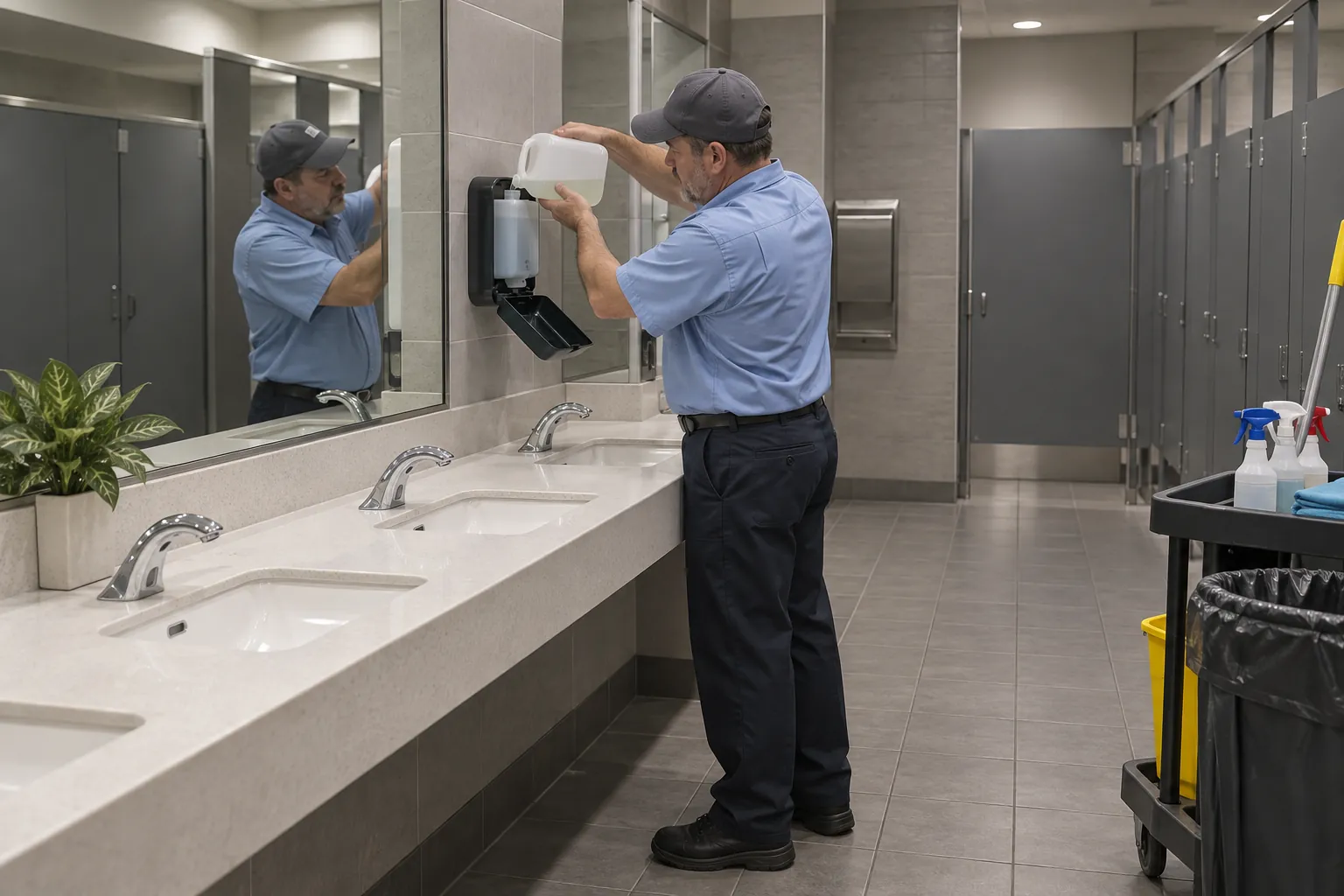
- Restrooms: clean and disinfect toilets, urinals, sinks and faucets; mop floors; restock toilet paper, soap and paper towels; empty trash and sanitary napkin receptacles; check for leaks, clogs, broken partitions and graffiti. The restrooms are where students, parents and staff judge the whole building, and a restroom cleaning log is often the first record a school keeps.
- Hallways, stairwells and lockers: dust-mop and spot-mop, wipe handrails, push plates and door hardware, clear litter from locker banks and around drinking fountains.
- Entrances and the main office: walk-off mats, glass doors and sidelights, the front counter and visitor seating.
- Cafeteria: tables and seats wiped between lunch periods and after the last one, floors swept and mopped, trash and food waste removed. The kitchen is usually the school nutrition program's responsibility under its own food safety plan, and the checklist should say exactly where the line falls.
- Gym and locker rooms: floors cleaned by the method the surface calls for, bleachers, mats, benches, showers and restrooms.
- Nurse's office: surfaces, cot, sink and the arrangements for sharps and other regulated waste, cleaned to a higher standard than a classroom.
- Science labs, art rooms and the teachers' lounge: sinks, counters and floors, with teachers responsible for their own chemicals and equipment.
- Pre-K and early childhood rooms: low surfaces, toys, floors where children sit, and any diapering area, on the program's own schedule and licensing rules.
Put the custodial closet on the checklist too: products in labeled containers and locked away from students, safety data sheets on hand, color-coded cloths and mops kept apart, and carts clean at the end of the shift. The CDC's general guidance for community facilities, When and How to Clean and Disinfect a Facility, puts it plainly: "Store and use chemicals out of the reach of children and animals."
03
Daily, weekly, break and summer tasks
School cleaning follows the school day and the school year. A workable checklist sorts the tasks into four rhythms, so the head custodian can see what must happen tonight and what can wait for a break:
- During the school day: restroom checks after class changes and lunch, spills and accidents dealt with as they happen, the cafeteria turned around between lunch periods, trash in the busiest areas. This is the day custodian's work, not the night crew's.
- Every night: classrooms, restrooms, hallways, entrances, the cafeteria, the office and the lounge, with trash emptied and high-touch surfaces cleaned throughout.
- Weekly: high dusting within reach, interior glass, baseboards, gym floor care, dumpster and loading dock areas, and a closer look at the rooms the nightly clean passes quickly. Weekly tasks are where most checklists quietly slip.
- Winter and spring breaks, and summer: the summer clean is when hard floors are stripped and refinished, carpets extracted, lights, vents and high surfaces cleaned, and furniture moved so every room is cleaned properly. Shorter breaks take the periodic work that cannot wait a year.
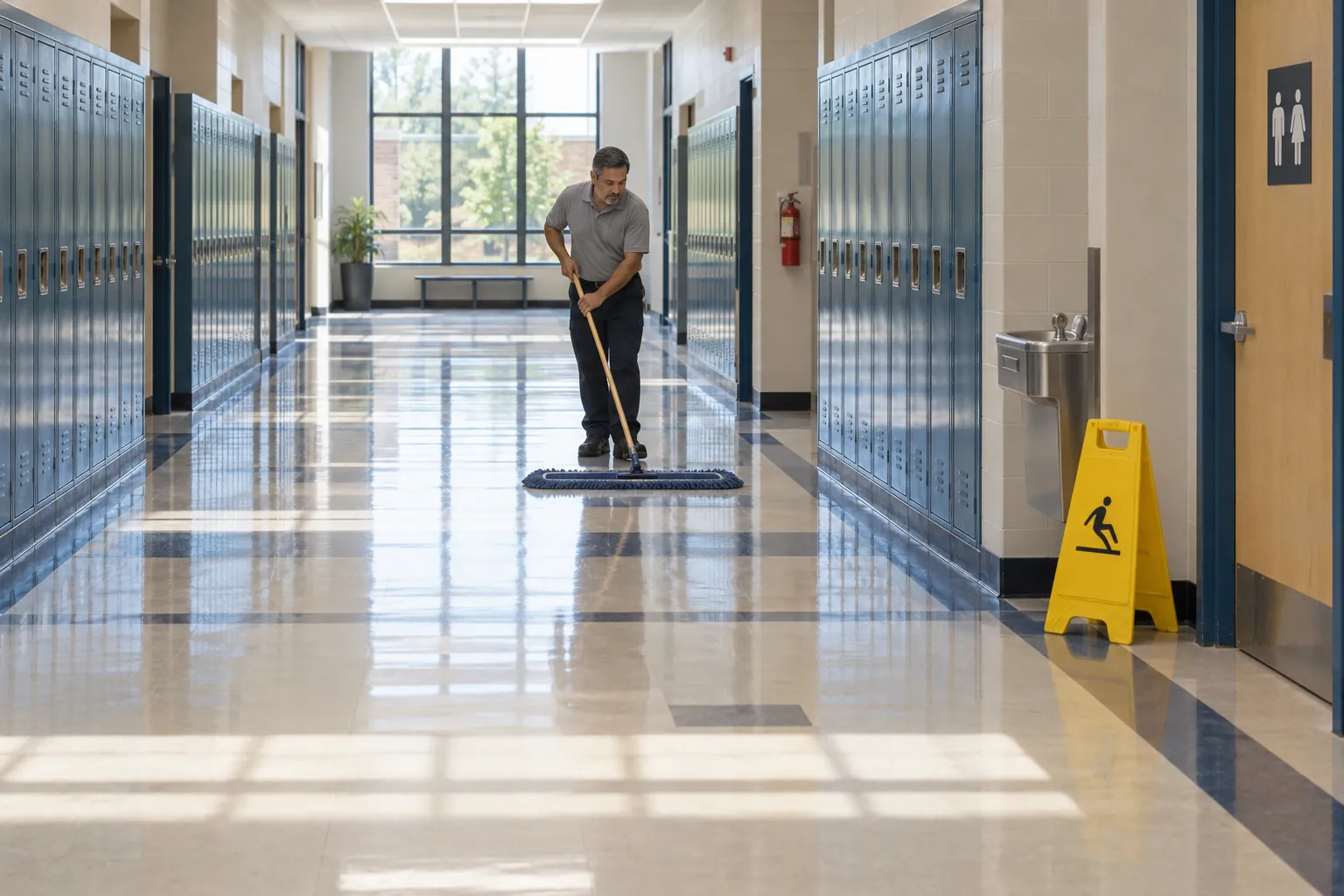
For floors, the National Forum on Education Statistics' Planning Guide for Maintaining School Facilities, published by the National Center for Education Statistics in 2003, gives a useful starting pattern. For carpet: vacuum daily, deep-clean before the school year starts and during the holiday break, and scrub-clean twice a year. For hard floors: dry-mop daily, wet-mop three times a week, spray-burnish every other week, and strip and finish once a year. Adjust it to the traffic and the finish in your building, but write the frequency down.
The CDC's facility guidance separates cleaning from disinfecting. It says to "clean high-touch surfaces regularly", such as door handles, stair rails and counters, and to clean other surfaces when they are visibly dirty, and to disinfect "areas of your facility where people have obviously been ill (for example, vomiting on facility surfaces)." That guidance is written for community settings and says it is not intended for food service areas or early care and education settings, which follow their own rules. The EPA's explainer on products that disinfect, sanitize and clean draws the same line: cleaning removes dirt, sanitizing kills bacteria, and disinfecting kills viruses and bacteria.
04
Products, contact time and who does what
A disinfectant only works as its label says. EPA's page on selected EPA-registered disinfectants notes that "the only way to accurately identify a product is by the EPA registration number" and that the label gives the pathogens it works against and the contact time, how long the surface must stay wet. A checklist that says "disinfect restroom fixtures" should name the product and the contact time, so the custodian is not wiping a surface dry in ten seconds. Dirt left on a surface also stops a disinfectant working, which is why cleaning comes first.
School cleaning is usually split between people who are rarely in the building at the same time:
- The night crew, district custodians or a janitorial contractor's cleaners, carries out the nightly clean and much of the break and summer program.
- The day custodian handles restroom checks, spills, the cafeteria between lunches, setups for events, and requests from teachers and the office (see the custodian duties guide).
- The head custodian or building engineer supervises the building's staff, holds the schedule and the supplies, and is the link with the principal.
- The facilities or maintenance director owns the district-wide program, the budget, staffing levels and any janitorial contract.
- The principal answers for the building day to day and hears the complaints first.
- Teachers and staff keep rooms clear enough to be cleaned and report problems.
- The school nutrition program cleans the kitchen to its own food safety plan.
Write the split down. Most disputes are about the gaps: who wipes cafeteria tables between lunches, who checks the restrooms after the last bell, and who moves the furniture before summer floor work.
Staffing drives everything else. The same NCES planning guide describes five levels of cleaning, from Level 1, a "spotless" building, to Level 5, which "can very rapidly lead to an unhealthy situation". It calls Level 3 "the norm for most school facilities", at which a custodian can clean about 28,000 to 31,000 square feet in eight hours, against 10,000 to 11,000 square feet at Level 1. A checklist written for Level 2 and staffed for Level 4 will be signed off and not done. The custodial staffing guide covers how to work the numbers.
05
How to check the checklist is being followed
A checklist initialed by the person who did the work is a starting point, not assurance. Whether the district employs its own custodians or buys janitorial services, it needs to know the routine is followed the same way every night in every building. Schools usually add three kinds of checking:
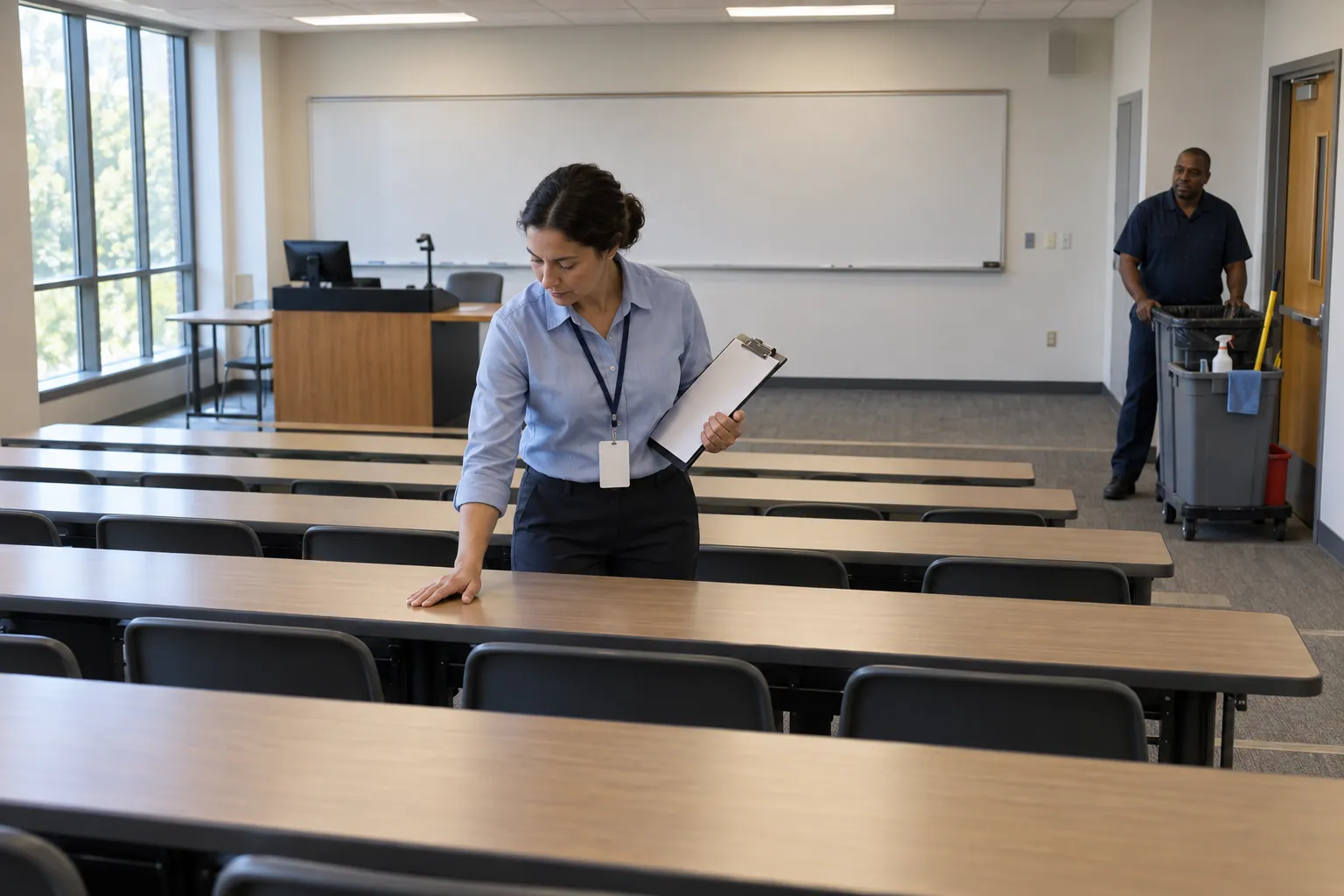
- Morning walk-throughs by the head custodian or principal before students arrive, when the result of the night clean is easiest to see: restrooms stocked, trash emptied, cafeteria floor clean, nothing left over from the evening's events.
- Periodic inspections against the written standard, scoring a sample of rooms in each building, jointly with the contractor where there is one, so results can be compared across schools; the janitorial quality control guide covers how.
- A review meeting each semester, or monthly with a contractor, covering inspection results, complaints, missed cleans, staffing, the summer program and any change in how the building is used.
Students, teachers and parents notice quickly when standards slip, and the early signs are predictable: full trash cans in the morning, sticky cafeteria tables, restrooms out of soap by the end of lunch. A district with an underperforming building or contractor usually knows from complaints long before it has the evidence to act, which is why a record of each clean, and each missed one, matters at the next review or the next contract renewal.
06
Where the school cleaning record fails, and what SiteClara does about it
Most school cleaning happens between 3 p.m. and 11 p.m., after the principal and the facilities director have gone home. The record is a sheet on a clipboard in the custodial closet, initialed for the week on Friday, or a contractor's word that the building was done. The first sign of a missed clean is a teacher's email the next morning.
SiteClara records the check where it happens. A printed QR code poster, with an optional NFC tag behind it, sits at each place on the checklist: each restroom, the cafeteria, each hallway, the gym and the nurse's office. Staff posters can go where students are unlikely to reach them. The custodian scans the code or taps the tag with their own phone, with no app to install, sees the checks due there, and marks each one done or explains what stopped them, with a photo when one is asked for. The time and the named person are recorded as it happens. A problem they find, such as a clogged toilet or a broken stall latch, is reported there and goes onto the team's list of jobs until someone closes it; the supervisor can escalate it to the person who manages the building.
The supervisor, whether that is the head custodian or the contractor's supervisor, sees what was due, what was done and what was missed, and records why a check was missed. Each day they review the totals and photos, add a note and approve a report that goes to the principal or other nominated contacts at 8 a.m. the next morning by default, showing what was completed, what is still open and how the scheduled checks went.
07
Questions people ask
What are the typical tasks of a school cleaner?
The Bureau of Labor Statistics' Occupational Outlook Handbook entry for janitors and building cleaners lists the core duties: gathering and emptying trash, sweeping, mopping or vacuuming floors, cleaning restrooms and stocking them with supplies, cleaning spills and other hazards, washing windows, walls and glass, and cleaning and disinfecting surfaces that are touched frequently. It adds ordering supplies, minor repairs, reporting major repairs to managers and locking doors to secure the building.
What should I include in a school deep clean checklist?
The NCES Planning Guide for Maintaining School Facilities sets out the periodic work a daily routine does not reach: deep-clean carpets before the school year starts and during the holiday break, steam-clean them annually with water at least 140°F, strip and finish hard floors once a year, and screen and reseal wood gym floors annually. Add high dust, vents, lights and interior glass, and move the furniture so every room is cleaned completely.
What are the recommended guidelines for school cleaning?
There is no single federal school cleaning standard. For general community facilities, the CDC's When and How to Clean and Disinfect a Facility says to clean high-touch surfaces regularly, to disinfect areas where people have obviously been ill, and to store and use chemicals out of the reach of children. It is not intended for food service areas or early care and education settings, which follow their own rules, and OSHA's standards set out above apply to the people doing the work wherever OSHA or a State Plan covers them.
08
Further reading, and a list to take away
Start with the CDC's When and How to Clean and Disinfect a Facility, the EPA's disinfectant lists and AHERA pages, OSHA's State Plans page to see whether your state covers public school staff, and the NCES Planning Guide for Maintaining School Facilities for custodial levels and floor care. Your state department of education and health department publish the rules that apply where you are.
Before the next school year starts, check that your school cleaning checklist:
- lists every area of every building, including the nurse's office, locker rooms, labs and pre-K rooms;
- gives each area specific tasks and a frequency: during the day, nightly, weekly, and at breaks;
- covers restroom checks and body fluid spills during the school day, not only the night clean;
- names the disinfectant, its EPA registration number and its contact time where disinfecting is required;
- says where the school nutrition program's cleaning ends and the custodians' begins;
- sets out the summer program with dates, and knows where asbestos-containing material is before floor or ceiling work starts;
- covers safety data sheets, color coding and a locked custodial closet;
- is staffed for the level of clean it describes;
- says how each clean is recorded and who sees the record;
- is reviewed each semester with the custodial team or the contractor.
Sources
Every document this guide quotes or links to, in the order it first cites them.
- 29 CFR 1910.22 osha.gov
- Sanitation standard, 29 CFR 1910.141 osha.gov
- OSHA-approved State Plan osha.gov
- Bloodborne Pathogens standard, 29 CFR 1910.1030 osha.gov
- Hazard Communication standard, 29 CFR 1910.1200 osha.gov
- Asbestos and School Buildings epa.gov
- 40 CFR 763.92 ecfr.gov
- New York Education Law section 409-i nysenate.gov
- When and How to Clean and Disinfect a Facility cdc.gov
- Planning Guide for Maintaining School Facilities nces.ed.gov
- EPA's explainer on products that disinfect, sanitize and clean epa.gov
- Norovirus prevention guidance cdc.gov
- Selected EPA-registered disinfectants epa.gov
- Occupational Outlook Handbook entry for janitors and building cleaners bls.gov
Related guides
 Premises and facilities managementCustodian duties: what the job involves, and how to show it was doneCustodian duties in schools, offices, churches and public buildings: cleaning, restrooms, opening and locking, safety checks, OSHA rules and a record of the work.
 CleaningCustodial staffing: how many custodians a building needs, and how to show itHow to work out custodial staffing: cleanable square feet, APPA's five levels, ISSA cleaning times, labor hours to FTEs, and checking the numbers hold up.
 CleaningRestroom cleaning log: what to record, and how to make it believableWhat a restroom cleaning log should record, how often to check, the OSHA and Food Code rules behind it, and how to keep a log a client or inspector will believe.
 CleaningJanitorial quality control: how to inspect, score and fix the cleaningHow janitorial quality control works: QA versus QC, building a cleaning inspection checklist, APPA appearance levels, sampling, scoring and corrective action.