Cleaning
USP 797 cleaning requirements: what gets cleaned, how often, and how to show it
USP General Chapter 797, and the state rules built on it, require the primary engineering control (PEC), work surfaces, pass-through chambers and floors of a sterile compounding area to be cleaned and disinfected daily on days when compounding occurs, and its walls, storage shelving and, in classified rooms, ceilings to be cleaned, disinfected and treated with a sporicidal disinfectant monthly.
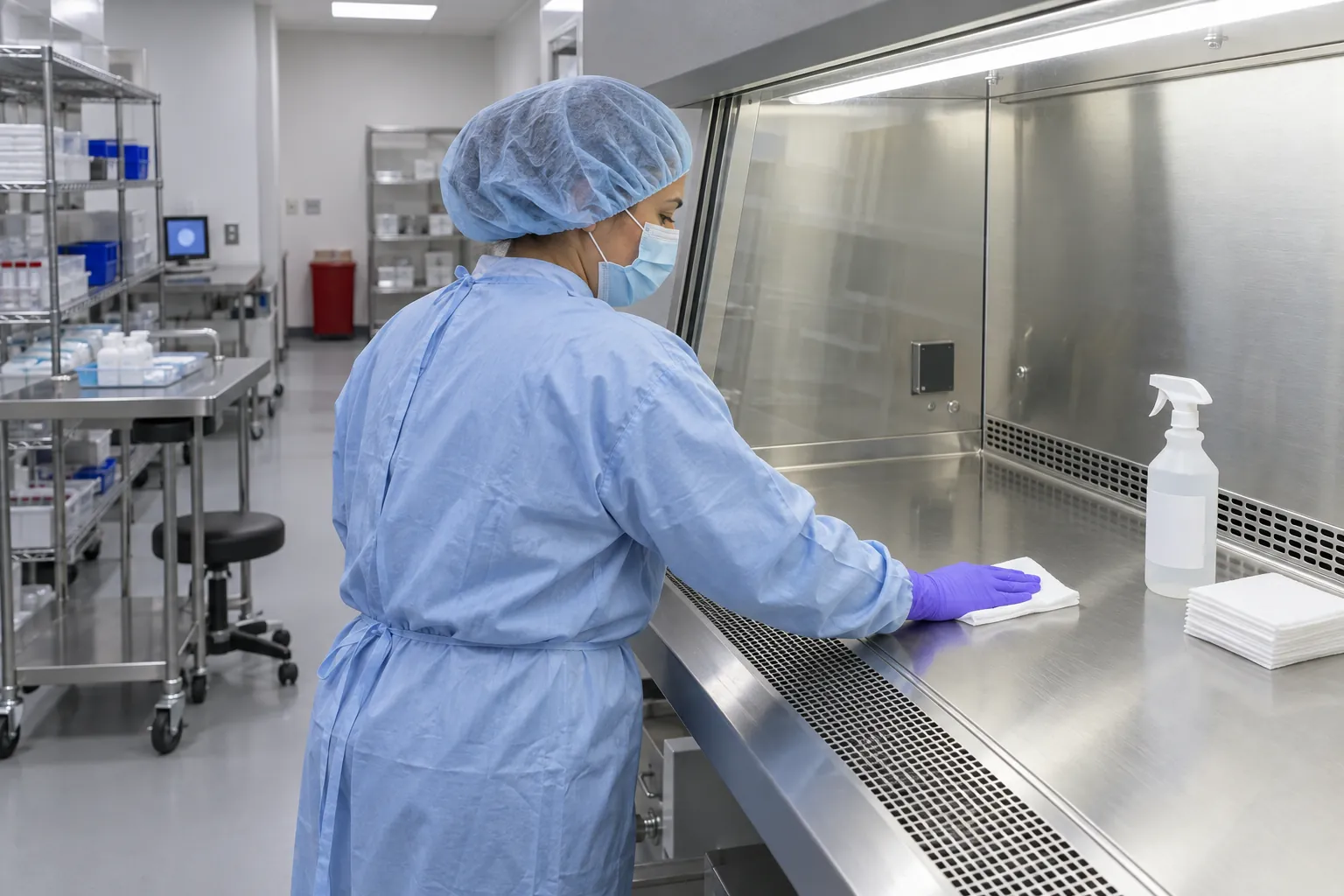
The chapter, published by the United States Pharmacopeia and enforced through state boards of pharmacy, sets the standard for compounding sterile preparations, and cleaning is a large part of it. The rooms around a hood or isolator are cleaned on a fixed cycle, surface by surface, and every clean is written down. This guide covers where the requirement comes from, what is cleaned and how often, the order of the steps, who may do the work, and what the cleaning record has to show.
01
What USP 797 is, and who enforces its cleaning rules
USP General Chapter 797, Pharmaceutical Compounding – Sterile Preparations, is the United States Pharmacopeia's standard for compounded sterile preparations (CSPs): the rooms, people, air, cleaning and records behind a sterile preparation made in a pharmacy. Its cleaning requirements reach beyond the pharmacist, into the work of pharmacy technicians, environmental services (EVS) staff and, in some buildings, a contract janitorial crew.
USP is a standards body, not a regulator. Its chapter becomes enforceable because law points to it. At the federal level, section 503A of the Federal Food, Drug, and Cosmetic Act (21 U.S.C. 353a), the exemption for pharmacy compounding, requires the substances and ingredients a pharmacy compounds with to comply with the applicable monograph and "the United States Pharmacopoeia chapter on pharmacy compounding". Outsourcing facilities are a different category: the FDA's page on human drug compounding laws says section 503B facilities "are subject to CGMP requirements", the manufacturing rules, so this guide is about 503A pharmacies, including hospital and health-system pharmacies.
Day to day, the enforcer is the state board of pharmacy. California's Business and Professions Code section 4126.8 says compounding by a pharmacy "shall be consistent with standards established in the pharmacy compounding chapters of the current version of the United States Pharmacopeia-National Formulary", and lets the board add its own standards. Texas writes the detail into its own rule, 22 TAC 291.133, Pharmacies Compounding Sterile Preparations, which sets the cleaning frequencies surface by surface. California's sterile compounding regulations open most sections with "In addition to the requirements in USP Chapter 797". So the first question for any compounding site is which state's rule applies, and what it adds to the chapter. The frequencies quoted in this guide are from the Texas rule.
02
The rooms and surfaces the cleaning rules cover
The cleaning rules apply to the areas where sterile preparations are made and the rooms that protect them. The words are specific, and it helps anyone who cleans there to know them:
- Primary engineering control (PEC): the device that provides the ISO Class 5 air where critical sites are exposed, such as a laminar airflow workbench, a biological safety cabinet or a compounding aseptic isolator. The inside of the PEC is the most critical surface in the pharmacy.
- Buffer room: in Texas's definition, an ISO Class 7 or cleaner room (ISO Class 8 for a Class B nuclear pharmacy) with fixed walls and doors where the PECs are located, entered only through the anteroom or another buffer room.
- Anteroom: an ISO Class 8 or cleaner room where hand hygiene and garbing happen, the transition between the rest of the pharmacy and the buffer room. The anteroom and buffer room together are the cleanroom suite.
- Segregated compounding area (SCA): a space defined by a visible perimeter that is not required to be classified, contains a PEC, and is suitable for Category 1 CSPs only.
- Pass-through chambers: the hatches that move supplies into a classified room without anyone walking them in.
Inside those areas the rules name the surfaces one by one, from the PEC and its work tray to floors, walls, shelving and ceilings. The pharmacy corridor and break room are ordinary facility cleaning, kept apart in both schedule and supplies.
The category of preparation matters too. Category 1, 2 and 3 CSPs are distinguished mainly by the environment they are made in and how long they may be stored. A pharmacy that makes Category 3 preparations carries heavier cleaning duties: Texas sets weekly sporicidal treatment for any pharmacy compounding Category 3 preparations, and weekly surface sampling "regardless of the frequency of compounding" them.
Cleanrooms are built to be cleaned: California requires surfaces within an SCA to be "smooth, impervious, free from cracks and crevices, and non-shedding". A cracked floor seam or a peeling wall guard is a cleaning problem as much as a maintenance one, and should be reported when it is seen.
03
How often: the daily, monthly and weekly cleaning
Texas sets the frequencies out in 22 TAC 291.133(d)(8)(H)(iv) for surfaces in classified areas used for Category 1, 2 and 3 preparations. In summary:
- PEC and the equipment inside it: cleaned and disinfected daily on days when compounding occurs, and when surface contamination is known or suspected. Sporicidal disinfectant monthly for pharmacies making Category 1 or 2 CSPs, weekly for pharmacies making Category 3.
- Removable work tray: work surfaces cleaned and disinfected daily on compounding days; all surfaces and the area underneath cleaned, disinfected and treated with sporicidal disinfectant monthly.
- Pass-through chambers: cleaned and disinfected daily on compounding days; sporicidal monthly, or weekly for Category 3.
- Work surfaces outside the PEC: cleaned and disinfected daily on compounding days; sporicidal monthly, or weekly for Category 3.
- Floors: cleaned and disinfected daily on compounding days; sporicidal monthly, or weekly for Category 3.
- Walls, doors, door frames, storage shelving and bins, and equipment outside the PEC: cleaned, disinfected and treated with sporicidal disinfectant monthly.
- Ceilings: in classified areas, cleaned, disinfected and treated with sporicidal disinfectant monthly; in a segregated compounding area, when visibly soiled and when surface contamination is known or suspected.
Two phrases carry a lot of weight. "On days when compounding occurs" means a pharmacy that compounds on weekdays only does not have to clean the PEC on a closed Sunday, but it does have to clean before it starts again. "When surface contamination is known or suspected" means a spill, a dropped item or a visibly soiled surface triggers a clean there and then, whatever the schedule says.
Beyond the fixed cycle, Texas requires sterile 70% isopropyl alcohol (IPA) in the PEC immediately before compounding starts, and on the work surface at least every 30 minutes while compounding goes on; a process longer than 30 minutes is not interrupted, and the surface is disinfected straight afterward.
A monthly task with no date is the one that slips. Put each monthly and weekly sporicidal application on a named day, with a named person, and follow the pharmacy's actual operating days, holidays included.
04
The method: clean, disinfect, apply a sporicidal, finish with sterile IPA
Cleaning, disinfecting and sporicidal treatment are three different jobs, and the rules keep them apart. Texas defines a cleaning agent as one "usually containing a surfactant, used for the removal of substances (e.g., dirt, debris, microbes, residual drugs or chemicals) from surfaces", and a disinfectant as one that destroys pathogens "but may not kill bacterial and fungal spores". A sporicidal disinfectant is the agent that deals with spores, which is why it is applied on its own cycle. Together they lower the number of microbes on each surface, so fewer can reach a preparation, which is the risk the whole cleanroom exists to control.
The order matters. The Texas rule's sequence is:
- Clean before disinfecting, unless a one-step disinfectant cleaner does both at once.
- Follow the manufacturer's directions or published data for the minimum contact time of every cleaning, disinfecting and sporicidal agent used.
- In the PEC, use sterile agents (sporicidal disinfectants excepted), and dilute any concentrate with sterile water.
- In the PEC, apply sterile 70% IPA after cleaning and disinfecting, or after a one-step cleaner or sporicidal disinfectant, to remove residue, and let it dry.
Contact time is where cleaning most often goes wrong. The EPA's page on selected EPA-registered disinfectants explains that the contact time is how long a product must stay on the surface to work, that "the surface should be visibly wet for the entire contact time", and that this may mean reapplying. The same page lists registered products by reviewed pathogen claims, including List K for products effective against Clostridioides difficile spores.
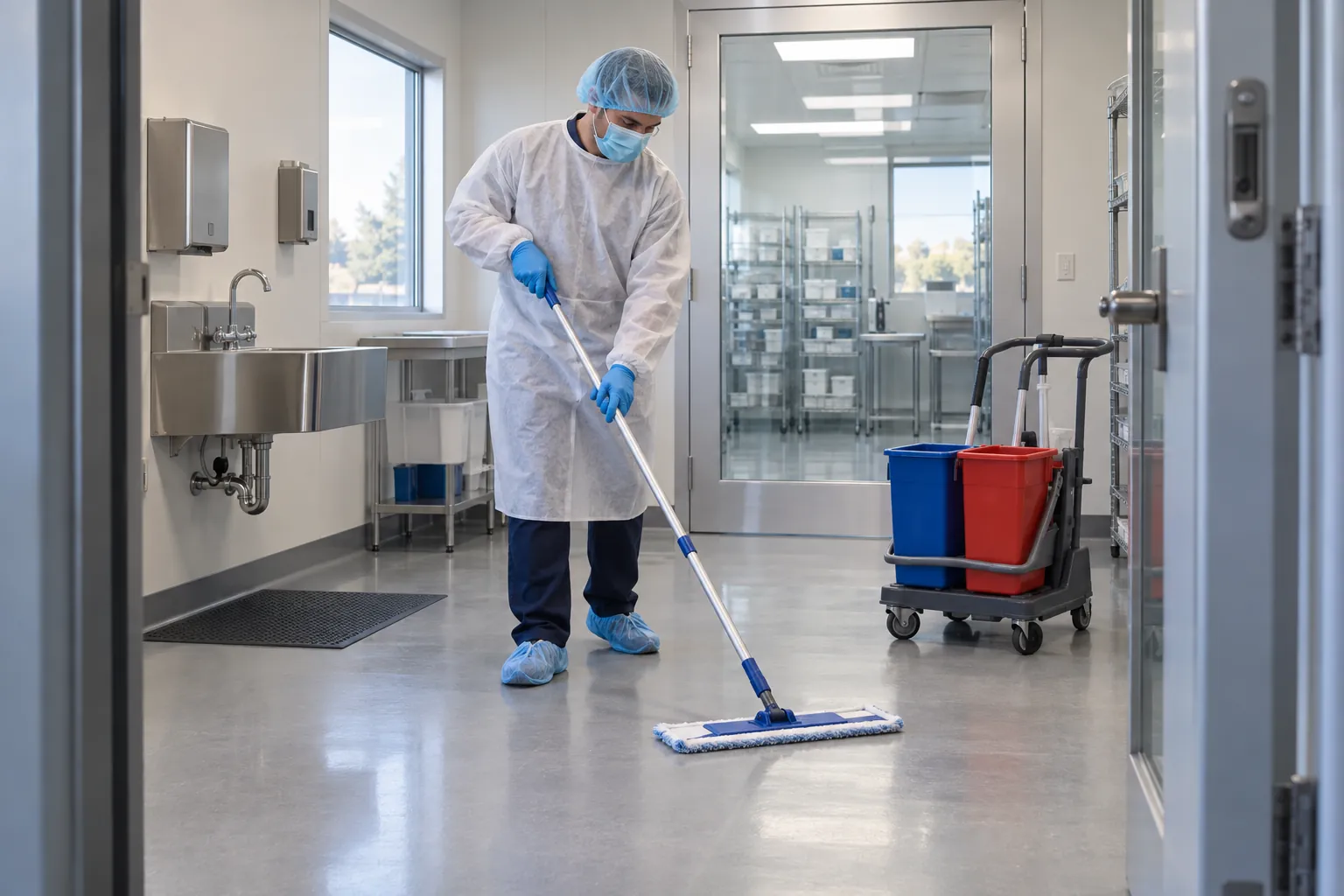
Texas requires cleaning materials such as wipers, sponges and mops to be non-shedding and dedicated to the buffer room, anteroom and SCA. Floor mops may be used in both the buffer room and the anteroom, "but only in that order": clean room first, then the dirtier one. California adds that reusable cleaning supplies not meant for the PEC must not be stored within 1 meter of it, and that every agent must be used as the manufacturer specifies.
Supplies coming in are wiped down with a sporicidal disinfectant, an EPA-registered disinfectant or sterile 70% IPA, and in Texas shipping cartons never go into the buffer room or SCA.
Sporicidal products are often strong chemicals. OSHA's Hazard Communication overview summarizes the employer's duty to keep labels and safety data sheets for exposed workers and to train them. Where hazardous drugs are compounded, USP General Chapter 800 and the state's rules add their own requirements.
05
Who cleans, and what the cleaning record must show
The pharmacist-in-charge owns the cleaning program. Texas makes the pharmacist-in-charge responsible for written standard operating procedures (SOPs) for cleaning and disinfecting the compounding areas "and assuring the procedures are followed". The work itself can be done by technicians, EVS staff or a contractor, but the rule is plain: "Cleaning shall be done by personnel trained in appropriate cleaning techniques."
People who only clean are not exempt from competency. Texas requires the pharmacy's SOPs to define the garbing competency evaluation and the aseptic technique evaluation for personnel who do not compound, naming "personnel who restock or clean and disinfect the sterile compounding area" and maintenance staff and contractors among them. For a hospital, EVS technicians assigned to the pharmacy cleanroom need the pharmacy's training and sign-off, not just general EVS orientation, and a janitorial contractor's scope of work should say who provides it.
The record is specific. Texas requires documentation of cleaning to include:
- the date of cleaning;
- the type of cleaning performed; and
- the name of the individual who performed the cleaning.
California's rule, 16 CCR 1736.7(c), printed in the Board's 2026 Pharmacy Lawbook, goes further: the documentation of "each occurrence" of cleaning, disinfecting and applying sporicidal disinfectants must include the identity of the person who did it and the product names of the agents used. California's documentation section, 1736.20, requires records to be kept for at least three years in a readily retrievable form, with an audit trail that keeps prior versions and shows who changed a record and when. Texas requires records to be kept for at least two years and supplied within 72 hours if the board asks.
The cleaning is also checked from the outside. Surface sampling is the measurement: in Texas, classified areas and pass-through chambers are sampled with contact plates or swabs at the conclusion of compounding, at least monthly for Category 1 and 2 pharmacies and at least weekly for Category 3, with action levels of more than 3 colony-forming units (cfu) per device in ISO Class 5, more than 5 in ISO Class 7 and more than 50 in ISO Class 8. A result over the action level means investigation and documented corrective action, and the cleaning log is one of the first records an investigator will ask for. A good log shows the gaps too: a daily clean missed on a compounding day, or a monthly sporicidal that slid past its date.
06
Where the USP 797 cleaning record fails, and what SiteClara does about it
The usual cleaning log for a cleanroom is a paper form on a clipboard in the anteroom, one line per day with columns for the PEC, the floor and the pass-through, and a separate monthly sheet for walls, ceilings and shelving. A row is initialed at the end of a shift for work nobody remembers doing, the product column says "same", and the monthly sporicidal is written up a week late. The pharmacist-in-charge sees the form on inspection day, and a cracked floor seam an EVS technician noticed is mentioned to whoever was passing.
SiteClara records checks at the place they happen. A printed QR code poster, with an optional NFC tag behind it, goes at each place where a check is scheduled, such as the anteroom entrance or the outside of a pass-through. A technician scans the code or taps the tag on their own phone, with no app to install, sees the checks set for that place, and marks each one done, or says what stopped them, such as compounding still in progress. The pharmacy decides what each check asks for, so a monthly sporicidal clean can ask which product was used and which surfaces were covered, with a photo when one is asked for. The time and the named person are recorded as it happens. A problem found on the way, such as a damaged wall guard or a pass-through door that no longer closes cleanly, goes onto the team's list of jobs until someone closes it.
A supervisor sees what is due, done and missed, and records the reason when a check was missed. Each day they review the totals and photos and approve a report that goes the next morning to nominated managers, such as the pharmacy manager or the EVS director. It shows what was reported, completed and still open, and how the scheduled checks went, with the reasons for any that were not done.
07
Questions people ask
According to USP 797, how often should the PEC be cleaned and disinfected?
Daily on days when compounding occurs, and whenever surface contamination is known or suspected. The Texas State Board of Pharmacy rules, 22 TAC 291.133, require equipment and all interior surfaces of the PEC to be cleaned and disinfected on that basis, with a sporicidal disinfectant applied monthly for pharmacies making Category 1 or 2 CSPs and weekly for those making Category 3. The same rule requires sterile 70% isopropyl alcohol on the PEC's work surface at least every 30 minutes while compounding goes on, or straight afterward when a single process runs longer.
How long do you wash hands under USP 797?
At least 30 seconds, from the hands to the elbows. The Texas State Board of Pharmacy rules, 22 TAC 291.133, require personnel in the anteroom to clean under their fingernails with a nail cleaner under running warm water, then wash from the hands to the elbows for at least 30 seconds with plain or antimicrobial soap, without brushes, and dry with lint-free disposable towels or a hands-free dryer. Before putting on sterile gloves in the buffer room or segregated compounding area, they cleanse their hands again with an alcohol-based hand rub and let them dry.
What is the 4-hour rule in USP 797?
It applies to immediate-use compounded sterile preparations: administration must begin within four hours of the start of preparation, and one not given in time is promptly discarded. The Texas State Board of Pharmacy rules, 22 TAC 291.133, exempt such preparations from the Category 1, 2 and 3 requirements only when, among other conditions, no more than three different sterile products are used, the compounding takes no more than an hour, and the preparation is not stored for later use. Hazardous drugs may not be prepared this way.
08
Where to read more, and a USP 797 cleaning checklist to take away
Start with the rule that actually binds you. That is your state board of pharmacy's sterile compounding rule and the current USP chapter it points to, which is published by USP. For examples of how states write the cleaning duty down:
- Texas State Board of Pharmacy rules, 22 TAC 291.133: frequencies and the cleaning record.
- California Board of Pharmacy, 2026 Pharmacy Lawbook: 16 CCR 1736.7 and 1736.20.
- FDA, Human Drug Compounding Laws: 503A and 503B.
- EPA, Selected EPA-Registered Disinfectants: contact times and List K.
A short list to take away:
- Find your state board's sterile compounding rule and check which version of USP 797 it points to.
- Map every room and surface in the compounding area: PEC, work tray, pass-throughs, work surfaces, floors, walls, doors, shelving, equipment and ceilings.
- Set each surface's daily, weekly or monthly task against your CSP categories, and put every monthly and weekly sporicidal on a named day.
- Write the SOP in the right order: clean, disinfect, sporicidal, sterile 70% IPA in the PEC, with each product's contact time.
- Keep cleaning materials non-shedding and dedicated to the suite, and mop the buffer room before the anteroom.
- Train and evaluate everyone who cleans there, including EVS staff and contractors, and keep the record.
- Record every clean with the date, the type of clean, the person and the products used.
- Review the record against the schedule each week, and read it alongside the surface sampling results.
Sources
Every document this guide quotes or links to, in the order it first cites them.
- Section 503A of the Federal Food, Drug, and Cosmetic Act (21 U.S.C. 353a) govinfo.gov
- Human drug compounding laws fda.gov
- Business and Professions Code section 4126.8 leginfo.legislature.ca.gov
- 22 TAC 291.133, Pharmacies Compounding Sterile Preparations pharmacy.texas.gov
- Selected EPA-registered disinfectants epa.gov
- Hazard Communication overview osha.gov
- 2026 Pharmacy Lawbook pharmacy.ca.gov
Related guides
 CleaningCleaning, sanitizing and disinfecting: what each one does, and when a building needs itCleaning, sanitizing and disinfecting defined by the CDC, EPA and FDA Food Code: when each is needed, how to do it right, and what the record should show.
 CleaningHospital environmental services: what EVS does, and how to show it was doneWhat hospital environmental services (EVS) does, the CDC, CMS and OSHA rules behind it, cleaning frequencies, who cleans what, and how cleaning is checked.
 CleaningOperating room cleaning: turnover, terminal cleaning and the record behind themHow an operating room is cleaned before the first case, between cases and at the end of the day, the rules and guidelines behind it, and how to show it was done.
 CleaningChemical dilution control: getting the mix right, every bottle, every shiftHow a chemical dilution control system works, what OSHA HazCom and EPA labels require, how to check dispensers and bottles, and what the record should show.